Rose quartz, rhodonite, lepidolite, amethyst, smoky quartz and moonstone are the stones most often used for emotional healing. In practice they support a reflective routine after grief, heartbreak or burnout, kept alongside your doctor's care as the gentler part of a difficult stretch.
Key takeaways
- The six stones traditionally used here are rose quartz, rhodonite, lepidolite, amethyst, smoky quartz and moonstone.
- These stones are kept alongside your doctor's care, as the gentler part of a routine rather than in place of it.
- A stone anchors a repeated practice, such as a few minutes of quiet reflection or journalling at the same time each day.
- Lepidolite is a lithium-bearing mica, which is where its long reputation as the stone for periods of transition comes from.
- Lepidolite is soft at roughly 2.5 to 3 on the Mohs scale, so it needs gentler handling than the quartz stones on this list.
- All metaphysical properties described here are traditional belief, not medical fact.
Can crystals actually heal emotional pain?
In crystal practice these stones are kept for comfort and steadiness through a hard stretch, alongside your doctor's care. Practitioners describe emotional healing as slow work rather than a single event, and the stone is the part of it you can hold. That is why the tradition leans on soft pinks, purples and smoky browns rather than the bright, driving stones.
What a crystal gives you is a physical anchor for a practice. Sitting for five minutes with a stone in your hand and your attention on your breathing is a small structured pause, and structured pauses matter when everything feels unstructured. The US National Center for Complementary and Integrative Health notes that meditation and mindfulness practices have been studied for stress and psychological wellbeing and are generally safe for most people. The stone is the cue that gets you into the chair.
The second function is symbolic, and it may be the older of the two. Grief especially wants somewhere to go, and a physical object you can hold, carry or put on a shelf gives it a location. Cultures have used objects this way for thousands of years, long before anyone called it crystal healing.
People often keep the same piece through a whole season of their life for that reason. It ends up carrying the memory of every quiet evening they sat with it, which is a large part of why practitioners say a well-used stone feels different from a new one.
Which crystals are traditionally used for emotional healing?
Six stones dominate this practice, and they are not interchangeable. Each is traditionally matched to a different emotional state, which makes choosing easier than staring at a shop wall wondering which one is calling to you.
| Stone | Traditionally used for | When people reach for it |
|---|---|---|
| Rose quartz | Self-compassion, gentleness | Heartbreak and harsh self-talk |
| Rhodonite | Forgiveness, working through resentment | Old anger that has outstayed its use |
| Lepidolite | Steadiness through transition | Moves, separations, job losses |
| Amethyst | Calm and mental quiet | Racing thoughts, restless nights |
| Smoky quartz | Grounding, letting go | Feeling untethered or numb |
| Moonstone | Acceptance of change and cycles | Grief that arrives in waves |
Rose quartz
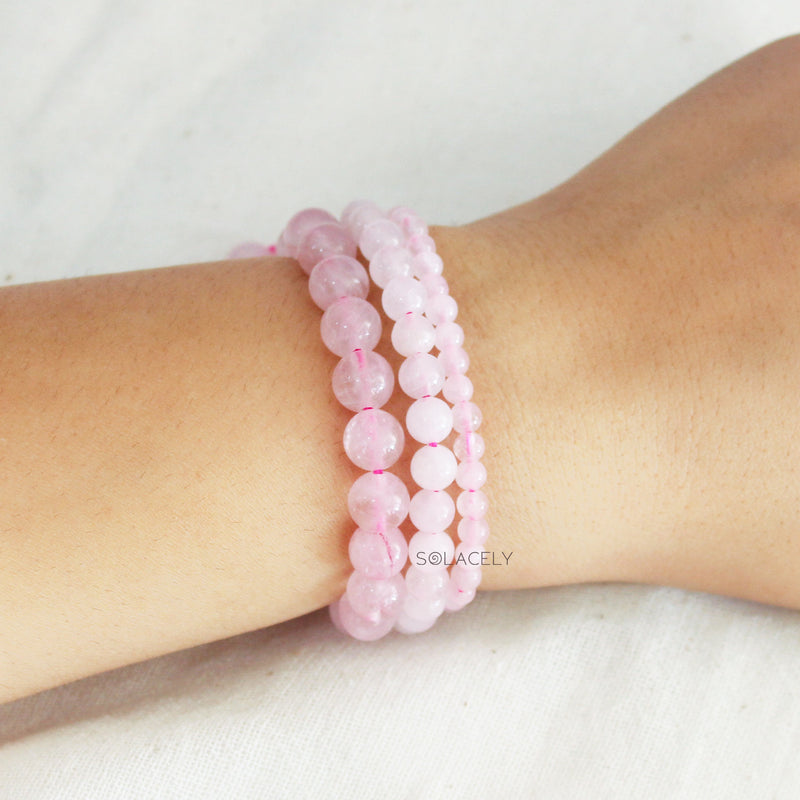
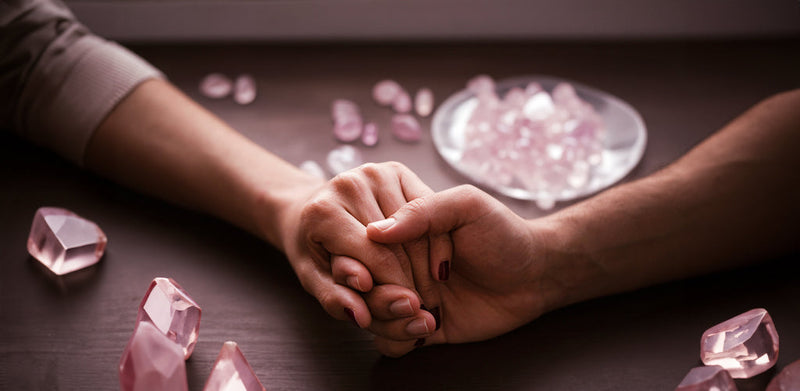
Rose quartz is quartz coloured pink by trace mineral inclusions, and it is the default stone of this whole category. Its traditional association is unconditional love, aimed inward as much as outward. People carry it after a breakup or a bereavement, when the loudest voice in the room is their own criticism. Our dedicated guide to rose quartz for emotional healing goes deeper into how it is used.
Rhodonite
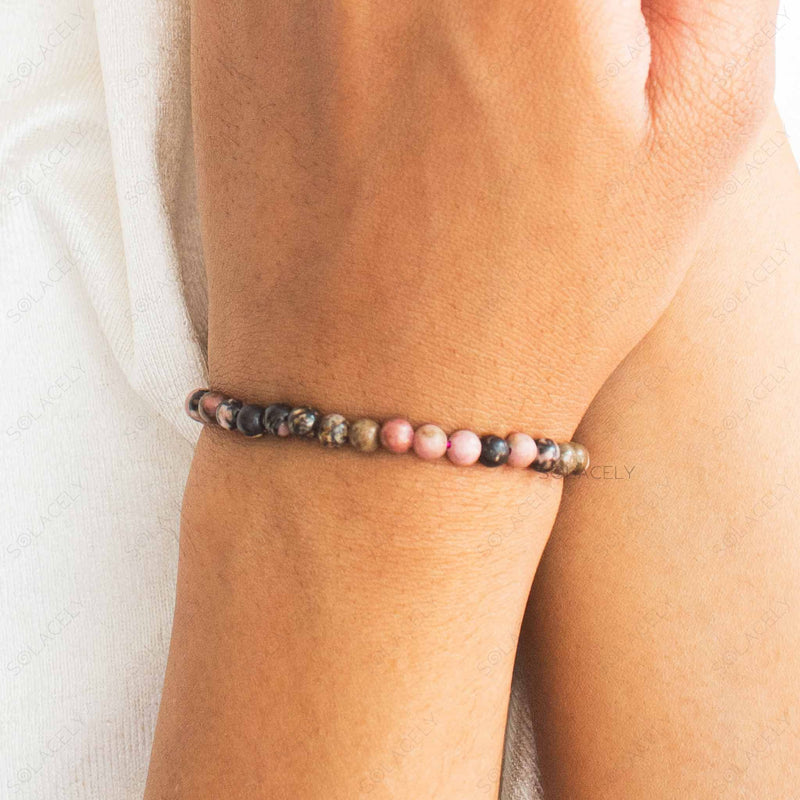
Rhodonite is a pink manganese silicate, usually veined with black manganese oxide. Those black seams are the reason it became the forgiveness stone in crystal tradition: the damage stays visible in the finished piece. It is worked with when resentment has become a habit rather than a feeling.
Lepidolite
Lepidolite is a lithium-bearing mica. Mineralogy describes micas as sheet silicates with perfect basal cleavage, which is why lepidolite flakes and why it is soft. The lithium sits chemically bound inside that structure, and its presence is where the stone's long association with calm and transition comes from. In practice it is the piece people keep through a move, a separation or a change of job, alongside their doctor's care.
Amethyst
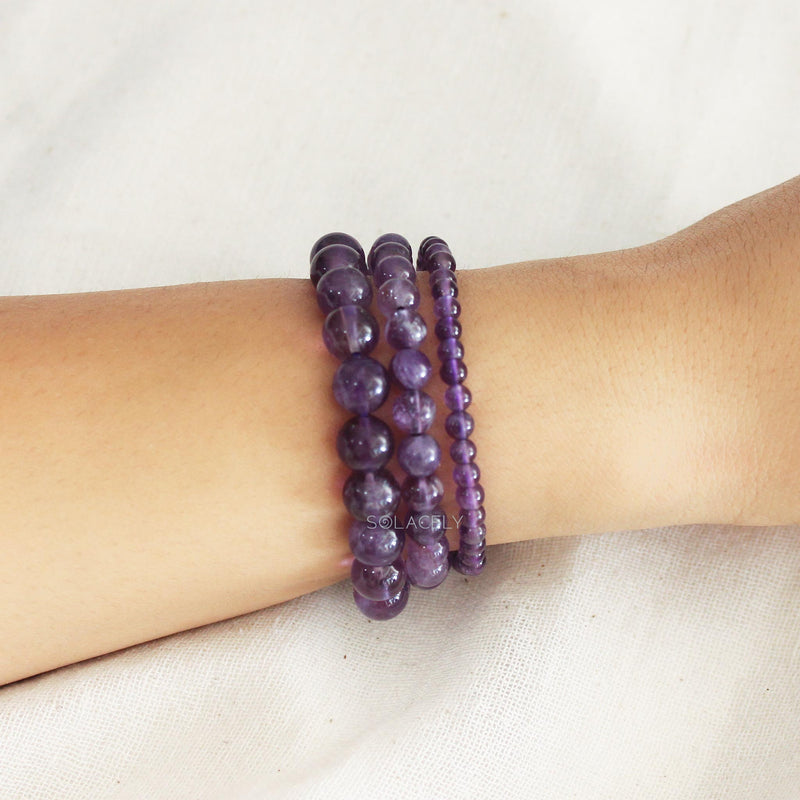
Amethyst is purple quartz, coloured by iron and natural irradiation, and it is the standard calming stone across almost every Western system. It is the one most often kept on a bedside table, and the one people pick when the emotional problem shows up mainly as a mind that will not stop at midnight.
Smoky quartz
Smoky quartz is quartz darkened by natural radiation acting on trace aluminium. Its traditional job is grounding and release, and it tends to suit people in the numb phase rather than the acute phase. It pairs well with rose quartz, which is softer and warmer.
Moonstone
Moonstone is a feldspar with a floating internal sheen called adularescence. Its traditional association is with cycles and change, which is why it turns up in grief practice so often. Grief is not linear, and a stone whose whole character is phases feels appropriate to people going through it.
How do you build a practice around them?
Pick one stone and one time of day. That is the whole design principle. Emotional healing practices fail because they are too elaborate to sustain in the exact week you need them most, so keep the routine small enough that a bad day cannot break it.
- Choose one stone, not six. Match it to the feeling that is loudest right now using the table above.
- Anchor it to something you already do. First coffee, last ten minutes before bed, the train home.
- Hold it and breathe for three minutes. Longer exhales than inhales. Set a timer so you are not clock-watching.
- Write two lines afterwards. What you felt, and one thing you will do today. Two lines is achievable. A page is not.
- Review after a fortnight. If the routine is helping, keep it. If you dread it, change the stone or the time.
Some people prefer placement to carrying: rose quartz on a bedside table, smoky quartz by the front door, amethyst near where you work. Both approaches are fine. What matters is that the object stays in your line of sight and keeps prompting the pause.
If your situation is specifically the end of a relationship, our guide to crystals for moving on from heartbreak covers a narrower version of the same practice. If self-criticism is the main problem, crystals for anxiety and self-love is the closer fit.
How should these stones be cared for?
Hardness varies a lot across this list, which is the main practical difference between them. Rose quartz, amethyst and smoky quartz are all quartz at 7 on the Mohs scale and shrug off ordinary wear. Rhodonite sits around 5.5 to 6.5, moonstone near 6 to 6.5 with a tendency to cleave, and lepidolite is genuinely delicate at roughly 2.5 to 3.
Practical rules that follow from that:
- Store lepidolite separately. A quartz bead will scratch it in a shared pouch within days.
- Keep amethyst and rose quartz out of long sunlight. Both fade, and the colour does not come back.
- Avoid soaking lepidolite and moonstone. Micas and feldspars do not enjoy prolonged water, and lepidolite can flake apart.
- Clean with a damp cloth first. Warm soapy water and a soft brush suit the quartz stones only.
For energetic cleansing, moonlight overnight, sound or a rest on selenite work for every stone here without risk. Skip salt water entirely, since it damages soft minerals, elastic cord and silver settings alike. Solacely's rose quartz and rhodonite bracelets are strung for daily wear, which matters more than it sounds when a piece is meant to be a daily prompt.
When should you stop and get proper support?
If low mood, anxiety, grief or intrusive thoughts have lasted more than a couple of weeks and are affecting sleep, work or relationships, that is the point to speak to a professional rather than to adjust your crystal routine. Persistent symptoms are a signal, not a personal failing, and they respond to treatment. The US National Institute of Mental Health maintains a guide to finding help, and most countries run an equivalent service.
Please seek help immediately if you are having thoughts of harming yourself. In the United States you can call or text 988 to reach the Suicide and Crisis Lifeline. In the UK, Samaritans can be reached free on 116 123. In India, the Tele-MANAS helpline is available on 14416. Most other countries run an equivalent free service, and emergency departments are always an option.
Crystals can sit alongside therapy, medication and the ordinary unglamorous work of sleep, movement and people who love you. They cannot stand in for any of it. Treated as one small part of a bigger picture, a stone on a bedside table is a harmless and sometimes genuinely comforting thing. Treated as a substitute for care, it becomes a way to delay the help that would actually work. For gentler day-to-day uplift rather than active repair, see crystals for good vibes, and for facing a specific hard moment, crystals for courage.
The properties described here reflect traditional and cultural belief around crystals. They are not medical claims. Crystals do not diagnose, treat, cure or prevent any mental or physical health condition, and they are not a substitute for therapy, medication or professional advice. If you are struggling with your mental health, please contact a doctor or a qualified mental health professional. In a crisis, contact your local emergency service or crisis line.
Sources
- National Institute of Mental Health, Help for Mental Illnesses
- NCCIH, Meditation and Mindfulness: What You Need To Know
Written by Chetena Sharma. Reviewed by the Solacely editorial team.
Frequently asked questions
About the author


Written by Chetna Sharma, crystal healing practitioner and co-founder of Solacely. Chetna has worked with healing crystals for over a decade and curates Solacely's protective stone collection.