Howlite Crystal: Meaning, Benefits & Properties (2026 Guide)
Howlite is the white-and-grey "calm stone." Mineralogically, it's a calcium borosilicate hydroxide with the formula Ca₂B₅SiO₉(OH)₅, a Mohs hardness of 3.5, and the distinctive web-like grey or black veining that makes it instantly recognisable in a tray of tumbled stones (Wikipedia). It was first described in 1868 near Windsor, Nova Scotia, by the Canadian chemist Henry How — a discovery story that gave the mineral its name. In crystal-healing tradition, howlite is the bedside stone people reach for during anxious nights, racing-mind workdays, and meditation practices that need a soft anchor. This guide covers the verified mineralogy, the Henry How discovery, the crown chakra association, and the right way to care for the stone given its unusual softness.
- Howlite is a calcium borosilicate hydroxide (Ca₂B₅SiO₉(OH)₅) with a Mohs hardness of 3.5 and a monoclinic crystal structure (Wikipedia).
- Discovered in 1868 near Windsor, Nova Scotia by the Canadian chemist Henry How after gypsum-quarry miners brought him the unknown mineral. American geologist James Dwight Dana named it "howlite" in his honour.
- Crystal-healing use: crown chakra (Sahasrara), the calm-and-quiet stone for sleep, anxiety, racing-mind nights, and meditation.
- At Mohs 3.5 it's notably softer than most crystals — best suited to pendants, earrings, and occasional bracelets rather than daily-wear ring settings.
- Care: skip soaking and ultrasonic cleaners. Use sound, smoke, moonlight, or selenite contact for energetic cleansing.

What Is Howlite Crystal?
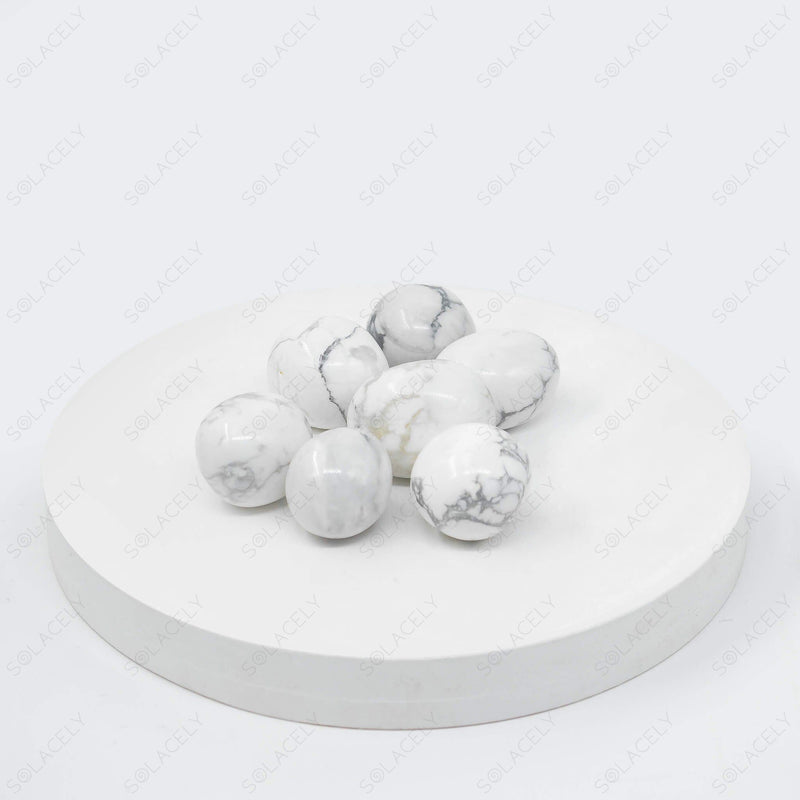
Howlite is a calcium borosilicate hydroxide mineral with the formula Ca₂B₅SiO₉(OH)₅, a Mohs hardness of 3.5, a specific gravity of 2.53 to 2.59, and a monoclinic crystal system (Wikipedia). It typically forms as opaque white to colourless nodules with characteristic grey or black veining in an erratic, often web-like pattern. It has no cleavage, breaking instead with a conchoidal or uneven fracture.
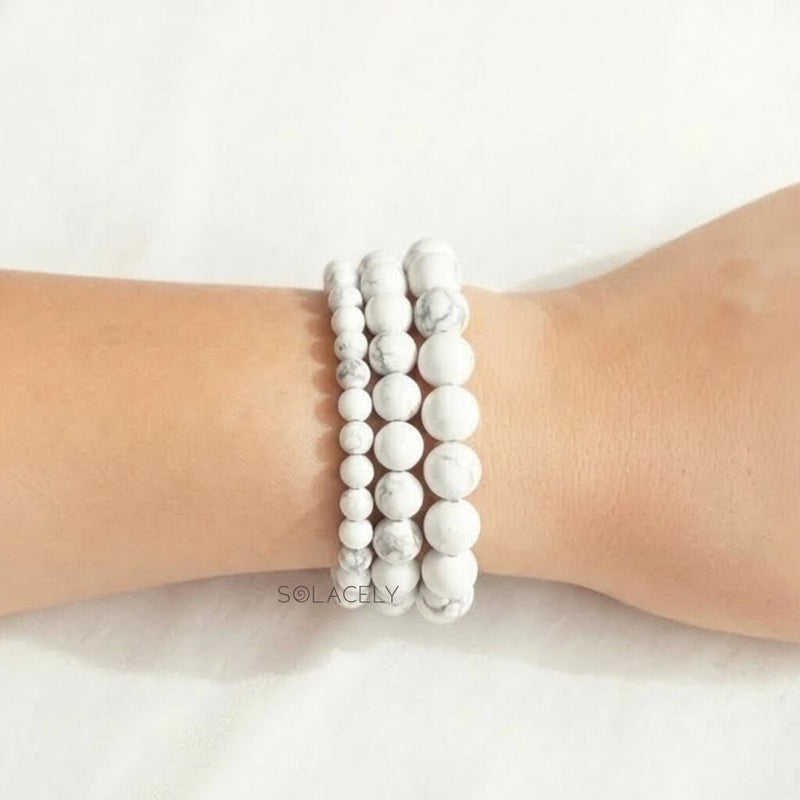
The visual fingerprint is unmistakable: matte, marble-like white with a network of fine dark veins running across the surface. Hold a polished howlite tumble next to almost any other crystal and the difference is obvious within a second. That distinctiveness is part of why it works so well as a meditation focus — it reads visually as "quiet" before you've even started a practice.
In crystal-healing tradition, howlite is the calm stone. Practitioners associate it with mental quiet, sleep, anxiety relief, and the kind of soft anchored attention that helps with overthinking. The customers I see returning for second howlite pieces are almost always people in stretches of poor sleep or the kind of week that fills up with small worries.
Where Was Howlite Discovered?
Howlite has one of the most specific origin stories of any modern crystal. It was discovered in 1868 near Windsor, Nova Scotia, Canada, when miners working in a gypsum quarry came across an unfamiliar white mineral and brought a sample to Henry How, a Canadian chemist and geologist (1828–1879) (Wikipedia). How analysed the chemistry, recognised it as a previously undescribed species, and called it "silico-boro-calcite" in his initial publication.
The name didn't stick. The American geologist James Dwight Dana — author of the standard mineralogy reference of the era — renamed the mineral "howlite" shortly afterward, in honour of How. The renaming convention is one of the cleanest in mineralogy: a discoverer's name attached to a stone he was kind enough to characterise without claiming for himself.
The geological context matters too. Howlite forms in evaporite deposits, the same kind of sedimentary environment where gypsum, borate minerals, and other water-soluble crystals form as ancient seas dry up. That's why miners working a gypsum quarry were the ones who first brought it to attention. The connection between howlite, calm energy, and the quiet of a salt flat at the end of evaporation is the kind of poetic alignment crystal-healing practitioners notice and writers don't.
Where Does Howlite Come From Today?
Howlite forms in evaporite deposits worldwide, with the most historically important localities at Windsor and Iona in Nova Scotia (Canada) — the original discovery sites — and Tick Canyon in the Sierra Pelona Mountains of California (Wikipedia). California has been a major commercial source for over a century, with Mexico and Russia also producing significant quantities of material that's worked into beads, tumbled stones, and carvings.
The geology is consistent across these locations. Howlite forms in lake-bed and ocean-bed evaporite settings, often as nodules in clay or alongside borate minerals like ulexite and colemanite. The Tick Canyon deposit in California is especially well-studied as a borate-mineral assemblage, and many of the howlite specimens in mineral collections worldwide trace back to Sierra Pelona working between roughly 1900 and the 1970s.
Modern howlite jewelry and tumbled stones come primarily from California and Mexican deposits, with smaller amounts from Russian and Canadian sources. The veining pattern varies a little by locality, but the overall white-with-grey-web aesthetic is consistent enough that howlite is one of the most reliably recognisable crystals in the modern wellness market.
What Are the Benefits and Healing Properties of Howlite?
Crystal-healing tradition assigns howlite three layers of benefit: emotional (calm, anxiety relief, sleep support), physical (energetic support tied to bone, teeth, and the calcium it contains, traditional only), and metaphysical (crown chakra, awareness, spiritual quiet). None of these claims is medically validated. They reflect long-standing tradition rather than clinical research.
Emotional Healing Properties
Howlite is the calm stone. Anxiety, racing-thought nights, irritation that won't drain, the kind of overwhelm that arrives when too many small obligations stack up — practitioners point to all of these as classic howlite indications. Customers tell us they keep a tumble in a bedside drawer for hard nights, in a desk drawer for hard meetings, and in a coat pocket for the kind of week that needs a portable anchor.
The practice is usually small and frequent rather than large and dramatic. Hold a polished howlite tumble in the palm for two minutes, breathe slowly, set the stone down, and return to whatever you were doing. The tradition isn't about depth. It's about a soft, repeatable reset.
Physical Healing Properties (Traditional)
In the crystal-healing tradition, howlite is associated with the body's structural systems — bones, teeth, and connective tissue — partly through its calcium content and partly through the colour symbolism of its bone-white surface. Practitioners place it on the chest or near the head during energy work, sometimes pairing it with selenite or moonstone for "soft tissue" support.
None of this is medical treatment. Howlite hasn't been shown in any peer-reviewed study to influence calcium absorption, bone density, or any biological process. The "physical" tradition is best read as a metaphor for attention rather than a treatment claim.
Metaphysical & Crown Chakra Properties
Metaphysically, howlite is a crown chakra stone associated with mental quiet, awareness, and the kind of receptive spiritual attention that benefits from less rather than more. It's used in dream work and journaling practices, often paired with amethyst for clarity and selenite for amplification. Used alone, it tends to feel slow and steady — the opposite of citrine's bright propulsion.
Practitioners often pair howlite with carnelian when the goal is balance (cool head plus warm energy), and with rose quartz when emotional softness is the focus. As a single-stone practice, howlite is most often programmed for "less" rather than "more": less worry, less noise, less reactivity.
Which Chakra Does Howlite Activate?
Howlite is most strongly associated with the crown chakra (Sahasrara), the energy centre at the top of the head traditionally linked to spiritual connection, awareness, and mental quiet. Its soft white colour and calming associations match the crown chakra's white-violet symbolism in modern crystal-healing practice. Some practitioners also use howlite secondarily on the third eye chakra for dream work and on the heart chakra for emotional regulation.
The pairing is intuitive. Crown chakra energy in the modern tradition is described as quiet, receptive, and pure — qualities that map directly onto howlite's bone-white visual and slow-anchored feel. It's rarely placed on the lower chakras as a primary stone. The energy is too soft for root or solar-plexus work in most traditions.
A simple way to use this: lie down, place a small howlite tumble at the centre of your forehead or just above the crown of the head, and breathe slowly for five to ten minutes. No active intention setting needed. The practice is about quiet, not about pushing toward a goal.
How Can You Use Howlite Day-to-Day?
The three most common uses are jewelry, meditation, and bedside placement. Each has a slightly different goal, and the form of howlite you choose should match it. Tumbled stones are versatile for meditation. Polished beads work well in bracelets. Larger palmstones and hearts sit comfortably on a bedside table or near a meditation cushion.
Wearing Howlite Jewelry
Howlite is best suited to pendants, earrings, and occasional bracelets rather than daily-wear ring settings. The reason is mineralogical: at Mohs 3.5 with no cleavage but a soft surface, the stone scratches easily under hard impact (Wikipedia). A copper coin will scratch it. A steel knife will mark it. Set into a pendant or earring where it doesn't take daily knocks, polished howlite stays beautiful for years.
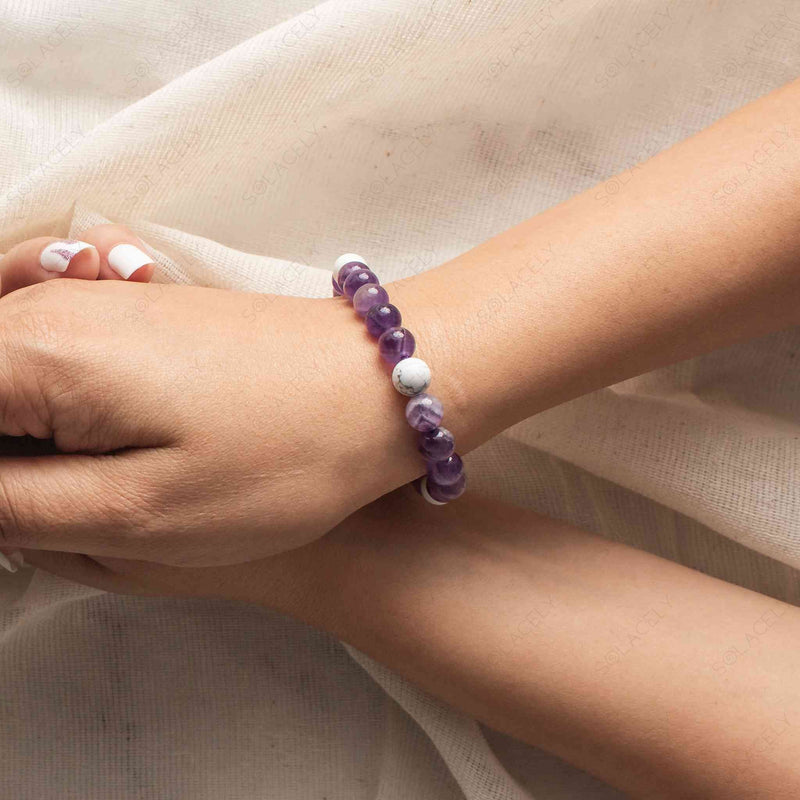
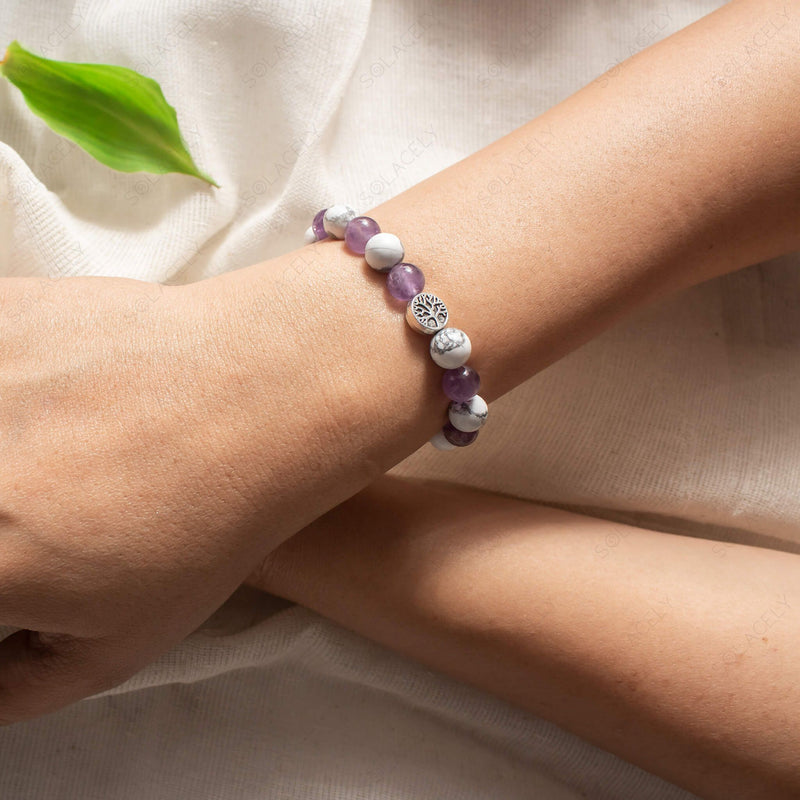
Howlite pairs especially well with sterling silver and white-metal settings, both of which echo the cool, neutral tone of the stone. A single howlite bead in a stacked bracelet alongside warmer stones (citrine, rose quartz, carnelian) gives a complementary palette without overwhelming.
Howlite for Meditation
For meditation, place a polished howlite tumble at the centre of the forehead lying down, or hold one in each palm seated. The stone's energy is genuinely quiet rather than dramatic — the meditation experience is about settling rather than activating. Five to ten minutes is enough.
A specific howlite practice for racing-mind nights: hold the stone over the chest while lying in bed, count four-count breaths for ten cycles, and place the stone on the bedside table when you're done. The combination of breath count plus tactile anchor often outperforms either alone.
Howlite at the Bedside
Howlite is one of the most popular bedside-table crystals in the modern tradition, on the strength of its sleep and anxiety associations alone. Polished palm stones, small hearts, and beaded mala strands all work. Place one within reach of where you sleep so the stone is the first thing your hand touches if you wake at 3 a.m.
Many practitioners build a "calm bedside trio" of howlite, amethyst, and selenite — three white-or-violet stones that share calming associations and visual cohesion. The trio works as much as a visual cue as an energetic one. Seeing the same calming arrangement every night becomes a small ritual of its own.
How Do You Cleanse and Charge Howlite?
Howlite is one of the more delicate stones in common crystal-healing use because of its softness. Skip salt water, ultrasonic cleaners, and ammonia-based cleaners. At Mohs 3.5, even normal abrasive contact during washing can dull the polish. Use dry methods for energetic cleansing: sound, smoke, moonlight, and selenite contact.
Why Cleanse and Charge Howlite?
In crystal-healing practice, cleansing clears residual energy a stone has picked up from its environment or wearer. Even if you don't subscribe to the energetic side, light cleaning is good physical hygiene for jewelry: skin oils, lotion, and dust dull howlite's natural matte surface, and gentle removal keeps the visual veining crisp.
A reasonable cadence: cleanse howlite once a month with normal use, more often if you wear a piece daily through poor-sleep stretches or use it in active anxiety-management practice. Charging is a separate step (re-energising the stone toward an intention), traditionally done after cleansing.
How to Cleanse Howlite (4 Safe Methods)
- Sound. Hold the stone near a singing bowl or tuning fork for 30 to 60 seconds. The safest method for soft stones — no contact, no impact, no risk to the surface.
- Smoke. Pass the stone gently through sage, palo santo, or incense smoke for about a minute. Don't hold it in direct flame.
- Moonlight. Set the stone on a windowsill overnight, ideally on a full or new moon. The traditional cleansing method for howlite, and the gentlest.
- Selenite or clear quartz contact. Rest howlite on a selenite plate or beside a clear quartz cluster for 6 to 12 hours.
Skip salt water, ultrasonic cleaners, and steam. All three risk dulling the stone's polished surface or accelerating wear on its softer regions.
How to Charge Howlite (4 Methods)
- Moonlight. The default howlite charging method. Place the stone on a windowsill overnight, ideally on the night before the full moon. Howlite's white colour and crown-chakra associations pair naturally with lunar charging.
- Selenite contact. Rest howlite on a selenite plate for 12 to 24 hours. Selenite is traditionally used as a cleansing-plus-charging stone, and the white-on-white pairing reinforces both stones' calming associations.
- Intention setting. Hold the cleansed stone near the crown of the head, set a single quiet intention (a worry to release, a sleep block to soften), and breathe with it for two to three minutes.
- Crystal grid. Place howlite at the centre of a grid surrounded by clear quartz points and amethyst tumbles to amplify a calm-and-clarity intention. Leave for 24 hours.
Skip strong direct sunlight for charging. Howlite is a quiet, lunar stone in the tradition, and its associations are built around moonlight, not sun.
Frequently Asked Questions
What is howlite crystal?
Howlite is a calcium borosilicate hydroxide mineral with the chemical formula Ca₂B₅SiO₉(OH)₅, a Mohs hardness of 3.5, and a specific gravity of 2.53 to 2.59 (Wikipedia). It typically appears as opaque white nodules with characteristic grey or black web-like veining and a monoclinic crystal structure.
Where was howlite first discovered?
Howlite was discovered near Windsor, Nova Scotia, Canada in 1868. Gypsum miners brought the unknown mineral to Henry How, a Canadian chemist and geologist (1828–1879), who first analysed it. He initially called it "silico-boro-calcite," and the American geologist James Dwight Dana renamed it "howlite" shortly after in his honour (Wikipedia).
Which chakra is howlite for?
Howlite is most strongly associated with the crown chakra (Sahasrara), the energy centre at the top of the head traditionally linked to spiritual connection, awareness, and mental quiet. Its soft white colour and calming associations match the crown chakra's white-violet symbolism in modern crystal-healing practice.
Can howlite help with sleep?
In crystal-healing tradition, howlite is one of the most popular bedside stones for sleep and racing-mind nights. The tradition pairs it with amethyst and selenite for a calming bedside trio. There's no clinical evidence for sleep effects, so it complements rather than replaces standard sleep practices like consistent bedtimes and screens-off rituals.
Can howlite get wet?
Brief contact with clean water is acceptable, but skip soaking, salt water, and ultrasonic cleaners. At Mohs 3.5 with no cleavage, howlite is softer than most crystals and can be scratched easily by a steel knife or glass (Wikipedia). Use a dry soft cloth for cleaning, and dry methods (sound, smoke, moonlight) for energetic cleansing.
Is howlite good for daily wear?
Howlite is best suited to pendants, earrings, and occasional-wear bracelets rather than daily-wear ring settings. At Mohs 3.5 it's softer than fingernail-resistant minerals and can be scratched by a copper coin or a sharp impact. Treated kindly, polished howlite tumbles and beads keep their character for years.
Where does howlite come from today?
Howlite forms in evaporite deposits, the same kind of geological setting where gypsum and borate minerals occur. Notable historic localities include Windsor and Iona in Nova Scotia (Canada) and Tick Canyon in the Sierra Pelona Mountains of California (Wikipedia). California, Mexico, and Russia are sources for commercial-grade material today.