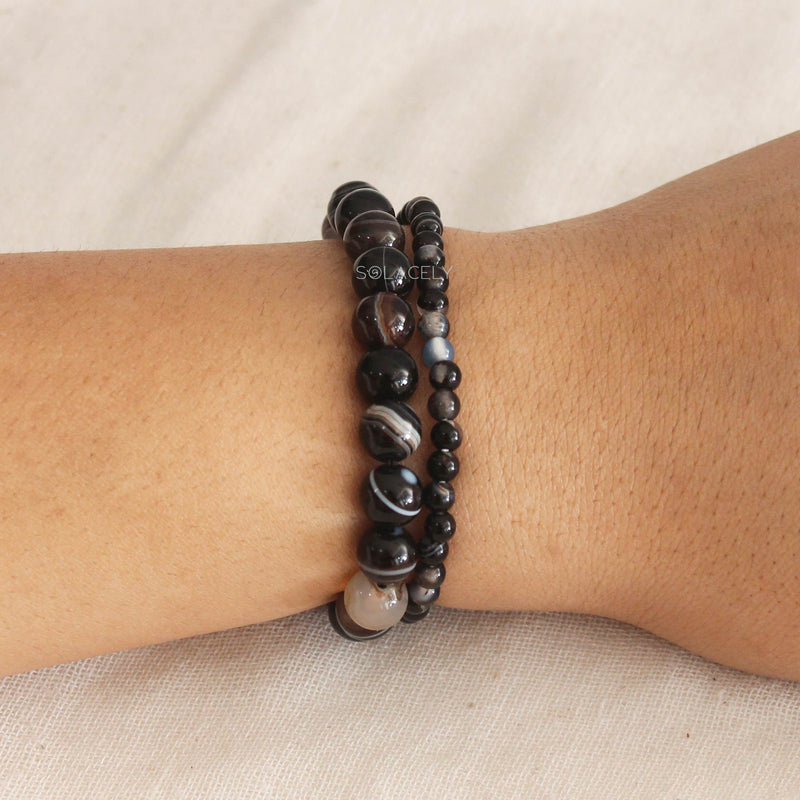
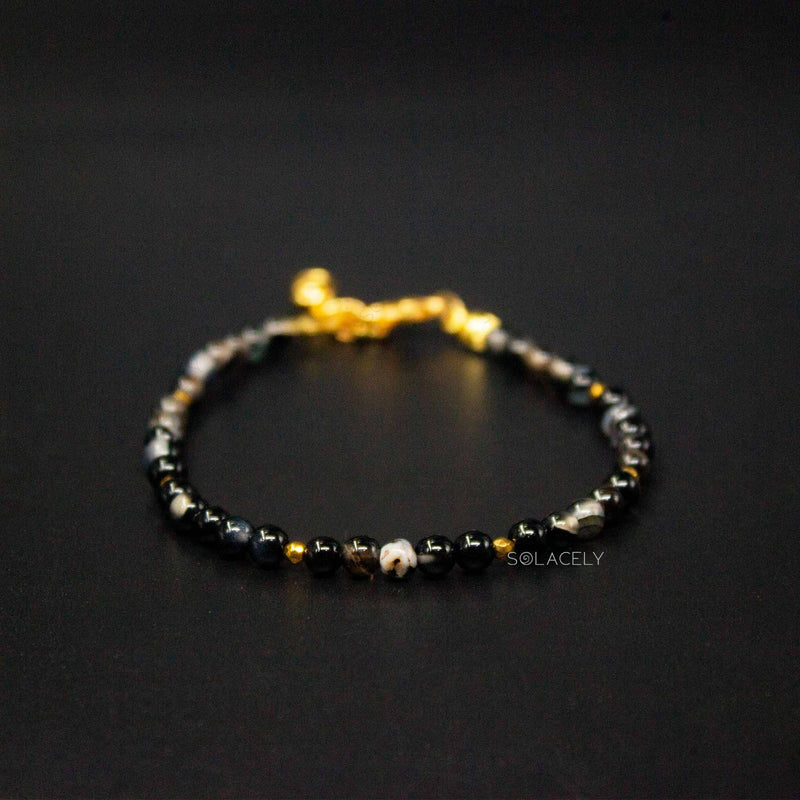
Sulemani hakik is banded black agate, a chalcedony quartz marked with white or grey lines. Across South Asia and the Middle East it has been the protective stone for centuries, worn as a ring or bracelet against nazar, the evil eye. At 7 on the Mohs scale it wears extremely well.
Key takeaways
- Sulemani hakik is banded black agate, a variety of chalcedony quartz.
- The name comes from Sulemani, meaning of Solomon, and hakik, the Persian and Urdu word for agate.
- At 7 on the Mohs hardness scale it is hard enough for a ring or bracelet worn every day.
- Traditionally kept for protection from nazar, for grounding, and for steady nerves through difficulty.
- Linked to the root chakra, the centre of safety and belonging.
What is sulemani hakik?
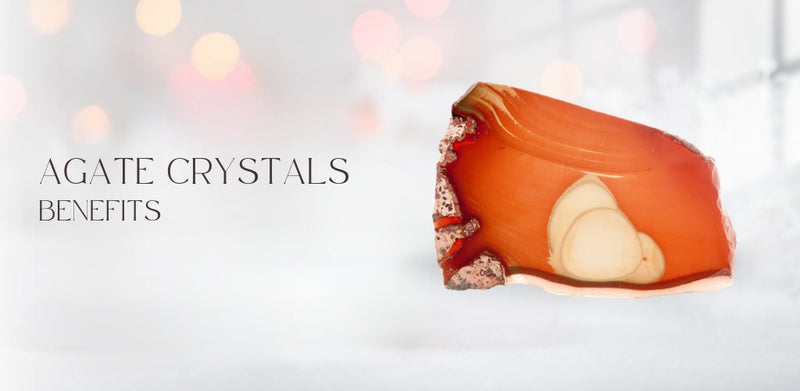
Sulemani hakik is agate, and agate is chalcedony, which is quartz made of crystals too small to see individually. What makes this variety distinctive is its colouring: a deep black or very dark brown body crossed by white, grey or cream bands, often in clean straight lines rather than concentric rings.
Because it is quartz it sits at 7 on the Mohs scale, hard enough to shrug off everyday knocks and to take the high polish that shows the banding properly. That durability is a large part of why it became a stone worn continuously rather than kept on a shelf.
It is found across India, Iran, Afghanistan and the wider region, and it has been traded along those routes for a very long time. Our fuller guide to agate crystals and their meanings covers the wider family it belongs to.
What does sulemani hakik mean?
The name carries its own history. Hakik is the Persian and Urdu word for agate, and Sulemani means of Solomon, a reference to the prophet Sulaiman, who is associated in tradition with a ring of great power. The stone has been understood as a protective seal ever since.
In South Asian and Middle Eastern practice sulemani hakik is above all the stone against nazar, the harmful attention of the evil eye. It is put on a newborn, given before a journey, and worn by people whose work puts them in front of many eyes. That is its central and continuing role.
The bands themselves are read as part of the meaning. Alternating dark and light is taken as a reminder that difficulty and ease alternate too, and that steadiness is what carries a person through both. That reading gives the stone its second association with patience and endurance.
Sulemani hakik properties at a glance
The table gathers the practical details alongside the traditional associations it carries.
| Property | Detail |
|---|---|
| Mineral | Agate, a banded chalcedony quartz |
| Colour | Black to very dark brown with white, grey or cream bands |
| Hardness | 7 on the Mohs scale |
| Chakra | Root |
| Origins | India, Iran, Afghanistan and the wider region |
| Traditionally kept for | Protection from nazar, grounding, patience, steady nerves |
What sulemani hakik is traditionally kept for
Protection is the first and largest use, and it is specific. Sulemani hakik is worn against nazar, the effect of envious or harmful attention, which is a live and widely held belief across South Asia and the Middle East. It is one of the two or three stones most commonly chosen for that purpose.
Grounding is the second thread. Linked to the root chakra, the centre of safety and belonging, it is the stone people put on when everything feels unsettled: a house move, a new job, a family difficulty. Its weight and its darkness are both part of why it is described as steadying.
Patience and endurance follow from the banding. Sulemani hakik is traditionally worn through a long difficulty rather than a sharp one, the sort of stretch that asks you to keep going rather than to act. That is a rather different quality from the energising stones, and it is why the two are often worn together.
It sits comfortably alongside other protective pieces. Black tourmaline is the usual companion, and our guide to black tourmaline meaning and properties covers that stone. In South Asian practice it is also often kept with a gomti chakra, another traditional protective piece.
How to wear sulemani hakik
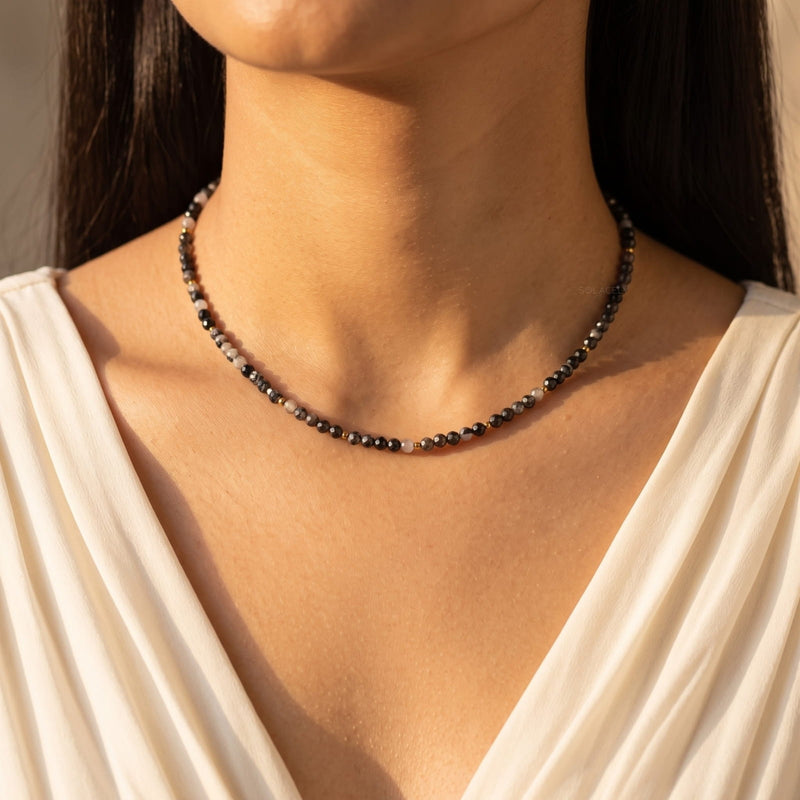
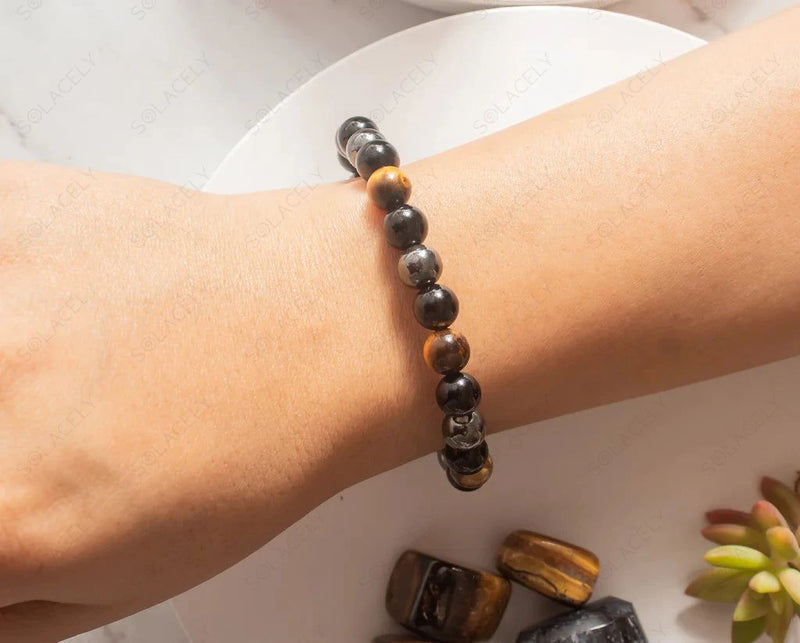
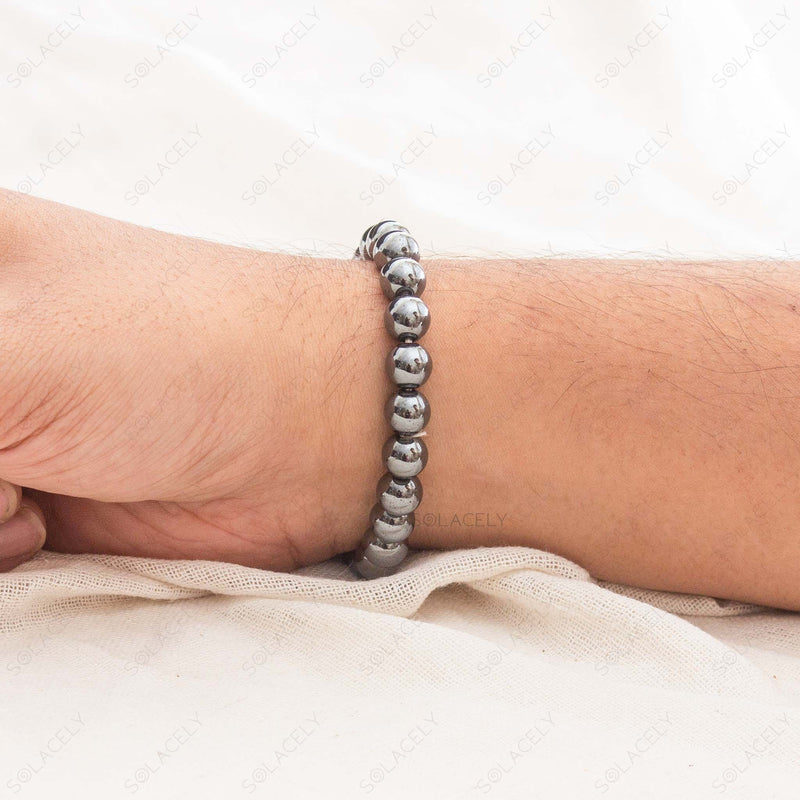
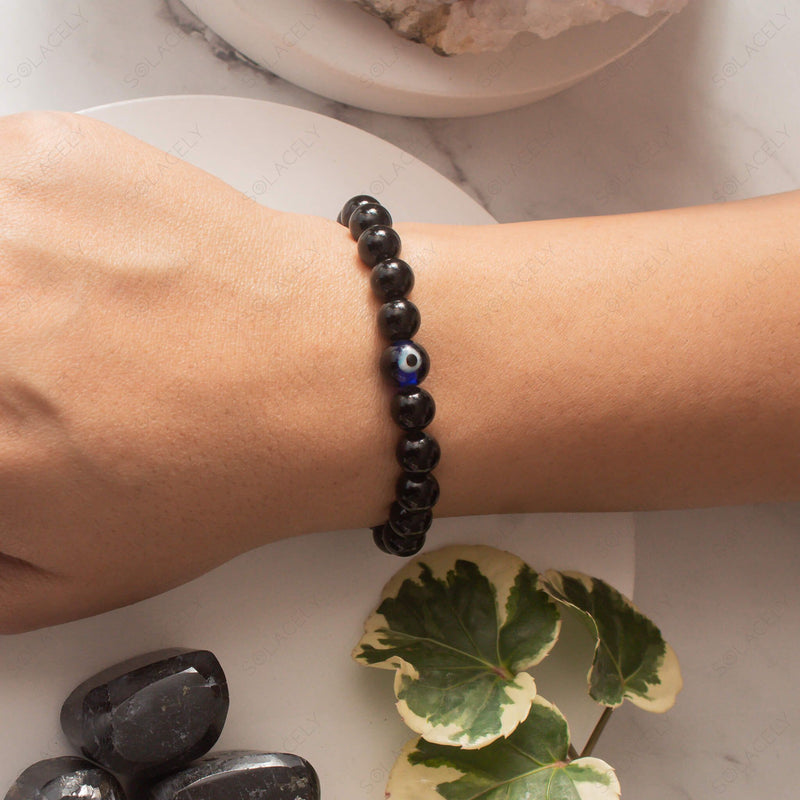
A ring is the most traditional form, reflecting the Solomon association directly, and it is often worn on the right hand. A beaded bracelet is the most common modern choice, and a strung necklace or a single pendant bead both appear widely too.
In crystal tradition the right wrist is the giving side and the left is the receiving side. For a protective stone the right is the usual choice, since the intention is to hold something off rather than to draw something in. Many people simply wear it on whichever hand is comfortable, which is perfectly acceptable.
For a child or a newborn, the traditional form is a small bead on a black thread rather than a bracelet, and this should never be tied around a neck or wrist unsupervised. Beads and threads are a genuine choking and strangulation risk for babies and young children.
Many people wear it continuously and never take it off, which the stone's hardness makes entirely practical. Others put it on for specific occasions: a wedding, an exam, a first day, a journey. Both are traditional and neither is more correct. What matters in practice is that the stone is on you at the moments you wanted it for, and continuous wear is simply the easiest way to guarantee that without having to remember.
Caring for sulemani hakik
It is one of the easier stones to look after. At 7 on the Mohs scale it resists everyday scratching, and warm soapy water with a soft cloth cleans it well. Rinse and dry it properly, and store it away from harder stones such as topaz and sapphire.
Take it off before swimming or heavy cleaning, since chlorine and strong household chemicals dull the polish over time. Elastic-strung bracelets should not be soaked at all, because prolonged water tires the cord long before it affects the stone.
Because it is a protective stone, tradition holds that it should be cleansed often, and after any occasion that felt heavy. Sound, incense smoke and moonlight all suit it, and a brief rinse is fine for a solid piece. Our step-by-step on how to cleanse and charge crystals sets out each method in order.
Sulemani hakik is worn as part of a long-standing spiritual and cultural tradition. It is not a medical device or treatment, and it does not diagnose, treat, cure or prevent any condition. Nothing here replaces advice from a doctor or other qualified professional, and you should never delay or stop medical care because of a crystal. Beads and threads are a choking and strangulation risk, so never leave a strand on a baby or young child unsupervised.
Sources
Written by Chetena Sharma. Reviewed by the Solacely editorial team.
Frequently asked questions
About the author


Written by Chetna Sharma, crystal healing practitioner and co-founder of Solacely. Chetna has worked with healing crystals for over a decade and curates Solacely's protective stone collection.