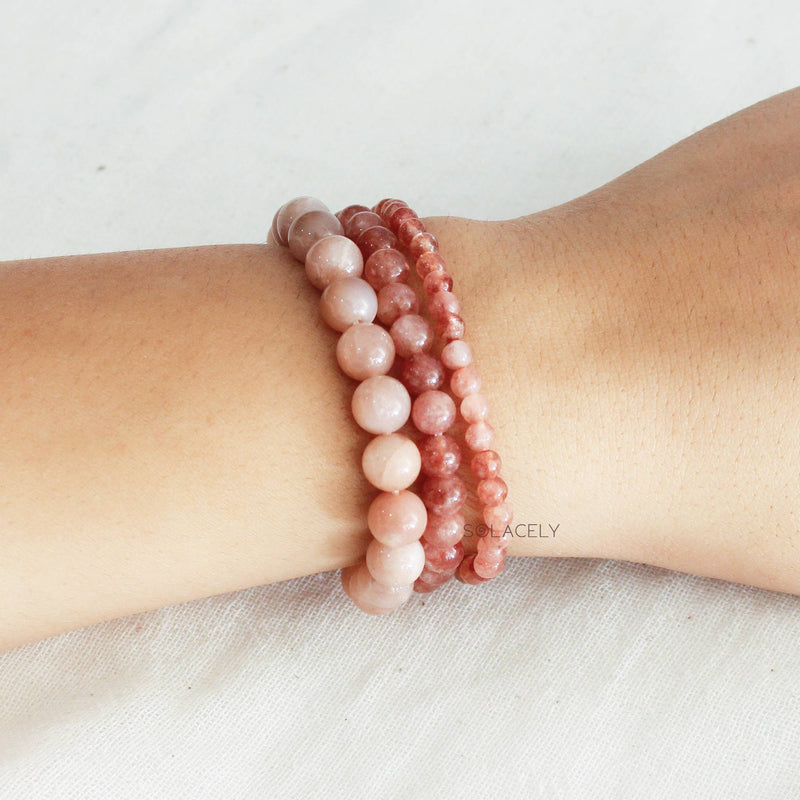
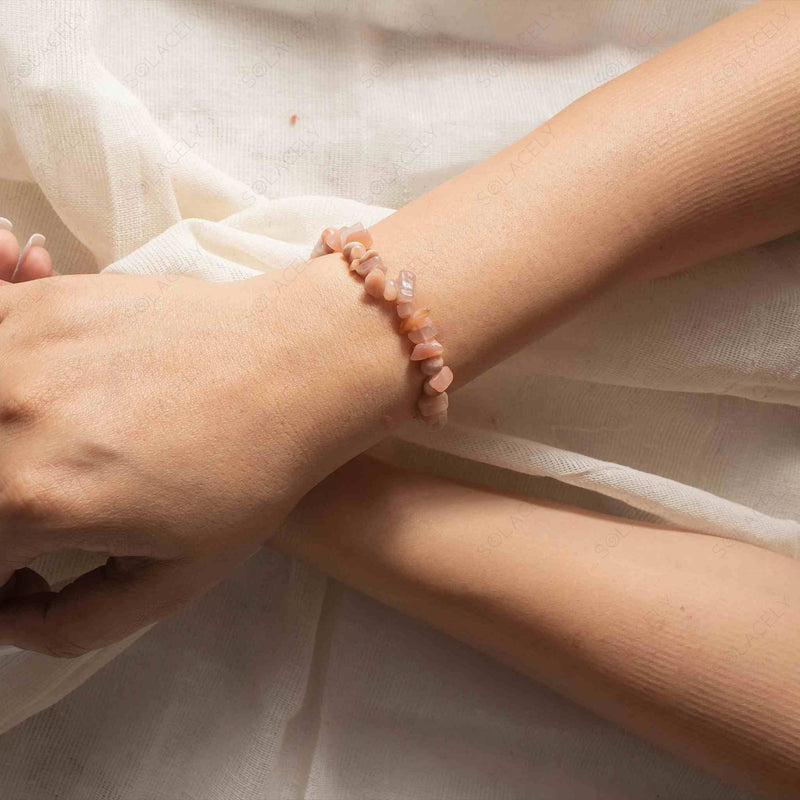
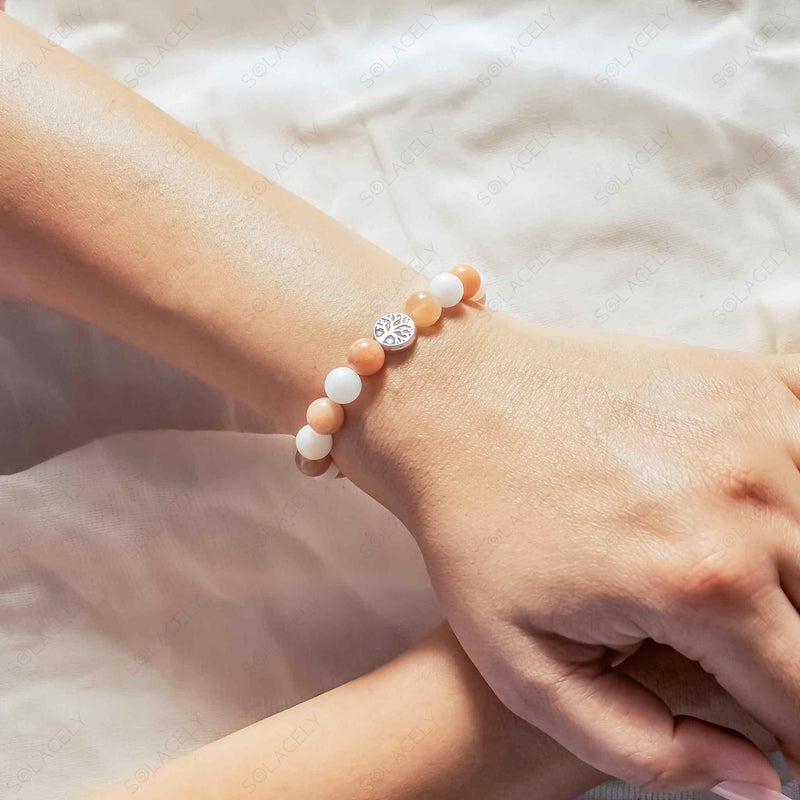
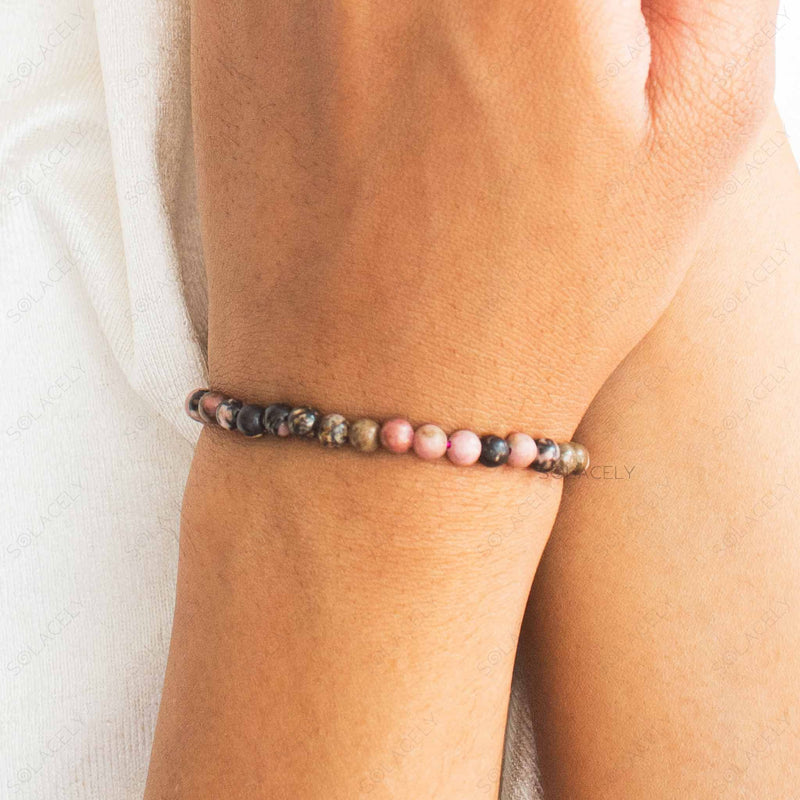
Sunstone and rhodonite cover two halves of the same difficulty. Sunstone is traditionally kept for the nerve to step forward; rhodonite for being fair to yourself afterwards. The pairing suits anyone whose confidence turns into harsh self-criticism the moment something goes wrong.
Key takeaways
- Sunstone steps forward, rhodonite forgives. Two halves of one pattern rather than two moods.
- Sunstone is a feldspar, and its flash comes from copper or hematite inclusions.
- Rhodonite is a manganese silicate, pink to rose red with characteristic black veining.
- Neither is a quartz: sunstone is 6 to 6.5 Mohs and rhodonite 5.5 to 6.5 with cleavage.
- Keep both off daily-wear rings and store them apart from quartz and garnet.
Why the pairing works
There is a pattern that a great many people will recognise. You put yourself forward, it goes imperfectly, and the response is not disappointment but something considerably harsher aimed squarely at yourself.
Sunstone addresses the first part. It is traditionally kept for warmth, vitality and the willingness to be seen, which is what is required to step forward in the first place rather than deferring it again.
Rhodonite addresses what comes after. Its association is with compassion turned inward, and it is the stone people reach for when the difficulty is not the setback itself but how they are speaking to themselves about it.
What sunstone actually is
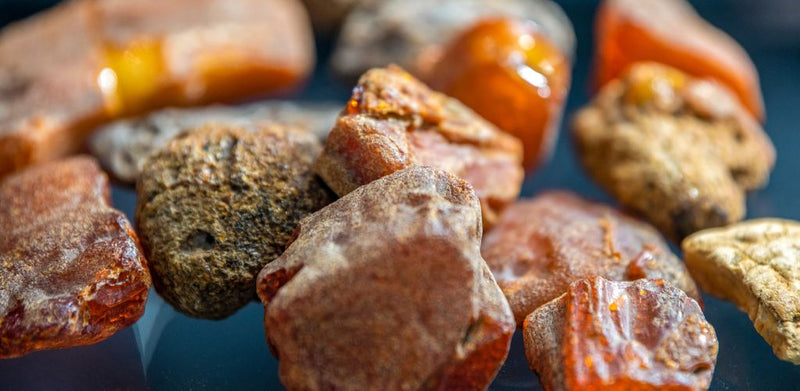
Sunstone is a feldspar, part of the most abundant mineral group in the Earth's crust. Its defining quality is not the peach to red orange body colour but the flash that travels across the surface when the piece is turned.
That effect is called aventurescence, and it comes from tiny plate-like inclusions of copper or hematite suspended in the feldspar catching light as the stone moves. Geology.com describes it as the optical phenomenon that gives the stone its name.
Practically it sits around 6 to 6.5 on the Mohs scale and has cleavage, which makes it softer and rather more vulnerable than the quartz family. It works well as a pendant or a bracelet and less well in a ring worn constantly. The sunstone guide covers the varieties.
What rhodonite actually is
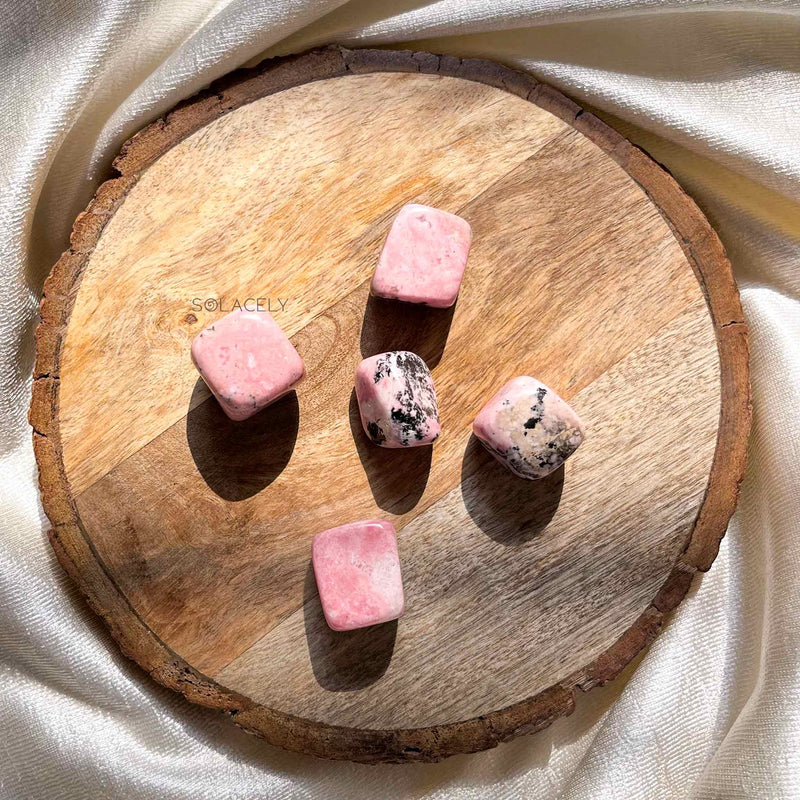
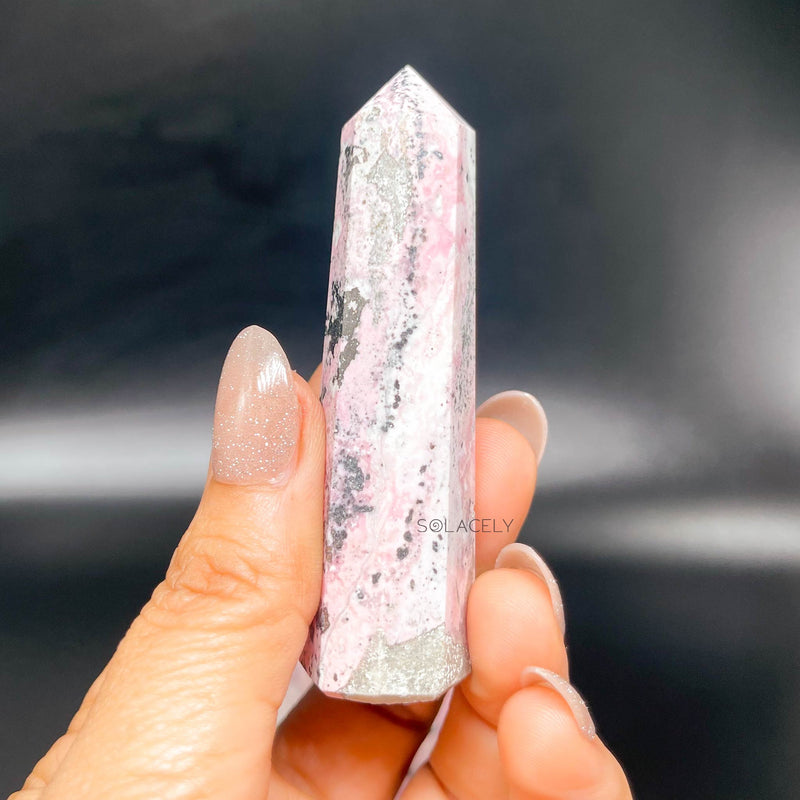
Rhodonite is a manganese silicate, and its colour comes directly from that manganese content. The range runs from a soft dusty pink through to a deep rose red, and the deeper material is generally the more sought after.
Almost every piece is crossed by black veining, which is manganese oxide formed as the material weathered. That webbing is characteristic of the stone rather than a flaw, and pieces without it are unusual and priced accordingly.
It sits around 5.5 to 6.5 on the Mohs scale, and the more relevant point is that it has cleavage and is prone to chipping. A rhodonite pendant will last indefinitely; a rhodonite ring worn every day will not.
Comparing the two
| Sunstone | Rhodonite | |
|---|---|---|
| Mineral | Feldspar | Manganese silicate |
| Colour | Peach to red orange, with flash | Pink to rose red, black veining |
| Hardness | 6 to 6.5 Mohs | 5.5 to 6.5 Mohs, cleaves |
| Traditionally kept for | Stepping forward, being seen | Self-kindness after the fact |
| When it is reached for | Before the attempt | Afterwards, in the quiet |
| Best format | Worn, pendant or bracelet | Kept still, palm or tumbled piece |
The timing row is the useful one. Attaching each stone to a different moment is what stops the pair blurring into a single vague set.
How the pair is used
The placements follow from the timing, and keeping them distinct is most of what makes this combination work.
- Sunstone worn on the day. The interview, the pitch, the conversation you have been putting off.
- Rhodonite kept somewhere quiet. A bedside or a desk, for the evening afterwards.
- Held while you review it. A physical object to hold while going back over how it went.
- Swap which is closest. Move rhodonite forward during a stretch of setbacks.
That third habit is the one people report keeping. Going back over something that did not land is where the self-criticism does its damage, and having a small object attached to doing that fairly is a genuinely useful structure.
Care and cleansing
Both are straightforward but neither is as forgiving as quartz, and the same rules cover them.
Warm water, mild soap, a soft cloth and a full dry suits either stone. Avoid ultrasonic and steam cleaners on both, since cleavage and heat are a poor combination, and keep sunstone out of prolonged strong sunlight.
Storage is where people go wrong. Both sit below quartz on the hardness scale, so keep them in their own pouches rather than loose in a box with amethyst, citrine or garnet, all of which will scratch either one.
Choosing the two
With sunstone, the flash is what to judge. Tilt the piece under a light and look for a strong even shimmer across the whole surface rather than a single bright patch. That matters more day to day than the depth of the body colour.
With rhodonite, look at the balance of pink to black. Some pieces are almost solid rose with a hairline of veining; others are heavily webbed. Neither is better, the webbed material is usually cheaper, so preference and budget tend to line up nicely.
Watch the edges on rhodonite in particular. Because it cleaves, tumbled pieces and beads pick up small chips in transit, and a clean piece costs very little more than a marked one.
A note on rhodonite's colour
Rhodonite is one of the few stones whose appearance changes noticeably over a long life, and it is worth knowing about before buying rather than being surprised by it later.
The black veining is manganese oxide, formed as the material weathered underground, and on some pieces that oxidation continues very slowly at the surface. A stone handled daily for many years can darken slightly along the existing veins. It is a gradual change measured in decades rather than seasons.
Most people who own a piece that long consider it a feature. A stone kept for being fair to yourself after difficult moments is one that accumulates a certain amount of history, and a surface that records some of that is fitting rather than a defect.
Who this pairing suits
It suits people who are already trying things. Somebody who never puts themselves forward at all needs the first half of this set rather than both, and would be better served starting with sunstone alone.
Where it earns its place is with the pattern of doing the brave thing and then punishing yourself for how it went. That is a common enough cycle, and having two objects marking the two ends of it is a reasonable way to notice it happening.
For the recovery half considered on its own, crystals for emotional healing covers the wider group, and crystals for confidence covers what else belongs alongside sunstone.
The properties described here reflect traditional and cultural belief around crystals. They are offered for reflection and wellbeing and are not medical advice, a diagnosis, or a treatment for any condition. If persistent self-criticism, low self-worth or low mood is affecting your daily life, please speak with a GP or a qualified practitioner. Keep small stones away from young children, and never place crystals in drinking water.
Sources
Written by Chetena Sharma. Reviewed by the Solacely editorial team.
Frequently asked questions
About the author


Written by Chetna Sharma, crystal healing practitioner and co-founder of Solacely. Chetna has worked with healing crystals for over a decade and curates Solacely's protective stone collection.