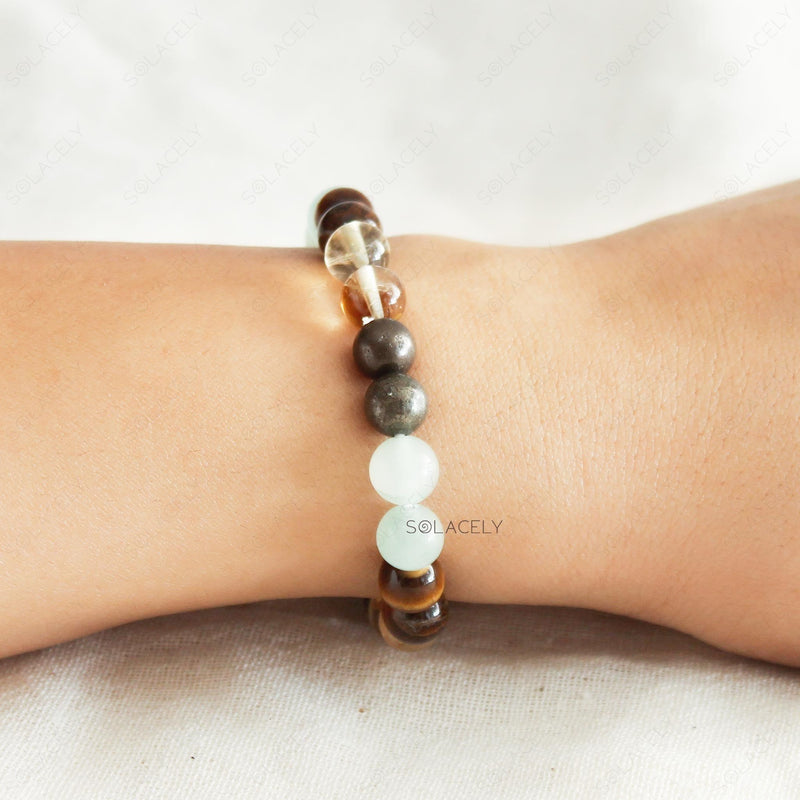
In feng shui, black obsidian is used as a protective, absorbing stone, placed near entrances, in the career area of the bagua, or worn as a Pixiu bracelet. The material itself is natural volcanic glass, formed when lava cools too fast to crystallise.
Key takeaways
- Obsidian is natural volcanic glass, formed when silica-rich lava cools far too quickly for a lattice to grow. That is where its deep gloss comes from.
- It sits at roughly 5 to 5.5 on the Mohs scale and breaks with a conchoidal, shell-like fracture that leaves extremely sharp edges.
- In feng shui tradition, black obsidian is linked to the water element and the north, career area of the bagua, and to entryways.
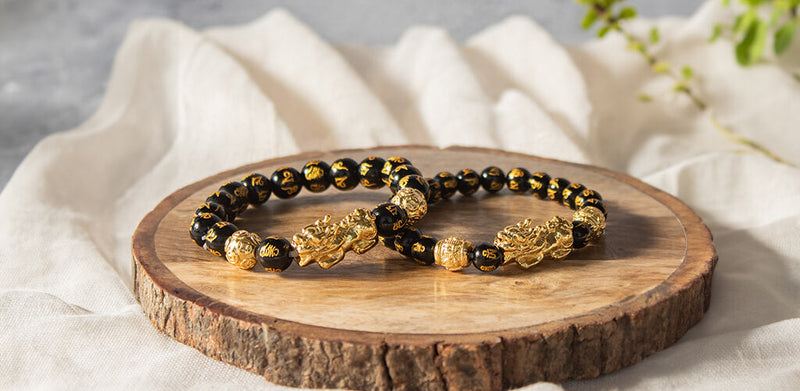
- The Pixiu bracelet convention is the left wrist, with the creature's head facing outward, away from the body.
- Keep heavy raw pieces with sharp edges clear of walkways, and let your own sleep decide whether obsidian stays in the bedroom.
- Care is straightforward: a soft damp cloth, gentle cleansing methods, and no salt, prolonged sun or ultrasonic cleaners.
What is black obsidian, and why is it prized?
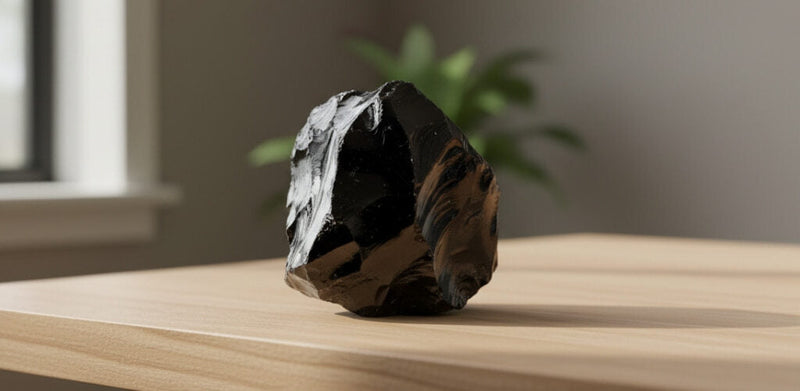
Black obsidian is natural volcanic glass. It forms when felsic lava, rich in silica, cools so rapidly that its atoms never settle into an ordered lattice, which is why geological references describe it as an igneous rock and a natural glass. What you hold is frozen liquid rock.
Its structure is amorphous, like a pane of window glass, and gemmologists group it with the mineraloids. That same structure gives obsidian the qualities people prize: a deep even gloss, a cool smooth surface, and a colour that reads as pure, unbroken black in almost any light. Few stones look so solid.
Chemically, obsidian sits close to rhyolite, and its dark glassy look comes from its composition together with tiny suspended particles of iron and magnesium minerals. Pure black is the most common colour, though sheen, snowflake, mahogany and rainbow varieties all exist and are the same material carrying different inclusions.
Hardness and fracture
Obsidian sits at about 5 to 5.5 on the Mohs hardness scale, softer than quartz and softer than a steel knife blade. It scratches easily. It also breaks in a distinctive way, splitting along smooth curved surfaces rather than flat planes, a pattern called conchoidal fracture.
Those curved breaks produce edges that are genuinely, dangerously sharp. It is precisely why obsidian was worked into blades, scrapers, arrowheads and ceremonial knives across Mesoamerica, the Mediterranean, Anatolia and the Pacific, long before metal tools were widely available. Anyone handling a raw piece should respect that history and lift it by the flat faces. For the wider stone profile, see our black obsidian meaning and properties guide.
What does black obsidian mean in feng shui?
In feng shui, black obsidian is treated as a protective and absorbing stone. Feng shui is the traditional Chinese practice of arranging buildings, tombs and objects in harmony with the flow of qi. Within that system, dark stones are placed where unwanted energy is believed to enter or pool.
Two threads sit behind that reputation. The first is colour symbolism. Black belongs to the water element in the five-element cycle, and water is associated with the north, with career and life path, and with depth and stillness. The second is the material itself: glossy, opaque, reflective. It looks like something that holds a boundary.
The mirror lore matters too. Polished obsidian discs were used as mirrors and scrying surfaces in ancient Mesoamerica, and that association with reflection and revelation carried into later crystal practice. Feng shui borrowed the same logic. A dark reflective surface facing a door is read as sending unfavourable energy back where it came from.
Feng shui is a living tradition with centuries of internal reasoning behind it, and black obsidian has held a steady place within it. People reach for the stone when a home feels exposed: a door opening straight onto a busy street, or a flat that never quite settled after a hard year. If the framework is new to you, our explainer on how feng shui works covers the bagua, the five elements and the commanding position.
Where is black obsidian traditionally placed in a home?
Three placements come up again and again in traditional practice: at or near the entryway, in the north or career area of the bagua, and on a desk when your back is to a door. Each one targets a spot that feng shui reads as vulnerable, either to incoming energy or to being caught unaware.
The entryway, the mouth of qi, is the most common. A sphere or a tumbled piece on a console table near the front door is the usual arrangement. In bagua terms, the north sector governs career and life path, and black obsidian's water association makes it the conventional stone for that corner.
The desk placement is more practical than mystical. If you sit with your back to the door, tradition says to put something dark and reflective within sight so you are not startled. A small polished piece near a monitor does that job. Our guide to crystals for home protection covers the wider room by room approach.
| Form | Traditional placement | Why it is chosen |
|---|---|---|
| Sphere | Entry console or a central shelf | Radiates evenly in all directions |
| Pyramid | Desk, study or career corner | Directional, associated with focus |
| Polished disc or mirror | Facing a door or a sharp corner | Reflective, used to turn energy back |
| Tumbled stones | Pocket, bag or car | Portable and safe to carry |
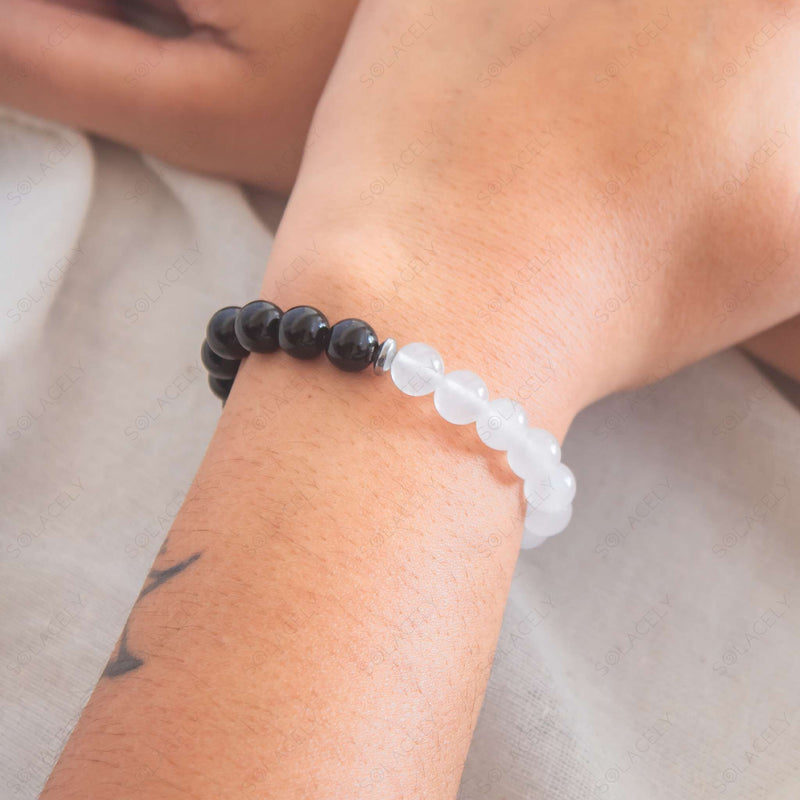
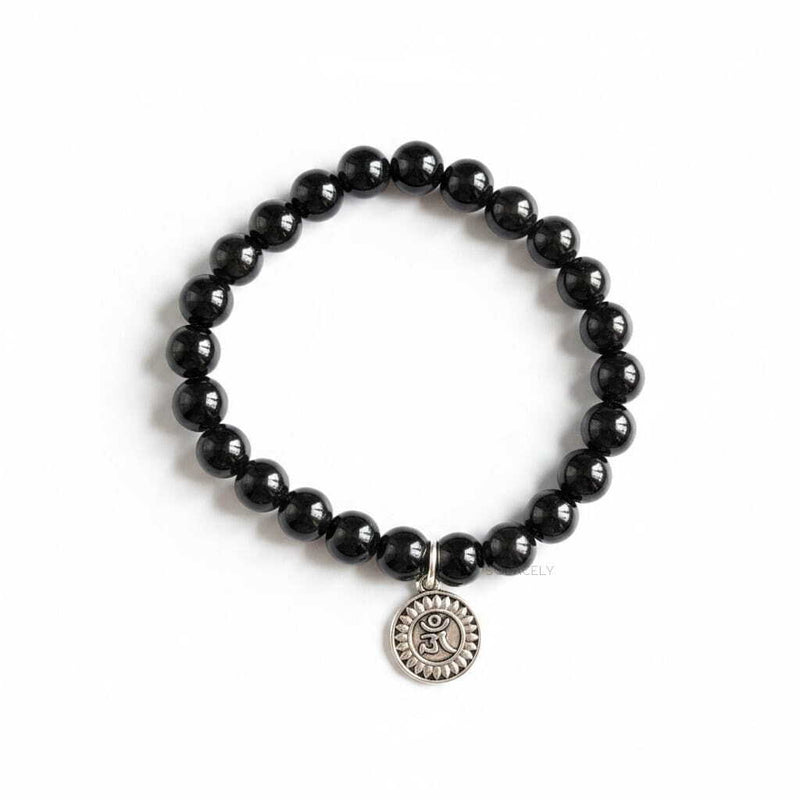
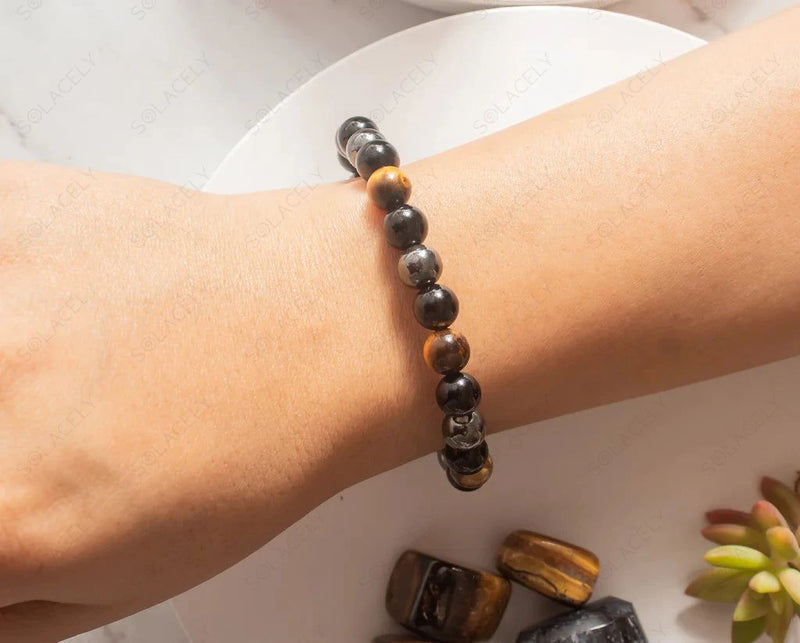
| Bracelet | Worn on the wrist | Travels with you outside the home |
| Raw chunk | Entry hall, clear of walkways | Boundary marker at the threshold |
Form matters less than consistency. A piece that sits in the same spot, gets dusted and gets noticed on the way past does more for a room than a larger stone tucked behind a plant. Choose the shape that suits the surface you actually have.
How is a black obsidian Pixiu bracelet worn?
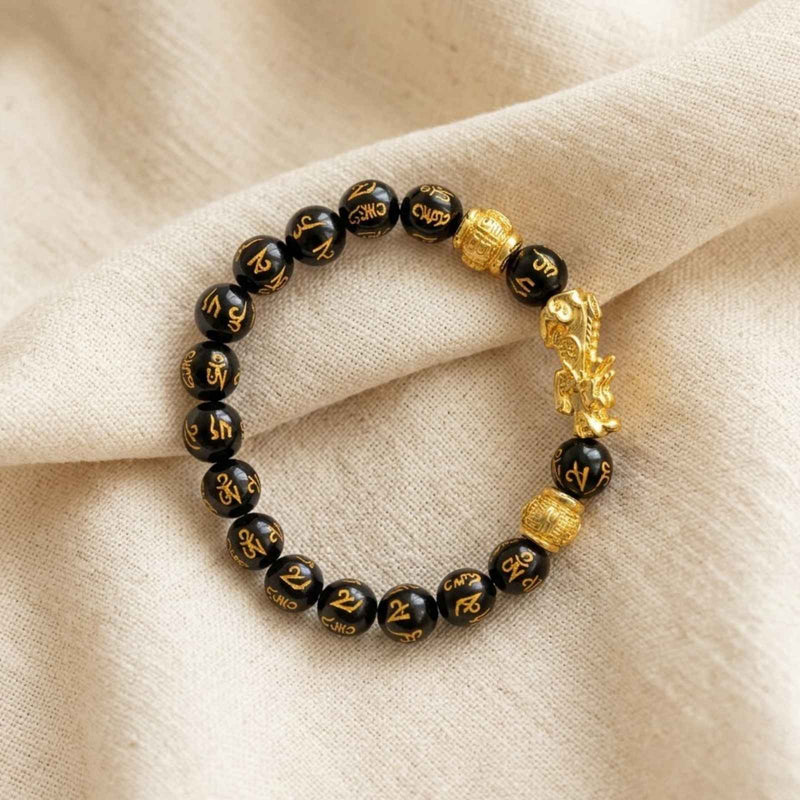
The convention is the left wrist, with the Pixiu's head facing outward, away from your body. In feng shui tradition the left side is the receiving side, so wealth-attracting pieces go there, while the outward-facing head is said to let the creature gather fortune from the world rather than from you.
Pixiu, sometimes written Pi Yao, is a legendary winged creature in Chinese tradition. The story goes that it consumes gold and silver but has no exit, so it keeps everything it swallows. That legend is the whole reason it became a wealth symbol, and it explains the obsidian pairing: an absorbing stone carrying an absorbing creature.
A few practical points that regular wearers tend to agree on. Keep the bracelet to yourself rather than passing it round. Take it off in the shower and while swimming, since strung glass beads and repeated soaking are a poor combination. Many wearers also rest it on a windowsill at the new moon and put it back on the next morning, which keeps the habit deliberate rather than automatic. If you want the full ritual, including the traditional activation and cleansing steps, read how to activate a feng shui Pixiu bracelet.
What should you avoid doing with black obsidian?
The two points worth planning around are physical. Heavy raw obsidian with unworked edges is a genuine cut hazard, particularly around children and pets, and it belongs well clear of walkways and low shelves. Bedroom placement is the other question, and here practitioners take different views.
The bedroom question
One school treats obsidian as too active for a sleeping space, arguing that a stone long associated with bringing buried material to the surface is not what you want beside your head at night. Another places a small piece under the bed for protection during sleep. Both approaches have long traditions behind them.
In our experience the simplest thing is to try it for a week or two. If you sleep better with obsidian in the room, keep it there. If you sleep worse, move it to a hallway or a living room shelf where it still faces the door. Plenty of people find a softer grounding stone suits the bedroom and keep obsidian for the entryway instead.
Other things worth avoiding
Do not store obsidian loose with quartz-family stones, which will scratch it. Do not scrub it with salt, since abrasives dull a glass surface fast. And keep spheres off narrow ledges above hard floors, because a single knock is enough to chip one. If you are choosing between the two most popular dark protective stones, our comparison of black obsidian and black tourmaline lays out the differences.
How do you cleanse and care for black obsidian?
Because obsidian is glass at roughly 5 to 5.5 on the Mohs scale, care is mostly about avoiding scratches and knocks. Wipe polished pieces with a soft damp cloth and dry them properly. Keep them away from harder stones in storage, and off hard floors, since a dropped sphere will chip.
For energetic cleansing, the gentle methods suit it best: moonlight overnight, sound from a bowl or bell, incense smoke, or a rest on a selenite plate. Feng shui practice often adds a cleanse at the new moon or after a difficult period in the house, on the reasoning that an absorbing stone should be emptied periodically.
Skip prolonged sun, skip salt water, and skip ultrasonic cleaners entirely. Rapid temperature change is unkind to glass. In our experience, the pieces that stay looking good for years are the ones handled routinely and stored deliberately, rather than the ones left to knock about in a bowl with everything else.
The properties described here reflect traditional and cultural belief around crystals and feng shui. They are not medical claims and are not a substitute for professional healthcare. If you are managing a health concern, speak to a qualified practitioner.
Sources
- Geology.com, Obsidian: An igneous rock and a natural volcanic glass
- Geology.com, Mohs Hardness Scale
Written by Chetena Sharma. Reviewed by the Solacely editorial team.
Frequently asked questions
About the author


Written by Chetna Sharma, crystal healing practitioner and co-founder of Solacely. Chetna has worked with healing crystals for over a decade and curates Solacely's protective stone collection.