Six stones carry almost all of the bedroom: amethyst for the bedside, lepidolite for anxious nights, rose quartz for the shared dresser, clear quartz at the headboard, black tourmaline by the door, and selenite on a high shelf. Three is plenty for most rooms, and the bedside dish does most of the work.
Key takeaways
- Amethyst is the bedside stone, lepidolite the one for a racing head, rose quartz the shared one, clear quartz the headboard piece, black tourmaline the doorway and phone stone, and selenite a high shelf piece only.
- Three stones is the sweet spot. Six is the ceiling before a bedside table stops feeling restful.
- A bedside dish beats under the pillow. Tumbles migrate in the night, catch on pillow seams and wake you up. A dish an arm's length away does the same job.
- Classical Vastu puts the head of the bed to the south first and east second, and treats bed direction as the highest-leverage change in the room.
- Selenite is gypsum at about 2 on the Mohs scale. It marks with a fingernail and dislikes damp, so it stays away from a humidifier or an ensuite.
- Everything here is traditional belief and cultural practice, kept alongside your doctor's care.
Why does the bedroom need its own logic?
Because it is not a smaller living room. The surfaces are fewer, the stones sit close to your face for hours, and you are asleep for most of the time they are working. That changes what belongs in the room and what does not.
Three things follow from it. Anything on the bedside dish is within arm's reach of your head for seven to nine hours, so size and edges matter more here than anywhere else in the house. The direction the bed faces carries more weight in traditional practice than the position of any other furniture. And the bedroom is usually shared, which makes it the one room where the practice has to suit two people rather than one.
If your bedroom doubles as a workspace, the stones below still apply, though most practitioners suggest keeping the desk out of the direct sightline of the bed. For the rest of the house, our guide to crystals for the living room takes the shared rooms on their own terms, because what suits a room people gather in is not what suits a room you sleep in.
Which direction should the bed face?
Classical Vastu treats bed orientation as the foundation of every other bedroom correction, and it is worth settling before you buy a single stone. The teaching is consistent across centuries of practice.
| Head pointing | Traditional reading | In practice |
|---|---|---|
| South | The preferred direction, described as settling the body for the night | The one most classical bedroom Vastu recommends first |
| East | Associated with vitality and fresh starts | A strong second choice where south is impossible |
| West | Neutral and workable | Used when south and east are both blocked by the room |
| North | The direction tradition steers away from | Where the layout is fixed, a clear quartz at the head is the customary softener |
Most bedrooms only allow one or two of these, and that is fine. Treat the direction as a free upgrade when the room permits it rather than something to rearrange your life around. The wider directional system, including the wealth corner and the Brahmasthan, sits in our Vastu remedies guide.
The six stones that earn a place
Each one has a specific spot and a specific job. Start with the first three and add the others only if the room asks for them.
Amethyst, the bedside stone
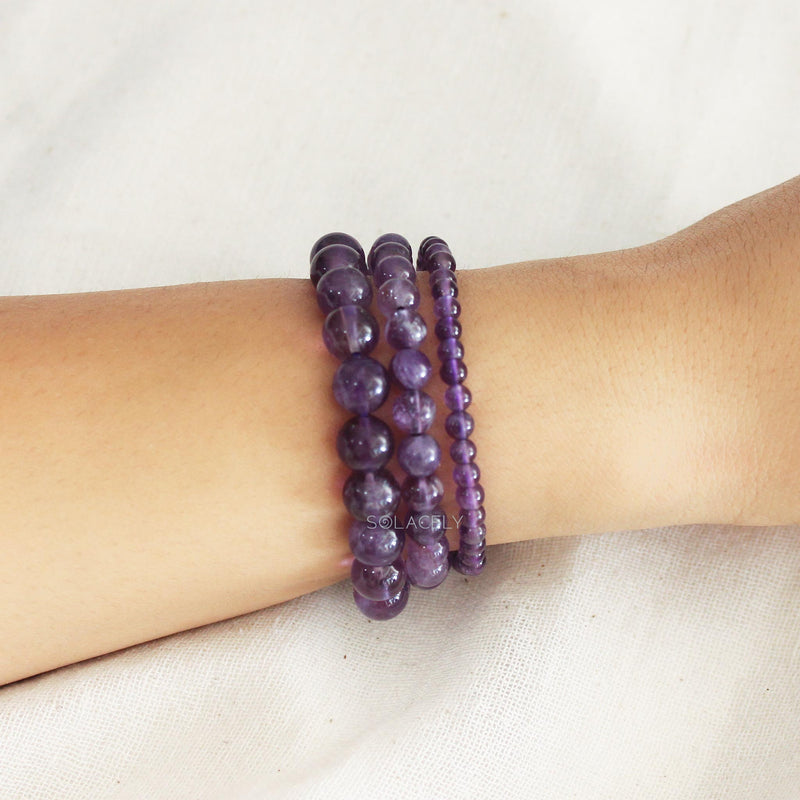
Amethyst is the stone most kept beside a bed, and it has held that role for a very long time. Purple quartz at 7 on the Mohs scale, hard enough that a knock off the table costs it nothing. Put a single tumble on the far edge of the bedside dish, away from the hand that reaches for water in the dark. Keep it out of a sunny window, because amethyst pales with long exposure and the colour will not come back. Our amethyst guide covers the rest.
Lepidolite, for the nights your head will not stop
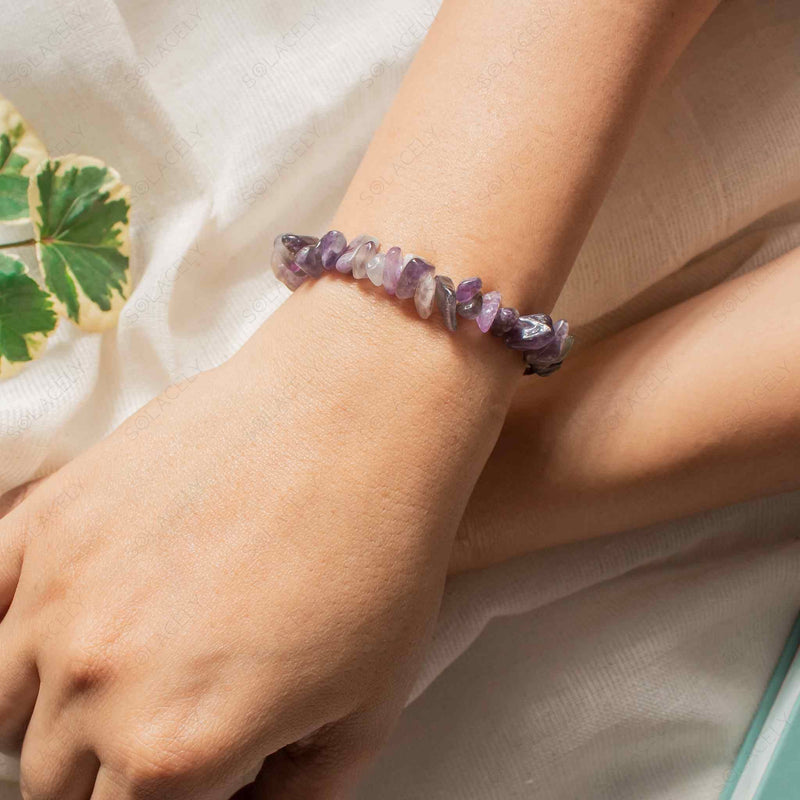
Lepidolite is a lithium-bearing mica, and that piece of geology is a large part of why it gathered its reputation for calm in modern practice. It is the piece people reach for after a day that will not put itself down. It is also soft, around 2.5 to 3, and it flakes, so it lives in a dish rather than loose in a drawer and never goes in water.
Rose quartz, the shared one
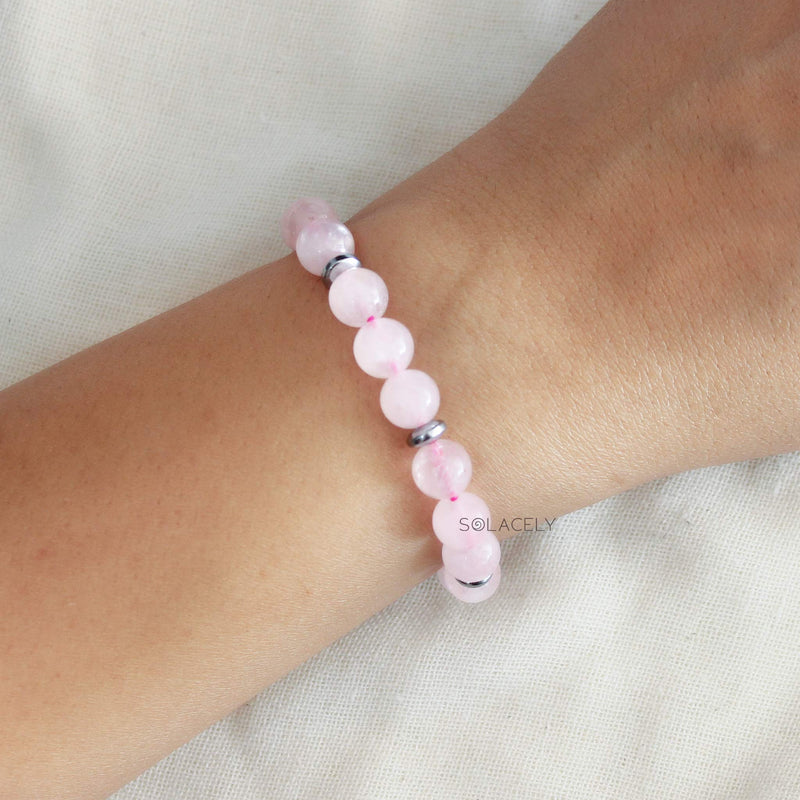
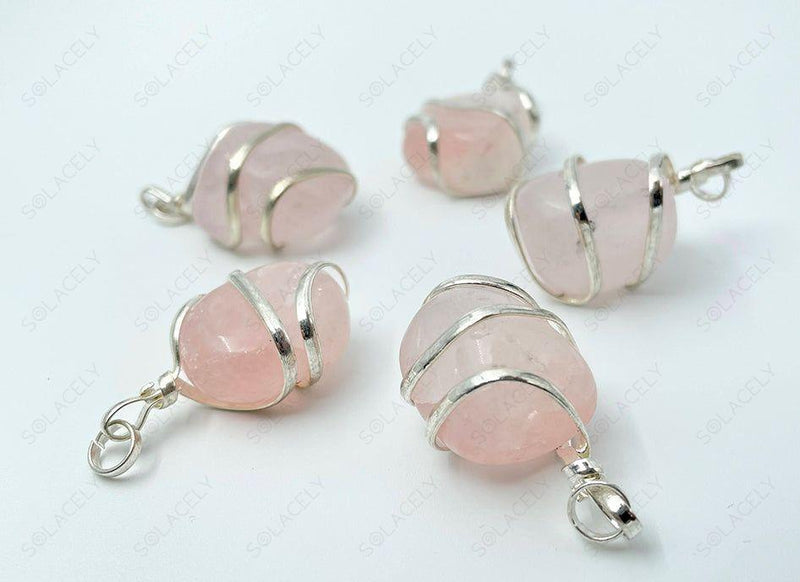
Rose quartz belongs on the dresser you both walk past, in a small dish, where it works as a marker for the relationship rather than a fix for it. Couples who get the most from it treat it as a shared cue at the start and end of the day. It is quartz at 7 and unbothered by ordinary handling, though the pink softens in all-day sun.
Clear quartz, the headboard piece
Clear quartz is the steadiest stone on this list, with no fading and no moisture worries. It sits on a headboard ledge or a shelf above the bed, and it is the customary choice when the bed cannot face the direction you would like. Use a polished tumble or a rounded piece. Sharp natural points do not belong above a sleeping head.
Black tourmaline, for the door and the phone
Black tourmaline has two jobs in a bedroom. One tumble by the door, following the old habit of marking a threshold. A second beside the phone or the charger, which is the modern version of the same idea and doubles as the cue to put the thing on Do Not Disturb before the light goes off. Tumbled forms only here, since raw schorl has edges that mark furniture.
Selenite, high shelf only
Selenite is a crystallised gypsum and one of the softest stones in regular use, sitting at roughly 2 on the Mohs scale. It scratches with a fingernail and it does not tolerate water, so it is a display piece on a high shelf or a wardrobe top, never a bedside stone. Skip it altogether if the room has an ensuite or you run a humidifier overnight.
Where do the stones actually go?
Three placements do nearly all the work, and two more are situational. Keep the list short and the practice survives a tired Tuesday.
- The bedside dish. One amethyst plus one lepidolite, or rose quartz if the week has been tender. This is the placement people keep.
- The headboard ledge. One clear quartz, particularly where the bed direction is fixed.
- The shared dresser. One rose quartz in a small dish, somewhere you both pass.
- Beside the door. One black tourmaline tumble, for anyone who feels the rest of the house follows them in.
- Beside the phone. A second black tourmaline at the charger, as the signal that the day is closed.
A few places to avoid. Under the pillow is the one people try first and abandon fastest, because tumbles travel in the night and catch on seams. Inside the bed frame or under the mattress puts pressure on the stone and does nothing for you. A south or west windowsill will pale amethyst over a summer. And stacking stones on top of electronics simply invites them onto the floor.
The five minute bedtime ritual
What people describe getting most from a bedroom practice is the shape it gives the end of the day. Keep it short enough that you will still do it on a tired weeknight.
- Pick up one stone. Amethyst by default. Lepidolite if the day was anxious. Rose quartz if it was emotionally heavy.
- Three slow breaths. In for four, out for six, stone in your hand, eyes shut.
- Name one thing you are putting down. Out loud or silently. Something plain, like leaving tomorrow's problem until tomorrow.
- Put the stone back on the dish. It stays out and you go in. That is part of the cue.
- Phone to Do Not Disturb. If the second tourmaline is by the charger, this is its moment.
Under five minutes, every night, is worth more than an elaborate version you do twice. The reason it holds is that it always happens in the same order, in the same place, with the same object in your hand. That repetition is what turns it from a nice idea into something your evening actually expects, and it is why practitioners are so insistent about putting the stone back in the same spot rather than carrying it into bed.
Give it a fortnight before judging it. If picking the stone up starts to feel like another item on a list rather than the end of one, shorten it further. One breath and one sentence at the bedside is a complete practice, and a version you keep beats a version you admire.
How do you cleanse bedroom stones?
Bedroom pieces get handled every night, so most practitioners refresh them every week or two, and more often after a rough stretch. Three methods fit a bedroom without adding anything to your evening.
- Moonlight overnight. Move the dish to a windowsill for one night. Safe for every stone above and no extra effort at all.
- Sound at lights out. A small bell or bowl near the dish for half a minute. Contact free, which is what the soft stones want.
- A dry cloth. Thirty seconds on the amethyst and rose quartz handles dust between cleansings.
Keep selenite and lepidolite out of water entirely, and skip salt water for anything that sleeps near your face. For a fuller picture of which stones suit the room, our best crystals for sleep guide goes wider, and for a child's room the safety picture is different enough that we cover it separately in crystals for children's bedrooms.
The properties described here reflect traditional and cultural belief around crystals. They are offered for reflection and wellbeing and are not medical advice, a diagnosis, or a treatment for any condition. If your sleep is persistently disturbed, please speak with a GP or a qualified sleep clinician, and keep any crystal practice alongside their care. Keep small stones away from young children, and never place crystals in drinking water.
Sources
Written by Chetena Sharma. Reviewed by the Solacely editorial team.
Frequently asked questions
About the author


Written by Chetna Sharma, crystal healing practitioner and co-founder of Solacely. Chetna has worked with healing crystals for over a decade and curates Solacely's protective stone collection.