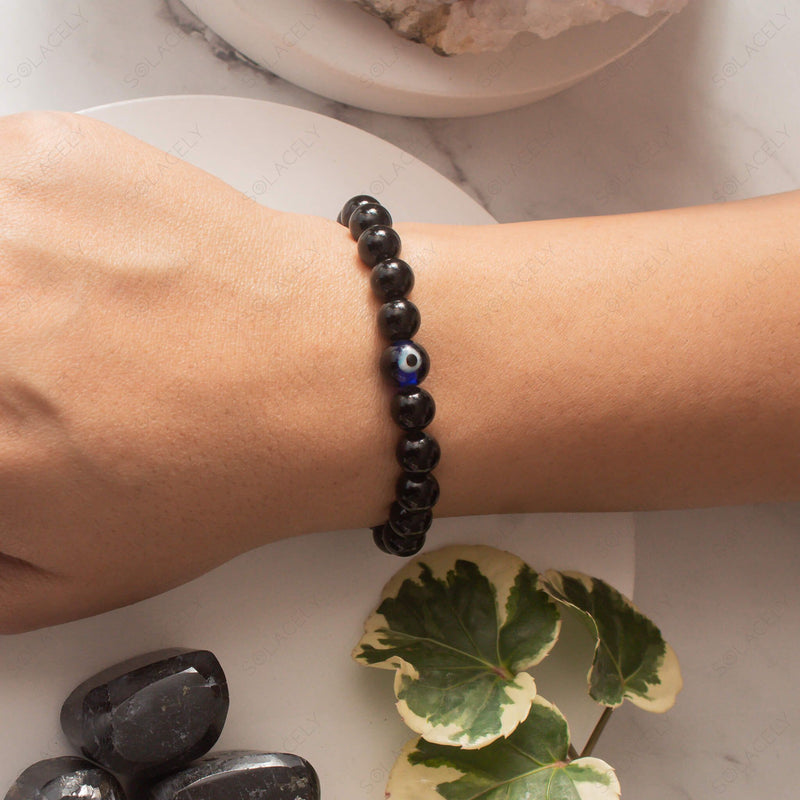
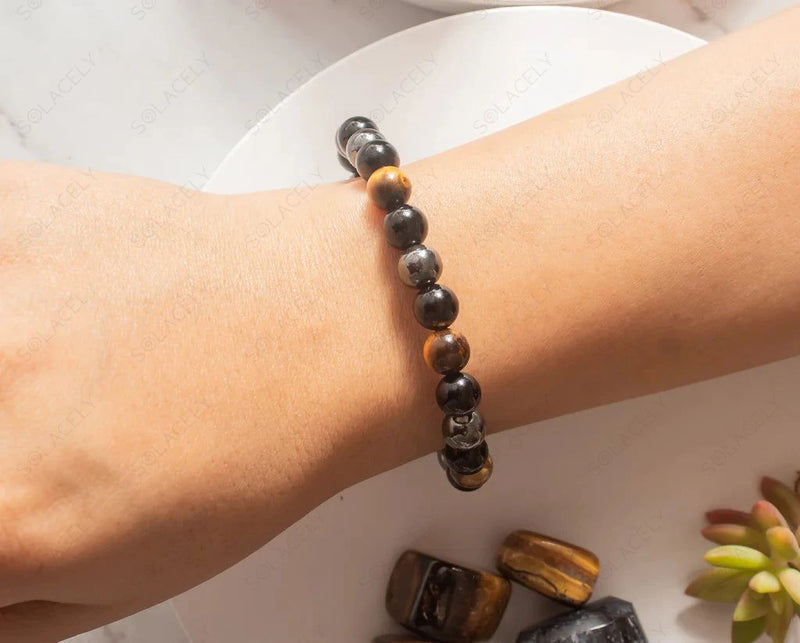
The stones most often chosen for protection are black tourmaline, hematite and black onyx. For self-healing, people reach for rose quartz, clear quartz, amethyst and selenite. Protection stones are traditionally used to hold a boundary. Healing stones are used to soften what sits inside it. Most collections end up holding one of each.
Key takeaways
- The core protection set is black tourmaline, hematite and black onyx. The core self-healing set is rose quartz, clear quartz, amethyst and selenite.
- Black tourmaline is a boron silicate that sits around 7 to 7.5 on the Mohs scale, hard enough for a bracelet you never take off.
- Selenite is a variety of gypsum and rates roughly 2 on Mohs. A fingernail marks it and water dissolves the surface, so it should never be rinsed.
- Placement matters more than quantity. One stone you touch every day does more for a routine than twenty in a drawer.
- Match the cleansing method to the mineral, not to habit. Prolonged sun fades amethyst, water damages selenite, and salt pits softer stones.
- Everything described here reflects traditional belief and cultural practice, not medical fact.
Which crystals are used for protection?
Three stones carry most of the weight in protection practice: black tourmaline, hematite and black onyx. All three are dark, dense and noticeably heavy for their size. That is not an accident. Traditional practice reads opacity and weight as the physical signature of a boundary, so these stones get worn on the body or set near a door.
Black tourmaline
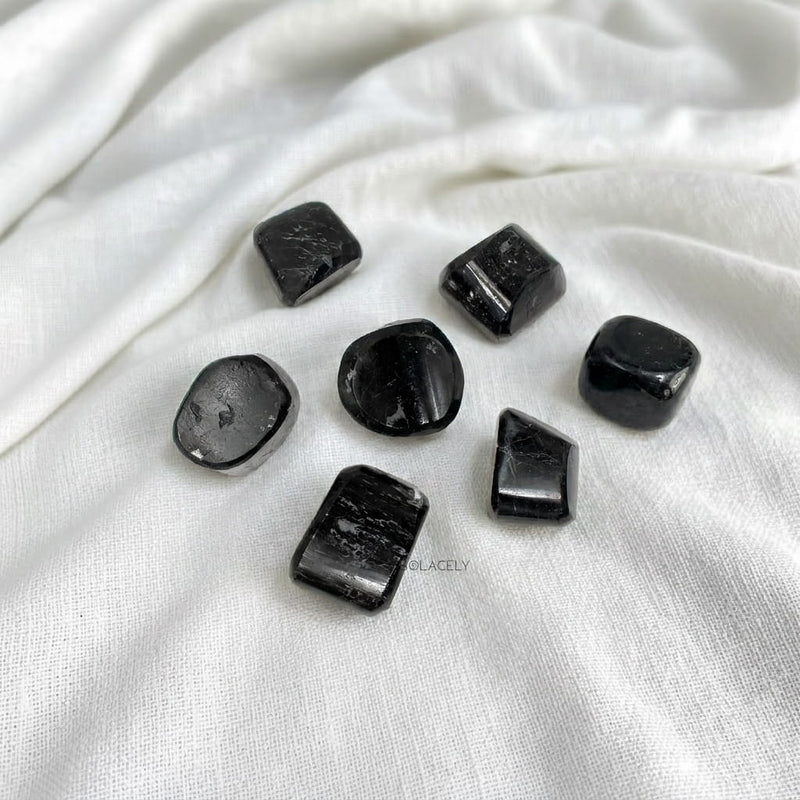
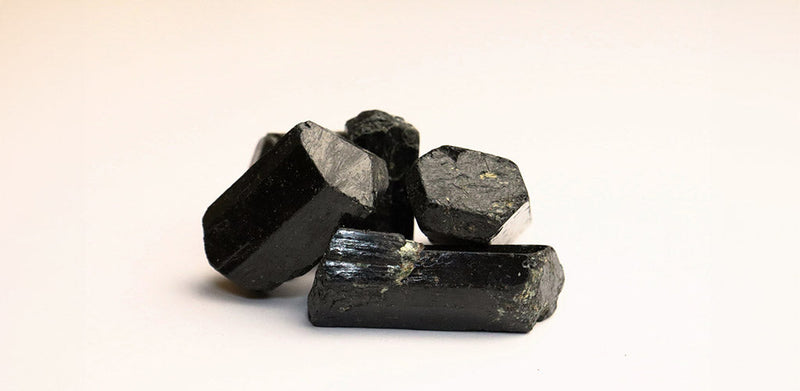
Black tourmaline is the stone almost everyone names first. Mineralogists call the black, iron-rich variety schorl. Tourmaline is a complex boron silicate group whose members vary widely in composition and colour, which is why one family produces stones from jet black to watermelon pink.
Hardness of roughly 7 to 7.5 makes it practical. A tourmaline bracelet takes knocks, sleeves and handwashing without dulling. In everyday use people keep a piece by the front door, in a work bag, or on a desk that faces an open-plan floor. The longer breakdown sits in our guide to black tourmaline crystal benefits. A black tourmaline bracelet keeps it close through the day.
Hematite
Hematite is an iron oxide with a bright metallic sheen and real heft in the palm. It is the most important ore of iron, and it always leaves a red to red-brown streak, which is where the name comes from. A silver-looking stone that draws red is a genuinely odd thing to hold.
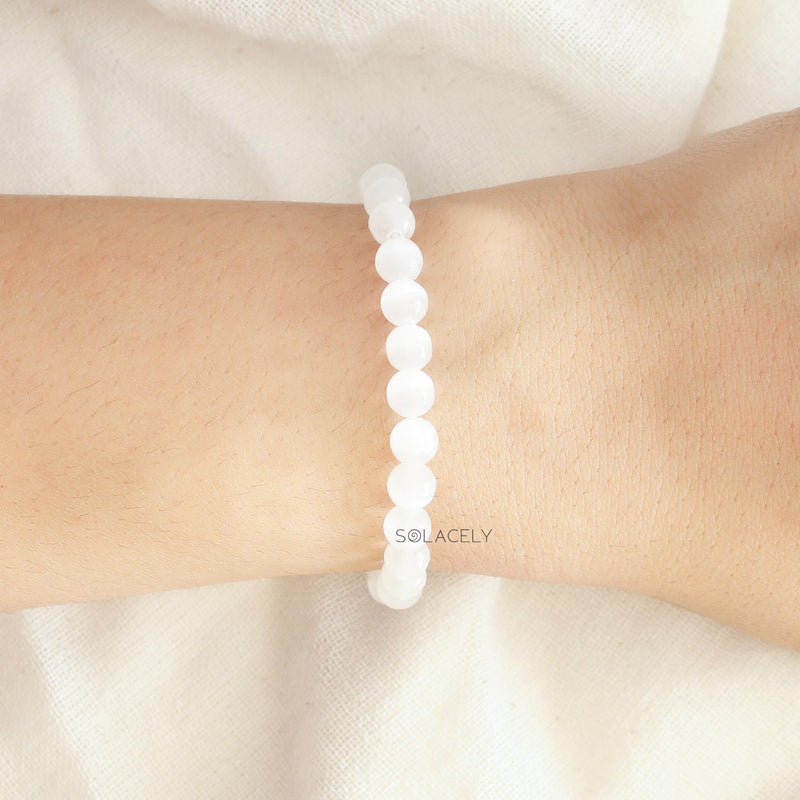
Its traditional role is grounding rather than shielding. Wearers reach for it on scattered days, when attention keeps sliding off whatever is in front of them. Two practical notes. Hematite is brittle for its weight and will chip if dropped on tile, so keep a tumble off hard floors. Magnetic hematite beads are their own well-established category, bought by people who enjoy the pull between the beads as they fasten a bracelet.
Black onyx
Black onyx is a banded variety of chalcedony, itself a microcrystalline form of quartz. Deepening the colour of onyx is a practice that goes back to antiquity and is entirely standard across the trade, which is why the black reads so evenly. Hardness near 7 means it wears well in rings and pendants.
Where tourmaline is traditionally used as a wall and hematite as an anchor, onyx is used for composure. It is the stone people choose before a hard conversation, a court date or a review meeting. Our broader guide to crystals for protection covers the wider set, including obsidian and smoky quartz.
Which crystals are used for self-healing?
Self-healing work uses lighter, more translucent stones: rose quartz for the emotional side, clear quartz as an all-purpose piece, amethyst for rest and reflection, and selenite for clearing. Three of the four are quartz-family minerals, so they behave similarly. Selenite is the outlier, and it needs different handling.
Rose quartz
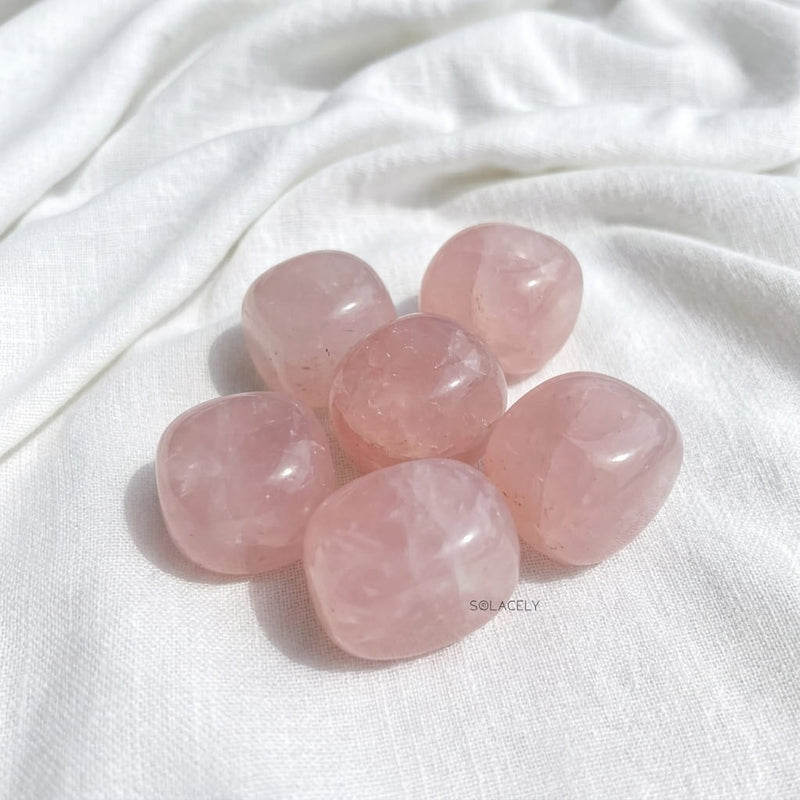
Rose quartz is the pink, usually cloudy variety of quartz, coloured by microscopic mineral inclusions. It is the stone traditionally linked to self-compassion as much as to romance, which surprises people who only know it as the love stone. People keep it where they wind down: a bedside table, a bathroom shelf, a coat pocket.
If you are working through a specific loss or a long low patch, the dedicated piece on rose quartz for emotional healing goes deeper into how people structure that practice.
Clear quartz
Clear quartz is silicon dioxide in its plainest form, and it is the most abundant mineral family in the Earth's crust. Crystal tradition calls it the master healer and uses it as an amplifier, which in practice means it gets paired with whatever else you are working with. Beginners are often told to buy it first. That advice holds up, mostly because it is cheap, durable and hard to misuse.
Amethyst
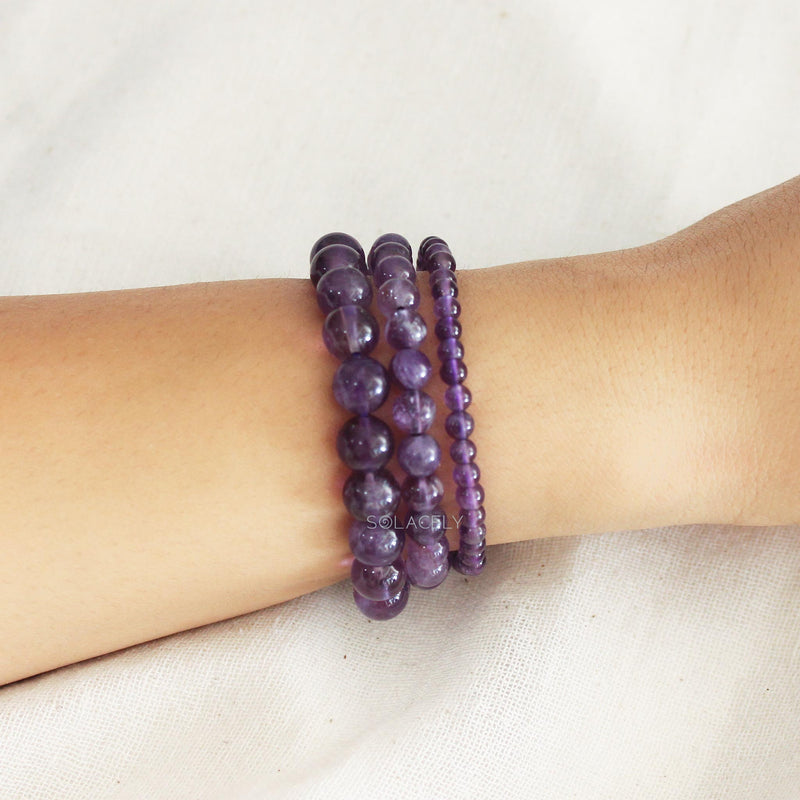
Amethyst is purple quartz. According to the Gemological Institute of America, its colour comes from iron and natural irradiation within the crystal, and prolonged exposure to strong light can fade that colour. That single fact should change how you store it. A windowsill is the worst place for a good amethyst, however pretty it looks there.
Traditionally it is the stone of rest, sobriety and a quieter head. Most people use it at night, near the bed or in a meditation corner, rather than carrying it around.
Selenite
Selenite is a crystalline variety of gypsum, and it is soft. Roughly 2 on the Mohs scale means a fingernail leaves a mark. It is also water-soluble, so a rinse under the tap will visibly degrade the surface over time. Crystal practice uses selenite to clear other stones, usually by resting them on a flat plate overnight. Our selenite guide covers the handling rules in full.
Protection stones and healing stones: what actually differs
The split is about direction. Protection stones are traditionally used to manage what comes toward you, so they get worn outward or placed at thresholds. Healing stones are used for what is already inside, so they get placed where you rest. The minerals differ too, and that changes how you care for them.
| Protection stones | Healing stones | |
|---|---|---|
| Typical stones | Black tourmaline, hematite, black onyx | Rose quartz, clear quartz, amethyst, selenite |
| Look | Dark, opaque, dense | Pale, translucent, light |
| Traditional purpose | Boundary, grounding, composure | Comfort, clarity, rest, clearing |
| Usual placement | Wrist, doorway, desk, car | Bedside, bath, meditation seat |
| Durability | Mostly hard and wearable | Mixed; selenite is fragile |
A useful way to decide is to ask what you want back. If the answer is "less coming at me", start with the dark stones. If the answer is "less going on inside me", start with the pale ones.
How do you use these crystals day to day?
The methods that survive contact with real life are simple: wear one stone, keep one where you sleep, and put one where the friction is. Elaborate rituals tend to fade after a fortnight. A bracelet you never remove and a tumble on the nightstand will still be in use six months later.
- On the wrist. The most reliable format, because you do not have to remember anything. Which wrist to choose is a common question, and we answer it in the piece on which hand to wear your crystal bracelet on.
- By the door. A tourmaline or onyx piece on the hall shelf is the traditional threshold placement. It also acts as a physical cue to pause before leaving.
- On the desk. Hematite for focus, tourmaline if the room drains you. Keep it within reach, not behind the monitor.
- Beside the bed. Amethyst or rose quartz. Selenite works here too, on a coaster, away from any glass of water.
- In the hand. Five minutes holding a stone while you breathe is the whole practice for most people. It does not need to be longer.
One practical caveat. Two stones you genuinely use will teach you more about your own routine than seven sitting in a dish. Start with two, and add a third only once the first two have become automatic.
How do you cleanse and care for these stones?
Care should follow the mineral rather than a one-size ritual, and the differences are large. Quartz-family stones tolerate a quick rinse. Selenite does not, because gypsum is water-soluble. Amethyst fades in prolonged strong light. Matching the method to the mineral is the fastest way to keep an otherwise good piece looking new.
| Stone | Approx. Mohs | Water | Direct sun |
|---|---|---|---|
| Black tourmaline | 7 to 7.5 | Brief rinse, dry fully | Fine |
| Hematite | 5 to 6 | Wipe only; avoid soaking | Fine |
| Black onyx | Around 7 | Brief rinse | Colour can fade over time |
| Rose quartz | 7 | Brief rinse | Colour fades over time |
| Clear quartz | 7 | Brief rinse | Fine |
| Amethyst | 7 | Brief rinse | Avoid; colour fades |
| Selenite | About 2 | Never | Avoid heat |
Safe methods that suit everything on this list: moonlight overnight, smoke from sage or palo santo, sound from a bowl or bell, or an hour resting on a selenite plate. Skip salt water entirely. It pits softer material and creeps into the drill holes of beaded bracelets, where it dries and weakens the cord.
How does a crystal practice fit into a normal week?
Crystals sit alongside the rest of your routine rather than in place of any of it. The tradition has always treated them as a reflective practice, something you return to in the same way you return to a walk, a journal or a quiet ten minutes. That is the frame most long-term users settle into, and it is the one that lasts.
What people describe, consistently, is that a stone works as a cue. Touching a bracelet before a difficult call is a small, physical reminder to slow down and choose a response rather than react. That is where the momentum comes from, and it explains why the stone you genuinely like the look of tends to serve you better than the one somebody told you to buy.
So buy the stone you find genuinely attractive. Keep it somewhere you will touch it, and give it a fixed place rather than a rotation. Then judge it by whether your day feels a little more deliberate than it did a month ago.
The properties described here reflect traditional and cultural belief around crystals. They are not medical claims and are not a substitute for professional healthcare. If you are managing a physical or mental health concern, please speak to a qualified practitioner.
Sources
Written by Chetena Sharma. Reviewed by the Solacely editorial team.
Frequently asked questions
About the author


Written by Chetna Sharma, crystal healing practitioner and co-founder of Solacely. Chetna has worked with healing crystals for over a decade and curates Solacely's protective stone collection.