Moonstone Crystal: Meaning, Benefits & Properties (2026 Guide)

moonstone meaning
benefits of moonstone

Moonstone is the gem with a glow inside it. Mineralogically, it's a feldspar — a sodium-potassium aluminosilicate with a Mohs hardness of 6 to 6.5 (Geology.com; Britannica) — but what makes it special is an optical phenomenon called adularescence: a soft, drifting sheen that looks like moonlight pooling just below the surface. It's the June birthstone, and most fine-quality stones come from the Dumbara district of Sri Lanka (Britannica). In crystal-healing tradition, moonstone is the "stone of new beginnings," tied to intuition, the divine feminine, and the rhythms of the moon. This guide covers the verified mineralogy, the optical science behind the glow, the traditional benefits, and the right way to care for the stone given its delicate cleavage planes.

Key Takeaways
  • Moonstone is a feldspar mineral (sodium-potassium aluminosilicate), Mohs 6 to 6.5, prized for adularescence — the soft inner glow that gives the stone its name (Geology.com; Britannica).
  • The glow is caused by light bending through thin alternating layers of orthoclase and albite within the crystal (Geology.com) — pure optical physics, not surface coating.
  • Moonstone is the official birthstone for June and is traditionally linked to the third eye and crown chakras for intuition and dream work.
  • Sri Lanka (Dumbara district) is the most important source of fine-quality moonstone, with major additional production from Brazil, Myanmar, and India.
  • Care: handles brief water contact but moonstone has two directions of perfect cleavage, so avoid hard knocks. Best in earrings, pendants, and occasional-wear rings.

A note before we begin. Nothing here replaces medical advice. Crystal healing is a complementary, faith-based practice. The spiritual and emotional benefits in this guide reflect long-standing tradition and personal experience, not clinical research.

What Is Moonstone Crystal?

Moonstone is the popular name for gem-quality feldspar that exhibits adularescence (Geology.com). At the chemistry level, it's a mixed sodium and potassium aluminosilicate (Britannica) with a Mohs hardness of 6 to 6.5. Body colours range across white, grey, peach, brown, pink, blue, green, yellow, and even fully colourless, but the common thread is that soft, drifting inner glow.

The name "moonstone" comes straight from how the stone behaves: rotate it in your hand and the sheen seems to float just under the surface, the way moonlight catches on the surface of moving water. The technical term, adularescence, comes from Mt. Adular in the Swiss Alps (Geology.com) where a particularly fine variety was historically mined.

In crystal-healing tradition, moonstone is the "stone of new beginnings." Practitioners associate it with intuition, the divine feminine, dream work, and the natural rhythms that govern emotional cycles. The customers I see returning for second moonstone pieces are often women working through transitions, creative people in idea-generation seasons, and partners shopping for June birthday gifts.

Moonstone (Mohs 6 to 6.5) sits with the softer, more delicate gemstone-jewelry stones. Source: Geology.com mineral data, 2026.
Mohs Hardness — Moonstone vs Other Jewelry Stones Mohs Hardness — Moonstone vs Jewelry Stones Higher = harder, more resistant to scratches and chips. Scale 0 to 10. 5–6 Turquoise 5.5–6 Opal 6–6.5 Moonstone 7 Amethyst 9 Sapphire 10 Diamond Mohs Hardness Scale Source: Geology.com mineral data, 2026

What Causes the Glow in Moonstone?

The glow has a name and a mechanism, and both are worth knowing. The name is adularescence, and the mechanism is pure optics: thin, alternating layers of orthoclase and albite (two related feldspars with slightly different chemistries) form within the stone as it crystallises (Geology.com). The two minerals have different refractive indices, so light entering the stone is bent, reflected, and scattered as it passes from one micron-thick layer to the next.

The result is the soft, mobile sheen people describe as moonlight on water. It's not a surface coating, not a polish effect, and not something that wears off. It's structural. The same way iridescent feathers and butterfly wings get their colour from microscopic layered structure rather than pigment, moonstone gets its glow from the way feldspar grew in the earth.

One small consequence of the layered internal structure: moonstone has two directions of perfect cleavage (Geology.com). The same planes that scatter light also act as planes of weakness, which is why moonstone is more delicate than, say, quartz at the same Mohs number. A sharp impact at the wrong angle can chip the stone.

How adularescence works: light enters the stone, hits alternating layers of orthoclase and albite (each with a different refractive index), and scatters back as a soft drifting glow. Source: Geology.com.
How Moonstone Glows — The Adularescence Mechanism How Moonstone Glows — The Adularescence Mechanism Light scatters between thin alternating layers of orthoclase and albite feldspar. Albite layer (lower RI) Orthoclase (higher RI) Light enters Soft drifting glow scatters back out Source: Geology.com — adularescence mechanism in feldspar moonstone

Where Does Moonstone Come From?

Sri Lanka is the world's most important source of fine-quality moonstone. Nearly all commercial-grade material comes from the Dumbara district (Britannica), where the stone is mined alongside other gem-quality feldspars. Significant additional production comes from Brazil, Myanmar, and India (Geology.com), with smaller quantities mined in Madagascar, Australia, and parts of the United States.

Humans have been working with moonstone for thousands of years. Romans believed it was solidified moonlight and associated it with their lunar deities. In ancient India and across South Asia it has been considered a sacred stone for as long as written records exist, particularly tied to the divine feminine and to dream work. Art Nouveau jewellers around 1900 — Lalique most famously — turned moonstone into one of the signature stones of the era, set into goddess-shaped pendants and curling silver brooches.

One quietly modern detail: moonstone is the official birthstone for the month of June (Geology.com), alongside pearl and alexandrite in the contemporary American birthstone list. That's why we sell more moonstone in May and June than in any other two months combined: it's the default birthday-gift stone for a huge slice of the calendar.

What Are the Benefits and Healing Properties of Moonstone?

Crystal-healing tradition assigns moonstone three layers of benefit: emotional (calm, intuition, emotional flow), physical (energetic support tied to feminine biological cycles, traditional only), and metaphysical (divine feminine, dream work, lunar attunement). None of these claims is medically validated. They reflect long-standing tradition rather than clinical research.

Important. Moonstone has not been shown in peer-reviewed clinical research to treat or cure any condition, including hormonal, fertility, or sleep concerns. Always consult a qualified healthcare provider for medical concerns. The benefits below describe traditional crystal-healing use, not medical effects.

Emotional Healing Properties

Moonstone is the stone people reach for when they're in transition. Job changes, relationship beginnings or endings, creative blocks, the soft fog at the end of a long stretch of effort — the traditional indications all share the same texture. Practitioners place moonstone on the heart or third eye during quiet practice, and customers often tell us they keep a small tumble in a coat pocket through hard weeks.

It pairs well with rose quartz when the underlying issue is emotional softness, and with clear quartz when the goal is clarity and intuition rather than soothing alone. Used by itself, it tends to feel quiet rather than energising — the opposite of pyrite, which is part of why people pair it with both depending on the day.

Physical Healing Properties (Traditional)

In the crystal-healing tradition, moonstone is associated with women's reproductive health, hormonal cycles, and digestion, partly through its lunar associations and partly through long-standing Ayurvedic and South Asian uses. Practitioners place it over the abdomen during energy work and pair it with rose quartz or carnelian for what's traditionally called "feminine balance."

None of this is medical treatment. Moonstone hasn't been shown in any peer-reviewed study to influence hormones, fertility, or any biological process. The "physical" tradition is best read as a metaphor for attention rather than a treatment claim, and any health concern should go to a qualified provider.

Metaphysical & Divine-Feminine Properties

Metaphysically, moonstone is the default divine-feminine stone in the modern crystal tradition. Tradition reads its soft, mobile glow as receptive, lunar, water-element energy and pairs it with intuition, dream recall, and creative gestation. It's the stone people put on their bedside table during a journaling practice, or wear during a new-moon intention setting.

Practitioners often pair moonstone with selenite for intuition and dream work, with amethyst for spiritual clarity, and with labradorite for protection during psychic practice. Used alone, it's most often programmed for a specific transition rather than a vague wish — the start of something new, the close of something tender.

Which Chakra Does Moonstone Activate?

Moonstone is most strongly associated with the third eye chakra (Ajna) and the crown chakra (Sahasrara), the two upper energy centres traditionally linked to intuition, insight, and spiritual connection. Some practitioners also use it secondarily on the sacral chakra (Svadhisthana) for emotional flow and divine-feminine work, particularly during practices around creativity or fertility tradition.

The pairing is intuitive. Lunar, water-element energy fits the cool, receptive nature of the upper chakras, and the soft drifting glow of adularescence echoes the way intuition arrives — not as a clear bright signal, but as something that surfaces gently and asks to be noticed. It's rarely placed on the lower chakras as a primary stone. The energy is too soft for root or solar-plexus work in most traditions.

A simple way to use this: place a moonstone tumble at the third eye (centre of the forehead) during a five-minute breath practice, set one specific intention around something you want to gain clarity on, and remove the stone afterwards. Quiet practice, not high-intensity.

How Can You Use Moonstone Day-to-Day?

The three most common uses are jewelry, meditation, and home placement. Each has a slightly different goal, and the form of moonstone you choose should match it. Polished tumbles work for meditation and altar work. Cabochons set as pendants and earrings are the most popular jewelry forms. Larger pieces (palm stones, hearts) sit well on a bedside table or altar.

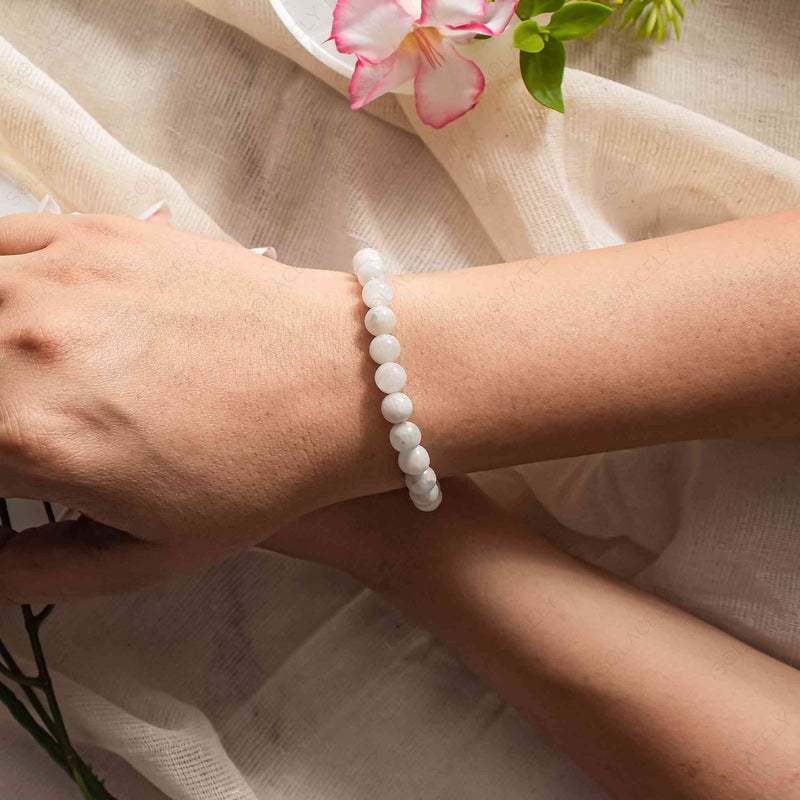
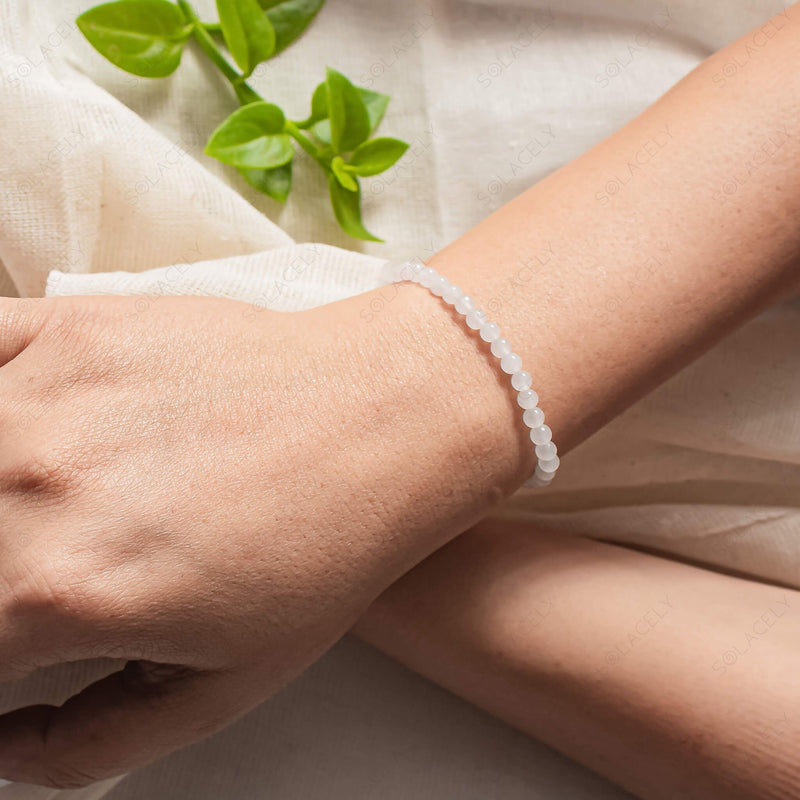
Wearing Moonstone Jewelry

Moonstone is best suited to earrings, pendants, and occasional-wear rings rather than daily-wear ring settings. The reason is mineralogical: moonstone has two directions of perfect cleavage at Mohs 6 to 6.5 (Geology.com), and rings take more accidental knocks than other jewelry. Set into a pendant or earring, it stays beautiful for decades.

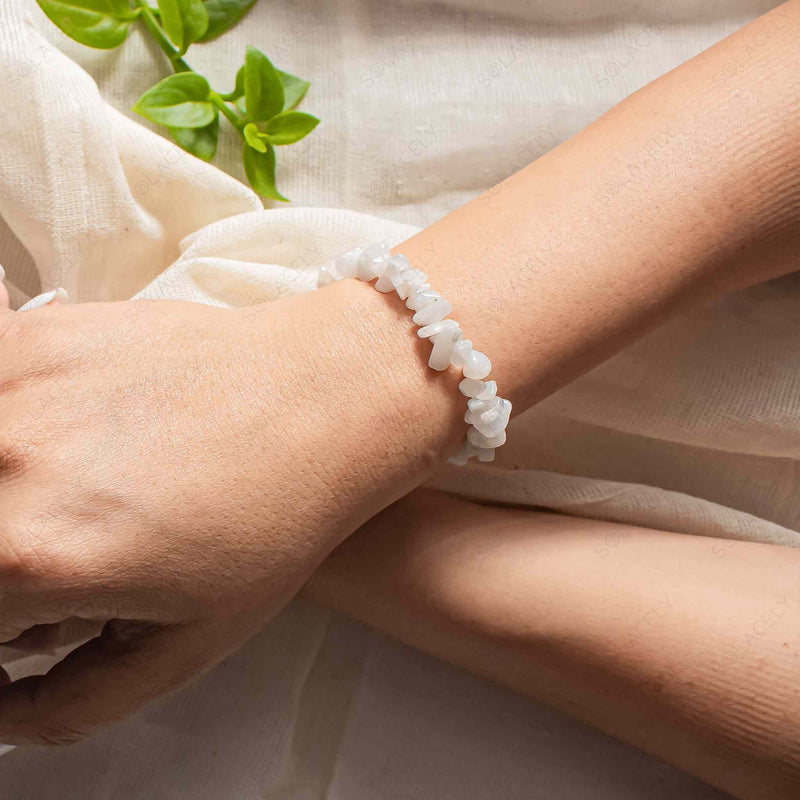
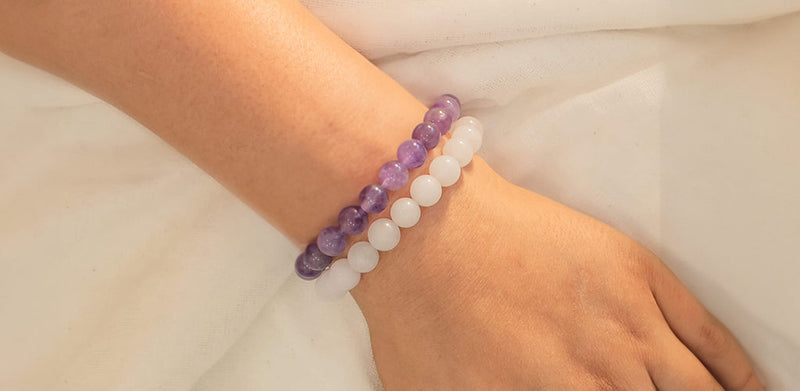
Moonstone pairs especially well with sterling silver and white gold, both of which echo its cool tone. A single moonstone bead in a stacked bracelet alongside warmer stones (rose quartz, citrine, peach moonstone) gives a gentle complementary palette without overwhelming.

Moonstone for Meditation

For meditation, place a polished moonstone at the third eye (centre of the forehead) lying down, or hold a tumbled stone in your dominant hand seated. The stone is light compared with denser crystals like pyrite or hematite, so the meditation experience is more subtle. Five to ten minutes is enough.

A specific moonstone practice I'd recommend for new-moon evenings: write a single intention for the cycle ahead, hold the stone over the page, and breathe slowly for two minutes. The combination of writing and stone work gives the intention something tangible to attach to.

Moonstone at Home

Moonstone is one of the most popular bedside-table crystals in the modern tradition. Its associations with sleep, dreams, and feminine intuition make the bedroom a natural home for it. Polished palm stones, small carved hearts, and faceted spheres all work. The stone's strength is gentleness, so the placement should be where you want softness rather than where you want sharp focus.

In feng shui terms, moonstone is sometimes placed in the family or relationships gua (the back-right corner of a room from the doorway), but the more common modern placement is simply close to where you sleep or journal. Consistency matters more than corner-of-room precision.

How Do You Cleanse and Charge Moonstone?

Moonstone is more delicate than many crystals because of its perfect cleavage. Brief contact with clean water is fine, but skip soaking, salt water, ultrasonic cleaners, and steam (Geology.com). For energetic cleansing, dry methods are safest: sound, smoke, moonlight, and selenite or clear quartz contact. Moonlight charging is the traditional method, and it's also the gentlest.

Why Cleanse and Charge Moonstone?

In crystal-healing practice, cleansing clears residual energy a stone has picked up from its environment or wearer. Even if you don't subscribe to the energetic side, light cleaning is good physical hygiene for jewelry. Skin oils and dust dull moonstone's natural sheen over time, and removing them keeps the adularescence visible.

A reasonable cadence: cleanse moonstone once a month with normal use, more often if you wear a piece daily through warm weather or workouts. Charging is a separate step (re-energising the stone toward an intention), traditionally done on or near a full moon.

How to Cleanse Moonstone (4 Safe Methods)

  1. Sound. Hold the stone near a singing bowl or tuning fork for 30 to 60 seconds. The safest method for jewelry, since there's no contact and no impact risk.
  2. Smoke. Pass the stone gently through sage, palo santo, or incense smoke for about a minute. Don't hold it in direct flame.
  3. Moonlight. Set the stone on a windowsill overnight, ideally on the night before the full moon. The traditional moonstone cleansing method, and the gentlest.
  4. Selenite or clear quartz contact. Rest the moonstone on a selenite plate or beside a clear quartz cluster for 6 to 12 hours.

Skip ultrasonic cleaners, steam, salt water, and any hard-impact cleaning method. Two directions of perfect cleavage means moonstone chips more easily than its Mohs number alone suggests.

How to Charge Moonstone (4 Methods)

  1. Moonlight. The signature method. Place moonstone on a windowsill overnight, ideally on the night of or before the full moon. The natural pairing — moonstone, moonlight, lunar charging — is part of why this is the most common technique.
  2. New moon intention. Hold the cleansed stone, state one specific intention out loud (a beginning, a transition, a creative project starting), and breathe with it for two to three minutes.
  3. Selenite contact. Rest moonstone on a selenite plate for 12 to 24 hours. Selenite is traditionally used to amplify moonstone's lunar associations.
  4. Crystal grid. Place moonstone at the centre of a grid surrounded by clear quartz points to amplify a specific intuition or dream-work intention. Leave for 24 hours.

Skip strong direct sunlight for charging. Moonstone is a lunar stone, and its tradition is built around moonlight rather than sun.

Frequently Asked Questions

What is moonstone crystal?

Moonstone is a gem-quality feldspar mineral, a sodium-potassium aluminosilicate, with a Mohs hardness of 6 to 6.5 (Geology.com; Britannica). It's prized for adularescence, the soft inner glow that seems to drift across the surface of the stone, and is the official birthstone for the month of June.

What causes the glow in moonstone?

The glow is called adularescence. It's caused by thin alternating layers of orthoclase and albite within the stone (Geology.com). The two minerals have different refractive indices, so light entering the stone is bent and scattered between the layers, producing the soft, drifting sheen that looks like moonlight on water.

Where does moonstone come from?

Sri Lanka is the world's most important source of fine-quality moonstone, with nearly all commercial-grade stones coming from the Dumbara district (Britannica; Geology.com). Significant additional production comes from Brazil, Myanmar, and India, with smaller quantities mined in Madagascar, Australia, and the United States.

Which chakra is moonstone for?

Moonstone is most strongly associated with the third eye and crown chakras, traditionally linked to intuition, dreams, and spiritual insight. Some practitioners also use it on the sacral chakra for emotional flow and divine-feminine work. Its lunar, water-element associations match these upper-energy centres in modern crystal-healing practice.

Is moonstone the June birthstone?

Yes. Moonstone is one of the official birthstones for the month of June (Geology.com), alongside pearl and alexandrite in the modern American birthstone list. Its association with the moon and the rhythms of intuition makes it a popular June-birthday gift, particularly for engagement and anniversary jewelry.

Can moonstone get wet?

Brief contact with clean water is fine. Skip soaking, salt water, ultrasonic cleaners, and steam. Moonstone has two directions of perfect cleavage (Geology.com), which means a sharp impact or sudden temperature change can chip the stone. Use warm soapy water with a soft cloth and gentle drying.

Is moonstone good for daily wear?

Moonstone is best suited to earrings, pendants, and occasional rings rather than daily-wear ring settings, because at Mohs 6 to 6.5 with two directions of perfect cleavage, knocks and scratches over time can chip the stone (Geology.com). Treated kindly, it remains beautiful for decades.

About the author

Chetena Sharma
Chetena Sharma

Written by Chetena Sharma, crystal healing practitioner and co-founder of Solacely. Chetena has worked with healing crystals for over a decade and curates Solacely's protective stone collection.
Back to blog
1 3