Pyrite is iron sulfide, brassy and metallic, forming in remarkably neat cubes. It is traditionally kept for drive and for backing yourself, which is why it lives on desks rather than in jewellery boxes. Its one firm requirement is that it stays completely dry.
Key takeaways
- Pyrite is iron sulfide, notably dense for its size and often forming perfect cubes.
- It sits at 6 to 6.5 on the Mohs scale, hard enough to handle but not to ignore.
- Keep it dry. No water cleansing, no salt, no humid shelves. Iron oxidises.
- Traditionally kept for enterprise and starting rather than for sustained effort.
- The old nickname is fool's gold, from the brassy colour and metallic lustre.
What pyrite actually is
Pyrite is iron sulfide, and Geology.com describes it as the most common sulfide mineral, found in a wide range of geological settings. What makes it distinctive to hold is density: a pyrite piece is noticeably heavier than a quartz one of the same size, and that weight is part of the appeal.
Its crystal habit is the other striking thing. Pyrite grows in cubes so regular that people meeting a specimen for the first time often assume it has been cut, when in fact the faces are natural and frequently carry fine parallel striations.
The brassy colour and metallic shine earned it the nickname fool's gold. In practice the two are easy to tell apart once handled: pyrite is much harder, considerably lighter than gold, and forms those angular cubes where gold does not.
What pyrite is kept for
The traditional association is with enterprise, drive and backing yourself. In practice it is the stone reached for at the moment of starting rather than the stretch of continuing, and that specificity is what makes it useful.
The recurring profile is somebody with a task they have been circling for days. Pyrite is heavy and satisfying to pick up, and the usual practice is holding it for ten seconds before opening the thing being avoided. That is a small ritual and it works because it is small.
It belongs alongside citrine rather than duplicating it. Citrine is kept for the confidence to ask; pyrite for the momentum to begin. For the money-focused version of the same set, see crystals for money.
The one rule: keep it dry
This matters more than anything else about pyrite, and it is the reason most spoiled pieces get spoiled. Pyrite is an iron mineral, and iron oxidises. Water and persistently humid air will dull the brassy surface and, in bad cases, leave it powdery and crumbling at the edges.
So the care rules are simple and absolute. Never water cleanse it, never put it in salt, never leave it in a bathroom, and keep it off a windowsill that gets condensation. Take pyrite jewellery off before washing your hands.
What it does want is a soft dry cloth. Wipe it occasionally and the shine holds for years. That single habit is the whole difference between a piece that stays bright indefinitely and one that dulls within a season.
Where pyrite is placed
| Placement | Traditional reasoning | Practical note |
|---|---|---|
| On a working desk | Drive and starting | Within reach, well away from any drink |
| Where invoices are written | Enterprise and fair trade | The most cited placement of all |
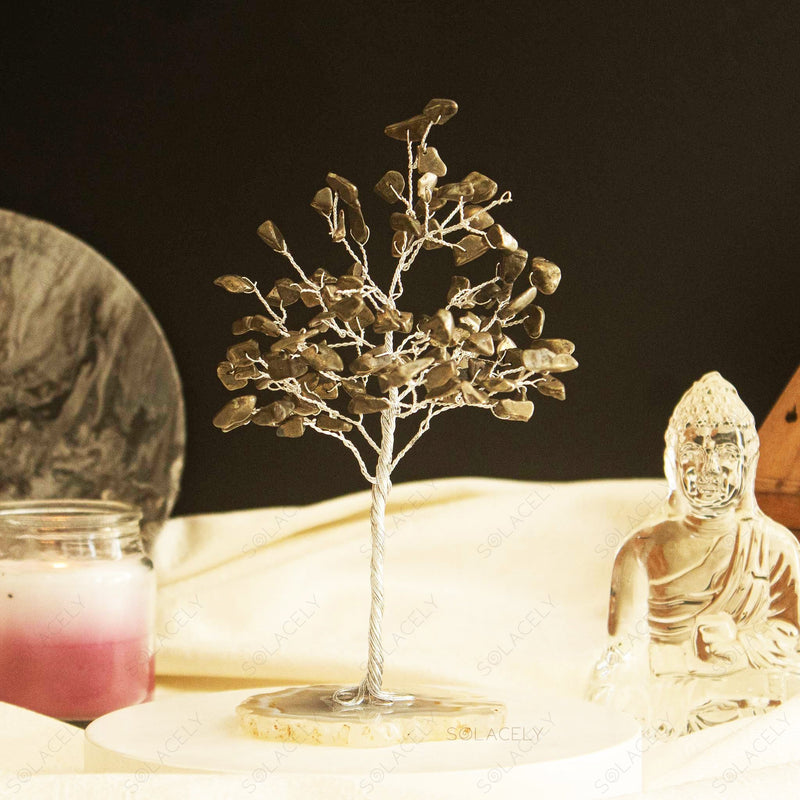
| A wealth corner | The southeast in feng shui practice | Keep the spot dry and dust-free |
| Held before a task | Momentum at the point of beginning | Ten seconds is enough for the cue to work |
| A bathroom or kitchen sink | Avoid entirely | Humidity is what ruins pyrite |
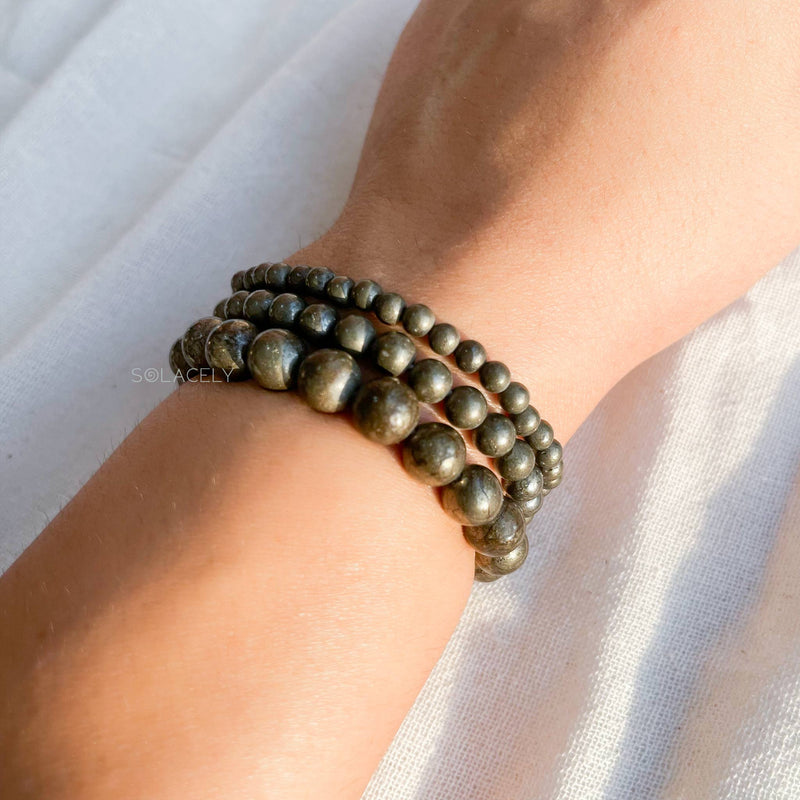
Format follows from all of this. Pyrite works best as a desk piece, a small cube or a cluster, rather than as a bracelet worn on a hand that gets washed a dozen times a day.
Buying a good piece
Pyrite is inexpensive and widely available, so quality rather than authenticity is the question. Look at the faces first: crisp, flat cube faces with visible striations indicate well formed material and are far more attractive than rounded, tumbled fragments.
Then check the surface for early oxidation. A piece already showing dull brown patches or a slightly powdery feel has met moisture somewhere along the way, and that process does not reverse. Fresh pyrite has a bright, almost mirror-like metallic sheen.
Clusters on matrix, where the cubes sit in the host rock they grew in, cost more than loose cubes and are worth it if the piece is going to sit somewhere visible. For the wider set kept for the same intentions, crystals for prosperity covers what else belongs on a desk.
A safety note worth reading
Pyrite needs one genuine caution beyond the water rule. Do not grind, sand, cut or polish raw pyrite without proper dust protection, since sulfide dust is not something to be breathing.
Equally, do not make elixirs or gem water with it. That advice applies to a number of minerals and it applies firmly here, and it is worth stating plainly because pyrite turns up in prosperity practices that sometimes suggest exactly that.
Handled dry, polished, and left intact, pyrite is a perfectly safe object to keep on a desk and pick up daily. All the cautions concern altering it or getting it wet.
Pyrite in a working set
Pyrite is rarely kept alone, and the partner stone changes what the set is actually for. Three combinations come up repeatedly.
- With citrine. The classic prosperity pair: pyrite for beginning, citrine for asking what something is worth.
- With clear quartz. The neutral option, where quartz anchors a desk and pyrite keeps its specific job.
- With black tourmaline. For people whose difficulty starting is really constant interruption.
Two is the sensible ceiling on a desk. Beyond that the arrangement stops signalling anything in particular, and the whole value of picking a stone up is that it means one thing. In chakra practice pyrite sits with the solar plexus, and crystals for the solar plexus covers that centre in full.
What pyrite can honestly offer
A physical interruption to avoidance, and that is genuinely useful. The gap between deciding to do something and opening it is where a great deal of work quietly dies, and picking up a heavy object as a fixed first step gives that moment a shape it otherwise lacks.
The weight is doing real work there. A light stone is easy to pick up absent-mindedly; a dense one demands a second of attention, and that second is the whole point of the ritual.
What it will not do is fix a workload that is too large for one person, or a business problem that needs a decision rather than momentum. Pyrite belongs to the starting, and the rest still has to be done.
The properties described here reflect traditional and cultural belief around crystals. They are offered for reflection and wellbeing and are not financial advice or a treatment for any condition. For decisions about money or business, please speak with a qualified adviser. Do not grind or sand pyrite without dust protection, never use it in elixirs or drinking water, and keep small pieces away from young children.
Sources
Written by Chetena Sharma. Reviewed by the Solacely editorial team.
Frequently asked questions
About the author


Written by Chetna Sharma, crystal healing practitioner and co-founder of Solacely. Chetna has worked with healing crystals for over a decade and curates Solacely's protective stone collection.