Smoky Quartz and Citrine: A Complete Pairing Guide for Stability and Drive
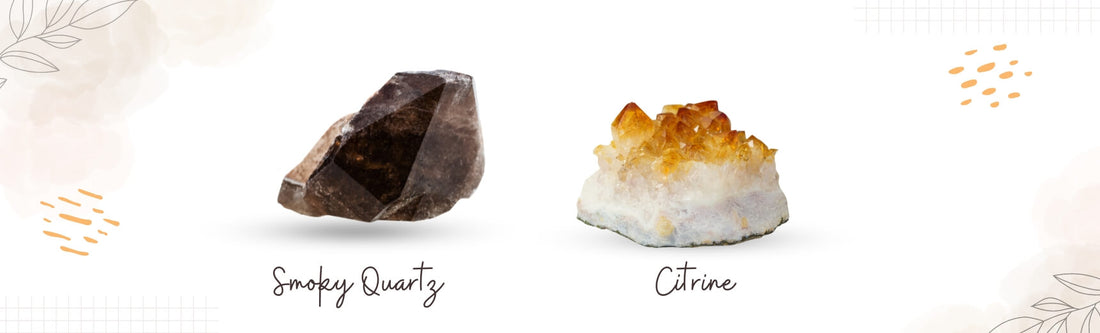

Smoky quartz and citrine is the rare crystal pairing where both stones are the same mineral. Both are varieties of quartz — silicon dioxide (SiO₂) — with the same Mohs 7 hardness, the same crystal structure, the same density, and identical care requirements. They differ only in what coloured them. Citrine's golden yellow comes from trace iron impurities in the crystal lattice, per Britannica. Smoky quartz's brown-to-grey tones come from a far more unusual cause: millions of years of natural gamma radiation from surrounding rocks acting on aluminium-bearing quartz, creating what mineralogists call "colour centres" in the lattice. The two stones are sister varieties of the same mineral family, paired for their chakra contrast — citrine at the solar plexus for drive, smoky quartz at the root for stability. This guide covers the mineralogy, the radiation story behind smoky quartz colour, and how to wear and care for the combination.
- Smoky quartz and citrine are both quartz (SiO₂), Mohs 7, with identical density and crystal structure. The difference is colour cause.
- Smoky quartz's colour comes from natural gamma radiation acting on aluminium-bearing quartz over geological time, per Britannica.
- The pairing's logic is root-chakra stability (smoky quartz) + solar-plexus drive (citrine) — one of the easiest "ground-and-act" combinations in the trade.
- This is the simplest pairing to care for in the entire crystal-jewellery world: identical chemistry means one set of care rules.
- Smoky quartz is the national gemstone of Scotland, where it's known as cairngorm.

Why Pair Smoky Quartz and Citrine?
The pairing's logic is chakra contrast within the same mineral family. Smoky quartz sits at the root chakra (muladhara), the energy centre associated with stability, security, and physical groundedness. Citrine sits at the solar plexus chakra (manipura), associated with personal power, confidence, and goal-setting. Together the two stones cover "stable base, then forward action" — anchored at the root, motivated at the gut. The matched mineralogy means the bracelet wears evenly and the visual contrast (warm gold against soft smoky brown) is one of the most subtly elegant palettes in crystal jewellery.
From what we've seen with Solacely customers, this is the pairing chosen most often by people who want grounding-and-drive without the heaviness of a hematite-led combination. Smoky quartz is light — same density as citrine — so the bracelet feels weightless on the wrist while still providing the visual and energetic anchor. It is also the pairing customers ask for most when they want a single bracelet that works in business, professional, and casual settings.
Smoky Quartz and Citrine Mineralogy
Citrine is a transparent variety of quartz coloured by colloidally suspended hydrous iron oxide. Its colour ranges from pale yellow to deep golden brown, per Britannica. It is Mohs 7, with no cleavage and a specific gravity of 2.65.
Smoky quartz shares all of those mineralogical properties — Mohs 7, no cleavage, specific gravity 2.65 — because it is also quartz. The difference is the coloration mechanism. Smoky quartz forms when clear quartz containing trace aluminium impurities is exposed to natural background gamma radiation from surrounding rocks over millions of years. The radiation knocks electrons out of position in the crystal lattice, creating "colour centres" that absorb light in a way that produces brown, grey, or near-black tones. The depth of colour reflects how much radiation the crystal has absorbed and how much aluminium was available to participate. In a real sense, smoky quartz is a long-exposure photograph of the planet's natural radioactivity.
The Quartz Family
Citrine and smoky quartz are two of the major coloured varieties of quartz, but they're not alone. The full quartz family is large enough that mineralogists organise it into transparent (macrocrystalline) varieties — citrine, amethyst, smoky quartz, rose quartz, clear quartz, milky quartz — and translucent (cryptocrystalline) varieties like chalcedony, carnelian, agate, jasper, and onyx. Every one of these stones is the same chemistry — SiO₂ — with the colour and texture dictated by trace impurities and the conditions of crystal formation.
Wearability: How the Pairing Holds Up
This is the easiest pairing in the entire crystal-jewellery trade to wear and care for. Both stones are Mohs 7, both have the same density (2.65), both have no cleavage, both polish identically, and both respond to the same cleaning methods. There is no soft stone to worry about, no porous stone to keep dry, no exotic chemistry. A beaded bracelet combining them simply wears as a "quartz bracelet" — one set of care rules for both stones. The only caveat is sunlight: both stones can fade slightly with prolonged UV exposure (smoky quartz can lighten over years; citrine's gold can shift), so take the bracelet off before extended sunbathing.
| Property | Citrine | Smoky Quartz |
|---|---|---|
| Mineral group | Quartz (SiO₂) | Quartz (SiO₂) |
| Mohs hardness | 7 | 7 |
| Specific gravity | 2.65 | 2.65 |
| Cleavage | None | None |
| Colour cause | Trace iron impurities | Natural radiation + Al impurities |
| Cleaning | Warm soapy water | Warm soapy water |
| Main sources | Brazil, Uruguay, Russia | Brazil, Madagascar, Switzerland, Scotland |
| Folk name | "Merchant's stone" | "Cairngorm" (in Scotland) |
| Traditional chakra | Solar plexus (Manipura) | Root (Muladhara) |
How to Use the Pairing
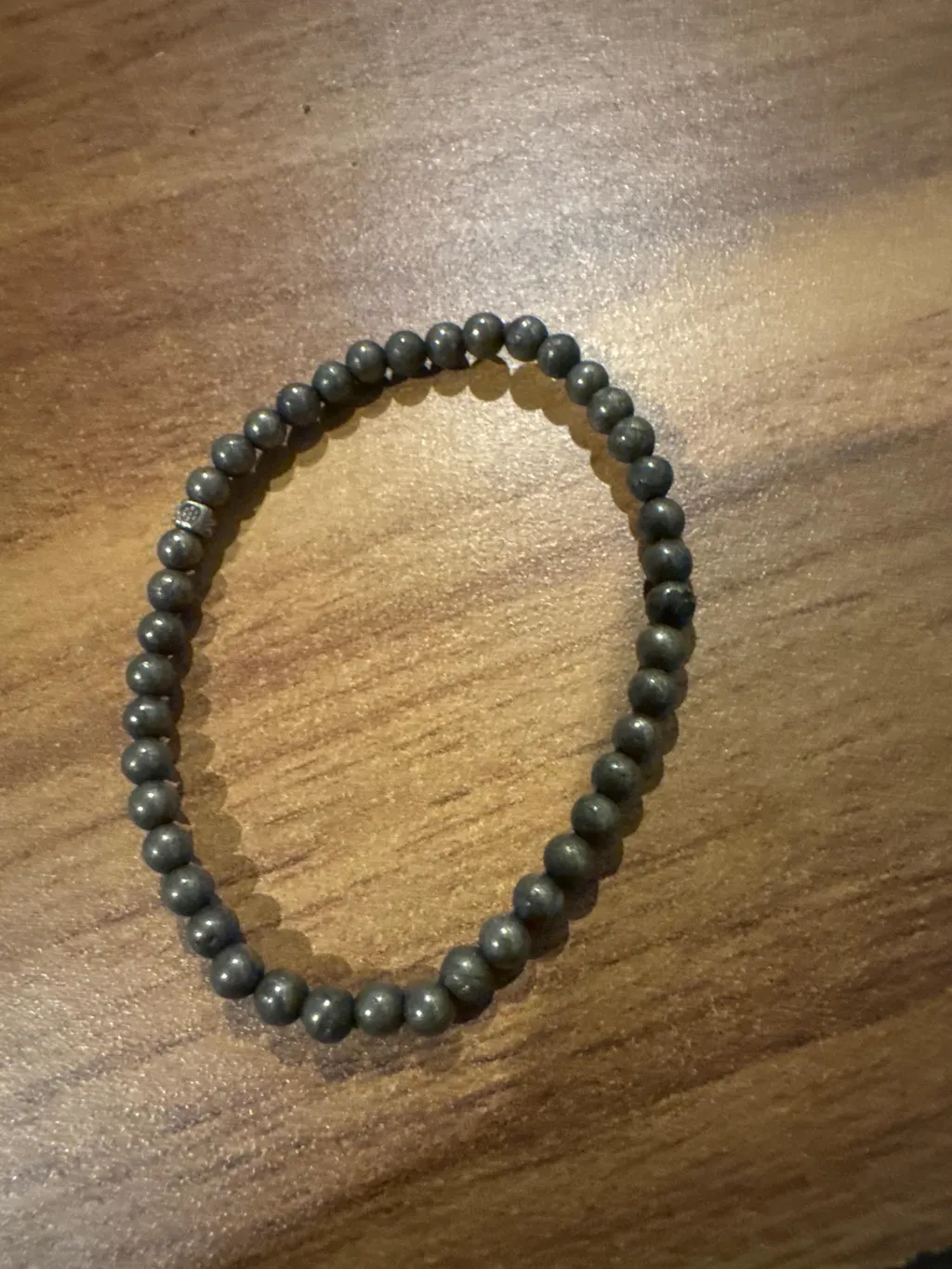
Beaded bracelet stack. The most popular format. Alternating citrine and smoky quartz beads in 6 mm or 8 mm sizing creates a warm gold-and-brown contrast that reads as quietly elegant rather than flashy. In our Solacely studio we string most combination bracelets with a 5/5 bead split. Because both stones share identical hardness, the bracelet wears completely evenly across years of daily use.
Pendant pair. A citrine point alongside a smoky quartz cabochon on a single chain, or two pendants on separate chains. Both stones take silver, gold, and brass settings without compatibility issues, and the gold-brown palette pairs especially well with warm-tone metals.
Meditation set. Hold one stone in each hand. Smoky quartz in the dominant hand for grounding and protective focus, citrine in the non-dominant hand for clarity and intention. The matched weight of the two stones makes this a balanced practice — neither hand dominates, which suits "even-keeled" meditation styles. A 10-to-15-minute breath session with one specific intention is the most common modern format.
Travel set. Because both stones are durable and need no special care, a citrine-and-smoky-quartz pocket pair is the easiest crystal travel set you can carry. No water restrictions, no sunlight panic, no porous-stone worries. Tuck both into a single pouch.
How to Care for the Combination
Cleaning. Warm soapy water and a soft cloth is the safe baseline for both stones, per GIA. Skip ultrasonic and steam cleaners — both can damage stones with internal fractures, which deeper-coloured smoky quartz sometimes has. A cotton swab works well to clean between beads on a stretch bracelet without dislodging the cord.
Storage. Keep the bracelet in a soft pouch when you take it off. Both stones can scratch softer gems (pearls, opals) so don't store them loose with mixed jewellery. Avoid extended direct sunlight; prolonged UV can fade both stones slowly over years.
Energetic cleansing. Moonlight overnight or a selenite plate is the safest energetic cleansing for this pair. Smoke (sage, palo santo) and sound (singing bowls, bells) work without damaging the surface. Skip the "cleanse in salt water" advice that circulates online — long salt soaks dull the polish on both stones.
Frequently Asked Questions
What does the smoky quartz and citrine combination do?
Smoky quartz (root chakra, grounding and stability) and citrine (solar plexus chakra, confidence and drive) form a "stability and drive" pairing. The two stones combine grounded, protective energy with motivated, action-oriented warmth. As same-family quartz stones, they wear evenly and need identical care.
Are smoky quartz and citrine the same mineral?
Yes. Both are varieties of quartz — silicon dioxide (SiO₂) — with Mohs 7 hardness and the same crystal structure. They differ only in colour cause: citrine's yellow comes from trace iron impurities, while smoky quartz's brown-to-grey colour comes from natural gamma radiation acting on aluminium-bearing quartz over geological time, per Britannica.
How does smoky quartz get its colour?
Smoky quartz forms when clear quartz containing trace aluminium impurities is exposed to natural background gamma radiation from surrounding rocks over millions of years. The radiation creates "colour centres" in the crystal lattice that absorb light in a way that produces brown, grey, or near-black tones. The aluminium-bearing quartz acts almost like a long-exposure photograph of the planet's natural radioactivity.
Can you wear smoky quartz and citrine as a bracelet?
Yes — this is one of the most durable crystal pairings available. Both stones are Mohs 7 with identical care requirements: warm soapy water, no ultrasonic cleaners, and avoid extended direct sunlight. Beaded bracelets in 6 mm or 8 mm sizes wear evenly with a 5/5 bead split, and the gold-and-smoky palette is one of the most subtly stylish in crystal jewellery.
Where does smoky quartz come from?
Major commercial sources include Brazil (especially Minas Gerais), Madagascar, the Swiss Alps, the Ural Mountains in Russia, and Scotland (where smoky quartz is known as "cairngorm" and is the national gemstone). Citrine is mined principally in Brazil, Uruguay, and Russia. Both stones are abundant relative to other gem materials, which keeps the pairing accessible at most price points.
How do you care for smoky quartz and citrine jewelry?
Warm soapy water and a soft cloth is the safe baseline for both stones, per the Gemological Institute of America. Skip ultrasonic and steam cleaners. Avoid extended direct sunlight on either stone — both can fade with prolonged UV exposure (smoky quartz can lighten, citrine's gold can shift). For energetic cleansing, a selenite plate overnight is the safest method for both.
About the author