Sunstone and carnelian is the warm on warm pairing. Most combinations work on contrast, cool against hot or action against reflection. This one doubles down instead. Both stones sit at the warm end, both are tied to the lower chakras, and together they are kept for sustained drive rather than balance.
Key takeaways
- Sunstone is a plagioclase feldspar at 6 to 6.5 on the Mohs scale, and its glitter comes from tiny reflective platelets, an effect called aventurescence.
- Carnelian is a reddish orange chalcedony, a microcrystalline quartz, at 6.5 to 7, coloured by iron oxide.
- Carnelian is the slightly harder of the two, which is the reverse of most pairings, so it is the sunstone that needs the spacer bead.
- Traditional practice puts sunstone at the solar plexus for confidence and carnelian at the sacral for creativity, so the pair reinforces rather than balances.
- Carnelian has one of the deepest documented histories of any gemstone, running from the Royal Tombs of Ur through Egyptian amulets to Roman signet rings.
- Everything described here is traditional belief and cultural practice.
Why pair two warm stones?
Because sometimes what a week needs is more of the same rather than a counterweight. Most popular pairings are built on contrast, and there is a good reason for that: two grounding stones can feel heavy, two heart stones can feel drifty. This one deliberately ignores that rule.
Both stones cover the lower warm centres, both carry associations with courage and vitality across several unrelated cultures, and both look it. So the pair gets chosen for situations that call for steady output rather than equilibrium: a creative project that needs daily progress, a training block, a week of presentations.
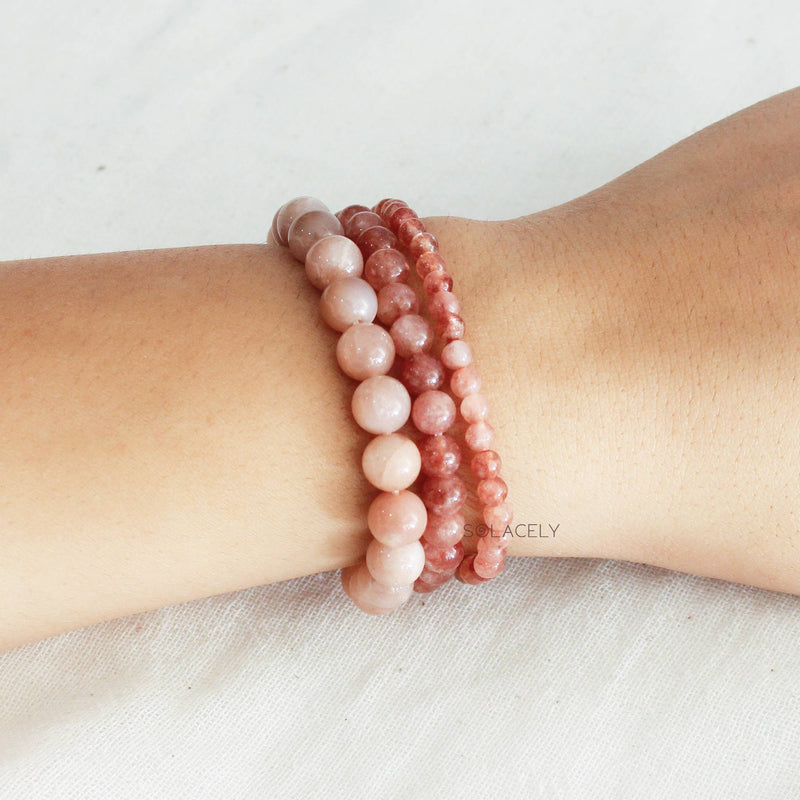
The visual case is the other half of it. Deep orange red carnelian beside gold and copper sunstone reads as one warm gradient rather than two stones competing, which is why the bracelet version is so popular. If you want the contrast version instead, sunstone and turquoise sets the same warmth against a cool blue.
What is sunstone?
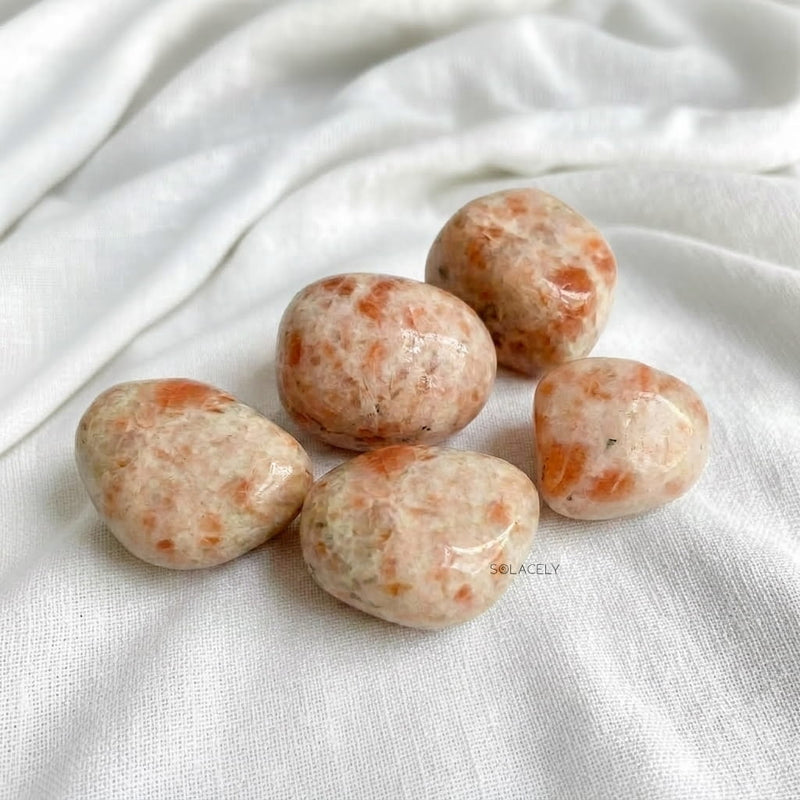
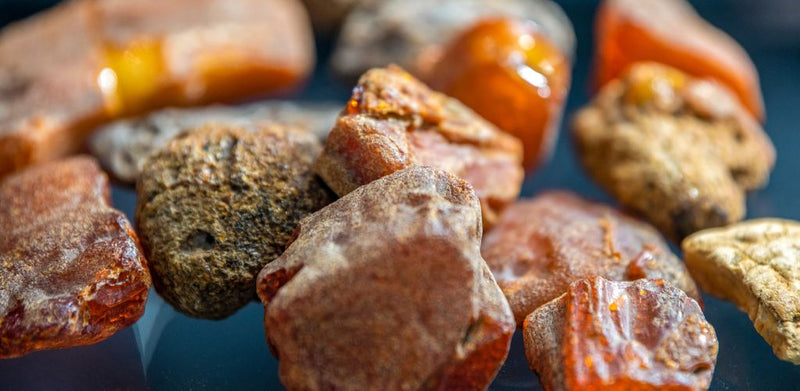
Sunstone is a plagioclase feldspar, usually an oligoclase, or in the Oregon material a labradorite. The shimmer that gives it its name comes from countless microscopic platelets suspended inside the stone, catching light as you tilt it. The Gemological Institute of America calls that optical effect aventurescence.
In most sunstone the platelets are iron oxides, which is where the familiar orange to red brown body colour comes from. Oregon material is the exception, carrying metallic copper and showing reds and greens that other deposits do not produce. Oregon named it the state gemstone in 1987, and the deposits near Plush in Lake and Harney counties remain the best known American source. India, Tanzania, Norway, Madagascar and Russia supply the rest.
At 6 to 6.5 on the Mohs scale it is comfortable in pendants and bracelets, though its two cleavage directions mean rings ask more of it than it comfortably gives. Our sunstone guide covers the grading.
What is carnelian?
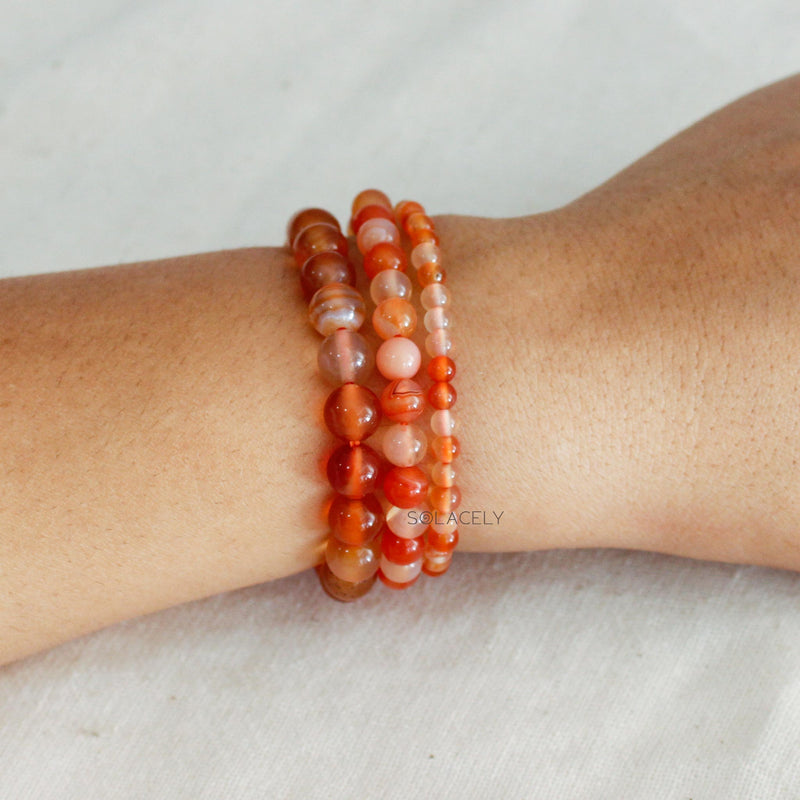
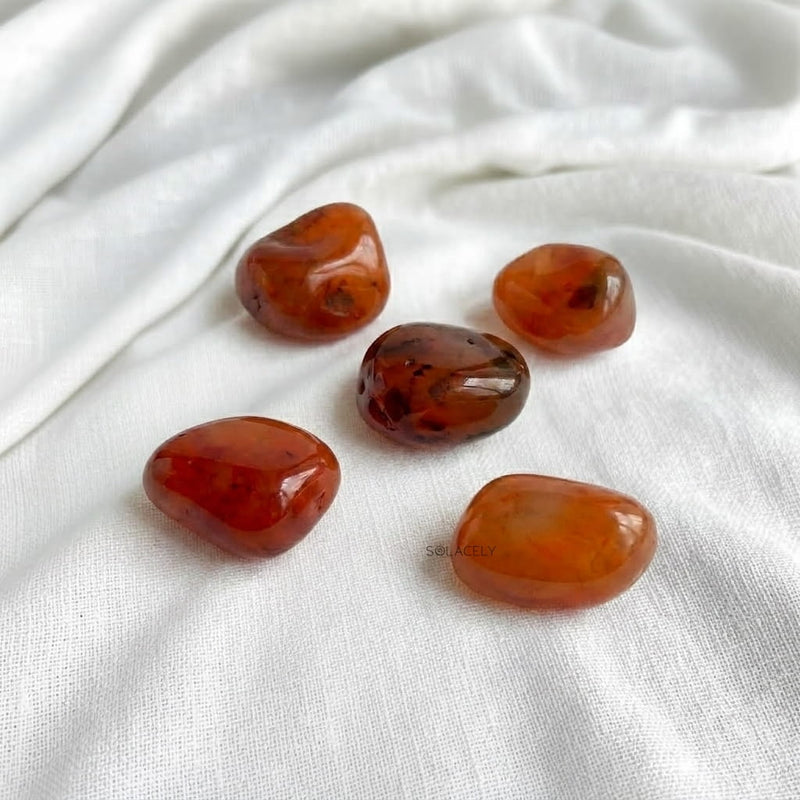
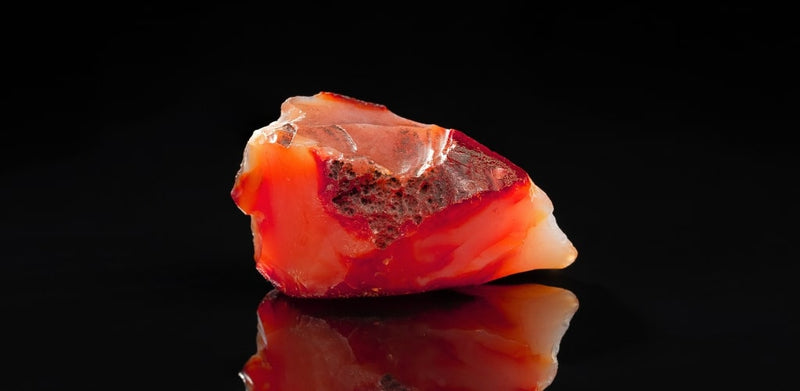
Carnelian is a reddish orange to brownish red variety of chalcedony, which is the microcrystalline form of quartz. Its colour comes from iron oxide held through the structure. Geology.com places it at 6.5 to 7, a shade below single crystal quartz because of that fine grained texture.
Unlike the feldspars it has no cleavage at all, which makes it markedly more impact tolerant than sunstone and one of the few practice stones that genuinely holds up in a ring. India supplies much of the commercial material, particularly Maharashtra and Gujarat, with more from Brazil, Madagascar, Botswana and Uruguay.
Warming iron bearing chalcedony to deepen and redden the orange is an ancient practice rather than a modern shortcut, used in Roman and South Asian workshops thousands of years ago, and the colour it produces is stable. That is why carnelian runs from a soft apricot through to a deep brick red. Pick the depth you want to wear. Our carnelian guide goes further.
The longest history of any stone in the range
Carnelian has a deeper documented record than almost anything else people keep for practice, and the specifics are worth knowing.
- The Royal Tombs of Ur, around 2600 BC. Excavations in the 1920s uncovered carnelian beads, seals and necklaces buried with royalty alongside gold and lapis. Much of the carnelian had been carried in from the Indus Valley.
- Ancient Egypt, from around 2500 BC. Carnelian appears in burial amulets, pectorals and protective jewellery. The Egyptians called it the setting sun and tied it to Isis, and carnelian scarabs are among the most common surviving Egyptian gem artefacts.
- Rome, roughly 100 BC to 300 AD. Carnelian became the dominant material for intaglio signet rings, the engraved seals pressed into wax on letters and contracts. Large collections sit in the British Museum and the Metropolitan Museum today.
That run across several unrelated civilisations is unusual. It also means carnelian's association with courage and vitality was in place several thousand years before any modern system of stone meanings existed, resting on archaeology rather than on anything recent.
The hardness gap runs the other way
Carnelian at 6.5 to 7 is slightly harder than sunstone at 6 to 6.5, which reverses the usual pattern. In most pairings the stone people buy first is the tougher one. Here it is the partner.
Practically this means that in a stacked bracelet the carnelian beads will very gradually soften the polish on the sunstone. The gap is half a point, so the effect is slow rather than dramatic, and a spacer bead between them removes it entirely. Carnelian also has no cleavage while sunstone has two directions of it, so a sharp knock is far more likely to split the sunstone.
| Property | Sunstone | Carnelian |
|---|---|---|
| Mineral | Plagioclase feldspar | Chalcedony, a quartz variety |
| Hardness | 6 to 6.5 Mohs | 6.5 to 7 Mohs |
| Cleavage | Two directions | None |
| Optical effect | Aventurescence, a glittering flash | An even translucent glow |
| Traditional role | Confidence and vitality | Creativity and courage |
| Best formats | Bracelet, pendant, tumble | Bracelet, pendant, ring |
How do you use the pairing?
Four formats cover almost everyone, and the bracelet is the one people come for.
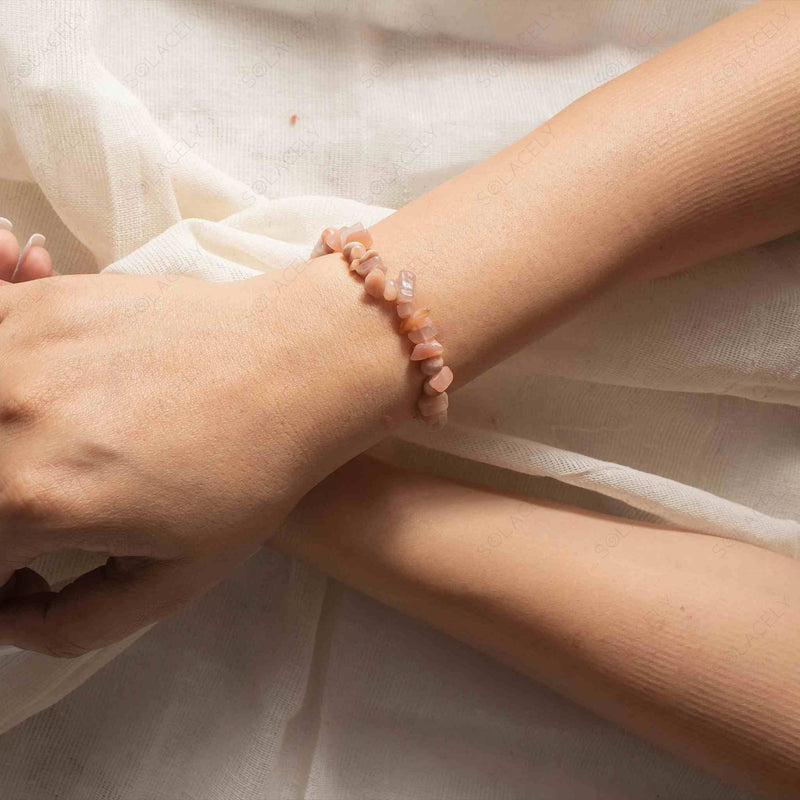
- Beaded stack. Alternating beads at 6mm or 8mm, reading as one warm gradient. Treat the sunstone as the more vulnerable bead and add a spacer.
- Pendant pair. A sunstone pendant with a carnelian cabochon on a separate chain. Pendants take fewer knocks, which suits the sunstone.
- Desk pair. Both near whatever you make things on, the sketchbook or the notebook. They support the same mode of work, so they act as one anchor rather than two competing cues.
- In the hand. One in each palm. Both are warm stones, so which goes where is a matter of feel rather than doctrine.
For a lying down practice the traditional layout puts sunstone at the solar plexus, just below the sternum, and carnelian on the lower abdomen. Both rest in the lower warm zone, which is the practical reason this pair is described as doubling down.
How do you care for them?
Care for the pair at sunstone's standard, since it is the softer stone and the one with cleavage.
Warm water, a drop of mild soap and a soft cloth handles both. Skip ultrasonic and steam cleaners on the sunstone, because vibration can travel along a cleavage plane, and if both are on the same bracelet default to the gentler method for the whole piece. Keep household solvents away from either.
Store them separately in soft pouches so the harder carnelian does not slowly dull the sunstone. On light, this is an unusual pair in that both tolerate brief morning sun without complaint, which is rare, though long exposure will lift a deep carnelian red over time. Moonlight is the safer default for a longer charge, and moonlight, sound or a rest on selenite all suit both stones.
The properties described here reflect traditional and cultural belief around crystals. They are offered for reflection and wellbeing and are not medical advice, a diagnosis, or a treatment for any condition. If you are managing a health concern, please speak with a GP or a qualified practitioner. Keep small stones away from young children, and never place crystals in drinking water.
Sources
Written by Chetena Sharma. Reviewed by the Solacely editorial team.
Frequently asked questions
About the author


Written by Chetna Sharma, crystal healing practitioner and co-founder of Solacely. Chetna has worked with healing crystals for over a decade and curates Solacely's protective stone collection.