Pyrite Crystal Meaning, Benefits & Properties (2026 Guide)


Pyrite is one of the most recognisable minerals on Earth and the original "fool's gold." Mineralogically, it's iron disulfide (FeS₂), 46.67% iron and 53.33% sulfur by weight, with a Mohs hardness of 6 to 6.5 and a specific gravity of 4.9 to 5.2 (Britannica; Geology.com). In crystal-healing tradition it's the "stone of action," paired with the solar plexus chakra and used for manifestation, focus, and confidence work. This guide covers the verified mineralogy, the historical record going back at least 10,000 years, the traditional benefits, and the dry-only cleansing methods that keep the stone from rusting on you.
- Pyrite is iron disulfide (FeS₂), 46.67% iron and 53.33% sulfur by weight, Mohs 6 to 6.5 (Britannica; Geology.com).
- The name comes from the Greek pyr, meaning "fire," because pyrite throws sparks when struck against steel. Prehistoric burial mounds contain pyrite nodules likely used as fire-starters (Britannica).
- Crystal-healing use: solar plexus chakra (Manipura), associated with confidence, willpower, and manifestation. Popular as a workspace and business-altar stone.
- Care: never use water or salt water. Iron sulfide rusts. Use sound, smoke, moonlight, or selenite contact instead.
- Common myth corrected: cubic pyrite is not magnetic. The related iron sulfides marcasite and pyrrhotite are.

What Is Pyrite Crystal?
Pyrite is iron disulfide, FeS₂, an isometric mineral made of 46.67% iron and 53.33% sulfur by weight, with a Mohs hardness of 6 to 6.5 and a specific gravity of 4.9 to 5.2 (Britannica; Geology.com). It crystallises as cubes, octahedrons, and twelve-faced pyritohedrons, with a metallic luster and a greenish-black to brownish-black streak. The conchoidal fracture, lack of true cleavage, and isometric symmetry are part of why a well-formed pyrite cube looks almost machined rather than grown.
The name comes from the Greek word pyr, meaning "fire," because pyrite throws sparks when struck against steel (Britannica). That single property is the reason it sits inside more human history than almost any other shiny stone.
In crystal-healing tradition, pyrite is the "stone of action." Practitioners associate it with manifestation, willpower, and the energy you need to follow through on a plan rather than just dream about it. The customers I see returning for second pyrite pieces are almost always entrepreneurs and freelancers, not mineral collectors.
Where Does Pyrite Come From?
Pyrite has been pulled from the ground for at least 10,000 years. Nodules of it have been recovered from prehistoric burial mounds, which suggests early people used it to start fires (Britannica). The same fire-starting trick survived into the gunpowder era, when wheel-lock firearms used a piece of pyrite rotated against a steel wheel to throw the spark.
Today, Italy and China are the world's largest pyrite producers, with Russia and Peru next in line (Britannica). Pyrite forms across an unusually wide temperature range, at high temperatures and low, which is why it shows up in igneous, metamorphic, and sedimentary rocks worldwide (Geology.com). Its most economically important modern role is as a host mineral for gold, since gold inclusions inside pyrite make it a major source of the metal during commercial extraction (Geology.com).
Cultures across the Americas used polished pyrite as mirrors. Mesoamerican craftspeople, including Olmec and later Aztec lapidaries, ground pyrite into reflective discs long before the Spanish arrived. Greek and Roman writers mentioned the stone under the same pyr root we use now. The mirror tradition is a useful frame for modern manifestation practice: pyrite has been a "mirror back at yourself" stone since long before vision boards existed.
What Are the Benefits and Healing Properties of Pyrite?
Crystal-healing tradition assigns pyrite three layers of benefit: physical (energetic support, not medical treatment), emotional (confidence and willpower), and metaphysical (manifestation, abundance, focus). None of these claims is medically validated. They reflect long-standing crystal-healing belief and personal practice rather than clinical research.
Physical Healing Properties of Pyrite
In the crystal-healing tradition, pyrite is associated with vitality and stamina, the kind of energetic "spark" suggested by its fire etymology. Practitioners place it on the solar plexus during energy work and pair it with grounding stones like hematite or smoky quartz when someone reports feeling drained or scattered.
Common traditional uses I see in client sessions: pyrite kept on a desk during long work sprints, tucked into a gym bag, or held briefly at the start of a focused breathing practice. Whether the effect is energetic or simply ritual focus is a fair question. Practitioners would say "both."
Emotional Healing Properties of Pyrite
Emotionally, pyrite is the stone people reach for when they're tired of self-doubt. Its associations cluster around confidence, courage, and the willingness to act on what you already know is right. The most common phrase I've heard from customers about pyrite is some version of "I needed something that wouldn't let me hide."
It pairs well with rose quartz when the underlying issue is harsh self-criticism, and with black tourmaline when the issue is anxious second-guessing. Used alone, it tends to feel "louder" than gentler stones, which is part of the appeal for people who want a push rather than a soothe.
Metaphysical & Manifestation Properties of Pyrite
Metaphysically, pyrite is treated as a manifestation and abundance stone. Tradition reads its golden colour as solar, masculine, fire energy and its cubic geometry as structure, focus, and follow-through. That combination, fire plus structure, is why it's so often placed on business altars or near financial paperwork rather than meditation cushions.
Practitioners often pair pyrite with citrine for "wealth grids," with green aventurine for opportunity, and with clear quartz to amplify intention. Used alone, it's most often programmed for a single specific goal rather than a vague wish, which fits the cubic structure metaphor: defined edges, defined intention.
Which Chakra Does Pyrite Activate?
Pyrite is most strongly associated with the solar plexus chakra (Manipura), which sits between the navel and the lower ribs and is traditionally linked to confidence, willpower, and personal authority. The pairing is intuitive. Solar plexus energy is golden and fiery in chakra colour theory, and pyrite is a literal golden fire stone.
Some practitioners also use pyrite secondarily on the sacral chakra for creativity-blocked clients, since both centres sit on the body's vertical "action axis." It's rarely placed on the higher chakras. The energy is too dense and too earthbound for crown or third-eye work in most traditions.
A simple way to use this: place a small pyrite cube on the solar plexus during a five-minute breath practice, set one specific intention, and remove the stone afterwards. Keep it short and specific. The point of solar plexus work is decisiveness, not a long meditation arc.
How Can You Use Pyrite Crystal Day-to-Day?
The three most common uses are jewelry, meditation, and workspace placement. Each one has a slightly different goal, and the form of pyrite you choose should match that goal. Raw chunks anchor a desk well but make poor jewelry. Tumbled stones are versatile. Polished cubes look striking on a shelf but bring no practical advantage over raw cubes.
Pyrite Crystal in Jewelry
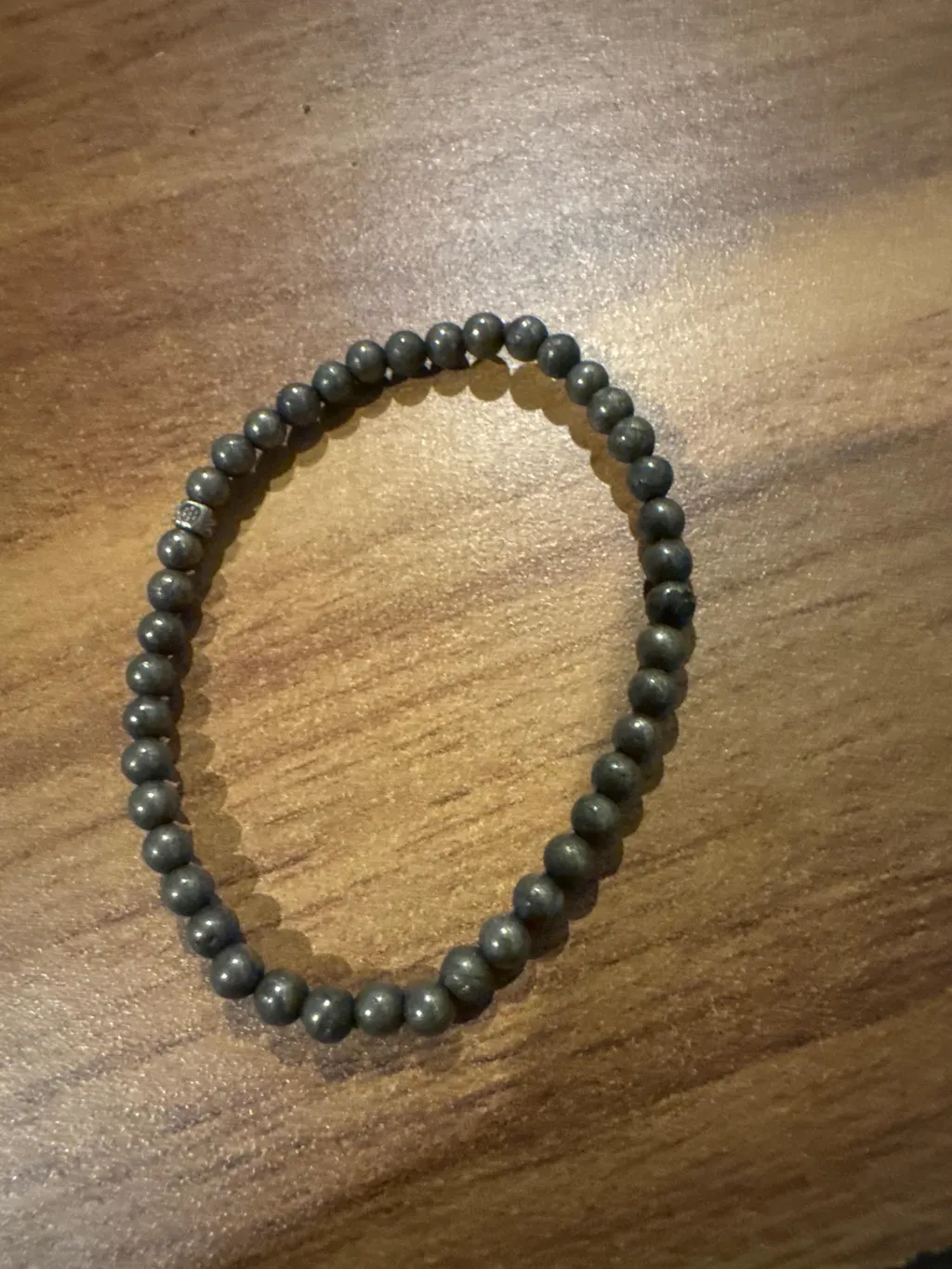
Pyrite jewelry keeps the stone in your energy field throughout the day, which is why it's a popular daily-wear option for entrepreneurs and creatives. Bracelets and pendants are the easiest forms to maintain. Rings collect more body oil and tarnish faster. Look for pieces set in stainless steel, sterling silver, or brass, and be ready to clean the stone monthly (more on that below).
If you're new to crystal jewelry, a single pyrite bead alongside other manifestation stones (citrine, green aventurine, tiger's eye) is a more flexible starting point than a full pyrite strand. Pyrite at Mohs 6 to 6.5 wears well alongside quartz-family stones at Mohs 7 without significant scratching either way.
Pyrite Crystal for Meditation and Mindfulness
For meditation, hold a single tumbled pyrite stone in your dominant hand and close the other around it. The stone is dense. That 4.9 to 5.2 specific gravity (Geology.com) is something you actually feel, and the physical weight is part of the practice. It anchors attention in a way lighter stones don't.
A short pyrite-specific meditation: three rounds of slow nasal breathing, one stated intention, three more rounds, then put the stone down. Five minutes total. The point is focus, not depth. Pyrite is not a contemplative stone. It's a "do the next thing" stone.
Pyrite as a Workspace Crystal
Pyrite is one of the most-recommended workspace stones in the modern crystal tradition, second only to citrine. A raw chunk on a desk, a small cluster near a monitor, or a pyrite cube paperweight all work the same way: a visible cue tied to a specific intention. The visual reminder matters as much as the energetic claim.
In feng shui terms, pyrite is most often placed in the wealth corner (back-left from the front door of the room) or near the place where invoices and contracts physically live. The placement matters less than the consistency. A pyrite stone you reset weekly with a stated intention will feel more "active" than one that drifts into the role of dust collector.
How Do You Cleanse and Charge Pyrite?
Never use water or salt water on pyrite. Iron sulfide oxidises (rusts) on contact with moisture, and salt accelerates the reaction badly enough to permanently damage the stone's surface (Geology.com). Stick to dry methods. This is the single most important pyrite-care rule, and the most commonly broken one.
Why Cleanse and Charge Pyrite?
In crystal-healing practice, cleansing is the act of clearing residual energy a stone has picked up from its environment or wearer. Even if you don't subscribe to the energetic side, regular cleansing is good physical hygiene for jewelry. It removes skin oils, dust, and sweat residue that dull the metallic luster.
A reasonable cadence: cleanse pyrite once a month with normal use, more often if you're using it for active manifestation work or wearing it daily through workouts. Charging is a separate step (re-energising the stone toward a specific intention), usually done immediately after cleansing.
How to Cleanse Pyrite (4 Safe Methods)
- Sound. Hold the stone near a singing bowl or tuning fork for 30 to 60 seconds. Safe for every form of pyrite, including jewelry.
- Smoke. Pass the stone through sage, palo santo, or incense smoke for about a minute. Don't hold it in direct flame.
- Moonlight. Set the stone on a windowsill overnight, ideally on a full or new moon. Bring it back inside before morning dew forms.
- Selenite or clear quartz contact. Rest the pyrite on a selenite plate or beside a clear quartz cluster for 6 to 12 hours.
Skip salt water, running water, sea water, and any "salt bowl" method. All four corrode iron sulfide and can permanently damage the stone's surface (Geology.com).
How to Charge Pyrite (4 Methods)
- Brief sunlight. Place pyrite in indirect or short direct sunlight (15 to 30 minutes max). Solar charging matches its fire association. Don't leave it baking on a windowsill all afternoon. Heat plus humidity can accelerate surface oxidation.
- Moonlight. Place pyrite on an indoor windowsill overnight, ideally on a full or new moon. Moonlight charging is the gentlest option and pairs well with intention setting before bed. Bring the stone back inside before morning dew forms — moisture is the one thing pyrite reliably reacts to.
- Intention setting. Hold the cleansed stone, state one specific intention out loud, and breathe with it for two to three minutes. Specific intentions ("close the Q3 contract") work better with pyrite than vague ones ("more abundance").
- Crystal grid. Place pyrite at the centre of a grid surrounded by citrine and clear quartz points to amplify a manifestation intention. Leave for 24 hours.
Frequently Asked Questions
Is pyrite the same as fool's gold?
Yes. "Fool's gold" is the common nickname for pyrite, given because its brassy yellow has been mistaken for real gold by inexperienced prospectors for centuries (Britannica). Real gold is far softer (Mohs 2.5 to 3) and noticeably denser than pyrite, and gold almost never crystallises in the cubic shapes that pyrite forms naturally.
Is pyrite magnetic?
No. Cubic pyrite is generally not magnetic. The closely related iron sulfides marcasite and pyrrhotite show magnetism, but pyrite itself does not, despite popular crystal-healing language calling it "magnetic for abundance" in a metaphorical sense.
Can pyrite get wet?
Ideally not. Pyrite is iron disulfide, and iron rusts. Brief contact with clean water won't ruin a piece, but soaking, salt water, and humid storage will accelerate oxidation and dull the surface (Geology.com). Keep pyrite jewelry off in the shower and at the pool.
Which chakra is pyrite for?
Pyrite is primarily associated with the solar plexus chakra (Manipura), which governs confidence, willpower, and personal authority in chakra tradition. Its golden colour and fire energy match the solar plexus colour symbolism almost exactly.
Where is pyrite found?
Italy and China are the world's largest pyrite producers, followed by Russia and Peru (Britannica). Pyrite forms in igneous, metamorphic, and sedimentary rocks worldwide, often in small amounts (Geology.com).
Is pyrite safe to wear daily?
For most people, yes, with two cautions. Pyrite contains sulfur, and very rarely a wearer with a sulfur sensitivity may notice skin irritation. The stone can also tarnish from skin oils, so wipe it down with a dry soft cloth after wearing and avoid showering or swimming in pyrite jewelry.
About the author