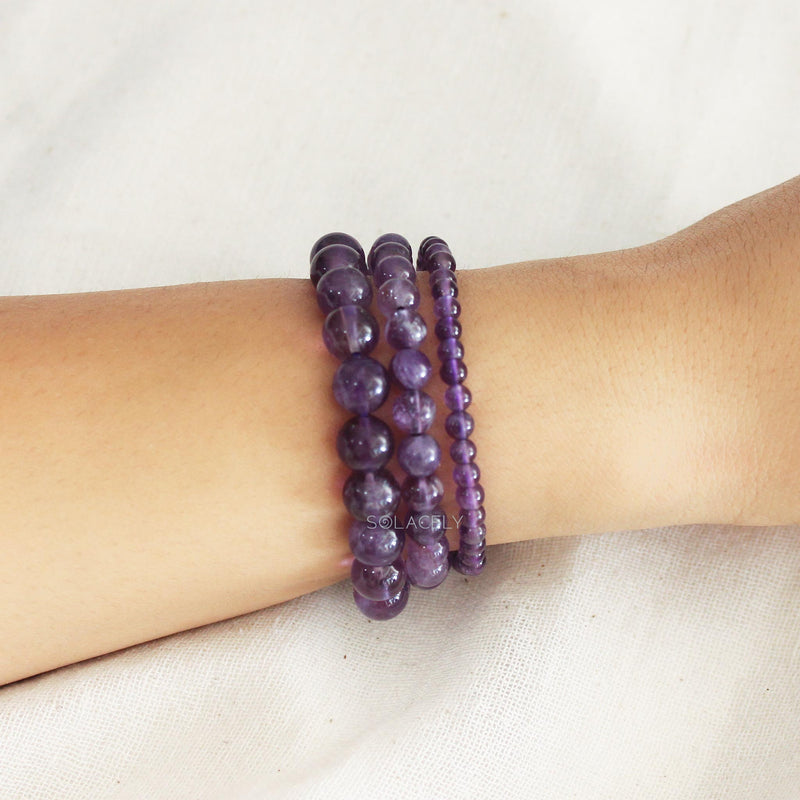
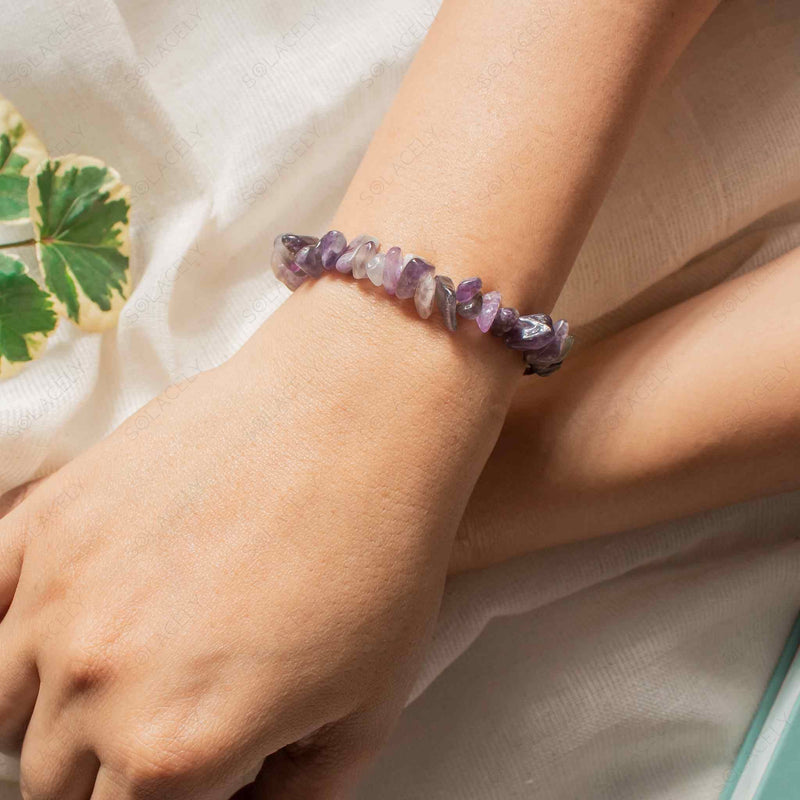
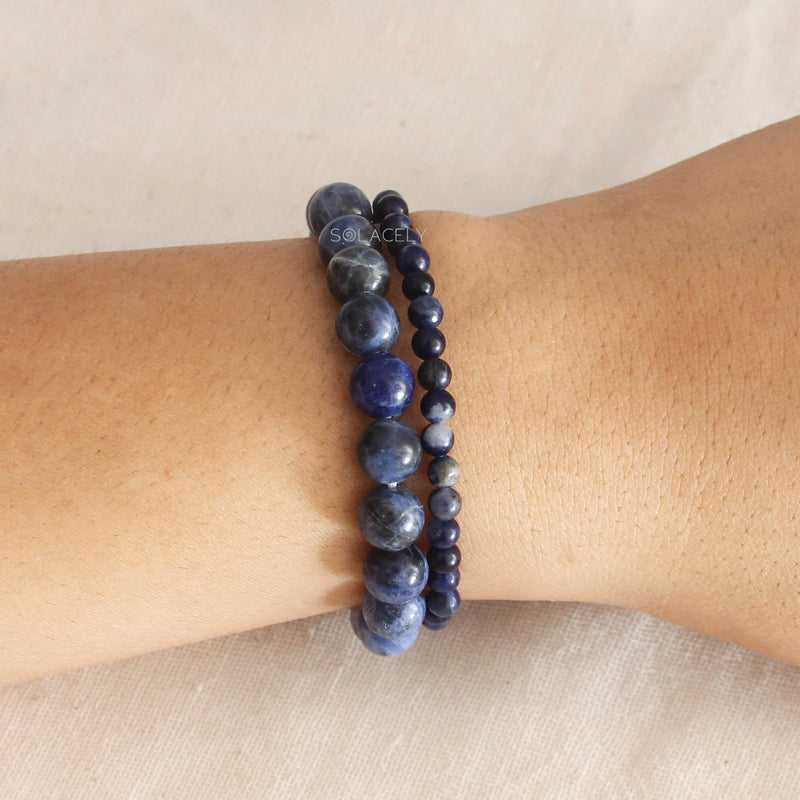
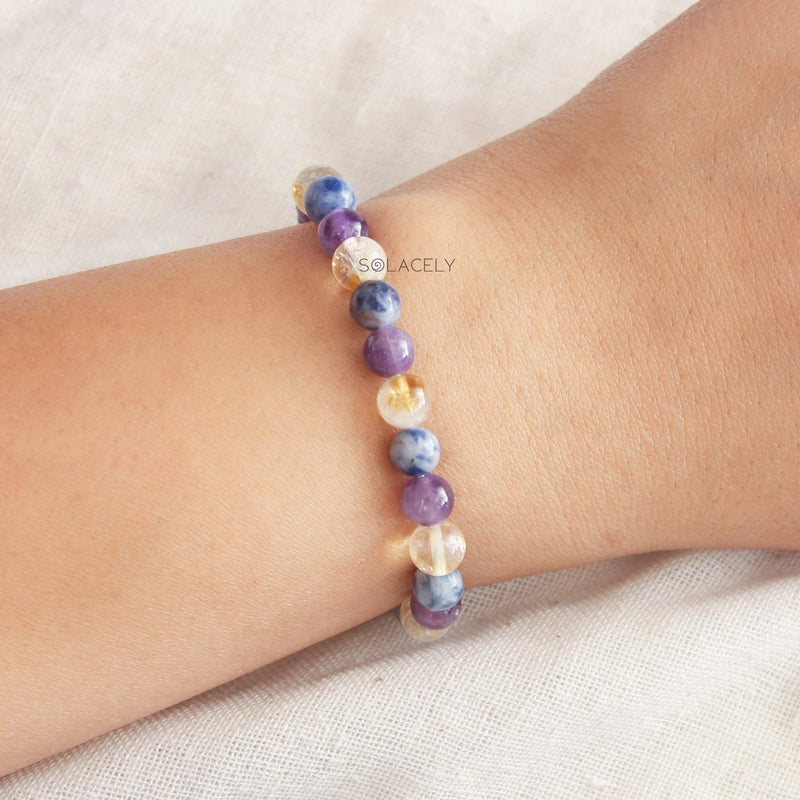
Amethyst and sodalite is the pairing people reach for when a day asks them to speak clearly and think carefully at the same time. Sodalite is the deep blue stone kept for plain, unhurried speech. Amethyst is the violet stone kept for a quiet head. One helps you say the thing, the other helps you sit with it afterwards.
Key takeaways
- Sodalite is a single mineral in the feldspathoid family, royal blue with white veining, sitting around 5.5 to 6 on the Mohs scale.
- Amethyst is purple quartz at 7, so it is the harder of the two and will mark sodalite if the beads are stored loose together.
- Traditional practice places sodalite at the throat for clear expression and amethyst at the crown for calm, which is why the pair is described as speak and reflect.
- Sodalite and lapis lazuli are two different blue stones. Lapis is a rock containing sodalite among other minerals, and it carries the gold pyrite flecks that sodalite does not.
- Both stones prefer shade. Amethyst pales in long sun, so moonlight or a rest on selenite suits them better than a windowsill.
- Everything described here is traditional belief and cultural practice.
Why are amethyst and sodalite paired?
Because they cover two neighbouring jobs rather than repeating one. Sodalite is worked with for saying what you mean without heat or hedging. Amethyst is worked with for the settling that comes afterwards, and our amethyst guide covers that side of it in full. Put them together and you have a combination aimed squarely at conversations that matter.
The colour logic is part of the appeal. Deep royal blue against soft violet is a quiet, serious palette that reads as jewellery first, which matters if you want to wear the pair into a meeting or a classroom without explaining yourself. In chakra language the two sit one step apart, sodalite at the throat and amethyst at the crown, and that adjacency is the usual reason practitioners give for stacking them.
In our experience the people who reach for this pair are the ones who talk for a living. Teachers, therapists, managers, anyone who spends the day choosing words carefully and then needs somewhere to put the residue of it. If the throat end is what interests you most, our throat chakra crystal guide covers the wider set of blue stones.
What is sodalite?
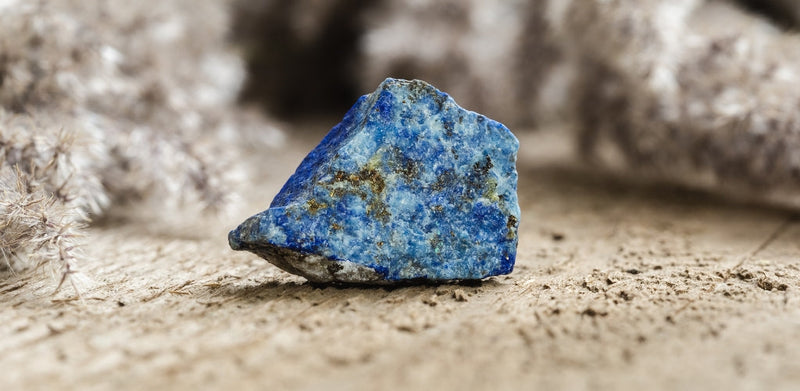
Sodalite is a sodium aluminium silicate belonging to the feldspathoid group, and Geology.com describes it as a comparatively soft blue mineral that takes a good polish and is widely used for beads, cabochons and carvings. Its colour runs from a mid royal blue to a deep, almost navy tone, nearly always broken by white veining.
That white marbling is the character of the stone rather than a flaw in it. Two pieces cut from the same block will vein differently, which is why sodalite beads have a handmade quality that more uniform stones lack. Colour depth is the thing to choose on. Some people want the darkest blue they can find, others prefer a lighter stone where the white shows more.
At 5.5 to 6 on the Mohs scale it is softer than quartz, and it has two cleavage directions, so it prefers formats that take fewer knocks. Beads, pendants and tumbles suit it. Rings ask more of it than it comfortably gives. The full picture sits in our sodalite meaning and properties guide.
Sodalite and lapis lazuli: choosing between two blue stones
These two get mentioned in the same breath constantly, and it is worth knowing what separates them so you can pick the one you actually want. They are both genuine, both traditional, and plenty of people end up owning both.
Sodalite is a single mineral. Lapis lazuli is a rock, an aggregate of several minerals at once, and sodalite is one of the things inside it alongside lazurite, calcite and pyrite. That pyrite is the visible difference. Lapis carries small gold flecks scattered through the blue, and sodalite does not.
So the choice comes down to what you want on your wrist. Lapis gives you the gold glint and the older scholarly history, and it costs more for it. Sodalite gives you a cleaner, more graphic blue and white, at a price that makes a full bracelet easy. Ask your seller which one a piece is, look for the flecks, and buy the blue you keep coming back to. Our lapis lazuli guide covers the other side of that decision.
What is the pairing used for?
Speaking situations, and the hours either side of them. The intentions people set with this combination cluster tightly, which is unusual and makes it easy to recommend.
- Before a difficult conversation. Sodalite for saying it plainly, amethyst for not rehearsing it forty times first.
- Teaching and presenting. The pair is kept for holding a room without hardening your voice to do it.
- Journalling and reflection. Amethyst is the traditional choice for the quiet end of the day, and sodalite keeps the writing honest with yourself.
- Study and structured thinking. Sodalite has a long association with orderly thought, which is why it turns up on so many desks.
What it is not built for is drive. Neither stone is a warm or energising one, so if what you want is momentum, the citrine and carnelian end of the range fits better. This pair is for precision and quiet.
How do you wear the pair?
Anything that keeps both stones in your eyeline works. The practical constraint is the hardness gap, and it is easily managed once you know about it.
- Two strands, one per wrist. The simplest arrangement and the kindest to the sodalite, since the two never rub.
- One alternating strand. Striking, and the usual choice. Put a spacer between the amethyst and sodalite beads so the harder stone does not sit directly against the softer one.
- Pendants. The most durable format of all. A sodalite cabochon near the throat and an amethyst drop above it follows the traditional placement neatly.
- Desk pair. A sodalite tumble by the keyboard and an amethyst piece further back, so you catch both when you look up.
- In the hand. Sodalite in the receiving hand, amethyst in the other, for five quiet minutes before you have to speak.
Rings are the one format to think twice about for sodalite. Hands take the most knocks of anything you wear, and a stone with cleavage would rather not be there. Keep sodalite to beads and pendants and it will last for years.
How do you care for amethyst and sodalite?
Care for both at the gentler standard, which means treating the whole piece as though it were sodalite. Warm water, a drop of mild soap and a soft cloth handles ordinary wear on either stone. Dry them properly afterwards, especially around bead holes.
Skip ultrasonic and steam cleaners for both. Sudden heat is unkind to a stone with cleavage, and the Gemological Institute of America notes that amethyst colour can be affected by heat as well. Put jewellery on last, after perfume and hand cream have dried, since residue dulls a polish faster than anything else.
Storage is where most damage quietly happens. Amethyst at 7 will scratch sodalite at 5.5 to 6 given a shared pouch and a few weeks, so give each piece its own soft bag or a divided box. For energetic cleansing, moonlight overnight, sound, or a rest on a selenite plate all suit both stones. Long sun sessions are the method to avoid, because amethyst pales with prolonged exposure and the colour does not come back.
The properties described here reflect traditional and cultural belief around crystals. They are offered for reflection and wellbeing and are not medical advice, a diagnosis, or a treatment for any condition. If something is weighing on you persistently, please speak with a GP or a qualified practitioner. Keep small stones away from young children, and never place crystals in drinking water.
Sources
Written by Chetena Sharma. Reviewed by the Solacely editorial team.
Frequently asked questions
About the author


Written by Chetna Sharma, crystal healing practitioner and co-founder of Solacely. Chetna has worked with healing crystals for over a decade and curates Solacely's protective stone collection.