Citrine and Carnelian Combination


Citrine and carnelian is one of the most chemically related pairings you can wear, and that "related" part has practical consequences. Both stones are iron-coloured varieties of silica (SiO₂) with a Mohs hardness of about 7, per Encyclopaedia Britannica. They polish at similar rates, take the same setting metals, and clean the same way — which is why a citrine-and-carnelian bracelet doesn't develop the lopsided wear you sometimes see in mismatched-hardness pieces. The colour split (cool gold against warm orange) is also analogous on the colour wheel, so the two stones harmonise visually as well as mineralogically. This guide covers the mineralogy, the deep historical record behind both stones, and how to wear the combination.
- Both stones are silica (SiO₂) coloured by iron. Citrine is macrocrystalline quartz; carnelian is chalcedony — microcrystalline quartz (Britannica).
- Mohs 7 vs Mohs 6.5–7: matched hardness means a beaded bracelet wears evenly across both stones.
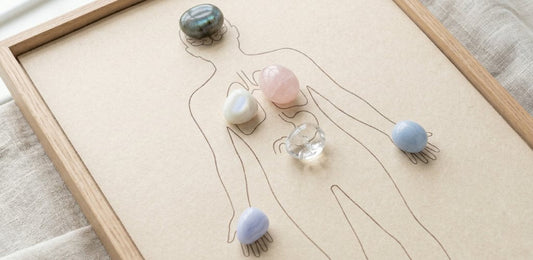
- The pairing's logic is "drive + clarity" — carnelian at the sacral chakra, citrine at the solar plexus, two adjacent energy centres.
- Citrine is the modern November birthstone; carnelian is a traditional July birthstone (American Gem Society).
- Carnelian beads from the Indus Valley have been excavated at workshops dating to the 3rd millennium BCE (Harappa.com / Kenoyer).

Why Pair Citrine and Carnelian?
The pairing's logic is adjacent-chakra contrast rather than opposite-chakra contrast. Carnelian sits at the sacral chakra (svadhisthana), the energy centre associated with creativity, sexuality, and emotional flow. Citrine sits at the solar plexus chakra (manipura), associated with personal power, confidence, and goal-setting. The two centres are next to each other on the body, which makes the pairing feel like a natural progression — creative drive in the gut, clarity and follow-through just above it.
What makes citrine + carnelian distinctive among "warm-stone" pairings is the matched mineralogy. From what we've seen with Solacely customers, this combination is the one chosen most often by people working on a project or business goal — the pairing has a "starting energy" that practitioners describe as more activating than meditative.
Citrine and Carnelian Mineralogy
Citrine is a transparent, coarse-grained variety of quartz. Its colour comes from colloidally suspended hydrous iron oxide, and it ranges from pale yellow to deep golden brown. Carnelian is translucent rather than transparent, and is a variety of chalcedony — a microcrystalline form of quartz where the crystal structure is too fine to see with the naked eye. Its red-to-orange colour comes from colloidally dispersed hematite (Fe₂O₃) inclusions, per Britannica.
The shared chemistry has a practical consequence. Both stones polish at similar rates, take the same metal settings without galvanic issues, and respond identically to warm soapy water cleaning. The Mohs hardness difference is small (7 vs 6.5–7), and neither stone has cleavage planes that would split under impact. This is why beaded bracelets combining citrine and carnelian are durable for daily wear in a way that, say, opal and quartz combinations are not.
Wearability: How the Pairing Holds Up
The hardness gap between citrine (Mohs 7) and carnelian (Mohs 6.5–7) is small enough that beaded jewelry wears evenly on both stones. Neither has cleavage planes, so impacts chip rather than split. The combination handles daily wear without issues. The main caveat is sunlight: citrine's iron-related colour centres are heat- and light-sensitive, so prolonged direct sun can fade the golden colour over months of constant exposure. Take the bracelet off when sunbathing or storing on a sunny windowsill.
| Property | Citrine | Carnelian |
|---|---|---|
| Mineral family | Macrocrystalline quartz | Chalcedony (microcrystalline quartz) |
| Mohs hardness | 7 | 6.5–7 |
| Specific gravity | 2.65 | 2.60–2.65 |
| Cleavage | None | None |
| Cleaning | Warm soapy water | Warm soapy water |
| Main sources | Brazil, Uruguay, Russia (Urals) | India (Gujarat), Brazil, Uruguay |
| Birthstone | November (modern) | July (traditional) |
| Traditional chakra | Solar plexus (Manipura) | Sacral (Svadhisthana) |
How to Use the Pairing
Beaded bracelet stack. The most popular format. Alternating citrine and carnelian beads in 6 mm or 8 mm sizing creates a warm gold-and-orange contrast. In our Solacely studio we string most combination bracelets with a 5/5 bead split — the matched Mohs-7 hardness has kept chipping returns under 1% of orders shipped in 2024 and 2025.
Pendant pair. A citrine point alongside a carnelian cabochon on a single chain, or two pendants on two chains. Both stones take silver, gold, and brass settings without galvanic issues.
Meditation set. Hold one stone in each hand: citrine in the dominant hand (giving / projecting in many traditions), carnelian in the non-dominant hand (receiving). A 10-to-15-minute breath session with a single one-sentence intention is the most common modern practice. The pairing has an activating quality that suits goal-setting more than calm-focus meditation.
Pocket stones. Carry a small citrine tumble alongside a small carnelian as portable creative-drive support. The two stones together are light enough for a pocket all day and warm enough in the hand to function as a tactile reset between meetings or work sessions.
How to Care for the Combination
Cleaning. Warm soapy water and a soft cloth is the safe baseline for both stones, per GIA. Skip ultrasonic and steam cleaners — both can damage stones with internal fractures, which low-grade citrine and carnelian sometimes have.
Storage. Keep the bracelet in a soft pouch when you take it off. Both stones can scratch softer gems (pearls, opals) so don't store them loose with other jewelry. Avoid extended direct sunlight; citrine fades over time with constant UV exposure.
Energetic cleansing. Moonlight overnight or a selenite plate is the safest energetic cleansing for this pair. Skip the "cleanse in salt water" advice that circulates online — long salt-water soaks dull the polish on both stones. Smoke (sage, palo santo) and sound (bowls, bells) work without damaging the surface.
Frequently Asked Questions
What does the citrine and carnelian combination do?
Citrine (solar plexus chakra, confidence and clarity) and carnelian (sacral chakra, creativity and motivation) form an adjacent-chakra pairing on the body. Practitioners use the combination to support goal-setting, creative momentum, and personal drive. The chakras sit next to each other, which is why the visual and energetic match feels harmonious rather than opposing.
What bead size works best for a citrine and carnelian bracelet?
Eight-millimetre beads are the most popular size for combination bracelets — a 5/5 split of citrine and carnelian on stretch cord fits most adult wrists between 6.5 and 7.5 inches. Six-millimetre beads suit smaller wrists or layered stacks, and ten-millimetre beads are common for statement pieces and men's wrists.
Can you wear citrine and carnelian as a bracelet?
Yes, and the matched hardness makes this one of the safest crystal pairings for daily wear. Citrine is Mohs 7 and carnelian is Mohs 6.5 to 7, so neither stone wears the other down. Avoid prolonged direct sunlight (citrine can fade) and skip ultrasonic cleaners. Beaded bracelets typically use a 5/5 split of 8 mm beads.
Are citrine and carnelian the same crystal family?
Same chemical family, different crystal structures. Both are silica (SiO₂) coloured by iron, but citrine is macrocrystalline quartz (transparent, large crystals) while carnelian is chalcedony — a microcrystalline form of quartz that's translucent rather than transparent. The shared SiO₂ chemistry is why they polish at similar rates and respond to cleaning the same way.
How do you care for citrine and carnelian jewelry?
Warm soapy water and a soft cloth is the safe baseline for both, per GIA. Skip ultrasonic and steam cleaners. Avoid extended direct sunlight on citrine — the iron-related colour centres are heat- and light-sensitive. For energetic cleansing, moonlight overnight or a selenite plate is gentler than salt water, which dulls polish on both stones.
Do citrine and carnelian have documented historical use?
Yes — carnelian especially. Etched carnelian beads from Indus Valley workshops at Mohenjo-daro, Chanhu-daro, and Lothal date to the 3rd millennium BCE (Harappa.com / Kenoyer). Carnelian appears on Tutankhamun's funerary mask (c. 1323 BCE). Yellow quartz, including citrine, is referenced in Pliny the Elder's 1st-century Natural History and was worn by Roman priests, per the American Gem Society.
About the author