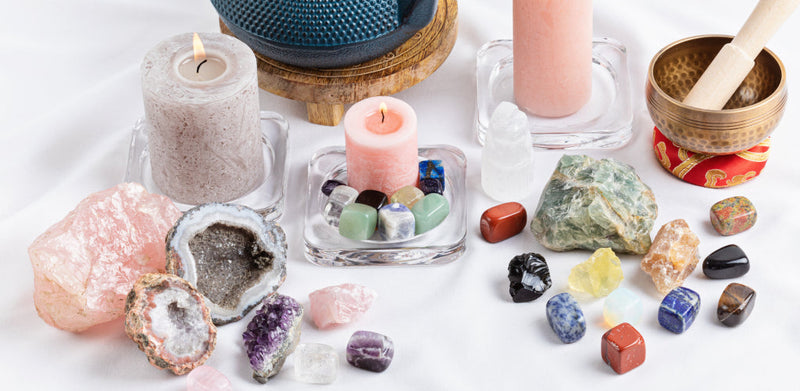
Crystal tumble stones are small rough stones smoothed and polished in a rotating barrel with abrasive grit and water, usually over several weeks. The process rounds off every edge and leaves a stone that sits perfectly in a closed hand. They are the same mineral as any raw specimen, just shaped differently, which is why they are the most practical form to carry, hold, or place. Here is how to choose and use them.
Key Takeaways
- Tumble stones are rough stones smoothed in a rotating barrel with grit and water over several weeks.
- They are the same material as raw crystals; the lower price reflects size and shaping.
- Hardness decides what survives a pocket. Quartz-family stones at 7 on the Mohs scale are ideal.
- Not every stone likes water. Selenite, malachite, and pyrite should be wiped, not soaked.
- Start with one or two you will actually carry rather than a full set.
How tumble stones are made
A tumble stone starts as a piece of rough rock. It goes into a rotating barrel with water and silicon carbide grit, and the barrel turns for days at a time. The operator repeats the cycle with progressively finer grits, finishing with a polish, so a full run commonly takes three to six weeks from rough to finished stone.
Nothing is added along the way. A standard tumble involves nothing but abrasion, so the stone that comes out is the same material that went in, just smoother. Quartz, for example, remains silicon dioxide at 7 on the Mohs hardness scale, as Encyclopaedia Britannica describes.
Tumbling is usually applied to material too small or irregular to cut into anything else, which is exactly why tumbles are affordable. A cheap tumble is not a lesser mineral, it is a smaller piece of the same one, and for something you plan to carry every day that is often the better buy.
Tumbled or raw?
It depends entirely on what you want the stone to do, and there is a good case for both.
Raw specimens keep their natural crystal habit, so an amethyst cluster or a quartz point looks exactly as it came out of the ground, which is the whole appeal for display. They are also more delicate, with points and edges that can chip.
Tumbles win on handling. There are no fragile terminations to snap, they sit comfortably in a closed hand, and they will not tear a pocket lining. That makes them the natural choice for carrying, for holding during meditation, and for laying out grids where stones get moved around often. They are also the sensible way to get to know a stone before committing to a larger piece. If you are just starting, our guide to crystals for beginners covers building a small, useful set.
Choose by hardness as well as by meaning
Once you know which intention you are after, hardness tells you which form of that stone will last. Pockets are busy places, full of keys, coins, and phones.
Stones at 7 and above, which covers the whole quartz family, handle daily carry easily. Stones in the 5 to 6 range, such as lapis lazuli, hematite, and moonstone, are lovely but will soften in polish over time, so give them a pouch. Below 4, in the world of selenite, malachite, and fluorite, you have display stones, and they are much happier on a shelf.
| Stone | Mohs hardness | Best for |
|---|---|---|
| Clear quartz, amethyst, rose quartz | 7 | Daily pocket carry |
| Tiger's eye, carnelian, aventurine | 7 | Daily pocket carry |
| Moonstone, lapis lazuli, hematite | 5 to 6 | Occasional carry, keep it pouched |
| Fluorite, malachite | 3.5 to 4 | Display and grids |
| Selenite | 2 | Shelf only, keep it dry |
A good starting four: clear quartz, amethyst, rose quartz, and tiger's eye. All hard, all inexpensive, and between them they cover the intentions most people begin with.
Three ways people use them
Carrying is the first and most common. One stone in a pocket or bag, chosen for a specific intention, touched whenever your hand finds it. Because it travels with you, the intention travels too.
Placing is the second: a stone on a desk, a bedside table, or a windowsill, where it marks a particular part of your day. Grids are the third, where several tumbles are laid out in a pattern around a central stone, usually for a single clear intention.
All three work through attention. A small object you meet several times a day keeps whatever you decided mattered somewhere near the surface. Pairing that with a pause and a slow breath is worth having in itself, and the U.S. National Center for Complementary and Integrative Health notes that mindfulness practices can help many people manage stress. To choose by intention, our guide to chakra stones and crystals maps the traditional associations, and crystals for protection covers the most requested one.
Cleaning and caring for tumble stones
For most tumbles, cleaning is simple: warm water, a drop of mild soap, a soft brush, then dry thoroughly. That lifts the skin oils and pocket lint that dull a polish over time, and it is all a quartz-family stone ever needs.
Water is the one place to be careful. Selenite dissolves slowly and loses its finish. Malachite contains copper and should never be soaked. Pyrite can rust and hematite can spot. For any of these, a barely damp cloth is the answer. If you are not sure what a stone is, treat it as water-sensitive and wipe rather than rinse.
Light is the other one. Amethyst, citrine, rose quartz, and fluorite all soften in colour under prolonged direct sun, so a bright windowsill is the one place a collection should not live. If you also cleanse stones in the spiritual sense, our step-by-step on how to cleanse and charge crystals covers which methods suit which material.
Sources
- Encyclopaedia Britannica - Quartz, mineral properties and Mohs hardness
- Encyclopaedia Britannica - Mohs hardness scale
- National Center for Complementary and Integrative Health - Meditation and Mindfulness
Frequently asked questions
About the author


Written by Chetna Sharma, crystal healing practitioner and co-founder of Solacely. Chetna has worked with healing crystals for over a decade and curates Solacely's protective stone collection.