The hamsa is an open right hand, usually shown symmetrically with an eye at its centre, worn across North Africa and the Middle East as an amulet of protection against the evil eye. Its name comes from the Semitic root meaning five, for the five fingers. It is older than the religions that carried it forward, and it is known as the Hand of Fatima in Islamic contexts and the Hand of Miriam in Jewish ones.
Key Takeaways
- The hamsa is a protective amulet against the evil eye, its name from the Semitic word for five.
- It predates both Islam and Judaism and is carried by both, as the Hand of Fatima and the Hand of Miriam.
- Fingers up wards off harm; fingers down invites good fortune in. Both are traditional.
- The central eye answers a gaze with a gaze, which is why the two motifs so often appear together.
- Traditionally worn on the body, hung at a threshold, or placed above a bed.
Where the hamsa comes from
The open hand as a protective sign is very old, older than the two faiths most associated with it today. Hand motifs appear in ancient Near Eastern and North African material culture well before the common era, and the symbol was carried forward and taken up rather than invented by any single tradition.
Encyclopaedia Britannica describes the hamsa as a hand-shaped amulet used for protection, particularly against the evil eye, across Middle Eastern and North African cultures. The name comes from the Semitic root for five, shared by the Arabic khamsa and the Hebrew hamesh.
As different communities took it up, they gave it their own names. In Islamic contexts it became linked with Fatima, the daughter of the Prophet Muhammad, hence the Hand of Fatima. In Jewish contexts it is often the Hand of Miriam, for the sister of Moses. The object is shared; the story attached to it belongs to whoever is telling it.
The evil eye, and why a hand answers it
To understand the hamsa you have to understand what it stands against. The evil eye is the idea that envious or admiring attention can itself cause harm, that a look can sour a run of luck, spoil a harvest, or unsettle a healthy child.
Encyclopaedia Britannica notes how widely this belief is held, across the Mediterranean, the Middle East, and South Asia, and in many places it is woven into everyday manners. In some communities, praising a baby without adding a protective phrase is a small social slip rather than a compliment.
The logic of the amulet follows from that. If the danger arrives through a gaze, the answer is something that looks back, or something that stands in the way. The hamsa does both at once: a raised palm as a barrier, and an eye at its centre returning the look. That is why the two motifs so often appear together on the same piece.
Which way should it face?
The most common question people ask, and the answer is that both orientations are traditional and each carries its own reading.
| Orientation | Traditional reading | Where you see it |
|---|---|---|
| Fingers up | A shield, turning harm away | Doorways, wall hangings |
| Fingers down | An opening, drawing good in | Pendants, blessing pieces |
| With central eye | Returning the gaze | Most traditional workmanship |
| Without eye | Blessing rather than defence | Modern and decorative pieces |
Neither direction outranks the other, and you will find both in traditional pieces. Most people simply choose the one that matches what they want it to say. If your hamsa is set with stones, our guide to crystals for protection covers the ones most often paired with it.
How it is worn and used
Traditionally the hamsa appears in three places: on the body as a pendant or bracelet, at the threshold of a home as a wall hanging or door ornament, and above a bed or a child's cot. All three share the same logic of guarding a boundary, whether that boundary is a person or a doorway.
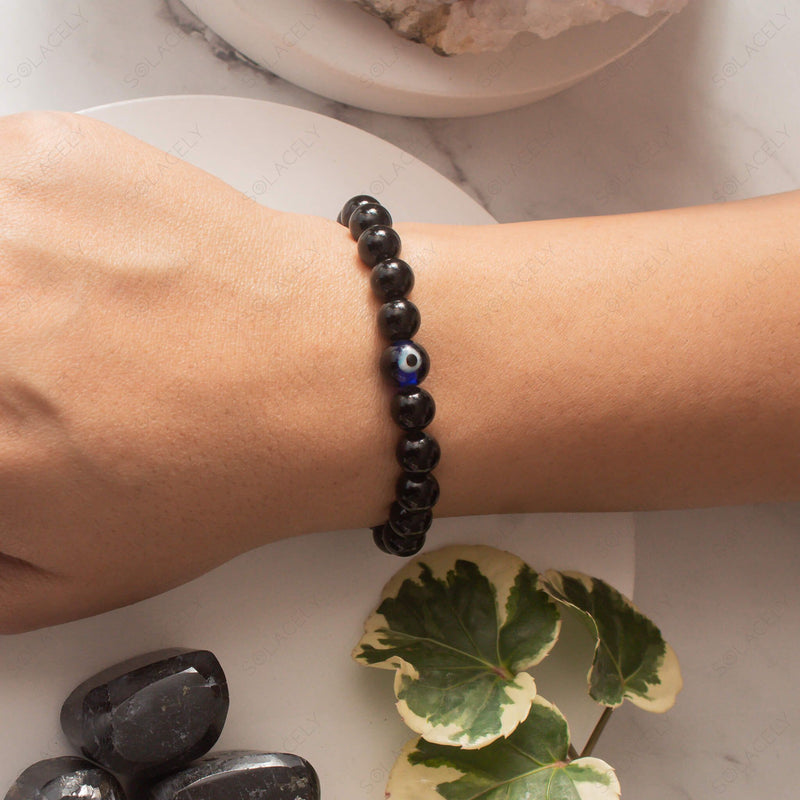
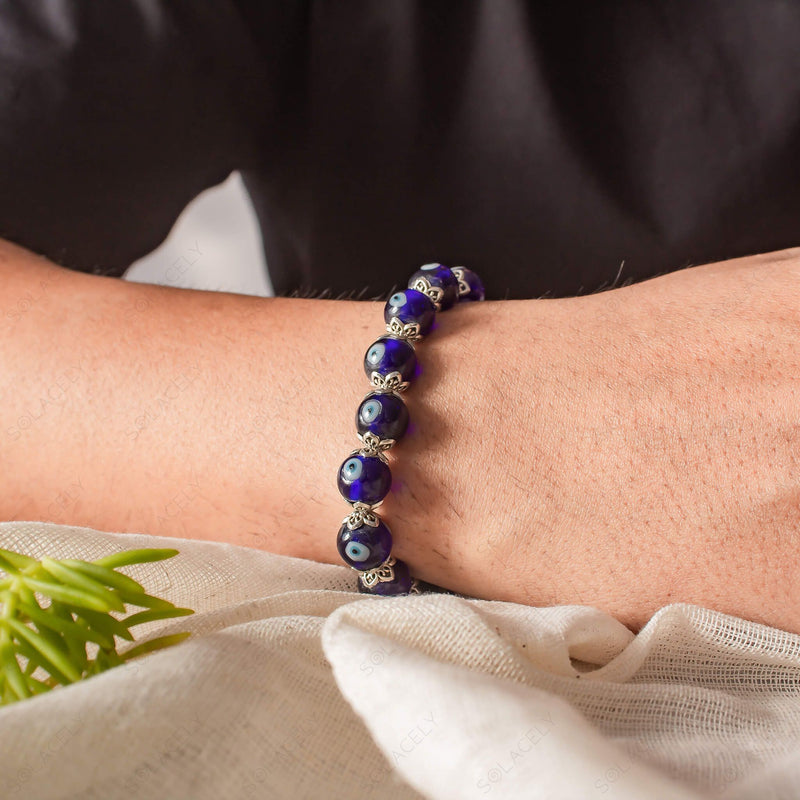
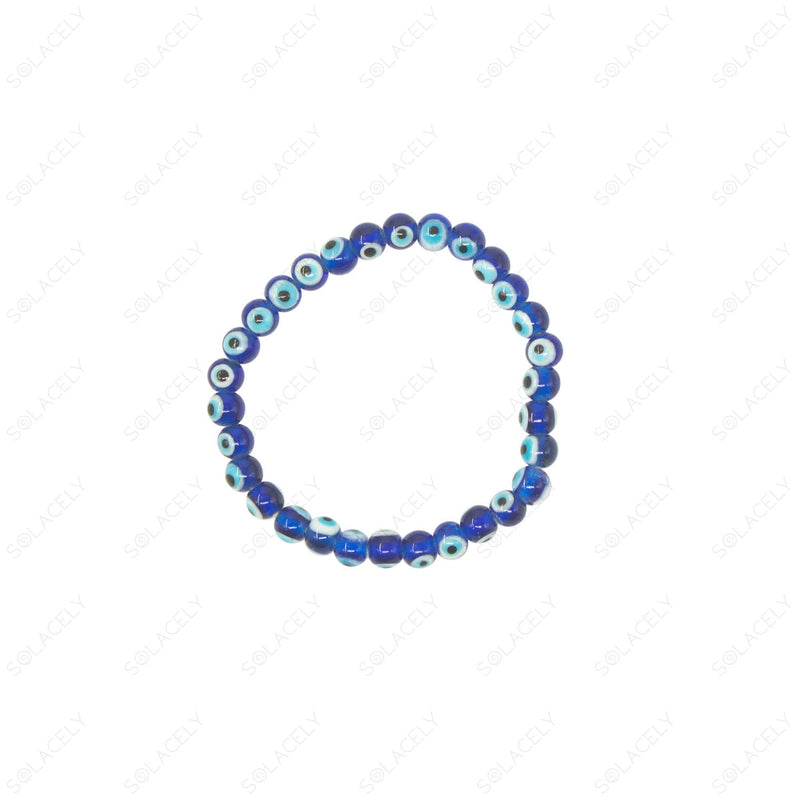
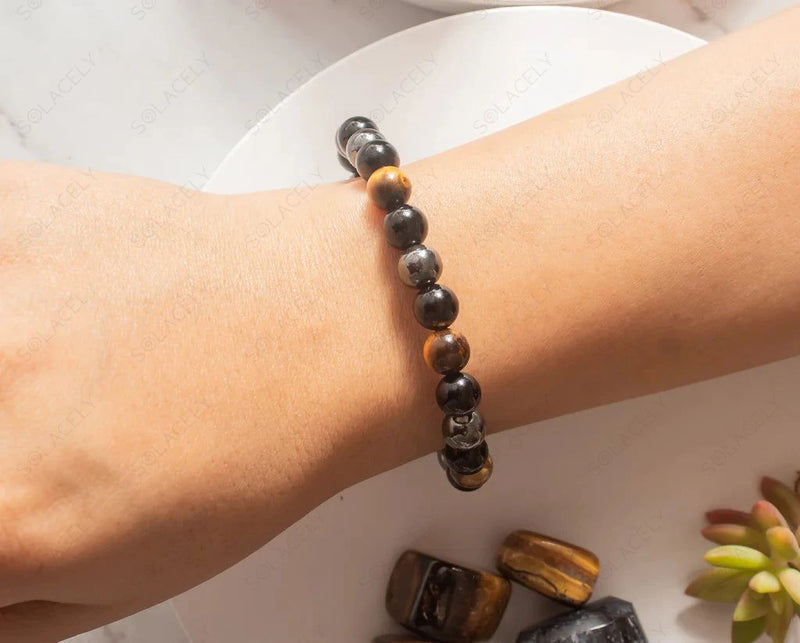
Materials have always varied with means and region: silver, brass, glass, ceramic, and enamel, often in blue, a colour itself long associated with turning away the evil eye. Modern pieces frequently pair the hamsa with black tourmaline, obsidian, or tiger's eye, bringing two protective traditions together in one object.
Whichever form you choose, a worn symbol works by carrying meaning and keeping it close, which is what people have always asked of amulets. Our guide to crystals for protection and good luck covers the wider tradition.
Wearing it respectfully
The hamsa belongs to several living communities rather than one closed tradition, so it is widely and openly worn, and there is no general prohibition on wearing one. It is worth wearing with a little knowledge behind it, though, which is really the pleasure of it.
That means knowing it is a protective amulet with roots in Jewish, Islamic, and older North African practice rather than a generic decorative motif. Being aware that it can hold real religious meaning for the person standing next to you. And taking some care over context, particularly in places where the symbol carries political as well as religious weight.
None of that is complicated. It amounts to knowing what you are wearing, which is a fair standard for any symbol with several thousand years behind it, and learning its story is part of what makes it worth wearing at all.
Sources
- Encyclopaedia Britannica - Hamsa
- Encyclopaedia Britannica - Evil eye
- Encyclopaedia Britannica - Amulet
Frequently asked questions
About the author


Written by Chetna Sharma, crystal healing practitioner and co-founder of Solacely. Chetna has worked with healing crystals for over a decade and curates Solacely's protective stone collection.