Hematite and black tourmaline are the two stones most often stacked together for protection and grounding. They are not interchangeable. Hematite is a dense iron oxide worn for steadiness, while black tourmaline is a borosilicate worn as a boundary stone. Used together, one holds you down and the other keeps things out.
Key takeaways
- Black tourmaline is schorl, the iron rich black species of the tourmaline group, at 7 to 7.5 on the Mohs scale. Hematite is iron oxide at about 5 to 6.
- Traditional use splits cleanly: hematite for grounding and physical steadiness, black tourmaline for boundaries and deflecting unwanted energy.
- Tourmaline is genuinely pyroelectric and piezoelectric, developing an electric charge as its temperature shifts or when it is pressed, which is part of why it picked up its protective reputation.
- A streak test separates them instantly. Hematite leaves a red brown mark, black tourmaline leaves a colourless one.
- Black tourmaline is the harder, more wearable stone. Hematite scratches, chips and can rust at the drill holes.
- All metaphysical properties described here are traditional belief, not medical fact.
What are hematite and black tourmaline?
They are chemically unrelated minerals that happen to look similar once polished. Hematite is an iron oxide, the world's most important ore of iron according to Geology.com. Black tourmaline is schorl, a complex borosilicate. One is a metal ore, the other is a silicate with boron in it.
Hematite
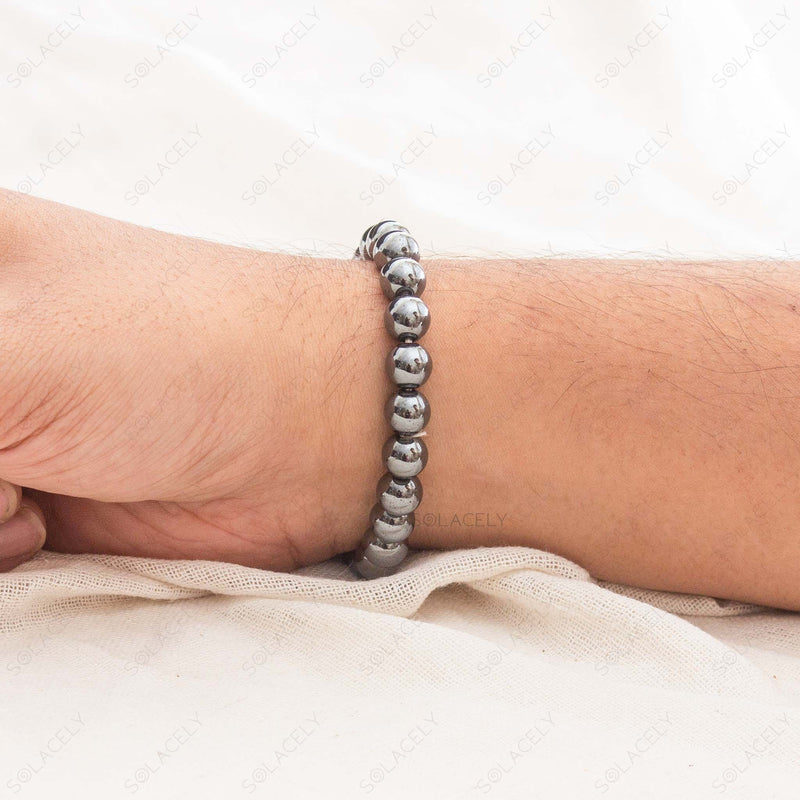
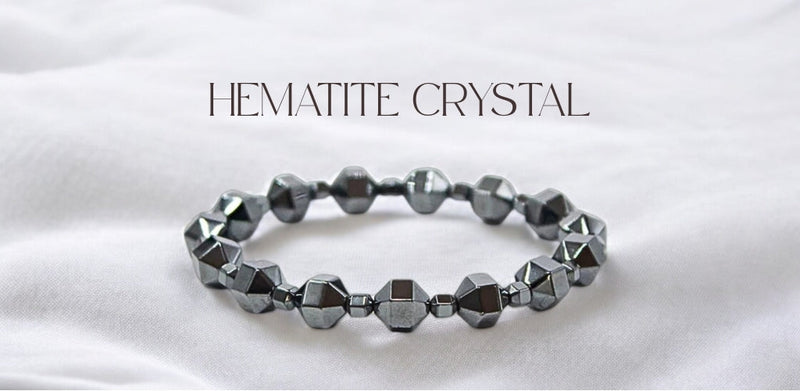
Hematite is the heavy one. Pick up a strand of hematite beads and the weight is the first thing you notice, well beyond what the size suggests. It polishes to a mirror finish that no other common bead material quite matches, and it sits at roughly 5 to 6 on the Mohs scale, softer than quartz. The name comes from the Greek word for blood, a reference to the red brown streak it leaves rather than to its silvery surface. Our full hematite meaning and properties guide covers its history in more depth.
Black tourmaline
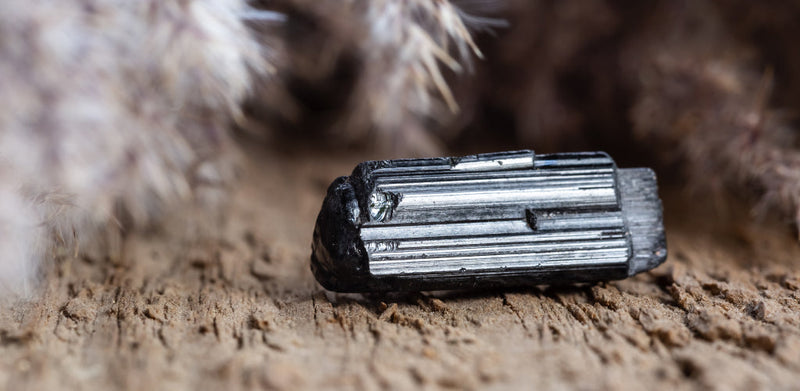
Black tourmaline, or schorl, is the most abundant member of the tourmaline group. Mineralogically it is a complex borosilicate that occurs in long prismatic crystals, commonly with lengthwise striations running down the sides. Those grooves are the easiest field mark on a raw piece.
The Gemological Institute of America puts tourmaline at 7 to 7.5 on the Mohs scale, which makes it genuinely durable for everyday jewellery. It is also harder than hematite, and that matters if you wear the two on the same wrist. For other combinations built around it, see our guide to black tourmaline crystal combinations.
Do you actually need both stones?
Often one stone carries the week on its own, and that is worth saying before you buy two. Both are traditionally described as grounding, so the pair earns its keep when it covers two different jobs rather than doubling up on one. The case for owning both rests on a real distinction in how each is used.
Here is the distinction as practitioners usually draw it. Hematite works inward. It is the stone people reach for when their own attention is scattered, when they are floaty, restless or stuck in their heads. Black tourmaline works outward. It is chosen for the environment, for crowded places, draining people and rooms that feel heavy.
So the pair earns its place when both problems are present at once, which is common enough. A crowded open plan office where you also cannot concentrate is the classic example. If only one of those is true, buy one stone and wear it properly. A single piece you actually keep on beats two you abandon in a drawer.
What is the hematite and black tourmaline pairing used for?
Boundary work, mostly. In traditional practice this combination is chosen by people who describe themselves as absorbing other people's moods, and who also want to feel more physically present rather than anxious. Commuters, nurses, teachers and customer facing staff ask for it more than anyone else in our experience.
- Crowded commutes. A single tourmaline bead or tumble in a pocket, hematite on the wrist.
- Draining conversations. Tourmaline is the traditional choice for holding a line without hardening into hostility.
- Focus that keeps slipping. Hematite is the older grounding choice here, and it doubles as a useful weighted object to hold.
- Home entrances. Black tourmaline near a doorway is one of the most widespread placements in modern crystal practice.
If you want the wider view of which stones are traditionally used this way, our crystals for protection guide compares the main options side by side. If you are deciding between the two most popular black stones, black obsidian versus black tourmaline is the more direct comparison. For a lighter version of the same instinct, one that leans on calm rather than armour, look at hematite and aquamarine.
Why black tourmaline sits beside a desk
Because screens are the modern drain, and tourmaline is the piece people most often keep between themselves and the source of it. A chunk behind the monitor, beside the router or on a bedside table is one of the most widespread placements in contemporary practice, and it is the first thing anyone setting up a home office asks about.
The reputation has an unusual physical footnote behind it. Tourmaline is genuinely pyroelectric and piezoelectric, meaning it develops an electric charge as its temperature shifts or when it is put under pressure. Mineralogists have described that behaviour for well over two centuries, and it is part of why the stone gathered its protective character in the first place.
Placed well, the stone doubles as a cue. Tourmaline behind the monitor is a standing reminder to look up, stretch and take the short break you keep skipping, which is where practitioners say the boundary really lives. The intention stays in view, and the working day gets shaped around it.
Hematite and black tourmaline compared
The differences that matter day to day are hardness, weight and how each one behaves when it gets wet. Black tourmaline is the more practical stone to wear hard. Hematite is the more satisfying one to hold.
| Hematite | Black tourmaline | |
|---|---|---|
| Mineral | Iron oxide | Schorl, a borosilicate |
| Hardness | About 5 to 6 Mohs | 7 to 7.5 Mohs |
| Streak | Red brown | Colourless to white |
| Look | Metallic, mirror polish | Matte to glassy, often striated |
| Weight | Very heavy for its size | Moderate |
| Traditional role | Grounding, focus, steadiness | Boundaries, deflecting negativity |
| Water tolerance | Poor, can rust at drill holes | Good, brief rinse is fine |
How should you wear the pair, and where do you place it at home?
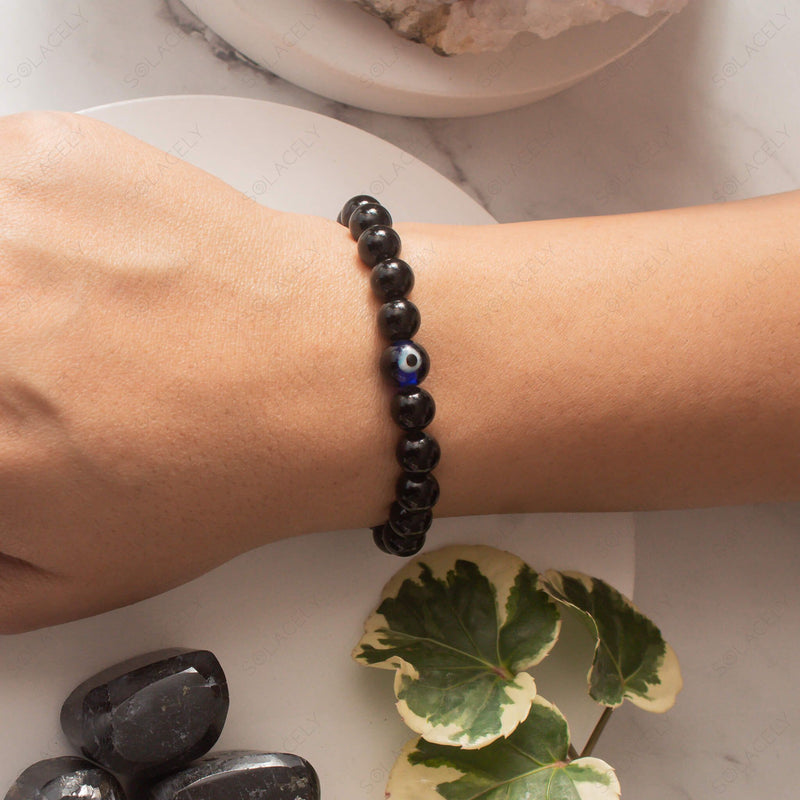
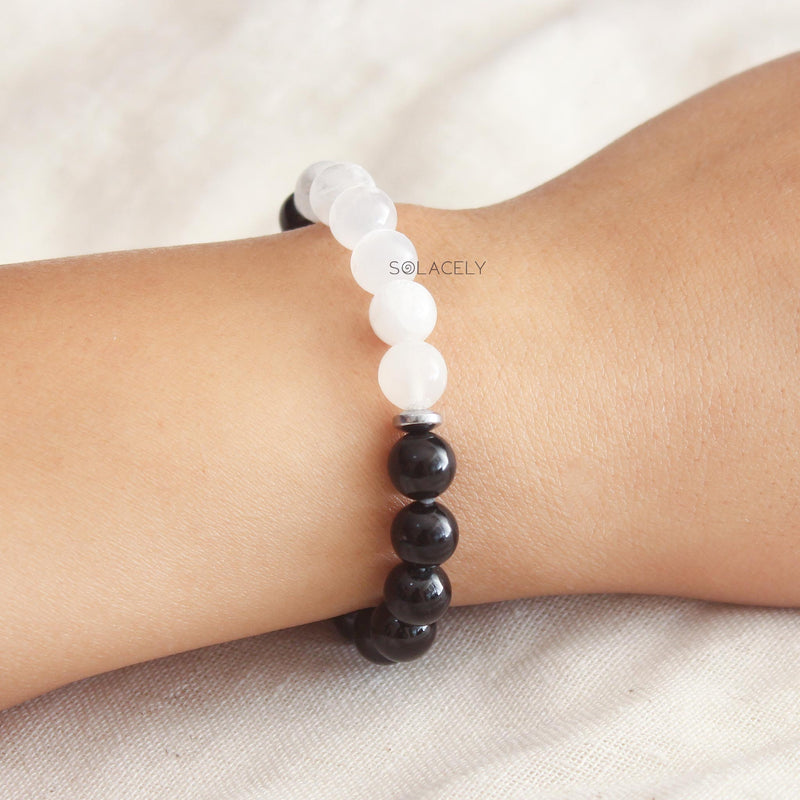
On the body, one strand of each on the same wrist is the standard approach, with a spacer between them so the tourmaline does not scuff the hematite polish. Many wearers keep hematite closest to the skin and tourmaline outside it, reading the outer stone as the barrier. It is convention rather than rule.
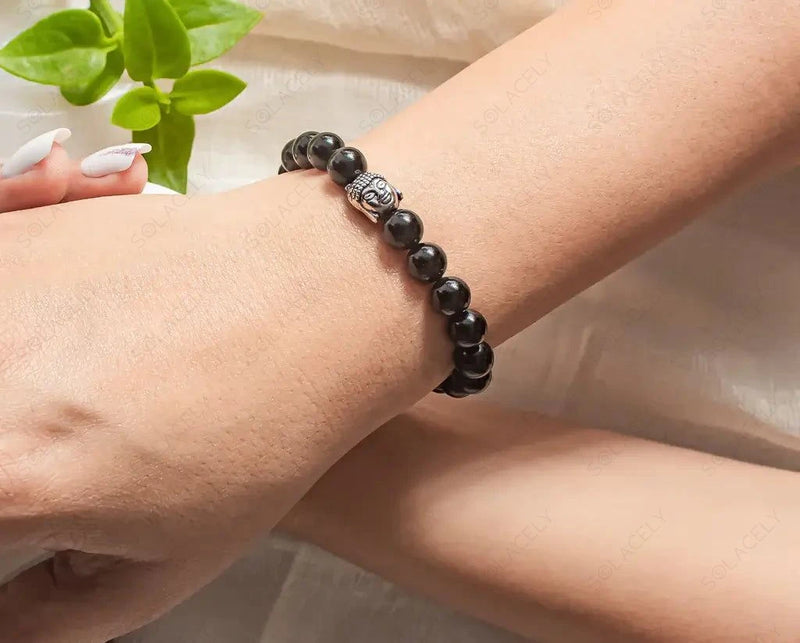
- Bracelets. The most common format, and the easiest to build up gradually.
- Pocket pieces. A rough tourmaline chunk survives pockets better than a polished hematite bead.
- Entrance and hallway. Tourmaline by the door is the traditional placement for household boundaries.
- Desk. Hematite within reach of your hand, tourmaline behind the monitor.
- Bedroom. Tourmaline is fine here. Hematite keeps some people wired, so test it before leaving it on the nightstand.
One caution about raw tourmaline. Schorl often arrives as a rough shard with sharp edges and it sheds tiny fragments, so keep loose pieces off soft furnishings and away from small children and pets.
How do you tell the two apart, and how do you care for both?
The streak test is the quickest and most satisfying way to separate them, and it is a nice thing to know. Drag the stone across unglazed porcelain, where the back of a bathroom tile works well. Hematite leaves a distinct red brown line, the mark that gave it its Greek name. Black tourmaline leaves almost nothing at all.
Weight is the second tell, and it needs no equipment. Hematite is dense enough that a strand of beads feels startling in the hand, while tourmaline sits at an ordinary jewellery weight for its size. A rough tourmaline crystal also shows those lengthwise striations down its sides, which hematite never does.
Care is simple once you know the difference in hardness. Wipe hematite with a dry cloth and store it separately, because anything harder will mark that polish, and standing water will leave rust marks. Black tourmaline handles a quick rinse and a soft cloth without complaint. Neither belongs in an ultrasonic cleaner at home. For cleansing, moonlight, sound or a rest on selenite suit both, and salt water suits neither.
The properties described here reflect traditional and cultural belief around crystals. They are not medical claims, they are not claims about physical shielding, and they are not a substitute for professional healthcare. If you are managing a health concern, speak to a qualified practitioner.
Sources
Written by Chetena Sharma. Reviewed by the Solacely editorial team.
Frequently asked questions
About the author


Written by Chetna Sharma, crystal healing practitioner and co-founder of Solacely. Chetna has worked with healing crystals for over a decade and curates Solacely's protective stone collection.