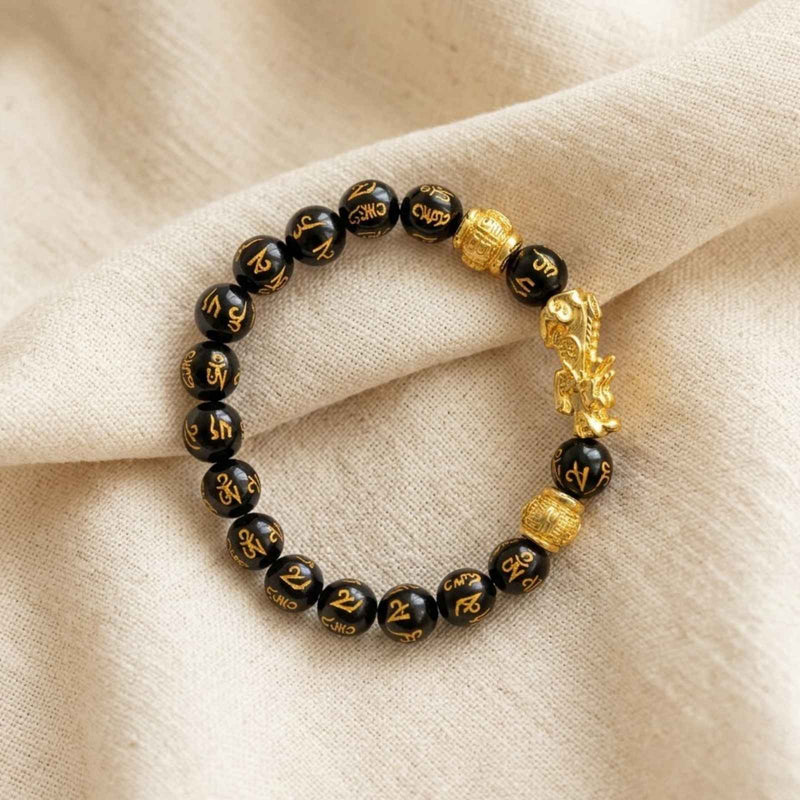
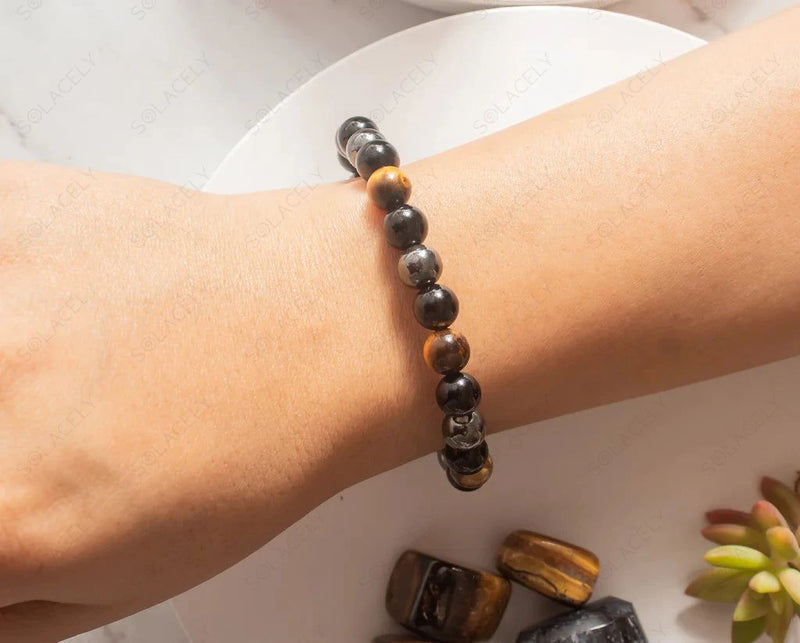
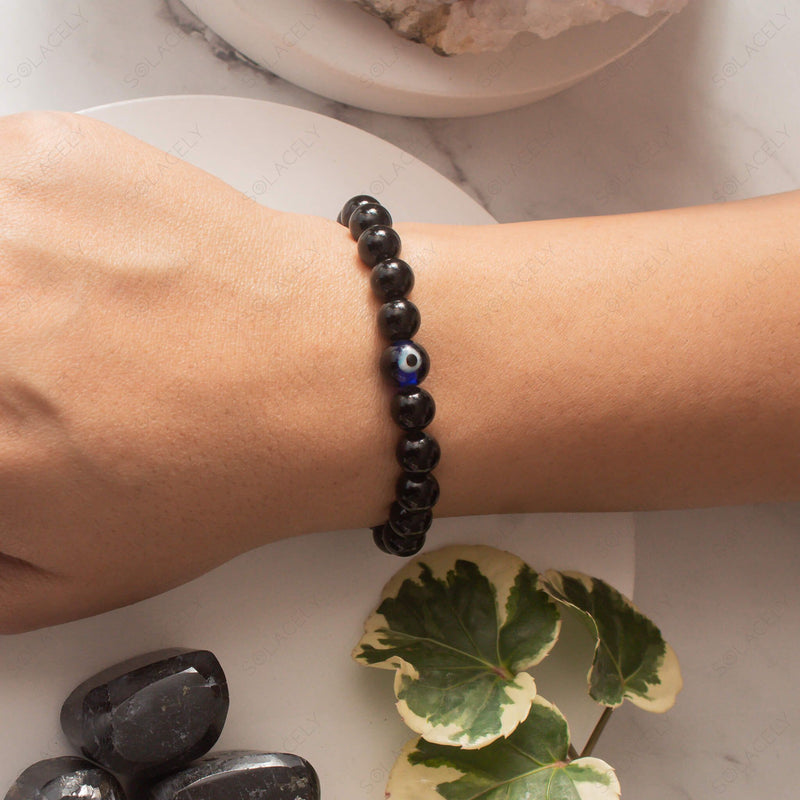
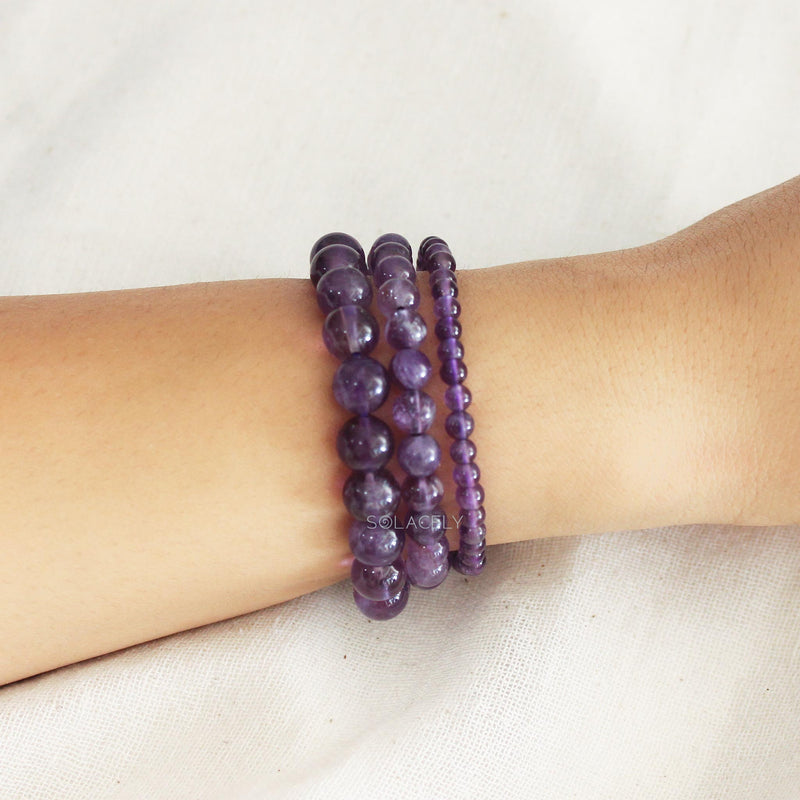
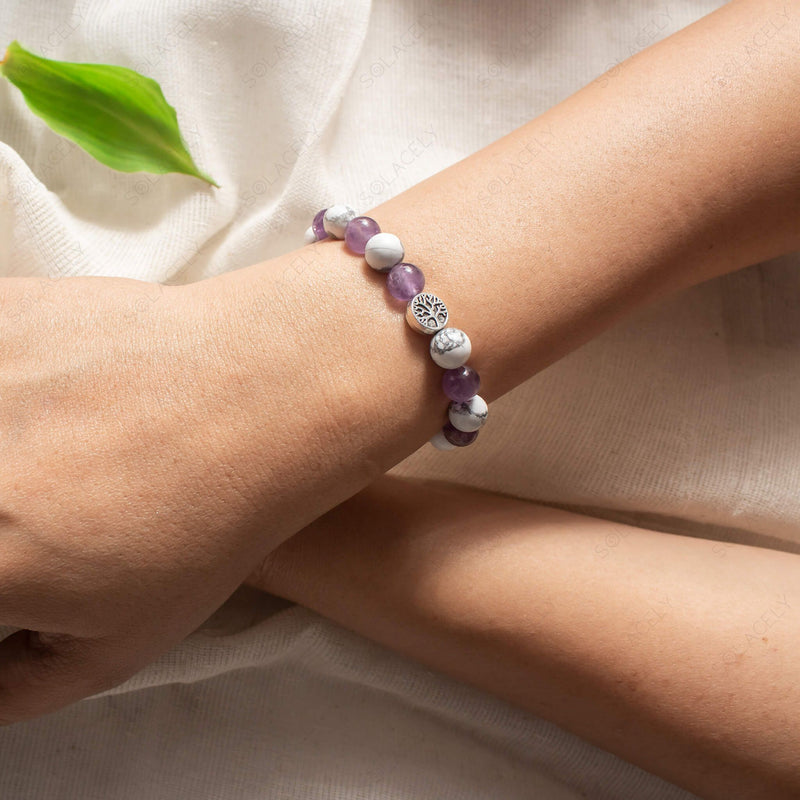
Wear it on your left wrist to receive and your right to give, the convention most people follow. Turn the Buddha charm inward so the reminder faces you. Size it so one finger slides comfortably underneath, and take it off before water. Get those four things right and a Buddha power bracelet becomes something you actually keep on, which is when it starts to mean something.
Key Takeaways
- Left wrist to receive, right to give. The left is usually the non-dominant wrist, so it takes less wear.
- Most people face the charm inward, toward the wrist, so the reminder is theirs.
- Fit so one finger slides under: wrist measurement plus about 1.5 cm for 8mm beads.
- Ease it on gently rather than rolling it over your hand, and take it off before showering.
- Buddha imagery is religious, so wear it with a little knowledge of what it means.
Which wrist to choose
The convention is left to receive, right to give. On that reading, a bracelet worn for calm, protection, or grounding sits on the left, where it is understood to draw something in, and one worn to carry confidence or generosity outward sits on the right.
Most people wearing a Buddha bracelet are after the first of those, which is why the left wrist is the usual answer. If you are wearing it to steady yourself before difficult days, left. If you think of it as something you project, right.
There is a practical bonus to the left for most people, too. Your dominant wrist takes far more knocks: desks, door frames, steering wheels, keyboards. A beaded bracelet on the non-dominant wrist simply lasts longer. Our guide on which hand to wear a crystal bracelet on covers the convention in more detail.
Which way the charm faces
Most people turn the Buddha face inward, toward the underside of the wrist. The reasoning is simple and rather lovely: if the bracelet is a reminder, it should be pointed at you rather than at everyone else.
Some wear it outward, and that is perfectly fine too. Choose the one that matches why you put it on. Inward if it is for you, outward if it is something you like to have seen.
One small practical note. A raised charm on the top of the wrist takes more knocks against desks and doorframes, and if your charm is plated rather than solid, inward and slightly to the side will keep its finish longest.
Wearing Buddha imagery with respect
This is worth a section of its own, because knowing it makes the bracelet mean more. The Buddha is a religious figure to hundreds of millions of people, and the image carries real weight.
The Encyclopaedia Britannica entry on Buddhism is a good half hour if you want the background. In practical terms, several Buddhist-majority countries ask visitors to treat the image carefully, and Sri Lanka and Myanmar in particular take a firm line on Buddha tattoos and novelty items, so it is worth knowing before you travel.
The guidance from within those traditions centres on placement: the head is the most respected part of the body and the feet the least, so imagery below the waist, on shoes, or set on the floor is considered disrespectful. A wrist is entirely appropriate. Wearing it as something meaningful rather than as a pattern is the whole of it.
Getting the fit right
Fit is where most beaded bracelets are won or lost, and it is easy to get right first time.
| Bead size | Add to wrist measurement | Suits |
|---|---|---|
| 6mm | About 1 cm | Smaller wrists, stacking |
| 8mm | About 1.5 cm | The most common size |
| 10mm | About 2 cm | Larger wrists, a single statement piece |
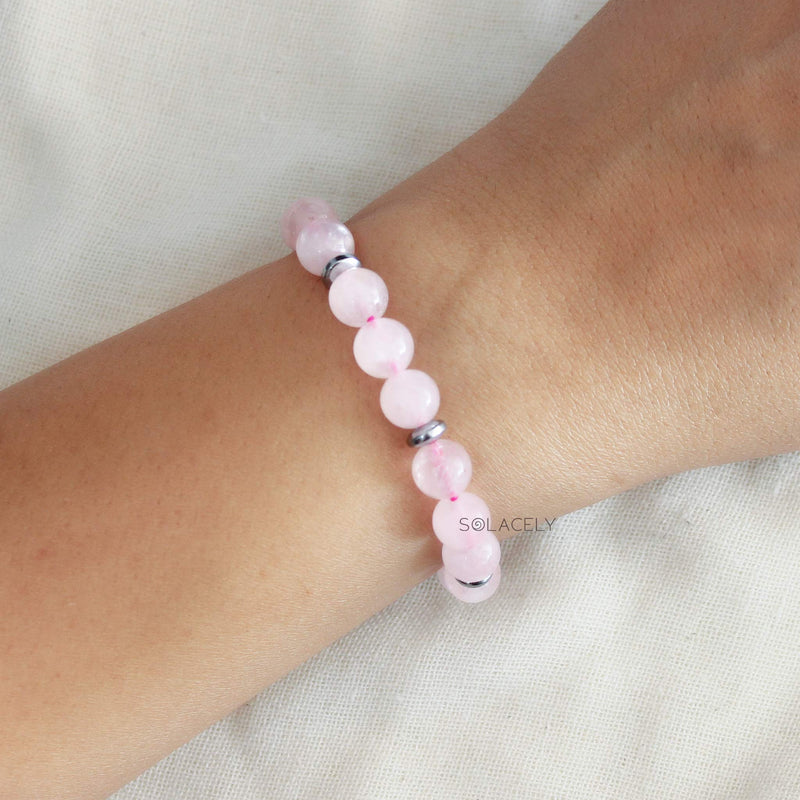
Measure around the wrist bone with a tape or a strip of paper, then add the figure above. The finished bracelet should let you slide one finger underneath comfortably. Too loose and it swings and knocks its own beads against desks; too tight and the elastic stays permanently stretched.
Making it last
Elastic cord has two enemies, and both are easy to avoid. The first is how you put it on. Rolling a bracelet over the widest part of your hand stretches the cord well past its working range, and doing that twice a day is what eventually breaks it. Ease it on gently, or open your hand flat and slide.
The second is liquid. Water, soap, shower gel, body oil, hand cream, and perfume all wear elastic down and dull the beads. Take it off before showering, swimming, and washing up, and put it on after moisturiser and perfume rather than before.
The beads themselves are usually the easy part. Quartz-family stones at 7 on the Mohs scale, as Encyclopaedia Britannica notes, handle daily wear well. Store the bracelet flat rather than hanging, since hanging keeps the cord under constant tension, and restring it as soon as you see elastic showing between beads rather than after you have lost half of them on a train platform.
Making it mean something
A bracelet worn without a reason is jewellery, which is a fine thing to be. If you want it to do the job it is meant for, give it one small habit.
The simplest version: as you put it on each morning, name one thing about how you want to be today. Patience with a particular person. Not snapping at six in the evening. Then, whenever you catch sight of it during the day, that is the reminder arriving at the moment you need it.
That is why the wrist works so well as a place for it. Few objects are in your eyeline as often as your own hands. For more on the stones these bracelets are usually strung with, see crystals for protection.
Sources
- Encyclopaedia Britannica - Buddhism
- Encyclopaedia Britannica - The Buddha
- Encyclopaedia Britannica - Quartz, mineral properties and Mohs hardness
Frequently asked questions
About the author


Written by Chetna Sharma, crystal healing practitioner and co-founder of Solacely. Chetna has worked with healing crystals for over a decade and curates Solacely's protective stone collection.