Kunzite is traditionally the heart opener, kept for tenderness and for softening after a hard season. Moonstone is the stone of cycles and intuition. Together they are held for emotional healing that is allowed to take its own time, which is why the pairing suits recovery rather than crisis.
Key takeaways
- Kunzite sits at the heart; moonstone at the crown and third eye. The pair runs from feeling to insight.
- Kunzite genuinely fades in light. Store it in a drawer and wear it in the evening.
- Moonstone's glow is adularescence, light scattering between internal layers.
- Both are delicate. Pendants and earrings, not rings.
- Kept for a season of recovery rather than an acute moment.
What kunzite is
Kunzite is the pink to lilac variety of spodumene, a lithium aluminium silicate. It was identified in the early twentieth century and named after George Frederick Kunz, the gemmologist who described it, which makes it one of the younger named gemstones.
Two things define it practically. First, it is strongly pleochroic, showing different depths of colour depending on the direction you look through it, so cutters orient it carefully to bring out the best pink. Second, and more importantly, it has perfect cleavage in two directions, meaning it parts very readily along internal planes. Cutters treat it as one of the more demanding stones to work.
Its colour is also genuinely light sensitive. Sustained exposure will pale the pink, which is why it is sometimes called an evening stone. That is a real characteristic of the material rather than a piece of lore.
What moonstone is
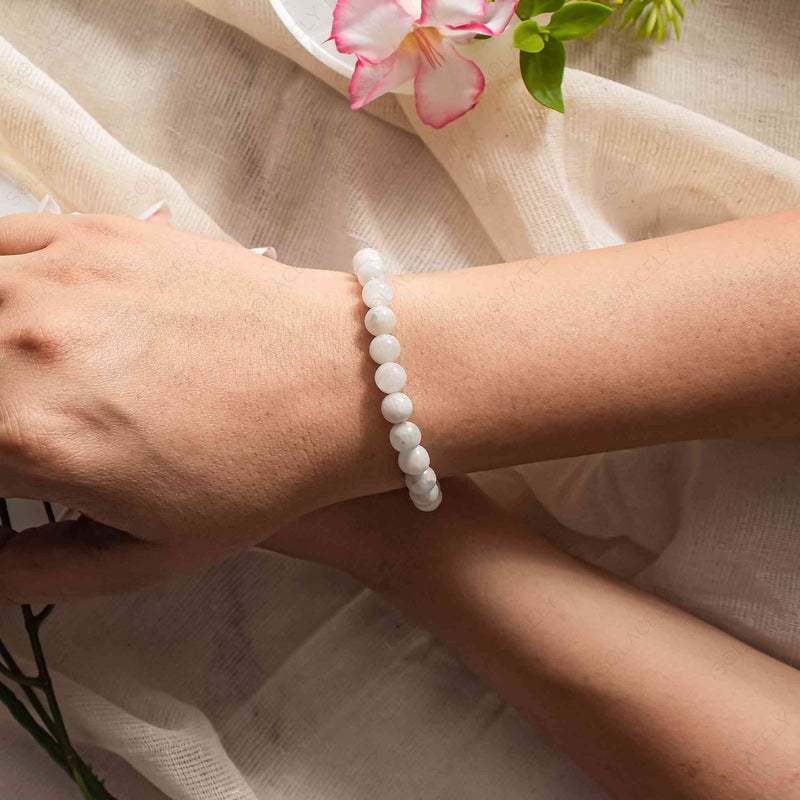
Moonstone is a feldspar, and its defining quality is adularescence: a soft billowing sheen that appears to float just beneath the surface and shifts as the stone moves. The effect comes from light scattering between microscopically thin alternating layers within the crystal rather than from any pigment.
That floating light is the whole reason for its name and for everything attached to it. A stone that seems to hold moonlight inside it was always going to be tied to the moon, to cycles and to intuition, and it has carried those associations across Roman, Indian and modern practice alike.
Rainbow moonstone, the variety with a blue flash on a near white body, is the one most commonly sold, and it is technically a labradorite rather than a true adularia moonstone. Both are legitimately sold as moonstone and both show the effect beautifully.
Why the two are paired
Kunzite works at the heart and moonstone at the crown and third eye, so the pairing runs from feeling to perspective. That span is the point. It is kept for the periods where something needs to be felt through rather than solved, and where forcing a resolution would be the wrong move.
People reach for it in a recognisable set of situations: the months after a loss, the slow part of getting over someone, a stretch of feeling raw and easily knocked. Both stones are gentle in character, and neither is an activating stone, which is exactly why they suit that territory.
Moonstone's association with cycles carries a useful idea inside it: that things move in phases rather than in straight lines, and that a flat week is not a failure. Our crystals for emotional healing guide covers the wider set kept for the same purpose.
How to wear and work with them
- Pendants or earrings. Both stones fare badly in rings, which take knocks.
- Kunzite in the evening. Protects the colour and suits the stone's quieter character.
- Moonstone daily. More robust than kunzite and easy to wear continuously.
- Placed in a session: kunzite at the centre of the chest, moonstone on the forehead.
- On a bedside table. A common placement for the pair through a difficult season.
For a session, lie down with kunzite over the heart and moonstone at the brow, and give it fifteen minutes with a longer exhale than inhale. There is no need to direct it anywhere; the traditional instruction with this pairing is simply to let whatever is there be there.
Our crystals for anxiety and self-love guide covers the self-regard side, and rose quartz for love covers the stone most often added to this pair.
Adding a third stone
Rose quartz is the usual addition, and it slots in naturally at the heart alongside kunzite for a gentler, more familiar version of the same intention. Rhodonite is added where the difficulty is self-forgiveness specifically.
Where the pairing needs weight underneath it, hematite or smoky quartz at the feet is the conventional answer. Both kunzite and moonstone belong to the softer, more diffuse end of the collection, and some people find they want something solid alongside. Our crystals that attract love guide covers the wider heart set.
Caring for two delicate stones
This pairing needs more care than most, and getting it wrong is easy.
Kunzite: keep it out of the light. Store it in a box or a drawer rather than on a shelf, and avoid leaving it in sunlight at all. Handle it gently, since its cleavage means a sharp knock can split it. Never use heat, steam or an ultrasonic cleaner.
Moonstone: softer than quartz at around 6 to 6.5 and it also parts along internal planes. Warm soapy water and a soft cloth, dried fully, and store it away from harder stones.
For energetic cleansing, moonlight is the obvious and traditional choice for both, and it has the advantage of keeping kunzite out of daylight. Sound and smoke work equally. Skip sun entirely for this pair.
Who this pairing suits
People in a slow recovery. Anyone in the long middle of grief, a separation or a period of feeling worn thin, where what is needed is patience rather than momentum. It also suits people who find the brighter stones jarring when they are low.
It suits less well someone who needs to act. For drive, nerve or motivation, carnelian, citrine and tiger's eye are the traditional answers, and this pair can wait until the season changes.
Crystals are offered here for reflection and wellbeing as part of a long standing tradition. They are not a treatment for grief, depression or any medical condition, and they are not a substitute for professional care. If low mood has persisted for weeks or is affecting your daily life, please speak to a qualified healthcare professional.
Sources
Written by Chetena Sharma. Reviewed by the Solacely editorial team.
Frequently asked questions
About the author


Written by Chetna Sharma, crystal healing practitioner and co-founder of Solacely. Chetna has worked with healing crystals for over a decade and curates Solacely's protective stone collection.