Lapis Lazuli: Meaning, Properties & Benefits (2026 Guide)

what is lapis lazuli
benefits of lapis lazuli

Lapis lazuli is the deep-blue stone of pharaohs and Renaissance painters. Mineralogically, it's a metamorphic rock rather than a single mineral, primarily composed of lazurite (the deep-blue mineral, 30 to 40 percent of the rock), calcite (the white veining), and pyrite (the gold-coloured flecks), with a Mohs hardness of 3 to 5.5 and a specific gravity of 2.7 to 2.9 (Wikipedia; Geology.com). The Sar-e Sang mine in Afghanistan's Badakhshan province has been worked for more than 6,000 years (Wikipedia), making it one of the oldest continuously operating gem mines in human history. Lapis was inlaid in Tutankhamun's funeral mask, ground into the ultramarine pigment that coloured the Virgin Mary's robes in Renaissance paintings, and is still the throat-chakra "wisdom stone" of the modern crystal tradition. This guide covers the verified mineralogy, the cultural history, and the right way to care for the stone.

Key Takeaways
  • Lapis lazuli is a metamorphic rock made primarily of lazurite (30 to 40 percent), calcite, and pyrite (Wikipedia).
  • Mohs hardness 3 to 5.5; specific gravity 2.7 to 2.9 (Geology.com). Soft enough that the stone is best in pendants and earrings rather than daily-wear rings.
  • Mined at Sar-e Sang in Afghanistan for over 6,000 years — one of the oldest continuously operating gem mines on Earth.
  • Inlaid in Tutankhamun's funeral mask (~1341–1323 BCE); found in Sumerian royal tombs at Ur from the 3rd millennium BCE (Wikipedia).
  • Ground into ultramarine pigment for Renaissance paintings; by weight, the pigment was more valuable than gold until synthetic alternatives appeared in the mid-1800s.
  • Crystal-healing use: throat chakra (Vishuddha) for expression and truth, and third eye chakra (Ajna) for insight.
  • Etymology: Latin lapis (stone) plus Persian lāžward (blue), the same root that gives us "azure" and Spanish azul.

A note before we begin. Nothing here replaces medical advice. Crystal healing is a complementary, faith-based practice. The spiritual and emotional benefits in this guide reflect long-standing tradition and personal experience, not clinical research.

What Is Lapis Lazuli?

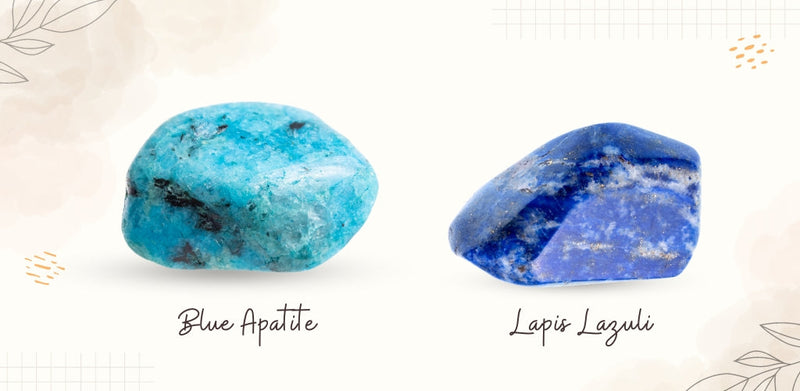
Lapis lazuli is a deep-blue metamorphic rock, not a single mineral (Wikipedia). The dominant blue mineral is lazurite, which makes up roughly 30 to 40 percent of the rock and is responsible for the unmistakable ultramarine colour. Threading through the lazurite are veins of white calcite and small flecks of golden pyrite (sometimes called "fool's gold" in other contexts), which give a fine lapis specimen the appearance of a starry night sky.

The hardness sits at Mohs 3 to 5.5, varying with the proportion of softer calcite (Mohs 3) to harder lazurite (Mohs 5 to 5.5). Specific gravity is 2.7 to 2.9, depending on how much pyrite is present (Geology.com). It's a relatively soft stone for jewelry use, which is why lapis traditionally appears in pendants, earrings, brooches, and inlay work rather than daily-wear ring settings.

The name itself is a small linguistic fossil. "Lapis" is Latin for stone, and "lazuli" descends from the Persian lāžward, meaning blue. The Persian root is the same one that gave us "azure" in English and azul in Spanish and Portuguese (Wikipedia). When you say "azure sky," you're using a colour word that lapis introduced into European languages.

Composition of typical lapis lazuli. Lazurite drives the blue, calcite produces the white veining, and pyrite contributes the gold flecks. Source: Wikipedia — Lapis lazuli composition.
Typical Composition of Lapis Lazuli Typical Composition of Lapis Lazuli It's a rock, not a single mineral — three components do most of the visual work. Lazurite Calcite Pyrite Other Lazurite ~30–40% (the deep blue) Calcite ~30% (the white veining) Pyrite ~15% (the gold flecks) Other ~20% (sodalite, haüyne, etc.) Source: Wikipedia — Lapis lazuli composition; proportions are approximate, varying by deposit.

Where Does Lapis Lazuli Come From?

The Sar-e Sang mine in Afghanistan's Badakhshan province has been the world's most important source of lapis lazuli for more than 6,000 years (Wikipedia). The mine sits high in the Hindu Kush mountains and is one of the oldest continuously worked gem deposits anywhere on Earth. Sumerian, Egyptian, Persian, and Chinese traders all sourced their lapis from these mountains, and Afghan lapis is still considered the gold standard for the deepest, most evenly coloured material.

Modern commercial sources include Chile (in the Andes), Russia (west of Lake Baikal), Pakistan, Myanmar, Italy, Mongolia, the United States (California and Colorado), and Canada (Wikipedia). Chilean lapis tends toward a slightly lighter, paler blue with more visible calcite veining, while Russian material from Lake Baikal can rival Afghan stone in colour intensity.

The historical record runs deep. Lapis was prized in the Sumerian Royal Tombs of Ur from the 3rd millennium BCE, used in seals, ceremonial weapons, and the famous Standard of Ur (Wikipedia). In Egypt, lapis was inlaid in the funeral mask of Tutankhamun (reign approximately 1341 to 1323 BCE) and in the eyebrows and beard plate of his sarcophagus. Across both cultures, the stone was associated with the heavens and royalty long before it became a meditation tool.

Why Was Lapis Lazuli More Valuable Than Gold?

For roughly 600 years between the Middle Ages and the mid-1800s, lapis was the only source of true blue pigment in European painting. Pulverised lazurite produced a colour called ultramarine, which by weight was more expensive than gold during the Renaissance because of the labour involved in mining it from a single distant source and grinding it into stable pigment (Wikipedia). The cost was so high that ultramarine was traditionally reserved for the most important figures in religious paintings — particularly the Virgin Mary's robes, which is why Marian blue is the colour it is in nearly every Renaissance Madonna.

Vermeer used ultramarine in Girl with a Pearl Earring's headscarf. Michelangelo used it in the Sistine Chapel. Some Renaissance contracts between painters and patrons specified separately, in writing, the cost of the ultramarine the painter was permitted to use, treated like a precious-metal allowance. The stone's value as pigment dwarfed its value as a gemstone for several centuries.

The story changed in the mid-1800s. Synthetic blue pigments — including French ultramarine (developed in 1828) and Prussian blue (already in use) — finally gave painters a stable blue that didn't require a 6,000-mile supply chain (Geology.com notes the synthetic transition). Lapis returned to being primarily a gemstone, but the cultural memory of its pigment value still echoes through every Renaissance painting hanging in a museum.

What Are the Benefits and Healing Properties of Lapis Lazuli?

Crystal-healing tradition assigns lapis lazuli three layers of benefit: emotional (truth, self-expression, calm clarity), physical (energetic support tied to the throat and head, traditional only), and metaphysical (throat and third eye chakra, wisdom, spiritual insight). None of these claims is medically validated. They reflect long-standing tradition rather than clinical research.

Important. Lapis lazuli has not been shown in peer-reviewed clinical research to treat or cure any condition. Always consult a qualified healthcare provider for medical concerns. The benefits below describe traditional crystal-healing use, not medical effects. Note also that lapis contains pyrite (an iron sulfide); drinking water that's been steeped with raw lapis is not recommended.

Emotional Healing Properties

Lapis lazuli is the truth-and-expression stone. Practitioners reach for it during difficult conversations, public-speaking preparation, and journal practices focused on getting honest with oneself about something. The traditional indications cluster around clarity rather than calm — closer to a stone you reach for when you need to find the right words than a stone you reach for when you need to soothe a raw emotion.

The most common phrase I've heard from customers about lapis is some version of "I needed to be able to say it." Whether the effect is energetic or simply ritual focus is a fair question. Practitioners would say "both."

Physical Healing Properties (Traditional)

In the crystal-healing tradition, lapis is associated with the throat (voice, thyroid, communication centre) and the head (intuition, mental clarity), partly through its throat-chakra link and partly through ancient Egyptian medical traditions that treated powdered lapis as a remedy for various ailments. Practitioners place the stone at the throat or forehead during energy work, sometimes pairing it with clear quartz for amplification.

None of this is medical treatment. Lapis hasn't been shown in any peer-reviewed study to influence thyroid function, vocal cords, or any biological process. The "physical" tradition is best read as a metaphor for attention rather than a treatment claim.

Metaphysical & Wisdom Properties

Metaphysically, lapis is the wisdom stone of the modern crystal tradition. The reading is part historical, part visual: thousands of years of association with priests, royalty, and the heavens, plus a deep blue colour that has long carried symbolic weight as the colour of depth, truth, and the night sky. Practitioners use it in journaling and dream-work practices, often paired with selenite or amethyst for spiritual amplification.

Common pairings: lapis with citrine for confident communication, with rose quartz for compassionate truth-telling, and with clear quartz to amplify a specific spoken intention. Used alone, it's most often programmed for a specific upcoming conversation, presentation, or creative project that requires honest self-expression.

Which Chakra Is Lapis Lazuli For?

Lapis lazuli is most strongly associated with the throat chakra (Vishuddha), the energy centre at the base of the throat traditionally linked to honest communication, voice, and self-expression. It's also commonly used on the third eye chakra (Ajna) for intuition and insight. The deep blue colour matches the throat chakra's primary colour symbolism almost exactly in modern crystal-healing practice, while the slightly violet shimmer of better-quality lapis bridges naturally toward the indigo of the third eye.

The two-chakra association is part of why lapis is traditionally placed at the upper body during energy work rather than below the heart. It's not a grounding stone, and it's rarely used on the lower chakras as a primary placement. The energy in the tradition is described as upward, expressive, and clear, which fits the throat-and-head positioning.

A simple way to use this: lie down, place a small lapis tumble at the base of the throat or in the middle of the forehead, and breathe slowly for five to ten minutes with one specific intention around something you need to say or see clearly. Keep it short. Lapis is an articulation stone, not a depth-meditation stone.

How Can You Use Lapis Lazuli Day-to-Day?

The three most common uses are jewelry, meditation, and workspace placement. Each has a slightly different goal, and the form of lapis you choose should match it. Tumbled stones and palmstones work well for meditation. Polished cabochons set in pendants and earrings are the most popular jewelry forms. Rings are possible but require care because of the stone's softness.

Wearing Lapis Lazuli Jewelry

Lapis is best suited to pendants, earrings, brooches, and occasional-wear rings rather than daily-wear ring settings. The reason is mineralogical: at Mohs 3 to 5.5, lapis is described by gemological references as "very soft for use in a ring" (Geology.com). Rings take more accidental knocks than pendants or earrings, and a hard impact can chip or scratch the stone. Set into a pendant or stud earring, polished lapis stays beautiful for decades.

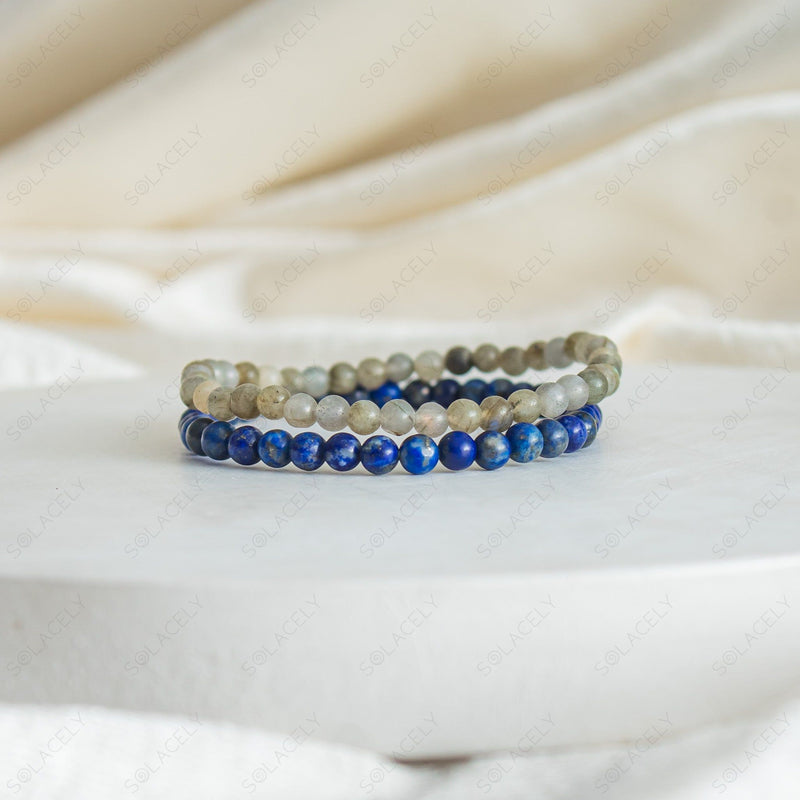
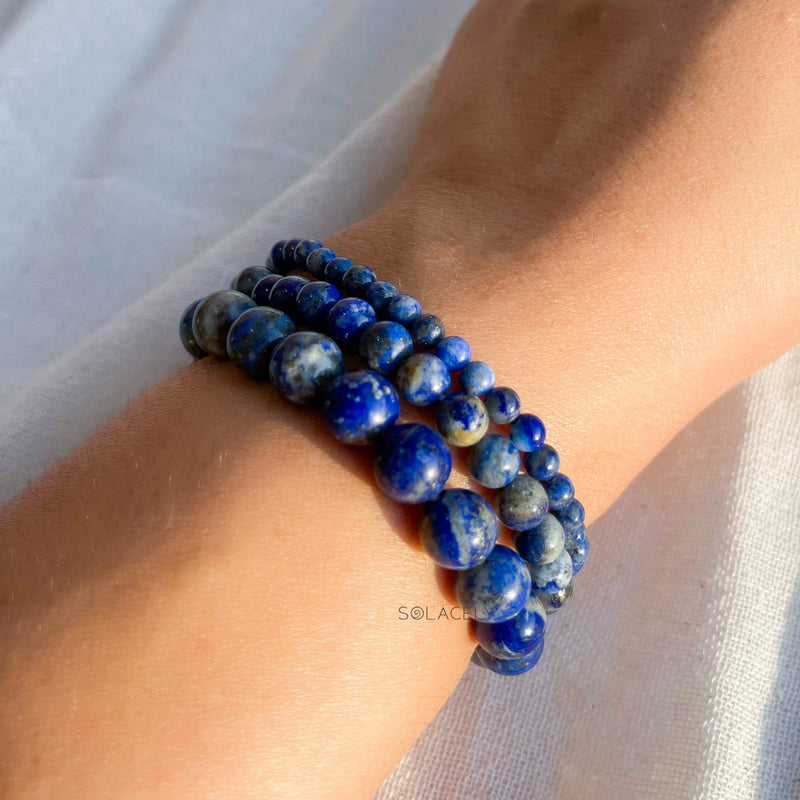
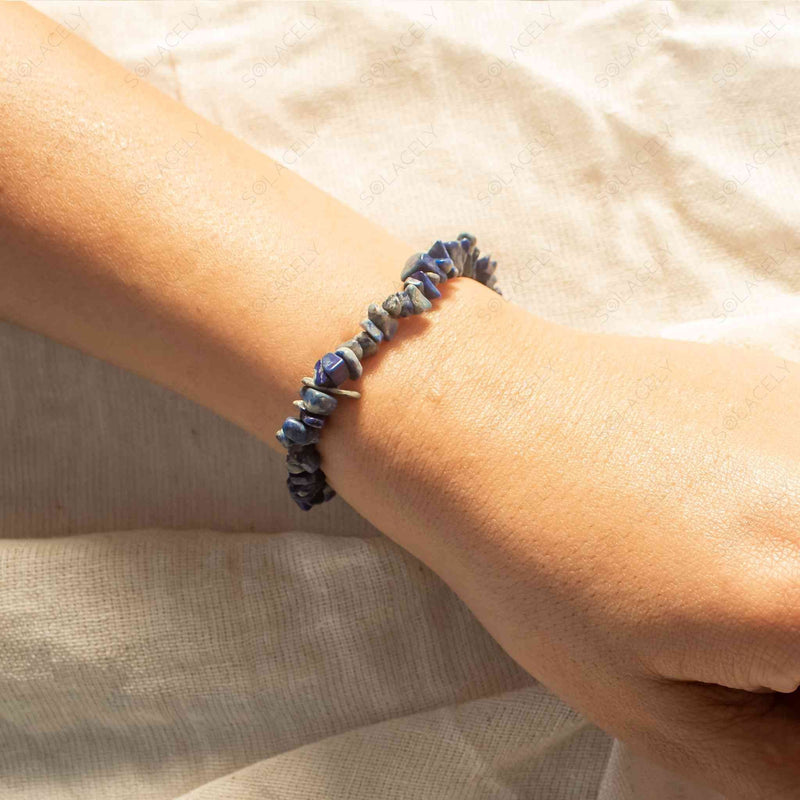
Lapis pairs especially well with sterling silver and yellow gold. The cool blue against warm gold is one of the most striking palettes in jewelry, and it's the same combination Egyptian goldsmiths used 3,000 years ago. Beaded bracelets work well too — just remove them before workouts or hands-on work.

Lapis Lazuli for Meditation

For meditation, place a polished lapis tumble at the base of the throat or in the centre of the forehead lying down, or hold one in each palm seated. The stone has a noticeable physical weight at SG 2.7 to 2.9, and that weight is part of the practice — it grounds attention upward toward the upper chakras rather than downward into the body.

A specific lapis meditation for honest self-expression: three rounds of slow breathing, one stated intention about something you need to say (to yourself or to someone else), three more rounds, then place the stone down and write down what surfaced. Five minutes plus a notebook. The point is articulation, not silence.

Lapis Lazuli at the Workspace

Lapis is one of the most-recommended workspace stones for writers, speakers, teachers, and anyone whose work involves communicating clearly. Common placements: a polished palmstone beside a notebook, a small tumble near a microphone or recording setup, a lapis cabochon paperweight on a desk during high-stakes drafting work. The visual reminder matters as much as the energetic claim.

In feng shui terms, lapis is sometimes placed in the knowledge-and-self-cultivation gua (the front-left corner of a room from the doorway). The placement matters less than the consistency. A piece you reset weekly with a stated communication intention will feel more "active" than one drifting into desk-decoration territory.

How Do You Cleanse and Charge Lapis Lazuli?

Lapis is more delicate than many crystals because of its softness and pyrite content. Skip soaking, salt water, ultrasonic cleaners, and steam. Iron-sulfide pyrite within lapis can rust on prolonged moisture contact, and the soft calcite component is sensitive to mild acids. For energetic cleansing, dry methods are gentlest: sound, smoke, moonlight, and selenite contact.

Why Cleanse and Charge Lapis Lazuli?

In crystal-healing practice, cleansing clears residual energy a stone has picked up from its environment or wearer. Even if you don't subscribe to the energetic side, regular cleansing is good physical hygiene for jewelry: skin oils, dust, and lotion residue dull the stone's natural depth over time, and gentle removal keeps the lazurite blue and pyrite flecks looking crisp.

A reasonable cadence: cleanse lapis once a month with normal use, more often if you wear a piece daily during a stretch of high-stakes communication work. Charging is a separate step (re-energising the stone toward an intention), traditionally done after cleansing.

How to Cleanse Lapis Lazuli (4 Safe Methods)

  1. Sound. Hold the stone near a singing bowl or tuning fork for 30 to 60 seconds. The safest method for soft stones — no contact, no impact, no risk to the surface.
  2. Smoke. Pass the stone gently through sage, palo santo, or incense smoke for about a minute. Don't hold it in direct flame.
  3. Moonlight. Set the stone on a windowsill overnight, ideally on a full or new moon. Bring it back inside before morning to avoid morning dew.
  4. Selenite or clear quartz contact. Rest lapis on a selenite plate or beside a clear quartz cluster for 6 to 12 hours.

Skip salt water, ultrasonic cleaners, and steam. All three risk damaging either the calcite, the pyrite flecks, or the polished surface.

How to Charge Lapis Lazuli (4 Methods)

  1. Moonlight. The default lapis charging method. Place the stone on a windowsill overnight, ideally on a full moon. Lapis's deep blue and historical association with the night sky pair naturally with lunar charging.
  2. Brief sunlight. Up to 30 minutes of indirect or short direct morning sunlight is acceptable. Lapis is generally light-stable, but extended baking can dull the surface over years.
  3. Intention setting. Hold the cleansed stone at the throat, state one specific communication intention out loud (a conversation to handle, a piece to write, a presentation to give), and breathe with it for two to three minutes.
  4. Crystal grid. Place lapis at the centre of a grid surrounded by clear quartz points and small selenite pieces to amplify a wisdom or expression intention. Leave for 24 hours.

Frequently Asked Questions

What is lapis lazuli?

Lapis lazuli is a deep-blue metamorphic rock, not a single mineral. It's primarily composed of lazurite (30 to 40 percent of the rock), calcite (the white veining), and pyrite (the gold flecks), with a Mohs hardness of 3 to 5.5 and a specific gravity of 2.7 to 2.9 (Wikipedia; Geology.com).

Where does lapis lazuli come from?

The most famous source is the Sar-e Sang mine in Afghanistan's Badakhshan province, where lapis has been worked for more than 6,000 years (Wikipedia). Modern commercial sources also include Chile (in the Andes), Russia (west of Lake Baikal), Pakistan, Myanmar, Italy, Mongolia, the United States, and Canada.

Was lapis lazuli used by King Tutankhamun?

Yes. Lapis lazuli was inlaid in the funeral mask of King Tutankhamun (reign approximately 1341 to 1323 BCE), and was widely used in Egyptian amulets, scarabs, and royal jewelry (Wikipedia). It was also found in the Sumerian Royal Tombs of Ur from the 3rd millennium BCE.

Why was lapis lazuli more valuable than gold?

From the Middle Ages until synthetic alternatives emerged in the mid-1800s, lapis was the only source of true blue pigment, called ultramarine. The cost of mining and grinding it for paint made the pigment, by weight, more valuable than gold during the Renaissance, which is why ultramarine was traditionally reserved for the Virgin Mary's robes in religious paintings (Wikipedia; Geology.com).

Which chakra is lapis lazuli for?

Lapis lazuli is most strongly associated with the throat chakra (Vishuddha) for honest communication and self-expression, and the third eye chakra (Ajna) for intuition and insight. The deep blue colour matches the throat chakra's primary colour symbolism almost exactly in modern crystal-healing practice.

Can lapis lazuli get wet?

Brief contact with clean water is acceptable, but skip soaking and salt water. At Mohs 3 to 5.5 lapis is relatively soft and contains pyrite, which can oxidise (rust) on prolonged moisture contact (Geology.com). Use a dry soft cloth for cleaning. For energetic cleansing, sound, smoke, moonlight, and selenite contact are gentlest.

Is lapis lazuli good for daily wear?

Lapis lazuli is best suited to pendants, earrings, and pins rather than daily-wear ring settings. At Mohs 3 to 5.5 it's described as "very soft for use in a ring" (Geology.com), since rings take more knocks than other jewelry. Treated kindly in pendant or earring settings, lapis stays beautiful for decades.

About the author

Chetena Sharma
Chetena Sharma

Written by Chetena Sharma, crystal healing practitioner and co-founder of Solacely. Chetena has worked with healing crystals for over a decade and curates Solacely's protective stone collection.
Back to blog
1 3