Peridot and Citrine: A Complete Pairing Guide for Renewal and Confidence
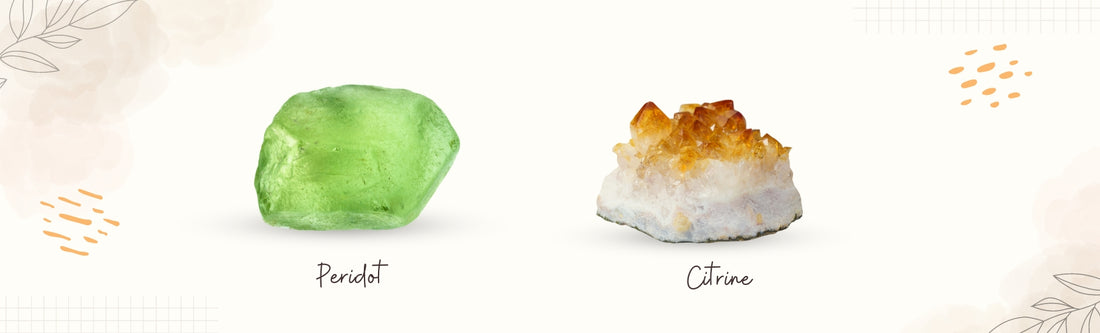

Peridot and citrine is the warm-spectrum pairing with a quietly extraordinary mineralogical fact: peridot is one of the very few gem minerals on the market that has been faceted directly from meteorites. Pallasite meteorites — a rare class that makes up about 1% of all meteorites — contain gem-quality olivine (peridot) embedded in an iron-nickel matrix older than Earth itself, per the Gemological Institute of America. Most peridot on the modern market is, of course, terrestrial — mined principally in Pakistan, China, Myanmar, the US, and Vietnam — but the cosmic story is real. Mineralogically, peridot is a gem variety of olivine ((Mg,Fe)₂SiO₄), with a Mohs hardness of 6.5 to 7. Paired with citrine (Mohs 7, quartz), the two warm stones support what crystal practitioners describe as "growth and drive" — peridot for renewal at the heart, citrine for confidence at the solar plexus. This guide covers the mineralogy, the pallasite peridot story, and how to wear and care for the combination.
- Peridot is the gem variety of olivine — magnesium-iron silicate ((Mg,Fe)₂SiO₄). Mohs 6.5–7, per Britannica.
- Peridot is one of the very few gem minerals also found in meteorites — specifically pallasite meteorites, ~1% of all meteorites (GIA).
- The colour of peridot comes from iron in the mineral's defining chemistry — not an impurity. This is unusual among gemstones.
- Citrine is Mohs 7. The matched hardness range with peridot makes the bracelet durable for daily wear.
- The pairing's logic is heart-chakra renewal (peridot) + solar-plexus drive (citrine) — a "new beginnings" combination popular for career transitions and fresh projects.

Why Pair Peridot and Citrine?
The pairing's logic is a heart-and-gut combination. Peridot sits at the heart chakra (anahata) in modern Western crystal practice, associated with renewal, growth, compassion, and seasonal rebirth — peridot is also the August birthstone, and its yellow-green colour is closely tied to late-summer harvest imagery. Citrine sits at the solar plexus chakra (manipura), associated with personal power, confidence, and goal-setting. Together the two stones cover the cycle of "open at the heart, act with the gut" — see the new direction with renewed compassion, then act with confidence.
From what we've seen with Solacely customers, this is the pairing chosen most often by people in transition phases — career changes, returning to school, recovery from a difficult season, or the start of a creative project. The visual contrast also lands well: cool yellow-green against warm gold is one of the most distinctive same-spectrum palettes in crystal beadwork, with both stones reading as "warm" yet visually different.
Peridot and Citrine Mineralogy
Citrine is a transparent, coarse-grained variety of quartz — silicon dioxide (SiO₂) coloured by colloidally suspended hydrous iron oxide. Its colour ranges from pale yellow to deep golden brown, per Britannica. It is Mohs 7, with no cleavage, and a specific gravity of 2.65.
Peridot is the gem variety of olivine, a magnesium-iron silicate with the chemical formula (Mg,Fe)₂SiO₄. Unlike most coloured gemstones, peridot's colour comes from iron in the mineral's defining chemistry — not from a trace impurity. The amount of iron in the crystal lattice determines whether the stone reads as a yellow-green (low iron) or a deeper olive-green (higher iron). Peridot is Mohs 6.5–7, with a specific gravity around 3.27–3.37, and the name "peridot" comes from the Old French word peritot, possibly via Arabic.
Peridot's Cosmic Connection
This is the part that sets peridot apart from every other crystal in the modern jewellery trade. Pallasite meteorites are a rare type of stony-iron meteorite that contain gem-quality olivine — the same mineral as peridot — suspended in an iron-nickel metal matrix. Pallasites originate from collisions between asteroids in the early solar system, where molten metal from the asteroid's core mixed with olivine from the mantle, then cooled into a striking green-and-silver mosaic. Per GIA's foundational article on interplanetary peridot, pallasite material is older than Earth itself, and gem-quality peridot has been faceted from cut sections of pallasite meteorites and sold as jewellery. The Smithsonian holds a 310-carat cut peridot in its national gem collection.
Wearability: How the Pairing Holds Up
The hardness gap between citrine (Mohs 7) and peridot (Mohs 6.5–7) is small enough that beaded jewellery wears evenly. Peridot's main wearability concern is brittleness: the stone has imperfect cleavage and can chip on hard impacts, especially at faceted edges and corners. Beaded bracelets handle this well because the beads are smoothed and rounded, but ring settings need protective mounts. Both stones can fade slightly with prolonged direct sunlight, so take the bracelet off before extended sun exposure.
| Property | Citrine | Peridot |
|---|---|---|
| Mineral group | Quartz (silicate) | Olivine (silicate) |
| Chemistry | SiO₂ + trace Fe | (Mg,Fe)₂SiO₄ |
| Mohs hardness | 7 | 6.5–7 |
| Specific gravity | 2.65 | 3.27–3.37 |
| Colour cause | Trace iron impurities | Iron in defining chemistry |
| Cleavage | None | Imperfect (brittle) |
| Birthstone | November (modern) | August (modern) |
| Main sources | Brazil, Uruguay, Russia | Pakistan, China, Myanmar, US, Vietnam |
| Traditional chakra | Solar plexus (Manipura) | Heart (Anahata) |
How to Use the Pairing
Beaded bracelet stack. The most popular format. Alternating peridot and citrine beads in 6 mm or 8 mm sizing creates a warm yellow-green-and-gold contrast unlike any other crystal-jewellery palette. In our Solacely studio we string most combination bracelets with a 5/5 bead split. The matched hardness means a single piece holds up across years of daily wear without one stone wearing the other.
Pendant pair. A peridot cabochon alongside a citrine point on a single chain, or two pendants on separate chains. Bezel mounts protect peridot's slightly brittle edges better than prong settings, and the warm yellow-green pairs beautifully with both yellow gold (matching) and white gold (contrast) settings.
Meditation set. Hold one stone in each hand. Peridot at the heart position or in the receptive (non-dominant) hand for renewal-and-compassion focus, citrine in the dominant hand for action-oriented intention. The pairing has a "new project" energy that suits goal-setting after a transition or change of direction. A 10-to-15-minute breath session with one specific intention is the most common modern format.
August + November birthstones. If you're shopping for someone with an August or November birthday, this pairing serves both modern birthstone traditions in one piece. Peridot is the August birthstone in the contemporary American Gem Society and Jewelers of America lists; citrine is the modern November birthstone.
How to Care for the Combination
Cleaning. Warm soapy water and a soft cloth is the safe baseline for both stones, per GIA. Skip ultrasonic and steam cleaners — peridot in particular often has internal fractures that heat or vibration can worsen. A cotton swab works well to clean between beads on a stretch bracelet without dislodging the cord.
Storage. Keep the bracelet in a soft pouch when you take it off. Store it separately from harder gems (sapphire, topaz, diamond) that could scratch the peridot. Avoid extended direct sunlight; both stones can fade with prolonged UV exposure — peridot's saturation can slowly soften, and citrine's gold can shift.
Energetic cleansing. Moonlight overnight or a selenite plate is the safest energetic cleansing for this pair. Smoke (sage, palo santo) and sound (singing bowls, bells) work without damaging the surface. Skip the "cleanse in salt water" advice that circulates online — long salt soaks dull the polish on both stones.
Frequently Asked Questions
What does the peridot and citrine combination do?
Peridot (heart chakra, renewal and growth) and citrine (solar plexus chakra, confidence and motivation) form a "growth and drive" pairing. The combination is associated in modern crystal practice with new-beginning energy — career transitions, fresh creative projects, or seasonal renewal. Both stones are also classical late-summer and abundance birthstones (peridot in August, citrine in November).
Is peridot really found in meteorites?
Yes. Peridot is one of the very few gem-quality minerals found in meteorites — specifically in pallasite meteorites, a rare class that contains olivine crystals embedded in an iron-nickel matrix. Pallasites make up about 1 percent of all meteorites, per the Gemological Institute of America, and gem-quality peridot has been faceted directly from them. Pallasite material is older than Earth itself.
What is peridot made of?
Peridot is the gem variety of olivine — a magnesium-iron silicate with the chemical formula (Mg,Fe)₂SiO₄. The yellow-green colour comes from iron in the crystal structure, per Britannica. Peridot is one of the very few gemstones whose colour is part of the mineral's defining chemistry, not an impurity. Mohs hardness 6.5–7.
Can you wear peridot and citrine as a bracelet?
Yes. Peridot is Mohs 6.5–7 and citrine is Mohs 7 — the matched range makes beaded bracelets durable for daily wear. Avoid hard impacts (peridot can chip on edges and corners), keep both stones away from extended direct sunlight, and skip ultrasonic and steam cleaners. Eight-millimetre beads in a 5/5 split is the most popular format.
Where does peridot come from?
Major modern sources include Pakistan (Sapat Valley in the Himalayas), China (Hebei province), Myanmar (Mogok), the United States (the San Carlos Apache Reservation in Arizona), and Vietnam. Historically the most famous source was Zabargad Island in the Red Sea (Egypt), where peridot has been mined for at least 3,500 years. A tiny share of commercial peridot is faceted from pallasite meteorites.
How do you care for peridot and citrine jewelry?
Warm soapy water and a soft cloth is the safe baseline for both, per the Gemological Institute of America. Skip ultrasonic and steam cleaners — peridot in particular can have internal fractures that heat or vibration can worsen. Avoid extended direct sunlight on citrine. For energetic cleansing, a selenite plate overnight or moonlight is the safest method for both stones.
About the author