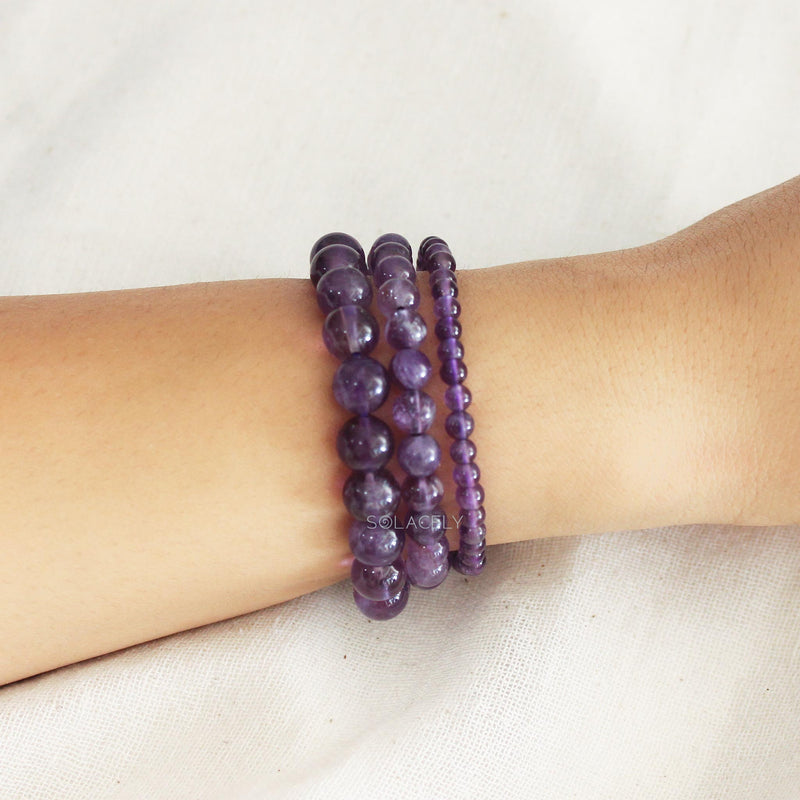
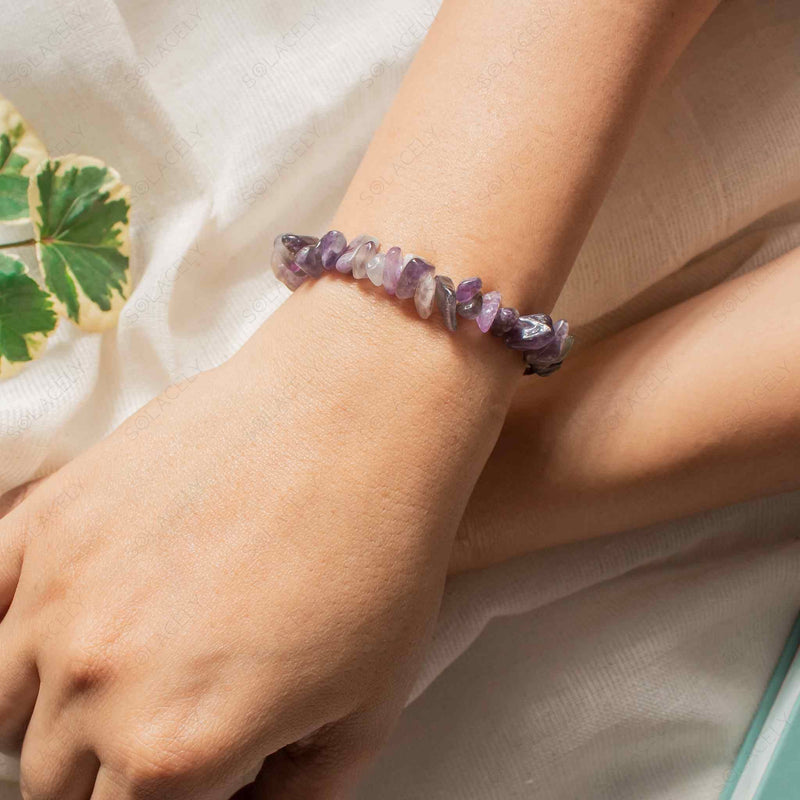
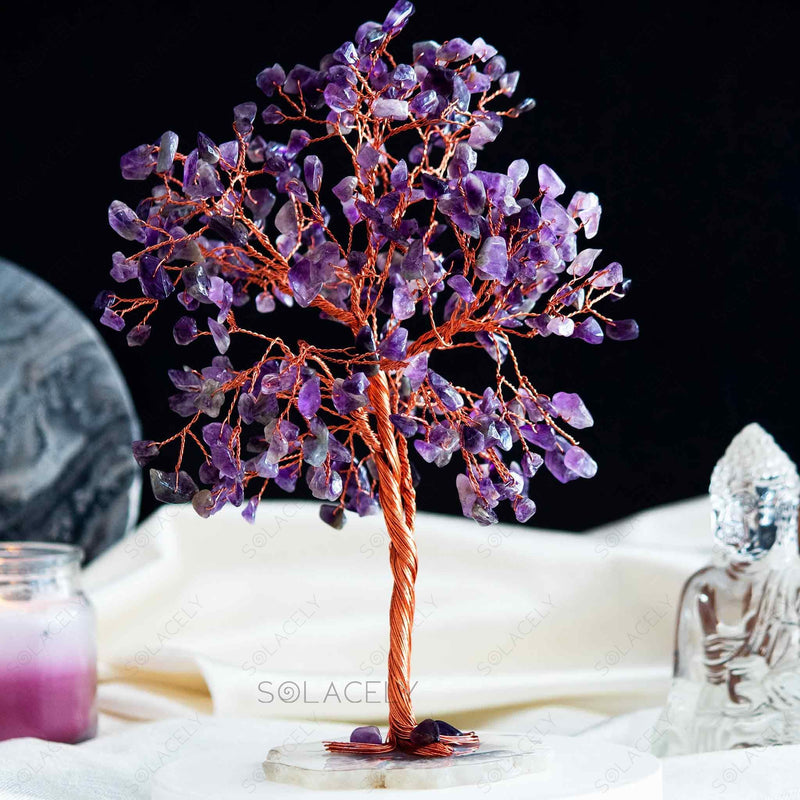
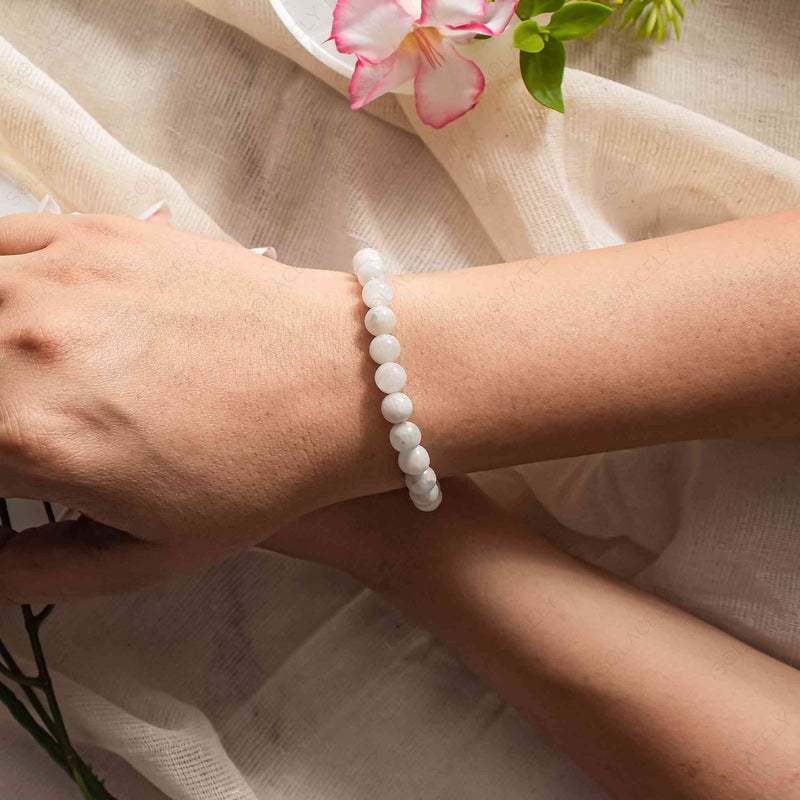
Amethyst and moonstone are paired for the quieter end of a practice. Amethyst settles a mind that will not stop; moonstone is kept for cycles, intuition and beginnings. The set belongs to evening and dream work rather than to pushing through a demanding day.
Key takeaways
- Both are quiet stones. This is a set for the end of a day, not for getting through one.
- Moonstone's floating sheen, called adularescence, comes from light scattering between microscopic layers in the feldspar.
- Amethyst is quartz at 7 on the Mohs scale; moonstone is softer at 6 to 6.5 with cleavage planes.
- Moonstone needs movement and daylight to show, so it is far better worn than stored.
- Keep amethyst out of long strong sun and moonstone out of ultrasonic cleaners.
Why the pairing works
Most pairings balance an active stone against a calm one. This one does not, and that is deliberate. Both halves work at the same quiet end of the range, which makes the set unusually coherent for a specific time of day rather than useful across a whole one.
Amethyst handles the settling. It is the stone that marks the point where the working day is finished, screens go down and the room quietens. Moonstone handles what comes after: rest, dreams, and the sense of a cycle turning rather than a task being completed.
That focus is the strength and also the limit. Anyone wanting a set to carry them through a demanding afternoon would be better served elsewhere, and the same is true of anyone looking for grounding weight.
What moonstone actually is
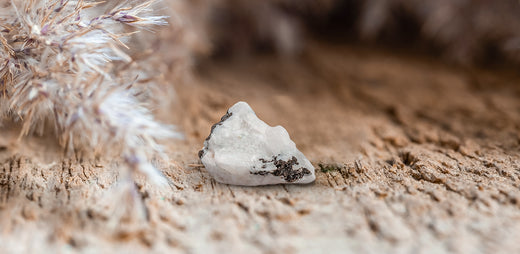
Moonstone is a potassium feldspar, and its appeal is entirely optical. The Gemological Institute of America attributes the floating blue sheen to light scattering between microscopic layers within the stone, an effect called adularescence.
The word floating is the right one. Unlike a surface shine, adularescence appears to sit just below the surface and moves as the stone turns, which is why moonstone looks alive in the hand and disappointingly plain in a photograph.
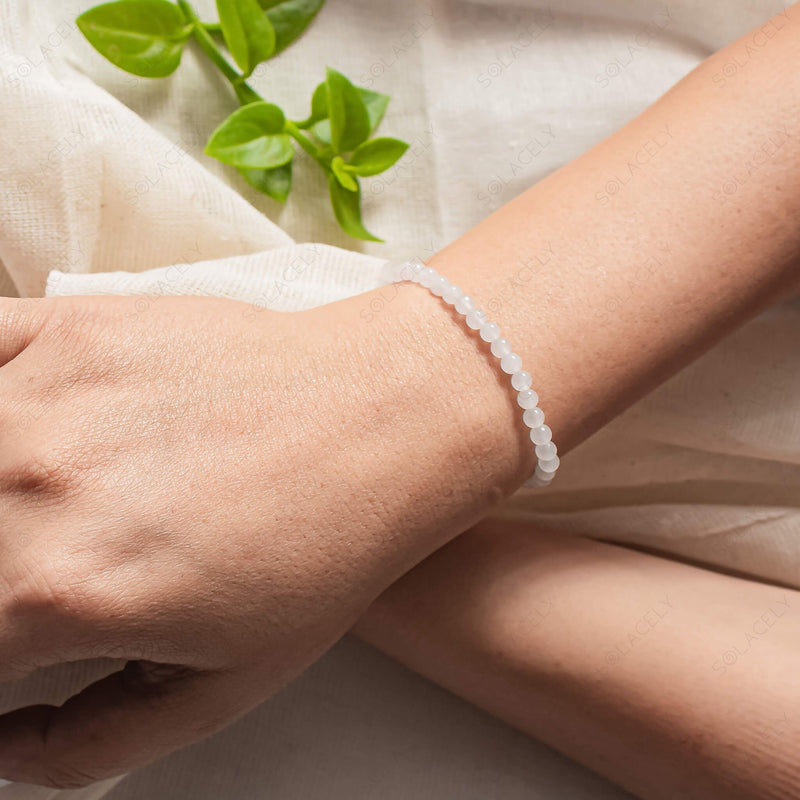
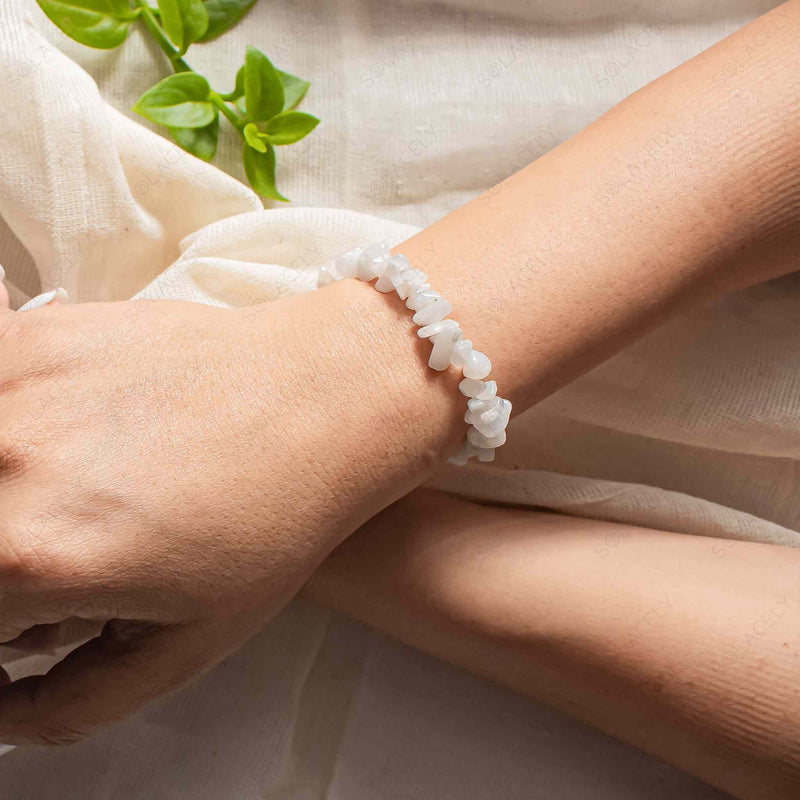
That has a practical consequence: moonstone needs movement and daylight to do anything. A bracelet or pendant earns far more from the stone than a piece kept in a drawer. The moonstone guide covers the varieties in more depth.
What amethyst brings
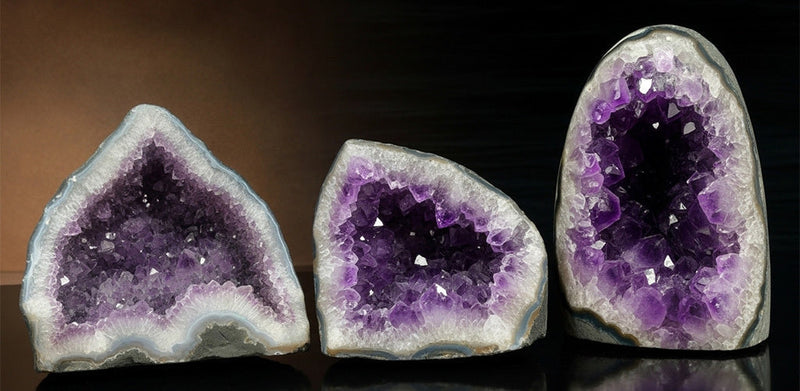
Amethyst is the purple variety of quartz, coloured by iron held within the crystal structure. At 7 on the Mohs scale with no cleavage, it is one of the most forgiving stones in any collection and it takes daily wear in any format.
In this pairing it plays the more practical role. It is the harder, cheaper, more durable half, and it is the one that will still look right after years of handling. That matters when the other half of the set needs protecting.
Its one care requirement is light. Long hours of strong direct sun soften the purple over months, so keep it back from a bright sill. The amethyst guide covers the colour ranges and what drives price.
Comparing the two
| Amethyst | Moonstone | |
|---|---|---|
| Mineral | Quartz, coloured by iron | Potassium feldspar |
| What you are buying | Depth and evenness of purple | Strength of the floating sheen |
| Hardness | 7 Mohs, no cleavage | 6 to 6.5 Mohs, distinct cleavage |
| Traditionally kept for | Settling, the end of the day | Cycles, intuition, beginnings |
| Best format | Anything, including daily rings | Pendant or bracelet, where it moves |
| Avoid | Prolonged direct sunlight | Ultrasonics, steam, sharp knocks |
Store them separately. Amethyst at 7 will scratch moonstone, and moonstone's cleavage means a knock does more than a scratch would. Check anything new against the Mohs hardness scale before adding it to the same pouch.
How the pair is used
The practices here are quieter than most, and almost all of them happen at home.
- Both at the bedside. The most common arrangement by a wide margin.
- Amethyst held, moonstone worn. One marks the transition, the other stays with you overnight.
- Cycle-aware practice. Moonstone kept where a journal or calendar lives, which is its traditional use.
- Dream work. Both placed together on a nightstand rather than in bedding, where a hard object simply wakes you.
If sleep specifically is the reason you are here rather than the wider practice, crystals for insomnia covers the bedside set and, more usefully, when to stop treating it as a crystal question.
Choosing a moonstone worth having
Moonstone varies enormously in quality and the difference is easy to see once you know what to look for. Tilt a piece slowly under a single light and watch the sheen travel.
A good piece shows a broad blue glow that moves across most of the stone. A weak one shows a narrow band that appears at one angle and vanishes at the next, or a milky whiteness with no movement at all. Both are genuine moonstone, so this is quality rather than authenticity.
Rainbow moonstone, which is technically a labradorite rather than the classic adularia, shows flashes of several colours and is widely sold under the moonstone name. It is a lovely material and entirely legitimate, but it is worth knowing they are not quite the same stone.
Care and cleansing
Warm water, mild soap, a soft cloth and a full dry suits both stones. Neither needs anything more elaborate and neither should meet a household cleaner.
Moonstone carries the specific cautions. Never use an ultrasonic or steam cleaner on a feldspar, since the cleavage makes it vulnerable to vibration, and take moonstone jewellery off before anything that risks a knock. A weekly wipe keeps the sheen clear, since the effect depends on a clean surface.
For energetic cleansing, moonlight is the traditional match for both and is also the gentlest option physically. Skip prolonged sun, which is unkind to amethyst's colour, and skip salt water, which does neither stone any favours.
Who this pairing suits
It suits people whose difficulty is switching off rather than getting going. That is a narrow brief and it is exactly why the set works: two stones pointed at the same moment do more than two stones pointed at different ones.
It suits less well anyone needing weight or drive. Neither stone is grounding in the way hematite is, and neither is assertive in the way citrine is. If a day feels unmoored rather than overactive, a different set belongs in the drawer.
One practical note in the pairing's favour: it is genuinely inexpensive. Both stones are widely available, neither is rare, and a good working set of two bracelets costs very little. That makes it a sensible first pairing for someone who wants an evening practice without committing much.
The properties described here reflect traditional and cultural belief around crystals. They are offered for reflection and wellbeing and are not medical advice, a diagnosis, or a treatment for any condition, including anything relating to menstrual or hormonal health. If you are managing a health concern, please speak with a qualified healthcare professional. Keep small stones away from young children, and never place crystals in drinking water.
Sources
- Gemological Institute of America, Moonstone Description
- Gemological Institute of America, Amethyst Description
Written by Chetena Sharma. Reviewed by the Solacely editorial team.
Frequently asked questions
About the author


Written by Chetna Sharma, crystal healing practitioner and co-founder of Solacely. Chetna has worked with healing crystals for over a decade and curates Solacely's protective stone collection.