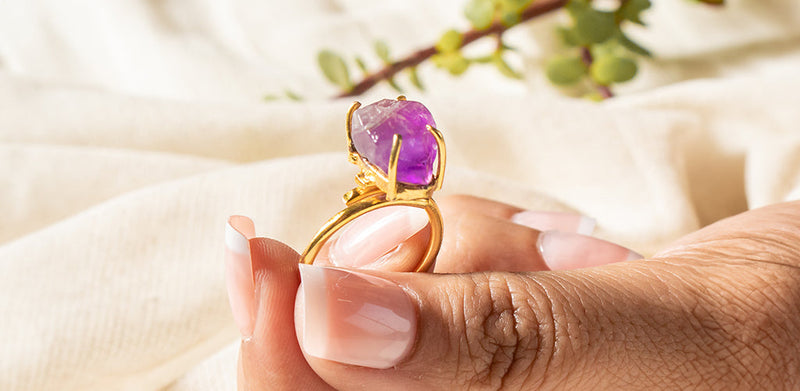
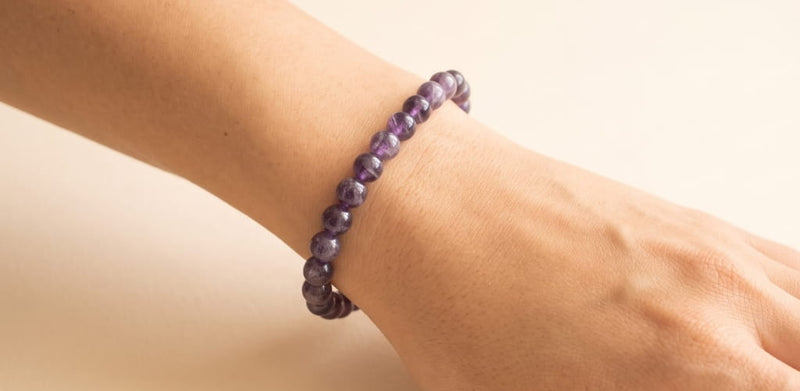
Amethyst jewellery is purple quartz cut and set for wear: rings, pendants, bracelets and earrings. The stone is silicon dioxide, it rates 7 on the Mohs scale, and it is the traditional February birthstone. That hardness is why amethyst is one of the few coloured stones comfortable in everyday jewellery.
Key takeaways
- Amethyst is the purple variety of quartz, silicon dioxide, coloured by traces of iron held inside the crystal structure.
- It rates 7 on the Mohs scale, hard enough for rings, pendants, bracelets and earrings in regular rotation.
- Amethyst is the traditional February birthstone and the customary gemstone gift for a sixth wedding anniversary.
- Colour runs from pale lilac to deep violet with red or blue flashes, and colour drives quality far more than size.
- Brazil, Uruguay, Zambia and Bolivia are among the best known sources, and the material is mined on almost every continent.
- Prolonged direct sunlight can pale amethyst, so a sunny windowsill is the wrong place to keep or charge a piece.
What is amethyst jewellery?
Amethyst jewellery is any piece set with amethyst, the purple variety of quartz. Chemically it is silicon dioxide, the same material as clear quartz and rose quartz, coloured by traces of iron within the crystal structure. It measures 7 on the Mohs scale, and it has been worn since antiquity.
Structurally, amethyst sits in the trigonal crystal system. It has no cleavage and breaks with a conchoidal fracture, the shell shaped chip you see on flint. Specific gravity sits near 2.65, and gemmological reference works give quartz a refractive index of roughly 1.54 to 1.55.
The purple itself comes from iron. Trace iron sits in the silica framework, and natural irradiation underground shifts it into the state that produces the violet we recognise. Because the effect depends on very small quantities, a single crystal can run from near colourless at the base to deep purple at the tip.
Amethyst is mined widely. Brazil and Uruguay supply the large geodes and cathedral pieces, Zambia is known for richly saturated rough, and Bolivia produces ametrine, a natural purple and golden combination inside one crystal. For the wider story of the stone, our guide to amethyst crystal meaning, properties and benefits is the place to start.
Which amethyst jewellery format wears best day to day?
Pendants and earrings wear best day to day, because they rarely meet hard surfaces. Rings take the heaviest knocks, so a protective setting matters most there. At 7 on the Mohs scale amethyst resists everyday scratching well, since household dust is largely quartz of about the same hardness.
| Format | How it wears | Best suited to |
|---|---|---|
| Ring | Highest impact of any format, exposed corners take the risk | Bezel or low settings for daily wear, raised solitaires for occasions |
| Pendant | Very little contact, hangs clear of most surfaces | Daily wear, larger stones, cabochons and raw points |
| Stud or drop earrings | Almost no contact, mainly at risk when stored loose | Daily wear at any stone size |
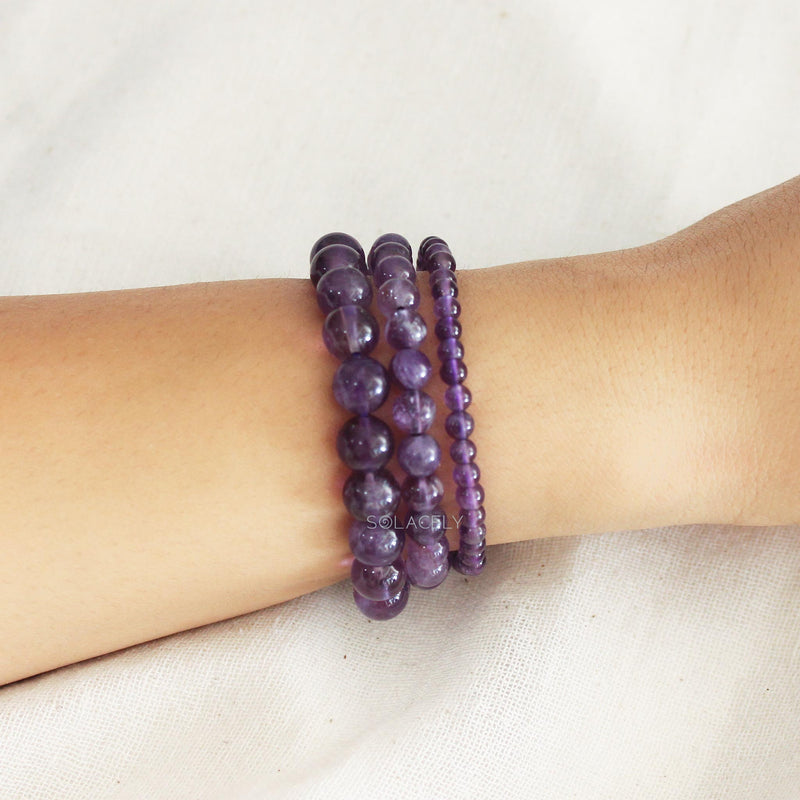
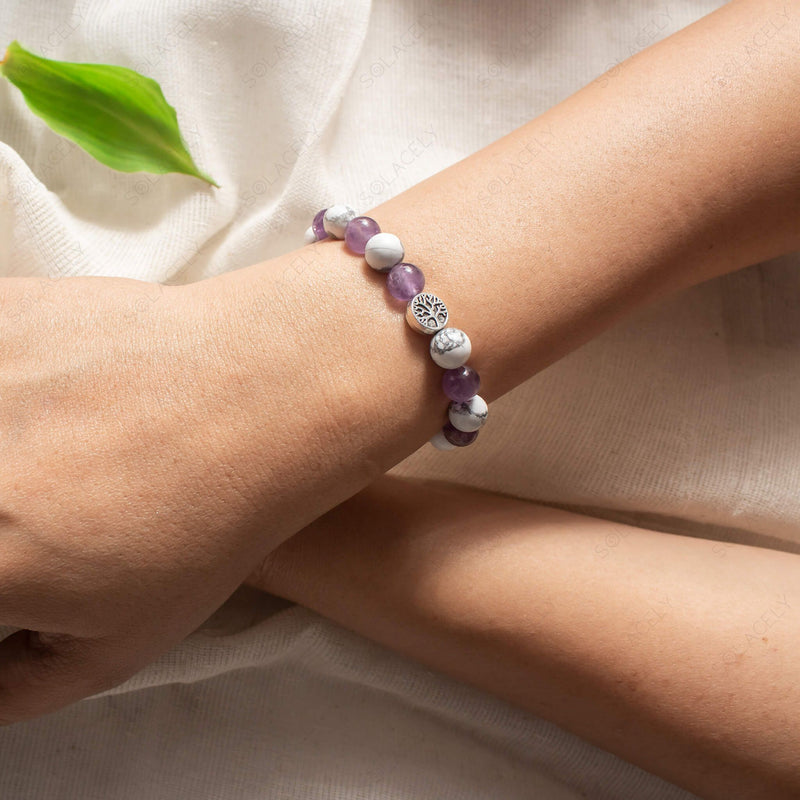
| Beaded bracelet | Constant brushing against desks, sleeves and door frames | Frequent wear, round polished beads over sharp facets |
| Link or tennis bracelet | Moderate contact, small stones sit lower than you expect | Regular wear if the settings are bezels or protected prongs |
Rings deserve the most thought. A stone that stands proud of the band looks wonderful and catches on coat pockets, so a bezel or half bezel is the practical choice for every day. Our guide to wearing an amethyst ring goes further into shapes and styles.
Beaded bracelets are the format most people start with, and they behave differently from set jewellery. Faceted beads show scuffs on their edges sooner than round polished ones. Elastic cord also ages, especially with soap and hand cream, so plan on restringing a well loved bracelet every year or two.
What makes a good amethyst colour?
Colour decides an amethyst more than carat weight does. The material collectors prize most is a strong, evenly saturated purple that holds its colour under different lighting, often with flashes of red or blue. Pale lilac stones carry the trade name Rose de France. Both are amethyst, so the choice is aesthetic.
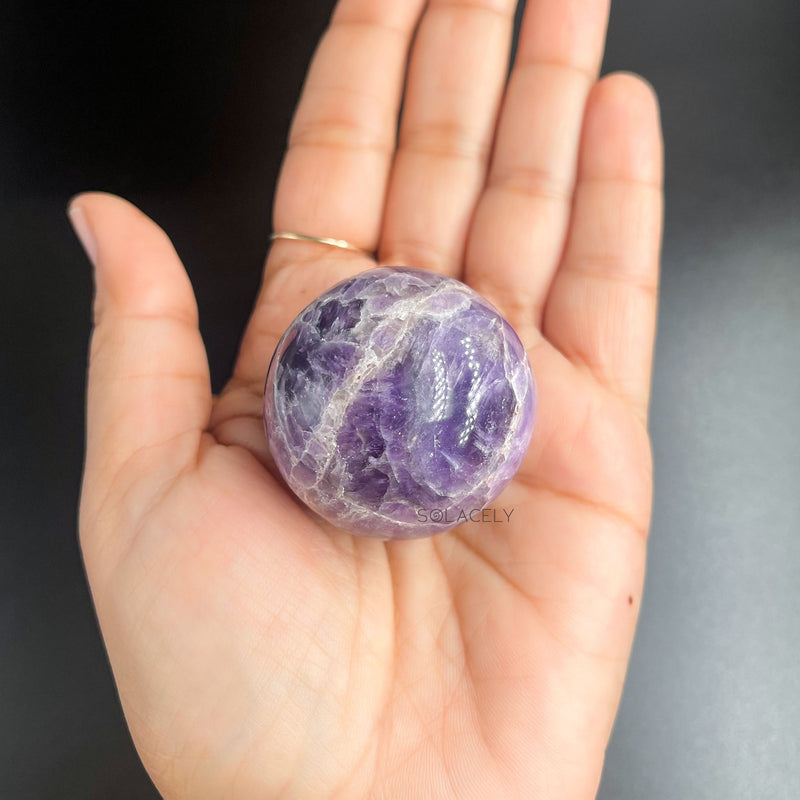
Amethyst grows in colour zones. Purple concentrates in bands and near the crystal tip, which is why a cutter orients the rough carefully to spread that colour evenly across the finished stone. Look at a faceted amethyst face up and you are usually seeing a deliberate piece of judgement about where the deepest zone sits.
The stone is also pleochroic, meaning it shows slightly different tones from different directions. Practically, that shows up in how a stone reacts to light. Some amethysts read as vivid purple in daylight and drift greyish or brownish under a warm bulb. Others hold their colour in both. Test any piece under a lamp before you commit.
Warming quartz to settle and even out its colour is a long established and entirely stable practice right across the coloured stone trade, and it is part of how good gem material reaches the counter. What matters when you buy is much simpler. Choose the shade you actually want to look at, on your own skin, in the light you live in.
Which settings and metals suit amethyst best?
Bezel and half bezel settings protect amethyst best, because metal wraps the girdle where chips begin. Sterling silver and white gold push the purple towards a cooler, bluer note, while yellow gold warms it towards red. Neither is more correct. Match the metal to the shade of the stone you chose.
Settings
A bezel gives the most protection and suits cabochons and smooth cuts especially well. Four and six prong settings show more of the stone and let light in from the sides, which flatters deeper purples. Halo settings ring the centre stone with small accents and make a modest amethyst read larger. Raw and rough set points are a different look entirely, more sculptural, and best kept to pendants.
Metals
Sterling silver is the most common partner for amethyst and the most affordable. It tarnishes, so a polishing cloth in the drawer earns its keep. White gold is usually rhodium plated, and that plating thins over the years and can be redone. Yellow and rose gold warm the stone, and rose gold flatters lavender shades particularly well.
One note on mixed pieces. If an amethyst sits alongside softer stones such as opal or pearl, care for the whole piece at the pace of the softest material in it.
How do you get amethyst jewellery sizing right?
Measure before you buy. Take a ring size at the end of the day, when fingers are at their largest, and warm rather than cold. For pendants, a 45cm chain sits at the collarbone and a 50cm chain falls just below it. Beaded bracelets need your wrist measurement plus roughly one centimetre.
Rings
Ring size shifts with heat, salt and time of day, so measure twice on different days. Wide bands feel tighter than narrow ones at the same size, so go up a half size for anything above about 6mm wide. Resizing a ring with a set stone is possible, though a jeweller has to work around the heat near an included amethyst.
Chains and pendants
Chain length changes where the stone lands, and that changes how often it knocks against a desk edge. A heavier pendant wants a sturdier chain than it usually arrives on. Check the bail opening against the chain thickness before you pair the two yourself.
Bracelets
Wrap a strip of paper round your wrist, mark it, measure it flat, then add about a centimetre for a comfortable stretch bracelet. Bead size changes the look more than most people expect: 6mm reads delicate, 8mm is the everyday standard, and 10mm makes a statement. If you are deciding which side to wear it on, our note on which hand to wear an amethyst bracelet covers the usual practice.
What is amethyst jewellery traditionally worn for?
Amethyst is traditionally worn for calm, clear thinking and restful sleep. In crystal tradition it is linked with the third eye and crown chakras, and people reach for it during meditation or a demanding stretch of work. It is also the February birthstone and the customary sixth wedding anniversary gemstone.
Amethyst has been set into jewellery for thousands of years. Greek and Roman workshops carved it into intaglios and beads, and it later appeared in ecclesiastical rings and royal collections across Europe. Purple carried weight as a colour long before it was easy to produce.
That association carries into how people wear it now. A pendant sits near the throat and stays in your eyeline in a mirror. A ring on the non dominant hand catches your attention while you type. Many people find that keeping the stone visible is the point.
If you are drawn to the colour as much as the stone, our overview of purple crystals and what they are associated with sets amethyst alongside its relatives. And for gifting, our February birthstone guide covers the birthstone tradition in full.
How do you care for amethyst jewellery?
Warm water, a drop of washing up liquid and a soft brush handle almost all amethyst cleaning. Rinse and dry with a lint free cloth. Keep the piece out of prolonged direct sunlight, which can pale the colour over time, so a sunny windowsill is the wrong place to charge it.
Skip steam cleaners entirely. Avoid ultrasonic cleaners on fracture filled or heavily included stones, because the vibration can travel along an inclusion that is already inside the gem. If you are unsure how included your stone is, clean it by hand.
Order of dressing matters. Perfume, hairspray and hand cream leave a film that dulls both stone and metal, so put jewellery on last and take it off first. Remove rings and bracelets for washing up and swimming, since chlorine attacks metal alloys and softens the adhesives used in some settings.
Store pieces separately in soft pouches or a lined box. Amethyst at 7 will scratch softer stones, and sapphire, topaz and diamond will scratch amethyst, so keeping everything apart solves both problems at once. Have prong settings checked once a year by a jeweller, particularly on a ring you wear daily.
For cleansing in the crystal sense, choose methods that leave the colour alone. Indirect moonlight, sound, incense or herb smoke, or simply wiping the piece down while you set your intention. All of these suit amethyst, and none involves hours of hard sun.
This article is shared for general interest and reflects long standing crystal tradition rather than medical guidance. Crystals are not a treatment for any physical or mental health condition, and they should never replace or delay care from a qualified professional. Keep small stones, beads and loose jewellery away from young children and pets, as they are a choking hazard. Never place stones in drinking water, and do not use them to make elixirs. If you have a health concern, please speak to your doctor.
Sources
Written by Chetena Sharma. Reviewed by the Solacely editorial team.
Frequently asked questions
About the author


Written by Chetna Sharma, crystal healing practitioner and co-founder of Solacely. Chetna has worked with healing crystals for over a decade and curates Solacely's protective stone collection.