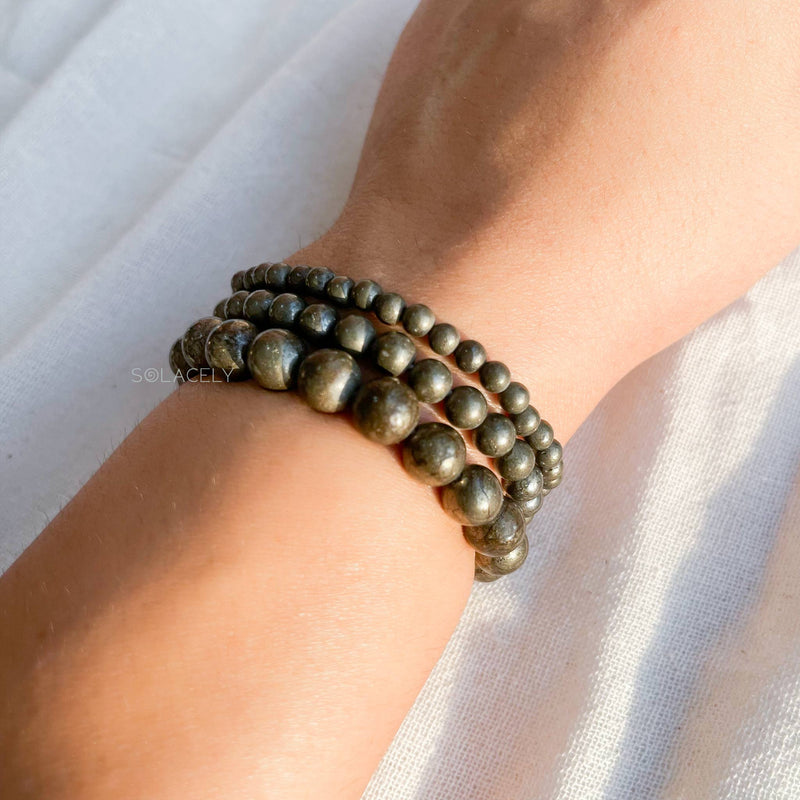
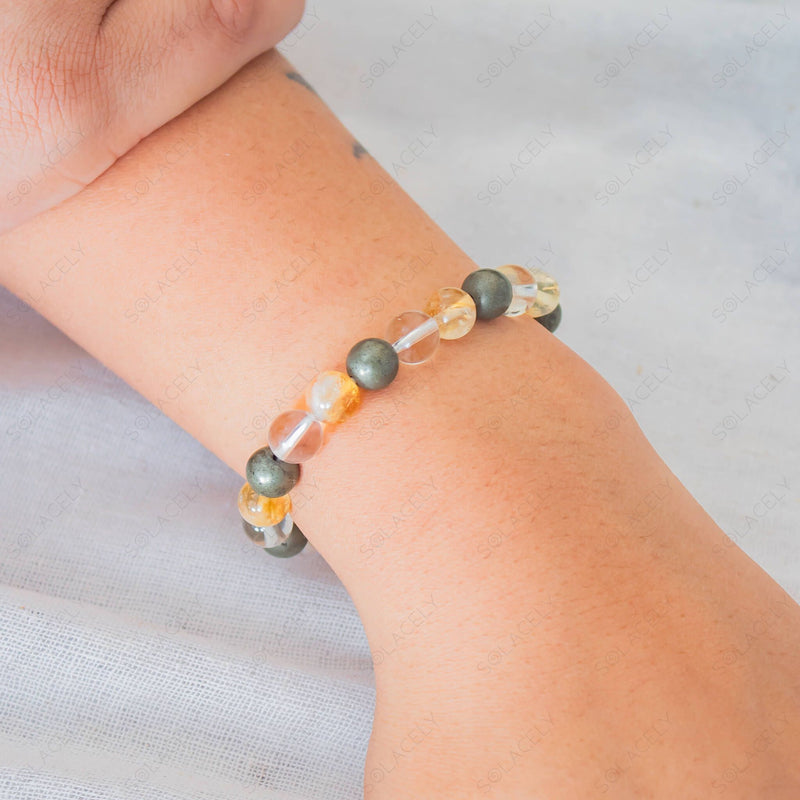
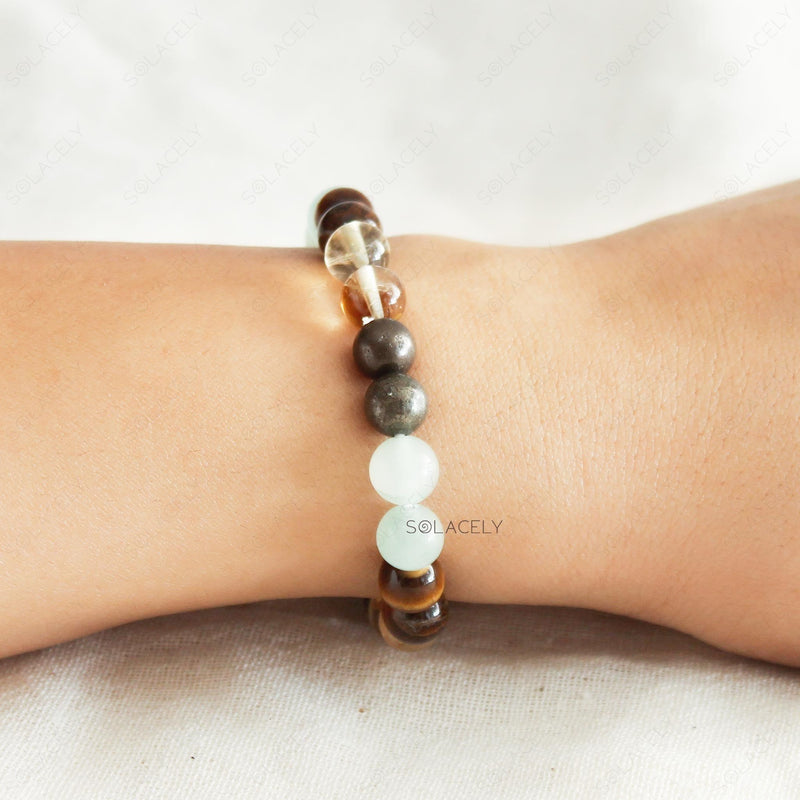
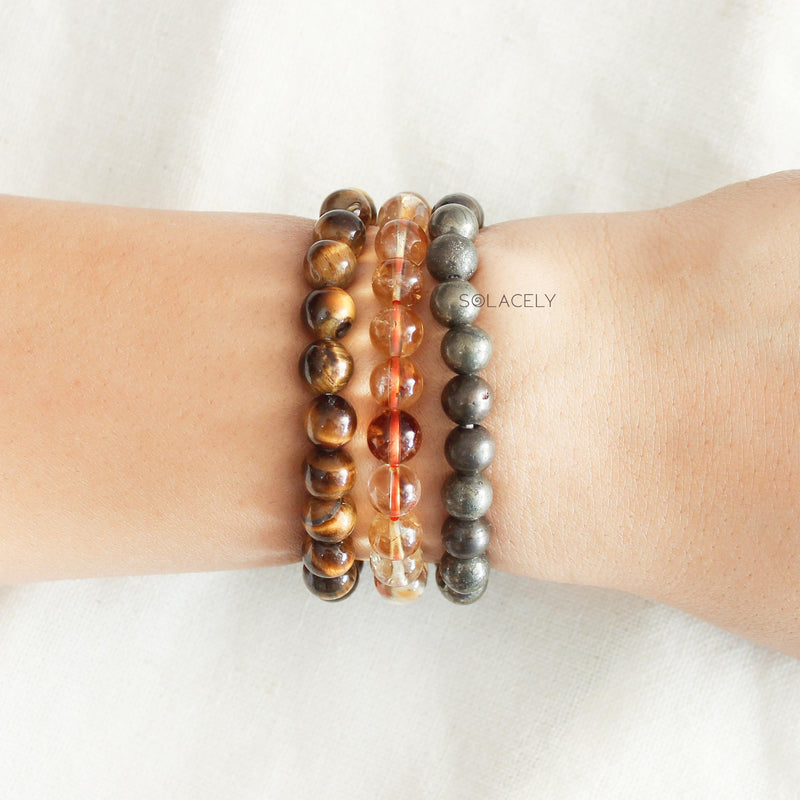
If your pyrite bracelet has darkened since you started wearing it, that is the clearest sign you own the genuine mineral. Pyrite is iron sulphide, and iron responds to air and skin. It dulls, it warms in tone, it develops a patina. Coated glass and painted resin stay bright forever, because there is nothing in them to react.
Key takeaways
- Tarnish is authenticity. Genuine pyrite dulls with time and skin contact. That is the mineral behaving normally.
- Weight is the quickest check. Pyrite is dense and feels heavier than it looks.
- Striations matter. Fine parallel lines on a natural face are a signature of pyrite growth.
- Bright brassy gold and deep grey gold are both pyrite. Shade varies by source and by age.
- The black residue that can appear on your wrist is pyrite dust from ordinary wear, not dirt.
- Ask any seller where the stone came from. Provenance is the question worth asking.
What genuine pyrite does over time
This is the part almost nobody explains, and it is the reason most people worry unnecessarily.
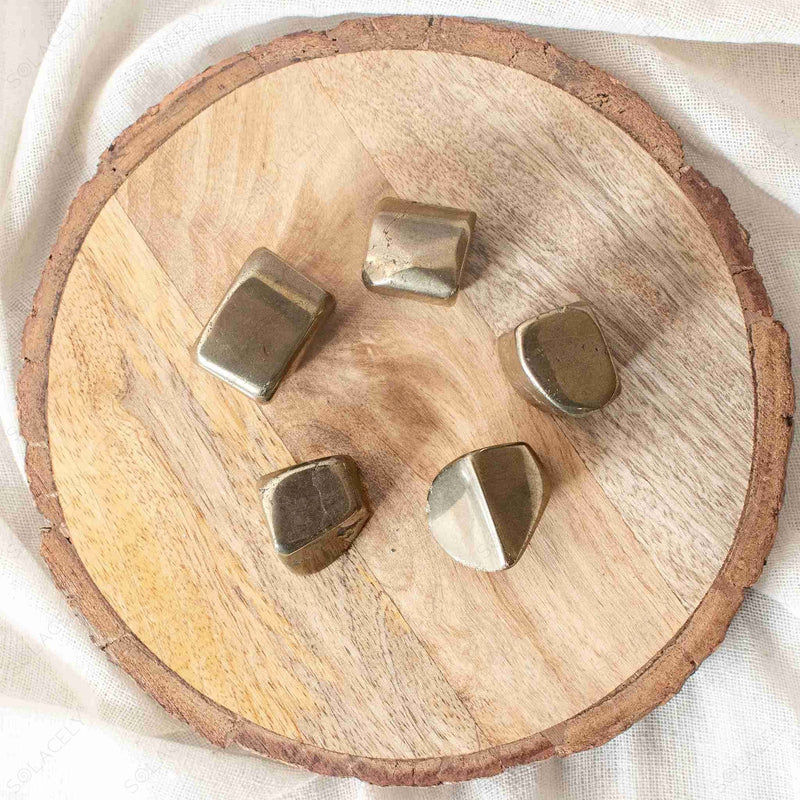
Pyrite is iron sulphide. Iron reacts with oxygen and moisture, so a pyrite bead worn against skin will slowly lose its first mirror brightness and settle into something warmer and deeper. On some beads it shows as a soft grey bloom, on others as a darker gold. It is the same process that gives an old brass door handle its colour, and it is not damage.
What this means in practice: a bracelet that looks identical after a year of daily wear has not been in contact with your skin in the way iron sulphide is. A bracelet that has mellowed has. For the full picture of the mineral itself, our guide to pyrite meaning and properties covers where it forms and why it grows in cubes.
You can slow the process, and that is worth doing. Keep the bracelet dry, take it off before water, and store it away from humidity. Our guide to cleansing pyrite without water covers this properly. What you cannot do is stop it, and you would not want to.
Six ways to recognise genuine pyrite at home
None of these needs equipment. Run two or three and you will know what you are holding.
1. Weight
Pick it up with your eyes closed and it should surprise you. Pyrite has a specific gravity around 5, which is roughly twice that of quartz, so a strand of pyrite beads feels substantially heavier than the same strand in glass or resin. This is the fastest check and the hardest to fake.
2. Lustre
Genuine pyrite has a true metallic lustre, brassy and slightly greenish rather than the flat buttery yellow of gold paint. Turn it under a moving light. Real metal shifts and flashes as the angle changes. A printed or coated surface stays evenly bright from every angle.
3. Temperature
Pick it up cold and it stays cool in your hand for a noticeable moment before it takes your body heat. Minerals conduct heat away from skin. Plastic and resin warm almost immediately.
4. The streak
Drag it across the unglazed underside of a ceramic tile or the back of a mug. Pyrite leaves a greenish black to brownish black streak. It never leaves a gold one, which is the classic point of difference from gold itself.
5. Shape and striations
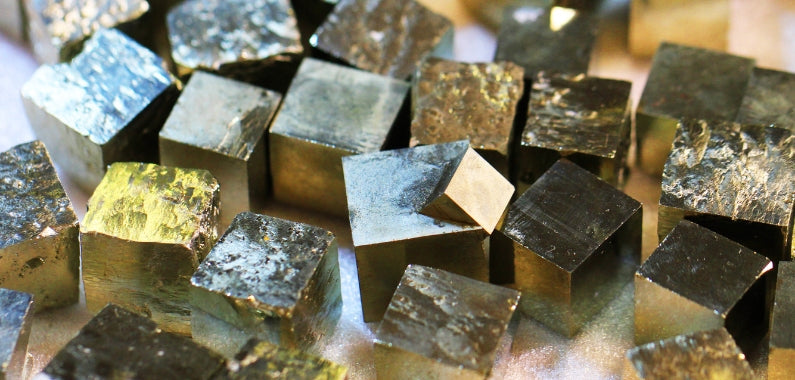
Pyrite grows in remarkably neat cubes, and the faces of natural crystals carry striations: fine parallel lines, like very shallow scratches all running the same way. On polished beads you will often still see them under a bright light if you tilt the bead. They are a growth signature, not a flaw.
6. The scent
Struck sharply against steel, pyrite gives off a faint sulphur smell, like a spent matchstick, and it can throw a spark. That is where the name comes from: the Greek pyr, meaning fire. Worth knowing, though there is no need to strike a bracelet you like.
Why bright gold and dark grey are both pyrite
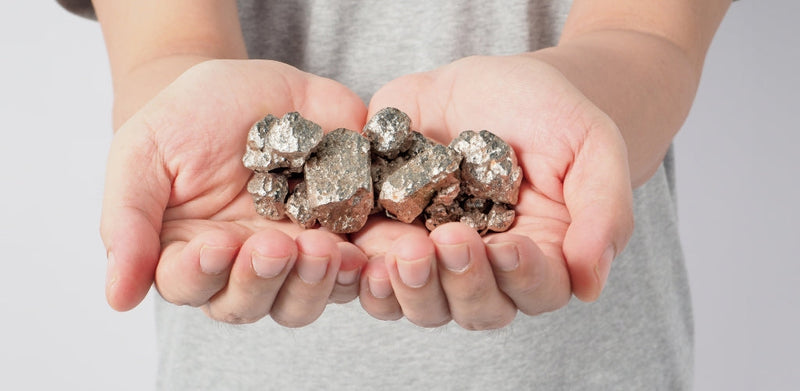
Pyrite varies by where it formed. Peruvian material is often bright and mirror brassy. Other sources run deeper, greyer, closer to old gold. Then age and wear shift it again.
So a bead that looks brighter or darker than a product photograph is usually telling you about its origin and its history, not about its identity. Two beads from the same strand can differ slightly, and a strand you have worn for six months will not match one still in its box.
The black residue on your wrist
Some people notice a faint dark mark on the skin or on a light shirt cuff. That is pyrite dust, produced by ordinary abrasion as the beads move against each other and against your sleeve, and it is normal for a natural stone worn daily.
It wipes off skin easily. It can mark pale fabric, so it is worth knowing before you wear it with a white cuff. Wiping the bracelet with a dry soft cloth every week or two keeps it to a minimum. Wash your hands after handling raw or unpolished pieces.
What to ask when you buy
Three questions tell you most of what you need to know about any seller in this category.
Where did the stone come from? A seller who works with natural material can usually tell you the source region. One who cannot may simply be buying finished strands without asking.
Is there any certification? Not every good stone carries paperwork, but the willingness to provide it says something about how the stock is bought.
Does the price make sense? Pyrite is not a costly mineral, so it does not need to be expensive. But a price well below everything else on the market, paired with no information about origin, is the combination worth pausing on.
Every Solacely pyrite bracelet is natural pyrite, ships with an authenticity certificate, and is cleansed by singing bowl before it is packed.
Your at-home checklist
| Check | Genuine pyrite |
|---|---|
| Weight in the hand | Heavier than it looks |
| Lustre under moving light | Metallic, shifts and flashes |
| First touch | Cool, slow to warm |
| Streak on unglazed ceramic | Greenish black to brownish black |
| Surface detail | Fine parallel striations, cubic habit |
| After months of wear | Mellowed, softened, patinated |
Run these on any bracelet, whoever sold it to you. For more on how pyrite is used and what it is kept for, see our guide to pyrite metaphysical properties.
Knowing what you are holding
The stone was named for fire, and then renamed after somebody's disappointment in a riverbed. Neither name was really about the mineral.
What you have on your wrist is iron and sulphur, grown into cubes underground over a very long time, heavy and bright and slowly going quiet at the edges. Knowing that, and knowing that the dulling is the stone behaving exactly as it should, is its own kind of grounding.
The uses described here reflect traditional and cultural crystal practice. They are not medical claims and are not a substitute for professional healthcare, financial or legal advice.
Sources
Frequently asked questions
About the author


Written by Chetna Sharma, crystal healing practitioner and co-founder of Solacely. Chetna has worked with healing crystals for over a decade and curates Solacely's protective stone collection.