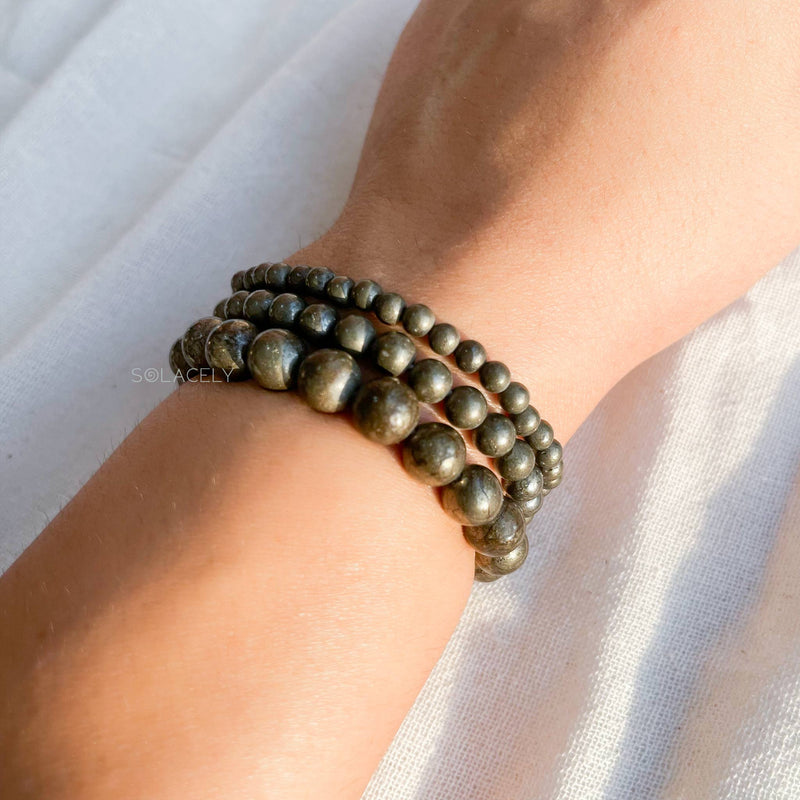
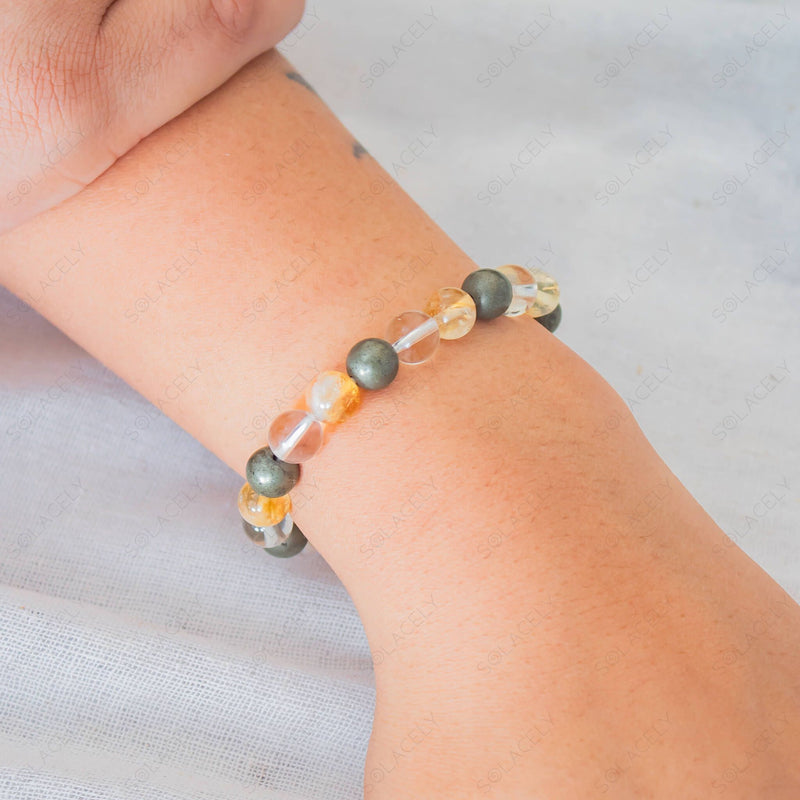
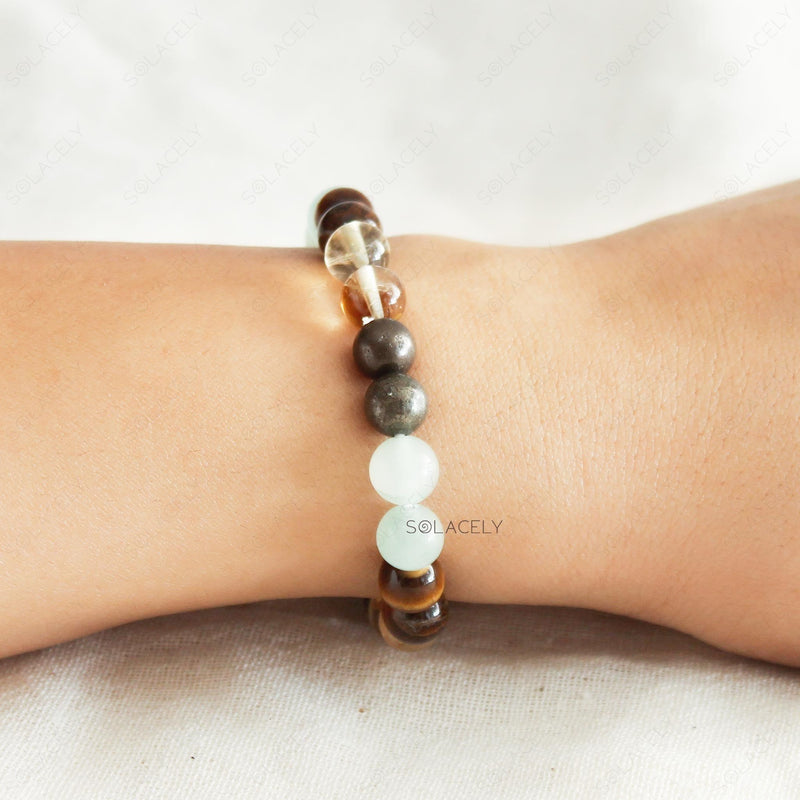
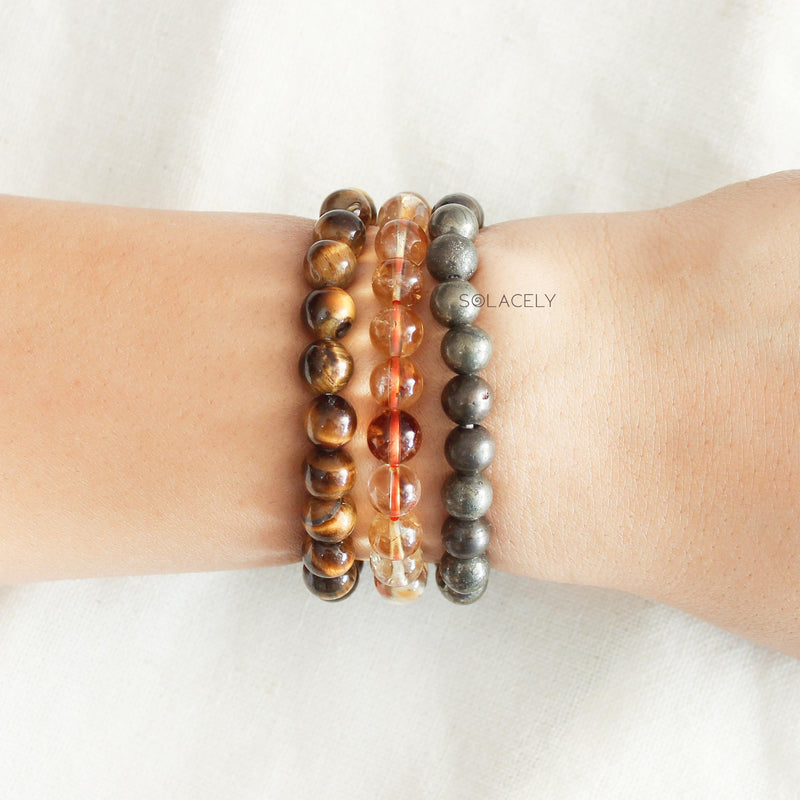
Choose 6mm if you are not sure. It is the middle size, it suits most wrists, and it is the one most people pick first. Bead size changes how a bracelet looks and how much you feel it on your arm. It does not change what the stone is or what it is kept for. A 4mm pyrite bracelet is not a lesser bracelet.
Key takeaways
- 4mm for dainty, everyday, and stacking. Sits neatly under a shirt cuff.
- 6mm is the default. Visible without being a statement.
- 8mm for presence. Pyrite is dense, so an 8mm strand has real weight.
- Bigger beads are not stronger beads. Size is about preference, not potency.
- Measure your wrist, then add a quarter to half an inch for comfort.
- Between two sizes, size up. A slightly loose elastic bracelet lasts longer than a tight one.
What bead size actually changes
Three things: how much of your wrist the bracelet occupies, how much you feel it as you move, and how it sits next to anything else you wear.
That is the complete list. It does not change the mineral, and it does not change what pyrite is traditionally kept for. Readers often assume a bigger bead must be a stronger one, and it is worth saying plainly that it is not. Choose the size you will actually enjoy wearing, because the bracelet you keep on is the one that does the work of reminding you.
4mm, the dainty one
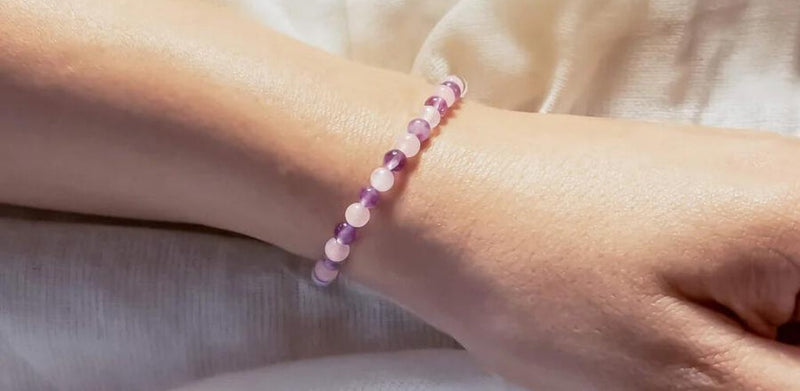
Small, light, and easy to forget you have on. This is the size for anyone who wants the stone present without it announcing itself, and it is the natural choice if you already wear a watch or other bracelets on the same wrist.
It slips under a shirt cuff cleanly, which matters if you work somewhere formal. It also stacks beautifully, because a fine strand reads as a detail rather than as a second bracelet competing with the first.
6mm, the classic
The middle, and the one to choose if you are choosing blind. At 6mm the beads are clearly visible and read as a deliberate piece of jewellery, but the strand is still light enough to wear all day without thinking about it.
If this is your first crystal bracelet, start here. It is the safest size to like, it photographs well, and it works on almost every wrist. Our guide to crystal bracelets for beginners covers the wider first purchase questions.
8mm, the bold one
For presence, and for people who like to feel the weight of a thing. At 8mm the beads are substantial and the bracelet becomes part of how you are dressed rather than a quiet detail.
One honest note. Pyrite is dense, considerably denser than quartz, so an 8mm pyrite strand is heavier than an 8mm strand in most other stones. Some people love that and find it grounding. Others notice it against a desk edge while typing. If you spend your day at a keyboard and you are torn, 6mm is the safer pick.
Measuring your wrist
Two minutes, and you only need a strip of paper.
- Wrap a strip of paper or a soft tape measure around your wrist, just below the wrist bone, where the bracelet will sit.
- Mark where the end meets, lay the strip flat, and read the measurement in inches.
- Add roughly a quarter to half an inch so the bracelet moves comfortably rather than gripping.
- Match that figure to the size chart below.
| Size | Bracelet length |
|---|---|
| S | 6 inches |
| M | 6.5 inches |
| L | 7 inches |
| XL | 7.5 inches |
| XXL | 8 inches |
All three bead sizes and all five wrist sizes are on the Pyrite Bracelet product page, along with the option of a plain strand or one finished with a pyrite cube charm.
Between two sizes? Size up.
Always. An elastic bracelet that sits a little loose will outlast one that is stretched taut every time you put it on, because the cord is under less tension at rest and less strain going over your hand. A tight bracelet also traps sweat against the beads, which pyrite in particular does not enjoy.
A note on stacking
If you plan to wear this with other bracelets, mixing bead sizes usually looks better than matching them. A 4mm strand next to an 8mm one reads as considered. Two 6mm strands side by side can read as accidental.
A common arrangement is one larger bead size as the anchor with one or two finer strands beside it. For which stones actually belong together, see our guide to pyrite crystal combinations, and for wider bracelet styling our roundup of bracelets for women.
The right size is the one you forget
There is no wrong answer in a dropdown of three numbers. The right size is the one that stops being a decision the moment it is on your wrist, and then catches the light in a meeting six weeks later and reminds you what you bought it for.
The uses described here reflect traditional and cultural crystal practice. They are not medical claims and are not a substitute for professional healthcare, financial or legal advice.
Sources
Frequently asked questions
About the author


Written by Chetna Sharma, crystal healing practitioner and co-founder of Solacely. Chetna has worked with healing crystals for over a decade and curates Solacely's protective stone collection.