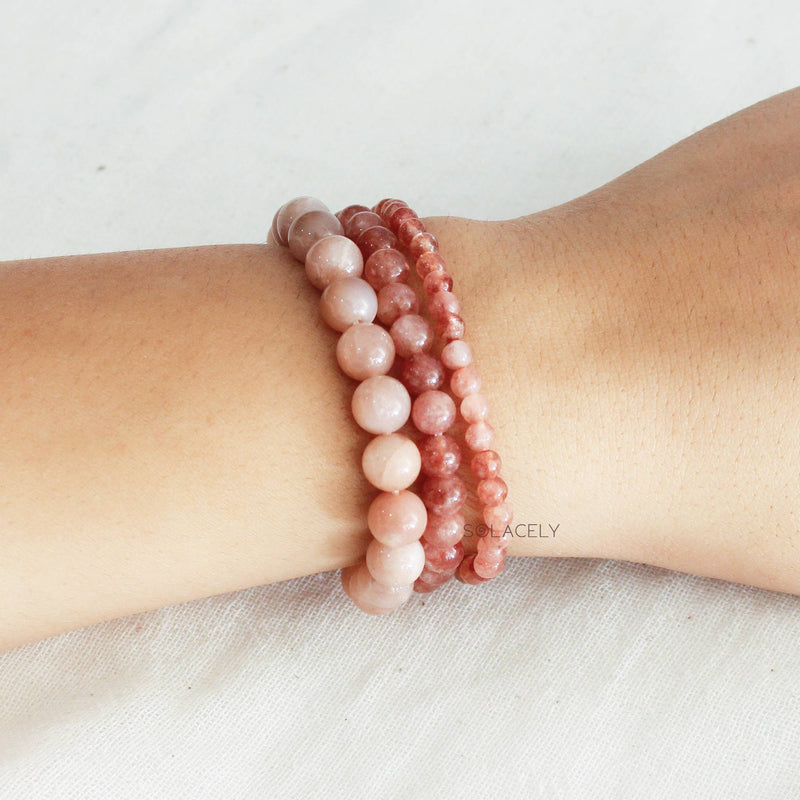
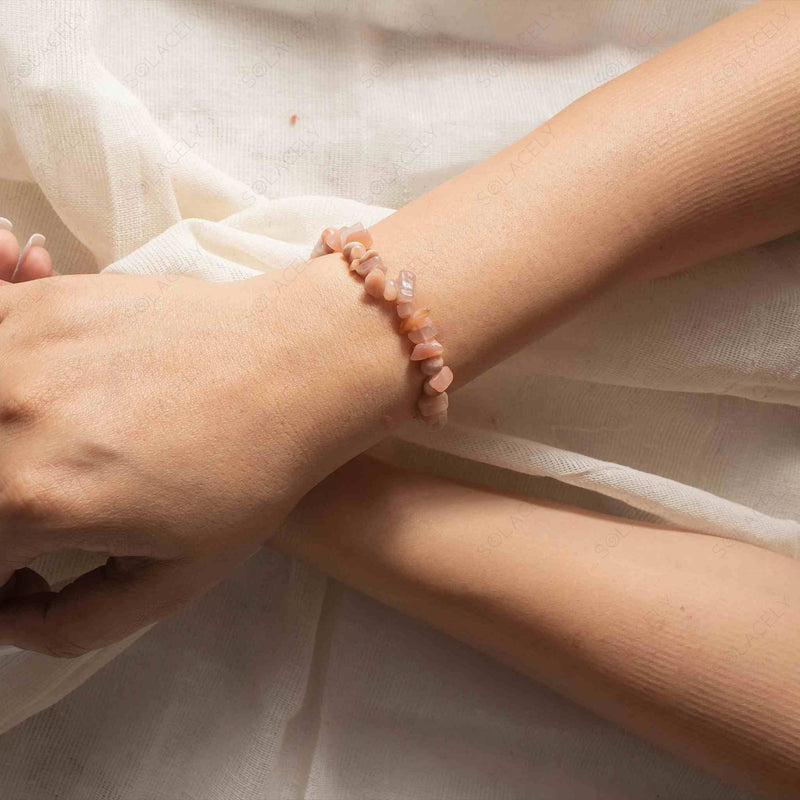
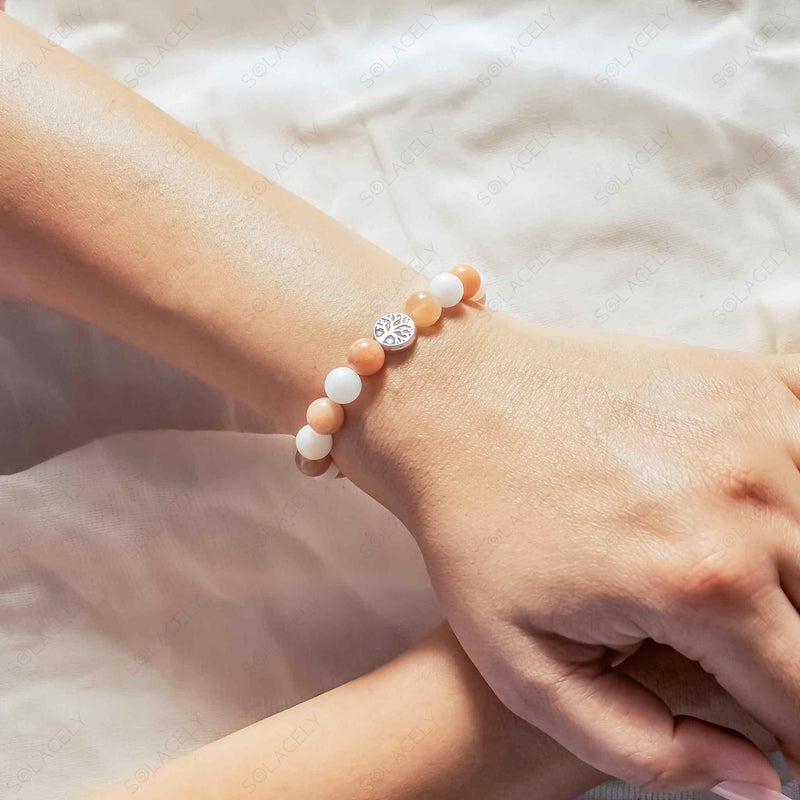
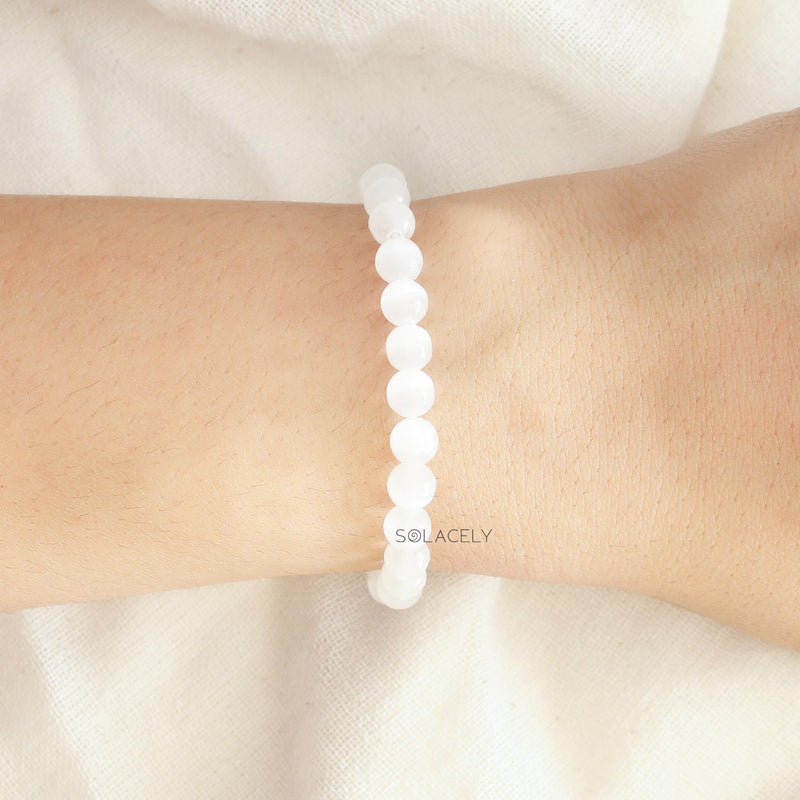
Sunstone and selenite divide the day between them. Sunstone is worn out into the world for warmth and visibility; selenite stays at home as the surface everything is rested on at night. That practical rhythm is why this pairing sticks where more abstract ones lapse.
Key takeaways
- Sunstone travels, selenite stays home. The pairing has a built-in daily cycle.
- Sunstone's flash, called aventurescence, comes from reflective copper or hematite platelets inside the feldspar.
- Selenite dissolves in water. Never rinse it, never soak it, and keep it out of humid rooms.
- Selenite is extremely soft at 2 on the Mohs scale, the reference point for a fingernail.
- Store them separately, since sunstone will scratch selenite easily.
Why the pairing works
Most recommended combinations pair two stones by meaning and leave the practicalities to sort themselves out. This one is organised around a routine instead, which is a large part of why people who adopt it tend to keep it.
Sunstone is the daytime half. It is kept for warmth, optimism and visibility, and because its flash depends on movement it genuinely belongs on a moving wrist rather than a shelf. Wearing it is not optional decoration; it is how the stone works.
Selenite is the evening half. It is kept for clearing, and in practice that means a plate or slab on a bedside table that the day's jewellery gets rested on overnight. Wear it, then rest it. That is the whole practice.
What sunstone actually is
Sunstone belongs to the feldspar group, and its defining feature is entirely optical. Geology.com explains that the glitter comes from minute reflective inclusions of copper or hematite suspended in parallel planes within the crystal, catching light as the stone moves.
That effect is called aventurescence, and it is the whole basis of the stone's appeal. Without it, sunstone is fairly plain peach-coloured material, which is why a piece that stays flat as you turn it is not worth paying for.
It sits around 6 to 6.5 on the Mohs scale with the cleavage planes common to feldspars, so a bracelet or pendant suits it far better than a ring. The sunstone guide covers the varieties and where the good material comes from.
What selenite actually is, and its one rule
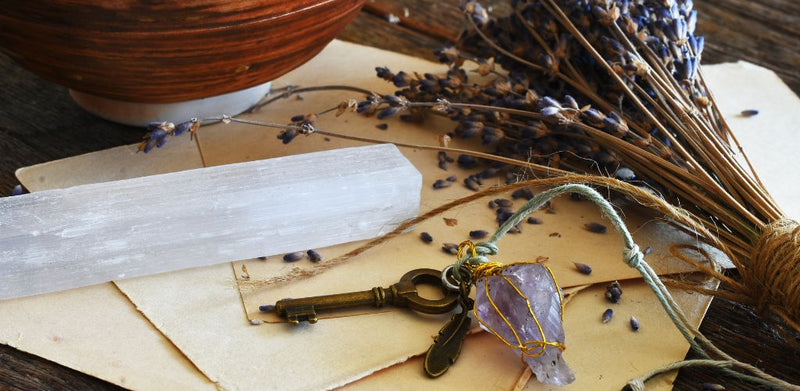
Selenite is a variety of gypsum, and Geology.com describes gypsum as an evaporite mineral formed as mineral-rich water dries out. Two consequences follow, and both matter more than any metaphysical claim.
The first is softness. Selenite sits at 2 on the Mohs scale, which is the reference point for a fingernail, meaning essentially everything else you own will scratch it. Give it its own space and dust it with a dry soft brush.
The second is the water rule, and it is absolute. Gypsum is water soluble, so selenite genuinely degrades when wet. A rinse dulls the satin finish, repeated wetting pits it, and a humid bathroom will slowly ruin a piece over months. The selenite guide covers this in full.
Comparing the two
| Sunstone | Selenite | |
|---|---|---|
| Mineral | Feldspar | Gypsum |
| Hardness | 6 to 6.5 Mohs | 2 Mohs, fingernail soft |
| Water | Warm soapy water is fine | Never. It dissolves |
| Traditionally kept for | Warmth, optimism, visibility | Clearing and resetting |
| Where it belongs | Worn, out in daylight | At home, as a plate or tower |
| Main risk | Cleavage, so avoid knocks | Moisture of any kind |
The hardness gap is the largest of any pairing commonly recommended, so storage genuinely matters here. Sunstone will mark selenite immediately if the two share a pouch.
How to run the daily cycle
The routine is simple enough to keep, which is the point.
- Morning. Sunstone goes on, ideally on the wrist you gesture with, where the flash catches your eye.
- Through the day. Nothing to do. Movement is what the stone needs.
- Evening. The bracelet comes off and rests on the selenite plate overnight.
- Weekly. A wipe for the sunstone with a soft cloth, a dry dusting for the selenite.
That last step matters more than it sounds. Sunstone's flash depends on a clean surface, so a piece worn daily and never wiped gradually looks duller than it should, which people often mistake for the stone losing something.
Buying both without getting caught
Sunstone is imitated more than most stones because the effect is easy to fake. Goldstone is manufactured glass with copper flecks in it, sold as sunstone constantly. The tell is the pattern: real sunstone's sparkle is uneven and concentrated in places, while goldstone's glitter is perfectly uniform with identical flecks throughout.
With selenite, almost every white tower and plate on the market is technically satin spar, a fibrous variety of gypsum. Both are gypsum, both behave identically, and the trade uses the names interchangeably, so nobody is cheating you. What is worth checking is condition: look along a wand for hairline splits, and avoid chalky white patches, which mean the piece has already met moisture.
Neither stone is expensive, so buy on condition rather than hunting for a bargain. A well finished sunstone bracelet and a clean satin spar plate together cost very little and will last indefinitely if kept apart and kept dry.
Who this pairing suits
It suits people who want a routine rather than a collection. The wear-it, rest-it cycle gives this pair a daily shape that most crystal combinations simply do not have, and that structure is the reason it survives past the first fortnight.
It also suits anyone coming out of a flat stretch. Sunstone is a lifting stone rather than a calming one, so the set works best for somebody who feels dulled rather than agitated. If the difficulty is anxiety, a grounding stone belongs in the mix instead.
What it will not do is carry a heavy week on its own. The cycle is a marker for winding down and starting again, and that is a fair and useful thing for two objects to do. For the manifestation framing of the sunstone half, see sunstone for manifestation.
Common mistakes with this pair
Three things go wrong repeatedly, and all three are avoidable.
- Rinsing the selenite. The single most common way a plate gets ruined. It never needs washing.
- Storing them together. Sunstone at 6 will mark selenite at 2 within days in the same pouch.
- Keeping the sunstone in a drawer. The flash needs movement, so an unworn piece does nothing.
A fourth is subtler. People sometimes buy a large selenite tower because it looks impressive and then have nowhere sensible to rest jewellery on it. A flat plate is the more useful object for this particular pairing, and it costs less.
The properties described here reflect traditional and cultural belief around crystals. They are offered for reflection and wellbeing and are not medical advice, a diagnosis, or a treatment for any condition. If you are managing a health concern, please speak with a qualified healthcare professional. Keep small stones away from young children, and never place crystals in drinking water.
Sources
Written by Chetena Sharma. Reviewed by the Solacely editorial team.
Frequently asked questions
About the author


Written by Chetna Sharma, crystal healing practitioner and co-founder of Solacely. Chetna has worked with healing crystals for over a decade and curates Solacely's protective stone collection.