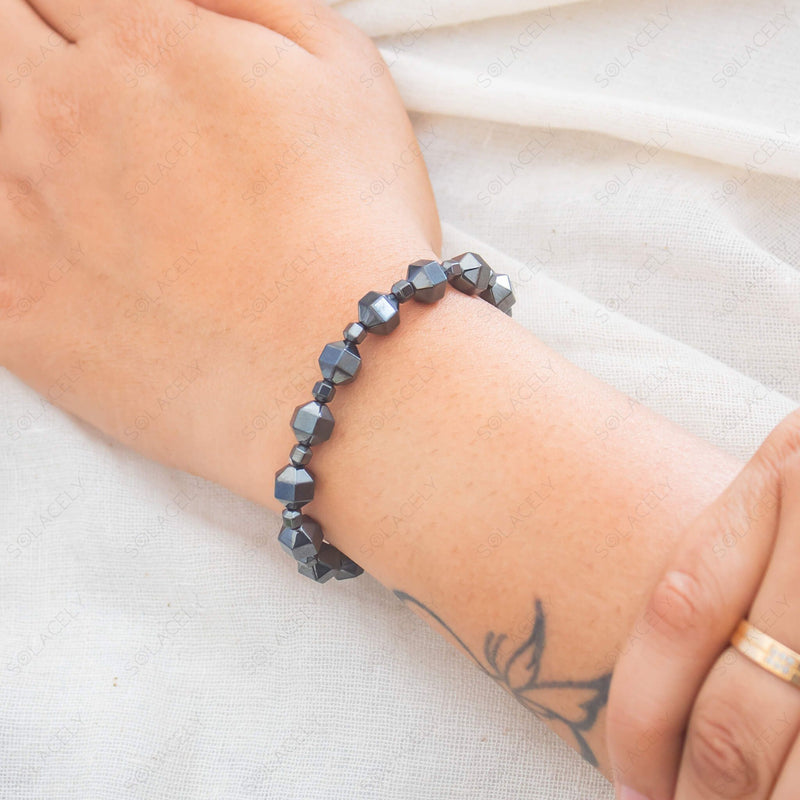
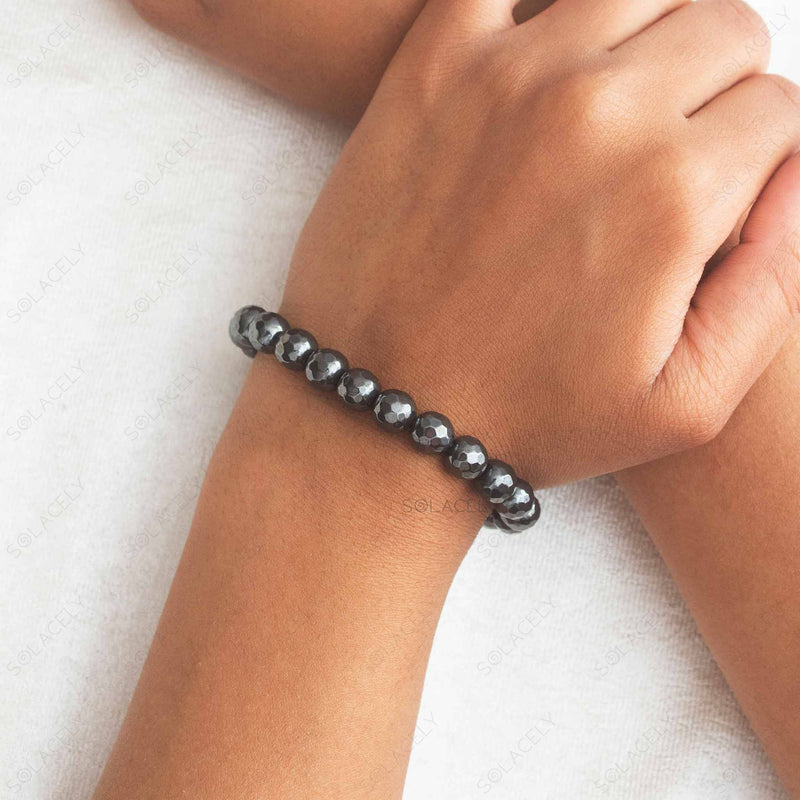
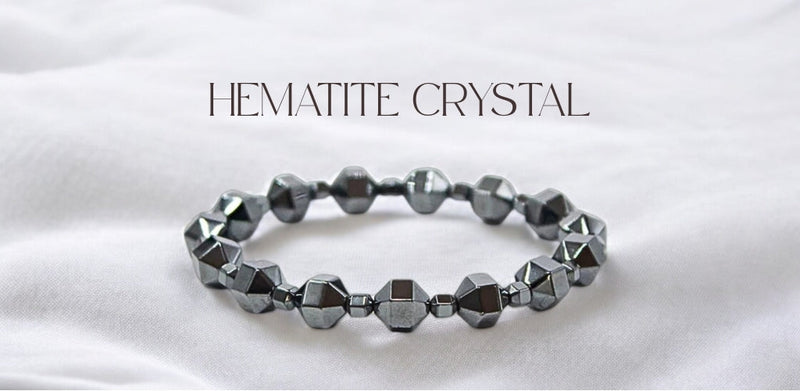
Wear a hematite bracelet on your right wrist. Hematite is a projecting stone, kept for grounding and for holding a line through a demanding day, and the right is the outward facing side. The left is a common and considered alternative when you want the steadiness inward instead.
Key takeaways
- Right wrist for the usual intention: staying grounded against outside pressure.
- Left wrist when the difficulty is feeling scattered in yourself.
- Its weight is the point. Hematite is noticeably heavy, which is why it works as a reminder.
- Keep it dry. It is an iron oxide and damp dulls the mirror polish.
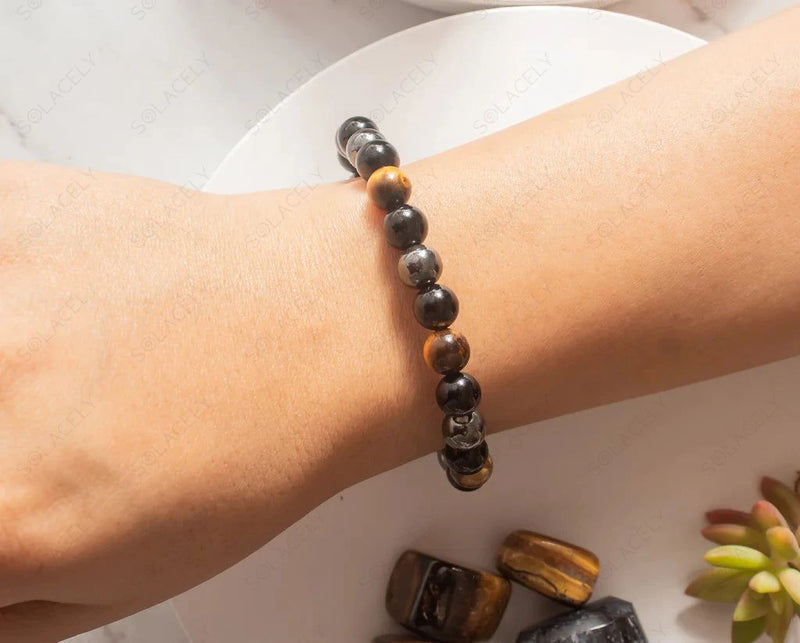
- Pairs closely with black obsidian on hardness, and with lapis lazuli on intention.
Why the right wrist
Crystal practice reads the left as the receiving side and the right as the projecting side. Anything meant to be drawn in goes left. Anything meant to be sent out, held steady or kept at a distance goes right.
Hematite belongs on the right in the usual reading. What it is kept for is staying planted when a day is pulling at you, which is outward facing work: the long shift, the difficult client, the hours where you have to stay level while other people are not. The right wrist matches that intention.
There is something worth knowing about the name. Hematite is iron oxide, and it leaves a rust red streak when scraped against unglazed porcelain, which is why the Greeks called it after their word for blood. A stone that looks like polished steel and marks like iron ore is a fair emblem for what it is worn to do.
When to wear it on the left
The left placement is common enough with hematite that it barely counts as an exception, and the distinction is worth drawing.
Right reads as holding a line against something outside you. Left reads as steadiness taken in. If you bought the stone because of a job, a person or a schedule, wear it right. If you bought it because you feel unmoored, restless or unable to settle in yourself, the left is the better fit.
Some people wear one on each wrist. Hematite is inexpensive enough that doubling up is realistic, and the arrangement reads as grounded on both sides rather than directional.
Once you know which wrist feels right for wearing Hematite, you can also consider how you want the bracelet itself to reflect your preferences and intentions. A customized stone bracelet gives you the flexibility to choose a combination that feels personally meaningful.
The weight is doing the work
This is the practical reason hematite suits the wrist better than most grounding stones, and it is easy to overlook.
Hematite is dense. A hematite bracelet is noticeably heavier than the same beads in quartz or agate, and it is cool to the touch for longer. That means you feel it, all day, without having to remember it. For a stone whose entire job is to remind you to stay planted, being physically noticeable is not a side effect. It is most of the mechanism.
It also means bead size matters more here than elsewhere. Ten millimetre hematite on a slim wrist can feel like a lot by mid afternoon. Eight millimetre is the safer default.
What to wear with it on the same wrist
| Partner stone | Mohs | What it adds |
|---|---|---|
| Black obsidian | 5 to 5.5 | Closest hardness match, and a sharper boundary |
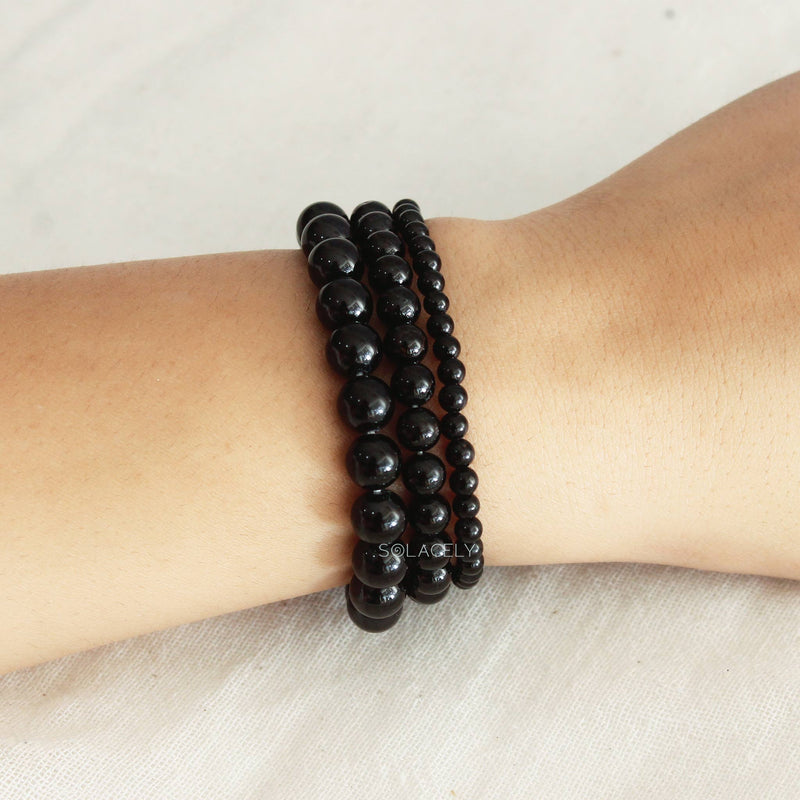
| Black tourmaline | 7 to 7.5 | The same intention, harder wearing |
| Lapis lazuli | 5 to 6 | Clear thinking alongside the steadiness |
| Clear quartz | 7 | Keeps the practice open rather than only braced |
Hematite sits at 5 to 6.5, so quartz family partners at 7 are harder and will gradually mark it where beads meet. Black obsidian and lapis lazuli are the closer matches. We cover the lapis combination in hematite and lapis lazuli.
A note on magnetic hematite
Natural hematite is only weakly magnetic. The strongly magnetic beads widely sold under the name are a manufactured ferrite material with the same mirror finish, and both are worn by plenty of people.
They simply are not the same thing, so if magnetism is what you are after, or specifically what you are not after, it is worth asking before you buy rather than after.
Looking after it
One rule covers almost all of it: keep hematite dry. It is an iron oxide, and prolonged damp dulls the polish and eventually leaves it looking grey rather than mirrored. Take it off for the shower, the pool and the sea, and never leave it soaking in salt water.
Cleansing is straightforward otherwise. Smoke, sound and moonlight are all safe. A dry soft cloth brings the shine back, and that is genuinely all the maintenance a hematite bracelet needs.
Where to go next
For the rule applied across every stone, see our pillar guide to which hand to wear your crystal bracelet. For what the stone is and what it is kept for, see hematite meaning, properties and benefits.
The uses described here reflect traditional and cultural crystal practice. They are not medical claims and are not a substitute for professional healthcare or advice.
Sources
Written by Chetena Sharma. Reviewed by the Solacely editorial team.
Frequently asked questions
About the author


Written by Chetna Sharma, crystal healing practitioner and co-founder of Solacely. Chetna has worked with healing crystals for over a decade and curates Solacely's protective stone collection.