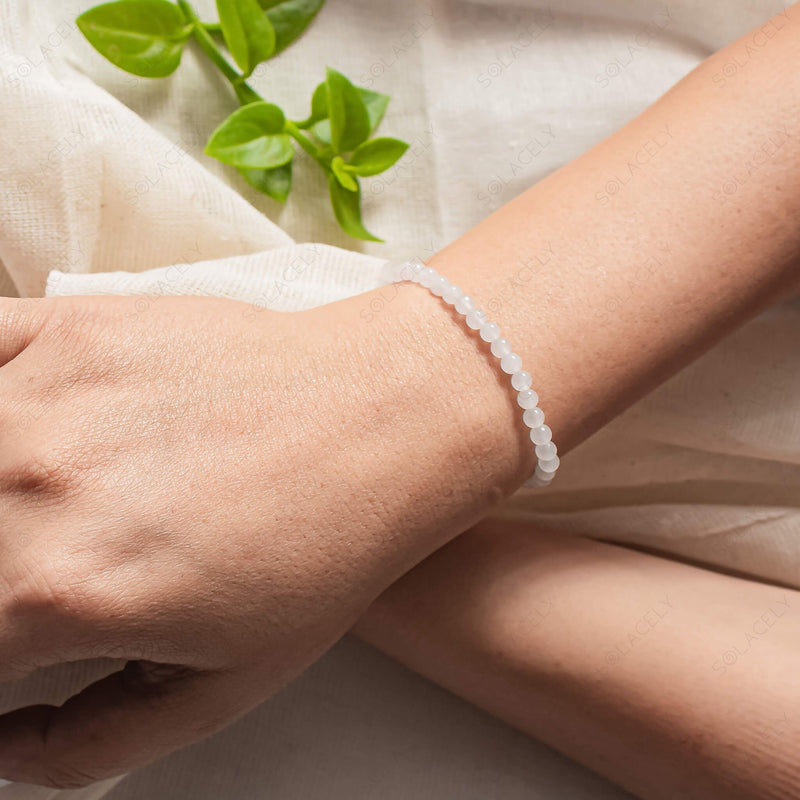
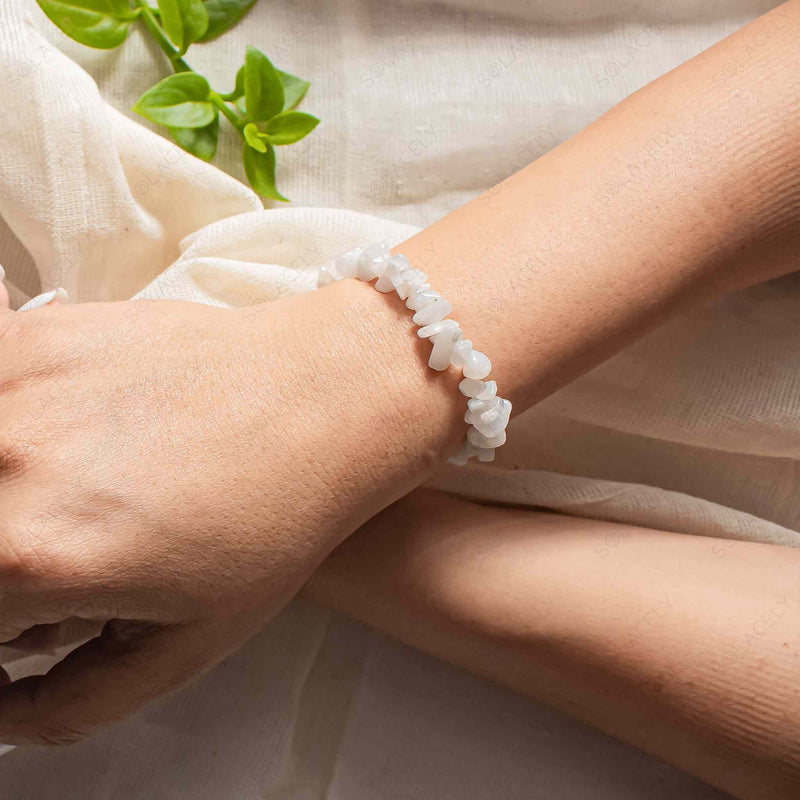
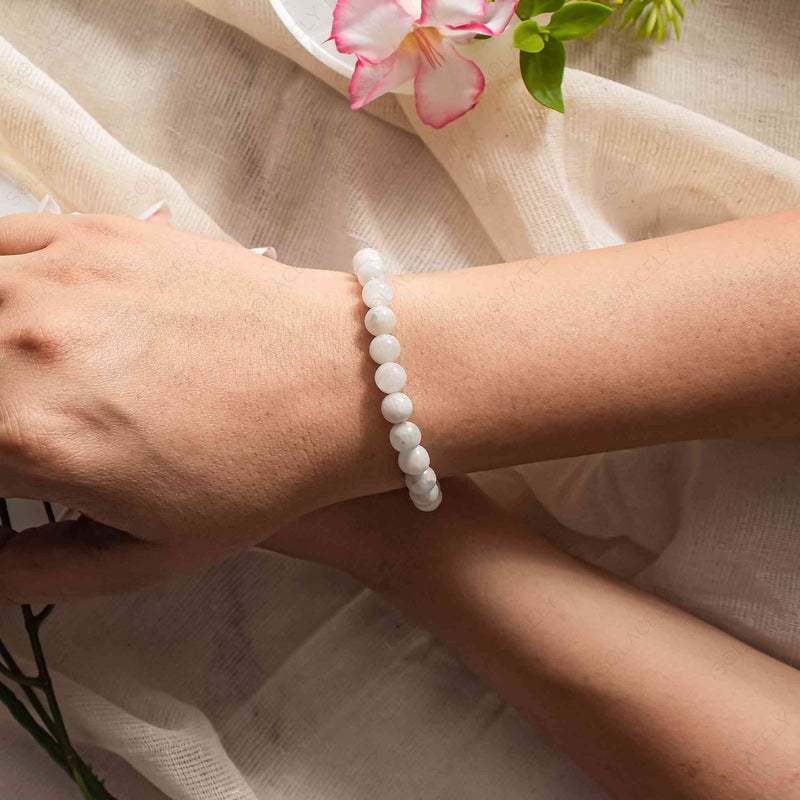
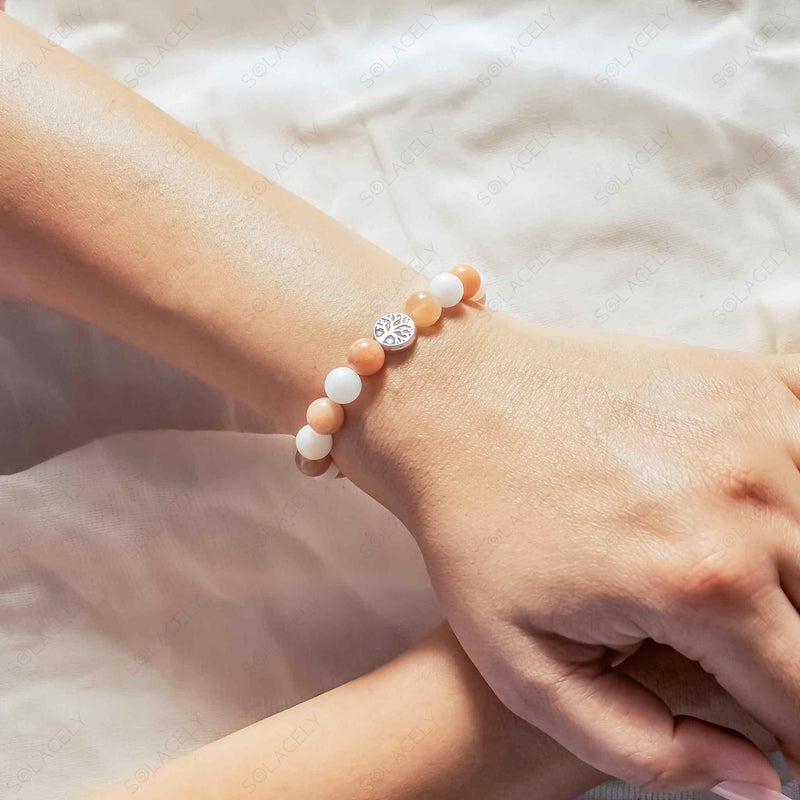
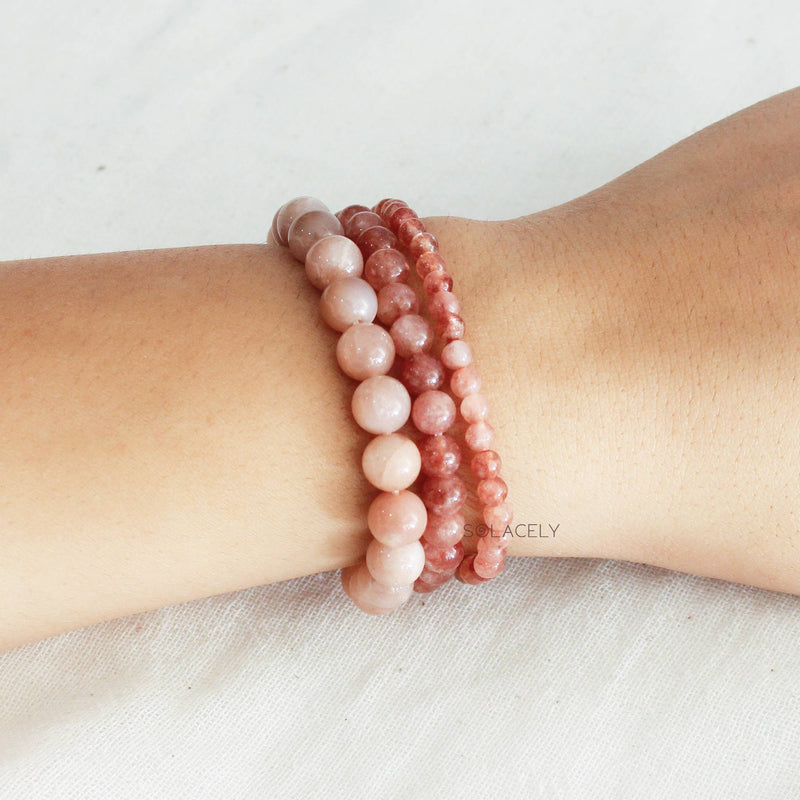
Wear a moonstone bracelet on your left wrist. Moonstone is the receiving stone of the whole tradition, tied to intuition, cycles and sensing rather than doing, and the left is the receiving side. It is one of the few stones where practitioners barely disagree.
Key takeaways
- Left wrist, almost without exception. Moonstone is the archetypal receiving stone.
- Rainbow and milky moonstone are varieties of the same feldspar. Same wrist.
- Sunstone is the classic counterpart, one per wrist.
- Feldspar with cleavage, so beads are fine but a ring wants a protective setting.
- No ultrasonic, no steam. Vibration and heat find cleavage planes.
Why the left wrist
The left is where crystal practice places anything meant to be taken in, and moonstone is the clearest example of an inward stone there is. Its tradition is intuition, receptivity, cycles and reading a situation rather than acting on it.
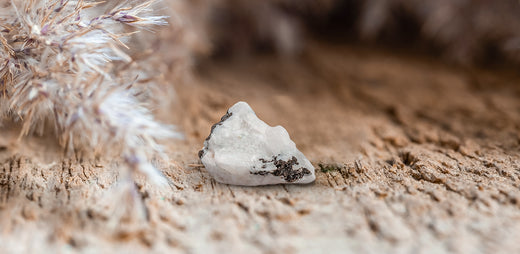
There is a secondary reason people cite. Moonstone shows a floating internal sheen called adularescence, long read as captured moonlight, and the moon in this tradition is the reflective counterpart to the sun. Reflection belongs on the receiving side.
That is why you will find very little disagreement on this one. Where other stones have a genuine second placement, moonstone is worn left by nearly everyone.
Does the variety change the wrist?
No. Rainbow moonstone, milky moonstone and the plain white material are all the same feldspar, distinguished by the colour and strength of the sheen rather than by any difference in tradition.
Rainbow moonstone flashes blue and is technically closer to labradorite in composition, but it is worn on the left for the same receiving reason. If a seller tells you a particular variety belongs on the right, ask what tradition they are drawing on.
Pairing moonstone with sunstone
This is the combination worth knowing, and it is one of the better balanced in crystal practice.
Sunstone points outward: doing, showing, asking. Moonstone points inward: reflecting, sensing, waiting. Worn as a pair, one on each wrist, they cover both directions, and because both are feldspars at similar hardness they age at the same rate.
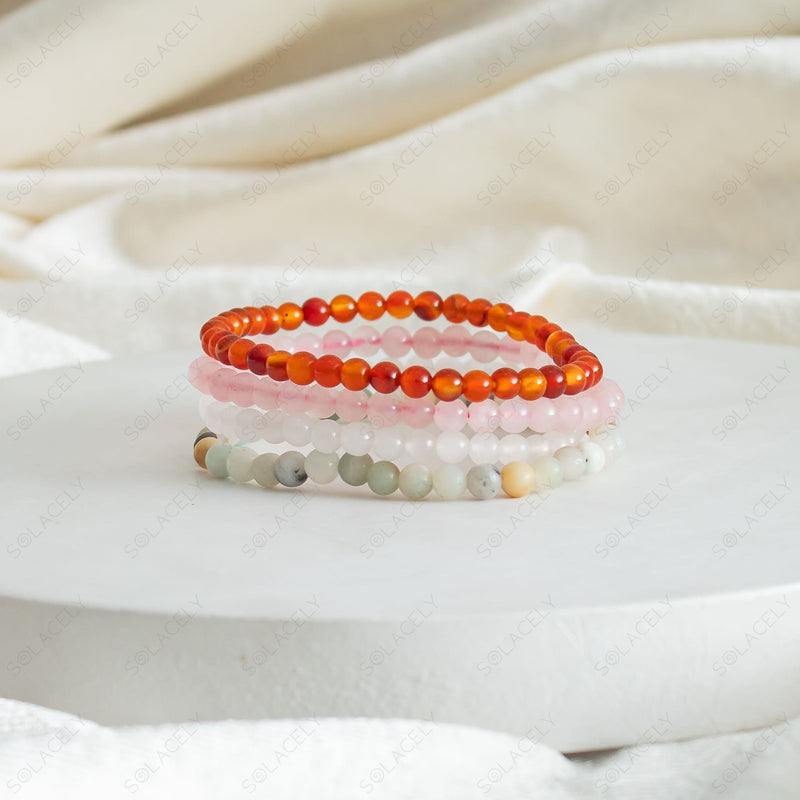
Some bracelets combine the two stones on a single strand instead. That works too, and it suits people who want the balance without wearing two pieces.
What else to wear with it
| Partner stone | Mohs | What it adds |
|---|---|---|
| Sunstone | 6 to 6.5 | The classic counterpart, matched hardness |
| Labradorite | 6 to 6.5 | The transitional stretch, same family |
| Rose quartz | 7 | Warmth, though harder so it wears better |
| Amethyst | 7 | Settling, for cycles that disturb sleep |
Sunstone and labradorite are the closest structural matches, being feldspars themselves. Quartz partners at 7 are harder than moonstone at 6 to 6.5, so over several years the moonstone beads will show wear first.
Looking after it
Moonstone is a feldspar with cleavage in two directions, which means it has built in planes of weakness and chips if knocked hard. In rounded beads that is rarely a problem; in a ring it would be, which is why moonstone rings want a protective setting.
Warm soapy water and a soft cloth only. Skip ultrasonic and steam cleaners entirely, because vibration and heat both find cleavage. Store it away from quartz beads, which are harder and will scratch it in a shared pouch.
Where to go next
For the rule applied across every stone, see our pillar guide to which hand to wear your crystal bracelet. For what moonstone is and what it is kept for, see moonstone meaning, benefits and properties.
The uses described here reflect traditional and cultural crystal practice. They are not medical claims and are not a substitute for professional healthcare or advice.
Sources
Written by Chetena Sharma. Reviewed by the Solacely editorial team.
Frequently asked questions
About the author


Written by Chetna Sharma, crystal healing practitioner and co-founder of Solacely. Chetna has worked with healing crystals for over a decade and curates Solacely's protective stone collection.