Black obsidian is volcanic glass, formed when silica-rich lava cools too quickly for crystals to grow. In crystal tradition it is the mirror stone, kept for honest self-reflection, grounding and protection. At 5 to 5.5 on the Mohs scale it is softer than quartz and fractures to a genuinely keen edge.
Key takeaways
- Obsidian is natural glass, not a crystal. It has no lattice, which is why it fractures in smooth curves.
- It sits at 5 to 5.5 on the Mohs scale, so it scratches and chips more readily than quartz.
- Traditionally the mirror stone, kept for seeing clearly, grounding and protection.
- Linked to the root chakra, the centre of safety and steadiness.
- Snowflake, mahogany, rainbow and Apache tears are all obsidian with different inclusions.
What is black obsidian?
Black obsidian is volcanic glass. When lava rich in silica cools so quickly that atoms have no time to arrange themselves into a repeating lattice, the result is glass rather than mineral crystal. That single fact explains everything distinctive about obsidian, from its gloss to its edge.
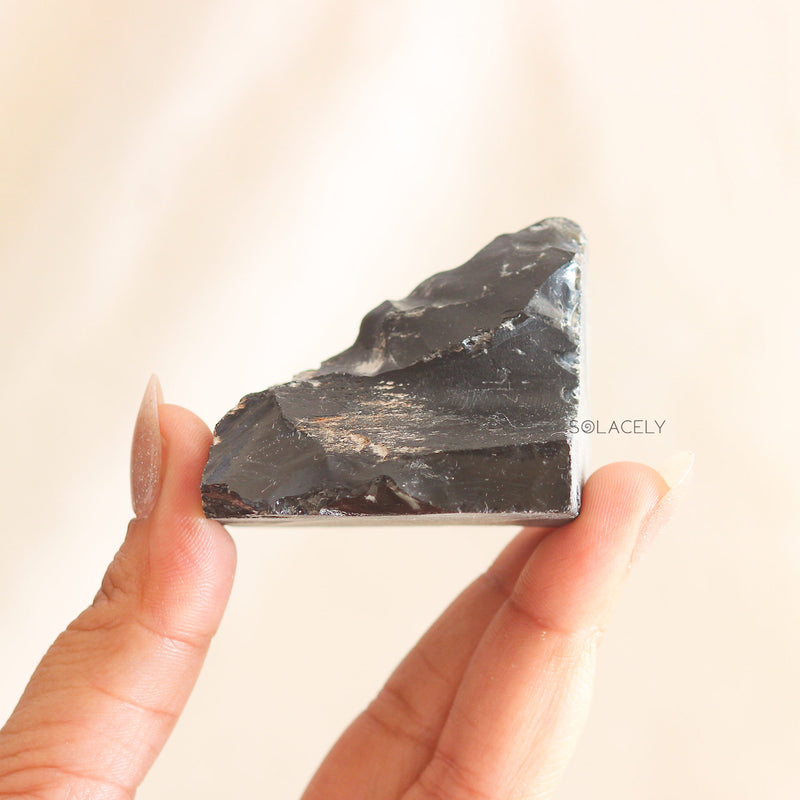
Because there is no crystal structure, obsidian breaks along smooth curved surfaces rather than flat planes, a pattern called conchoidal fracture. Those curved breaks meet at edges that can be sharper than surgical steel, which is why obsidian was flaked into blades and arrowheads for tens of thousands of years.
Its deep black comes from magnetite and other iron-bearing inclusions suspended in the glass. Obsidian is found wherever there has been silica-rich volcanism, notably Mexico, the western United States, Iceland, Turkey and Italy, and it has been traded across long distances since prehistory.
What does black obsidian mean?
Black obsidian means seeing plainly. Polished obsidian was made into mirrors in Mesoamerica, and the Aztec god Tezcatlipoca, whose name means smoking mirror, was associated with exactly that: a surface that shows you what is there rather than what you would prefer.
That history gives the stone its modern reputation. In crystal practice obsidian is the one worked with when something needs to be looked at honestly, which is why practitioners describe it as direct and tend to reach for it deliberately rather than wear it constantly. Its quality is often called uncompromising.
Alongside the mirror sits protection, which comes from the same source. A stone that shows you what is really going on is, in the logic of the tradition, also a stone that keeps you from being deceived. Obsidian is placed at doorways and carried for exactly that purpose.
Black obsidian properties at a glance
Obsidian's properties are unusual because it is a glass rather than a mineral, and that shapes both how it is used and how it must be handled.
| Property | Detail |
|---|---|
| Type | Volcanic glass, amorphous, not crystalline |
| Colour | Deep glossy black, sometimes with sheen or flecks |
| Cause of colour | Magnetite and iron-bearing inclusions |
| Hardness | 5 to 5.5 on the Mohs scale |
| Fracture | Conchoidal, producing very sharp edges |
| Chakra | Root |
| Traditionally kept for | Seeing clearly, grounding, protection, release |
The types of obsidian
All obsidian is the same glass. What creates the named varieties is what is suspended in it or what happened to it as it cooled, which makes the group unusually easy to understand once you know that.
Snowflake obsidian carries white or grey patches of cristobalite, a form of silica that began to crystallise in the cooling glass, producing the flower-like clusters it is named for. In tradition it is the gentler member of the family, kept for balance and for accepting change.
Mahogany obsidian is streaked reddish-brown by iron oxide inclusions, and it is traditionally the warmer, more grounding form, kept for steadiness and for strength through a decision. Rainbow obsidian shows bands of iridescent colour when tilted to the light, caused by fine layers of magnetite nanoparticles, and it is kept for hope alongside grounding.
Apache tears are small rounded nodules of translucent obsidian, dark but light-passing at the edges, named for a Native American legend of grief. They are the stone of that tradition kept for mourning and for the slow work of getting through it.
What black obsidian is traditionally kept for
Honest self-reflection is the first and defining use. Obsidian is the stone people use for journalling, for shadow work, for the sort of sitting where you intend to look at something you have been avoiding. It is used in sessions with a purpose rather than worn all day.
Grounding follows from its root chakra association. The root is the centre of safety and belonging, and obsidian is kept for feeling planted when everything is unsettled. A palm stone held in the hand is the usual form, and its weight does a good deal of the work.
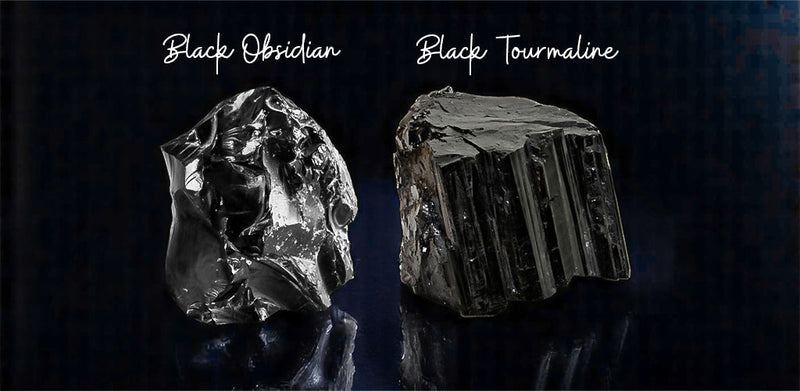
Protection is the third strand. Obsidian is placed at doorways and windows and carried into places that feel draining. It pairs naturally with black tourmaline, and our comparison of black obsidian and black tourmaline sets out which to choose when.
Release is the fourth. Because it is associated with seeing plainly, obsidian is also the stone kept for putting something down: a habit, a resentment, a version of yourself you have outgrown. Our note on green jade and black obsidian covers a softening pairing for that work.
How to use and care for black obsidian
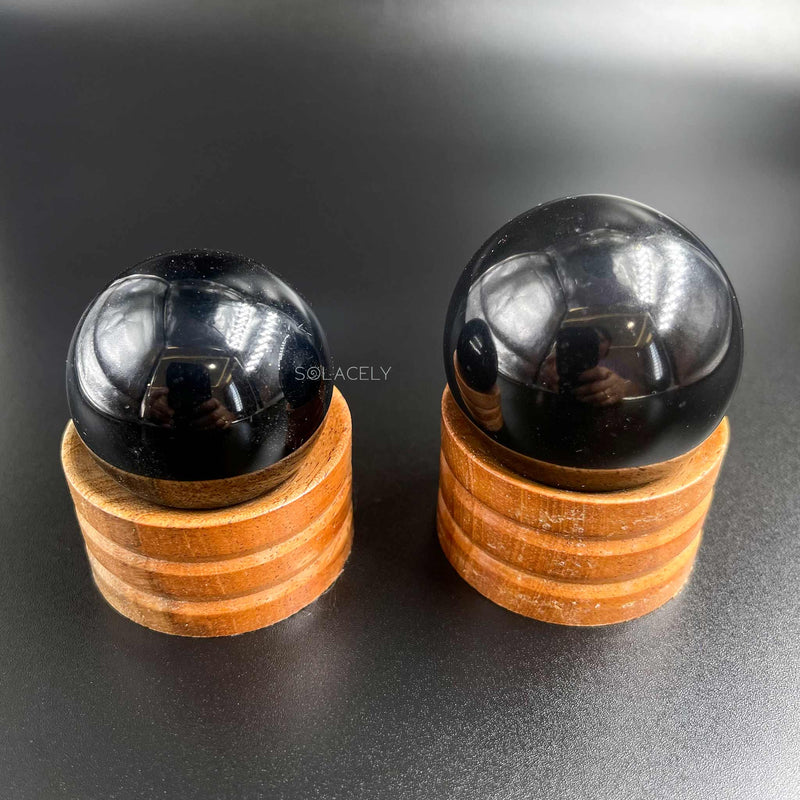
Hold it, place it, or work with it in sessions. A palm stone or sphere in cupped hands during meditation is the traditional form. At home, obsidian is placed at a front door, on a hallway shelf or in a room that needs settling, and our note on black obsidian and feng shui covers placement in detail.
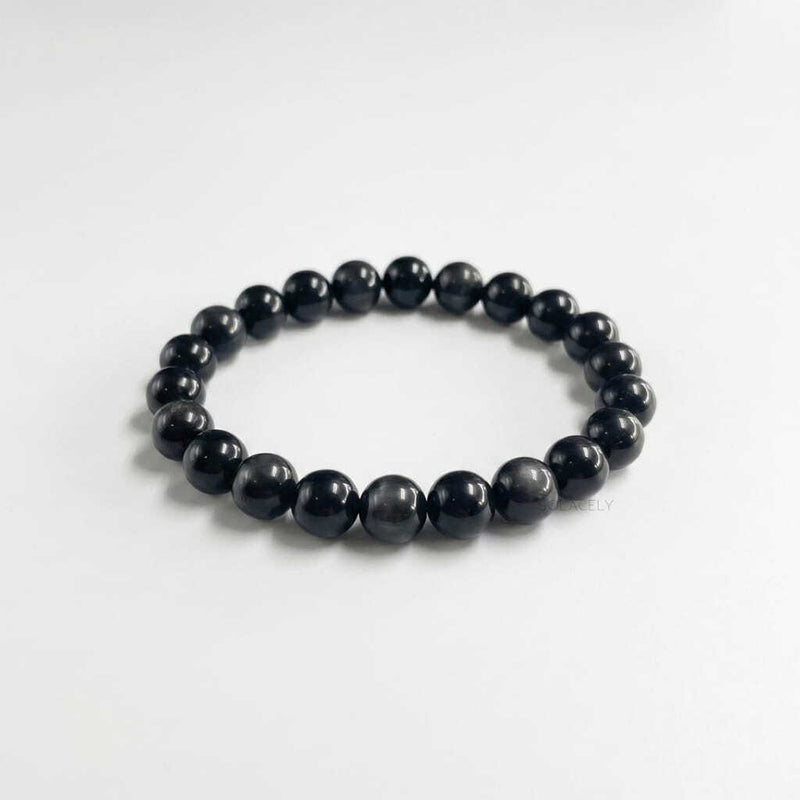
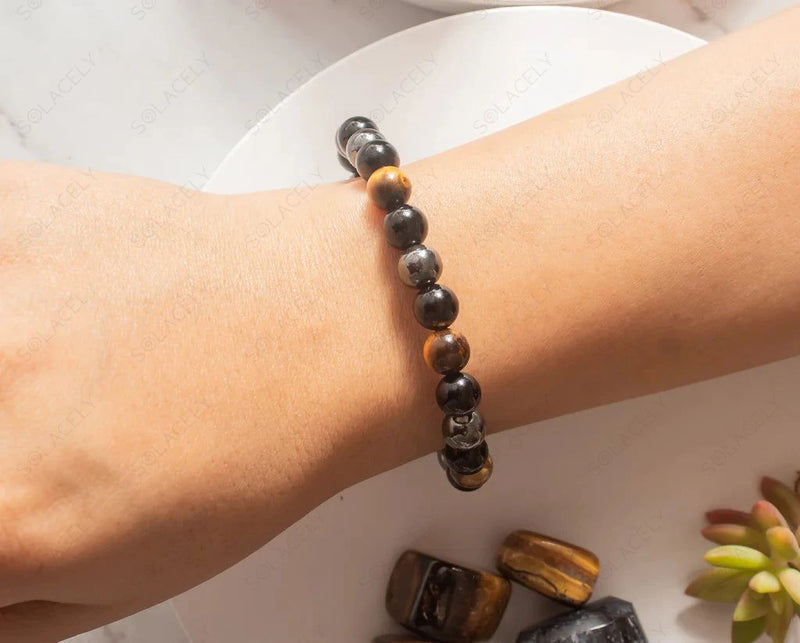
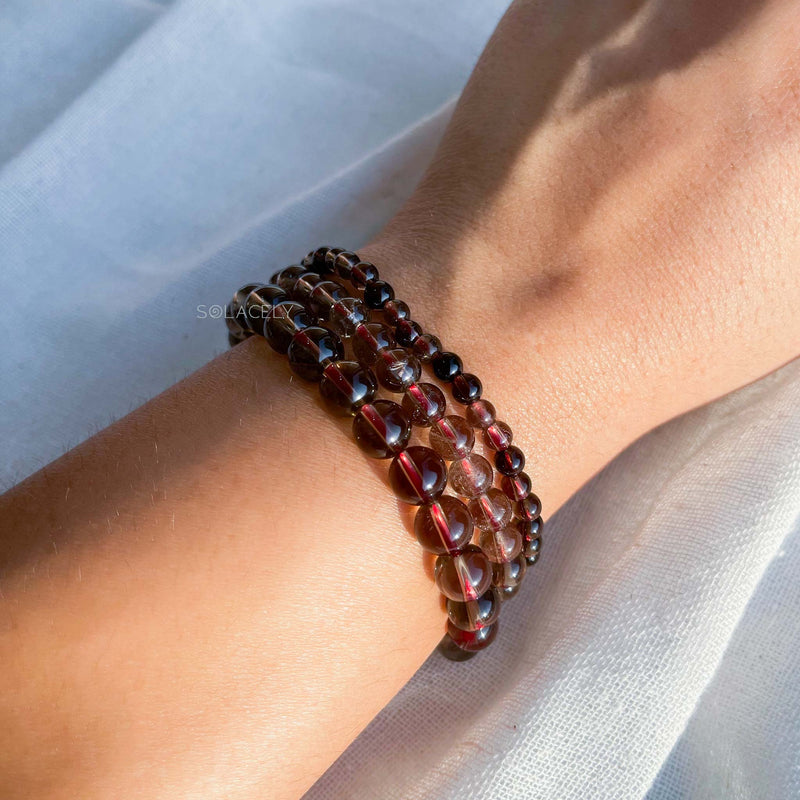
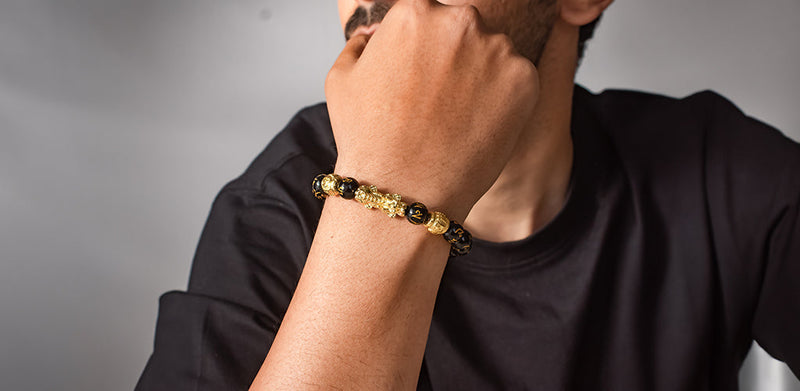
For wearing, choose polished beads and know their limits. At 5 to 5.5 obsidian is softer than quartz, so it scratches against harder stones and chips if knocked against a hard surface. It suits a bracelet worn thoughtfully rather than one taken to the gym.
Handle raw and knapped pieces with real care. Broken obsidian edges are genuinely sharp and can cut, so check any raw piece before you hand it to someone, and keep flaked or arrowhead pieces well away from babies and young children.
Care is simple. Wipe polished pieces with a soft dry cloth, or use warm soapy water and dry immediately. A brief rinse does obsidian no harm, though nothing should be left soaking. Keep it off hard floors and store it away from harder stones. For cleansing in the spiritual sense, sound, incense smoke and moonlight all suit it, and our step-by-step on how to cleanse and charge crystals covers each method.
Black obsidian is worn and kept as part of a long-standing spiritual and cultural tradition. It is not a medical device or treatment, and it does not diagnose, treat, cure or prevent any condition. Nothing here replaces advice from a doctor, therapist or other qualified professional. Obsidian is a natural glass and broken, raw or knapped pieces have genuinely sharp edges that can cut, so handle them carefully and keep them away from babies and young children.
Sources
- Geology.com, Obsidian: volcanic glass, formation, varieties and uses
- Gemological Institute of America, Gem Encyclopedia
Written by Chetena Sharma. Reviewed by the Solacely editorial team.
Frequently asked questions
About the author


Written by Chetna Sharma, crystal healing practitioner and co-founder of Solacely. Chetna has worked with healing crystals for over a decade and curates Solacely's protective stone collection.