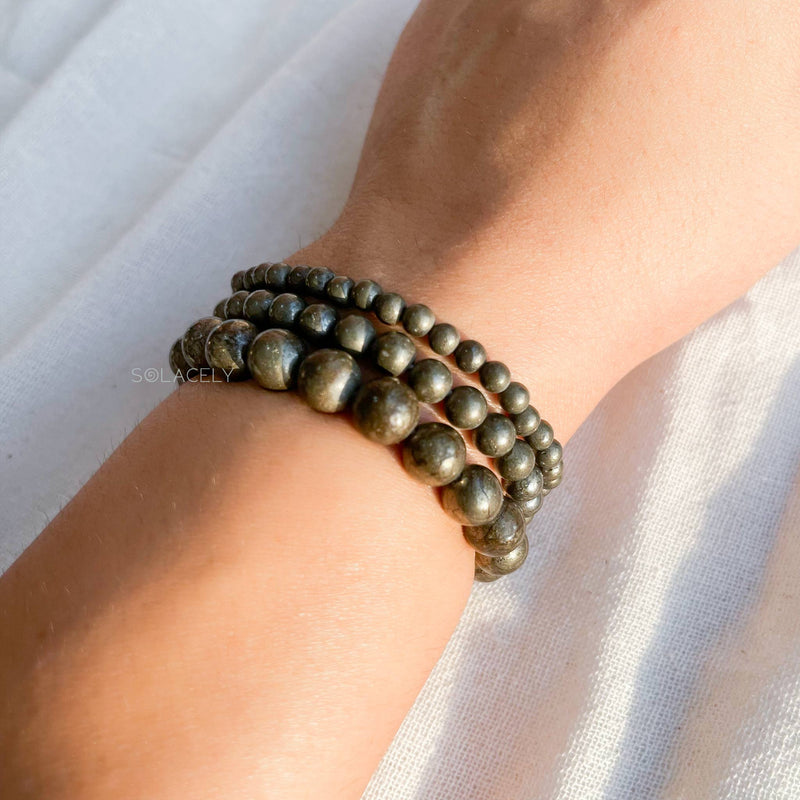
The best crystals for work success are pyrite for drive, citrine for confidence, tiger's eye for follow-through, clear quartz for focus and black tourmaline for boundaries. Between them they cover the five places a working week usually comes unstuck.
Key takeaways
- Pyrite, citrine, tiger's eye, clear quartz and black tourmaline are the five most kept work stones.
- Match the stone to the specific problem: starting, believing, finishing, focusing or protecting your time.
- Three on a desk is the practical ceiling. Beyond that they stop reading as deliberate.
- Pyrite must stay dry, so keep it away from a desk water glass and never cleanse it in water.
- These are traditional associations kept as daily reminders rather than claims about outcomes.
Match the stone to the actual problem
Work does not go wrong in one way, which is why a generic list rarely helps. Not starting is a different difficulty from not finishing, and being constantly interrupted is different again from lacking the nerve to put yourself forward.
The five stones below map onto those five failures, and choosing on that basis is what turns a desk arrangement into something useful. Pick for the thing that actually derails your week rather than for the stone that photographs best.
The quick version: pyrite for starting, citrine for believing you should, tiger's eye for staying with it, clear quartz for general focus, and black tourmaline for holding the boundary around your time. For the wider prosperity set, crystals for business success covers what sits alongside.
Pyrite and citrine for drive and confidence
Pyrite is the starting stone. It is dense, brassy and satisfying to pick up, and it has been kept for enterprise and effort for a very long time. People reach for it when the work is clear and the beginning is the problem.
Its one firm requirement is dryness. Pyrite is iron based, so it should never be cleansed in water or salt and should not live next to a water glass on a desk. Keep it dry and its metallic shine lasts indefinitely. The pyrite guide covers it properly. A hand-strung pyrite bracelet keeps that steadiness within reach through the day.
Citrine is the confidence half. Long known as the merchant's stone from the practice of keeping a piece where money was handled, it is traditionally kept for optimism, warmth and self-belief. Where pyrite gets you to begin, citrine is what makes putting yourself forward feel reasonable. Its care note is simple: keep it out of long strong sun.
Tiger's eye, clear quartz and black tourmaline
Tiger's eye is for the middle of a project, the stretch after the interesting part has finished. Its golden banded sheen shifts as it moves, and it is traditionally kept for willpower and for staying with a decision. At 7 on the Mohs scale it is hard enough to live in a pocket all week.
Clear quartz is the neutral anchor. It carries no narrow association beyond clarity, which is exactly why it works as the stone a desk set is built around. It is also the most affordable of the five and the easiest to look after.
Black tourmaline is the boundary stone, kept between you and whatever interrupts. In open-plan offices and shared homes people place it between the desk and the door, which is the traditional protective placement and a surprisingly practical prompt to guard your own focus time.
Building a desk set
| Where the week goes wrong | Stone | Where to put it |
|---|---|---|
| Cannot get started | Pyrite | Held for ten seconds before opening the task |
| Undercharging, not speaking up | Citrine | Where you handle invoices or messages |
| Losing interest partway | Tiger's eye | Pocket or wrist, so it travels with you |
| General scatter | Clear quartz | Centre of the desk as the anchor |
| Constant interruption | Black tourmaline | Between you and the door or shared space |
Three is the working maximum. A desk with a dozen stones on it stops signalling anything, and the whole value of the practice is that picking one up means something specific. For placement detail, see crystals for the office desk.
Making the set actually work
The habit matters more than the arrangement. A stone that sits on a desk unnoticed is decor; a stone attached to a repeated action becomes a marker for the transition into working, which is the hardest part of most days.
- Tie it to one action. Stone in hand, phone face down, timer started, in that order every time.
- Keep it within reach. A stone in a drawer cannot do anything for you.
- Give each one job. If everything on the desk means focus, nothing does.
- Move them when the work changes. Pyrite away and tiger's eye out once a project is underway.
- Clean them weekly. Tie it to something you already do, like clearing the desk on a Friday.
Pairing the set with a real method does the rest. A written next action, a timed work block, or simply deciding the first task the night before all carry weight that no arrangement of stones is meant to carry alone.
Care for a working set
Desk stones are handled constantly and pick up skin oil quickly, so a wipe with a soft cloth once a week keeps them looking sharp. Citrine, clear quartz, tiger's eye and black tourmaline all take warm water and mild soap comfortably.
Pyrite is the exception and it is worth repeating: dry cloth only, no water, no salt, and not on a humid shelf. That one habit is the difference between a pyrite piece that stays bright for years and one that goes dull in months.
Keep citrine out of long direct sunlight, and store the set so harder stones are not sitting against softer ones. If success at work is really about landing something specific, good luck crystals for success narrows the selection, and crystals for money covers the prosperity side.
Working from home, an office, or a shared desk
Where you work changes what the set needs to do, and it is worth adapting rather than copying a layout wholesale.
At home the main difficulty is usually the boundary between work and everything else, so the stone that earns its place is the one marking the start and end of the day. People commonly keep a piece that only comes out during working hours and goes away afterwards, which does more for the boundary than any arrangement left permanently on the desk.
In an open-plan office the difficulty is interruption and the lack of a space that feels yours. A small, discreet set works better than a display, and black tourmaline positioned between you and the walkway is the traditional choice. On a hot desk, a single pocket stone is the practical answer, since nothing can be left out.
What this practice can honestly offer
A working set gives you a repeatable cue for the transition into focused work, and that transition is where most days are won or lost. Attaching it to a physical object makes it easier to keep than an intention held only in your head.
What it will not do is carry a workload problem. If the real issue is too many projects, unclear priorities or a role that has grown past what one person can hold, the honest answer is that the arrangement on your desk is not where the fix lives. Raise it, renegotiate it, or get help with it.
Used alongside a functioning system, though, a small set of stones is a pleasant and genuinely effective bit of daily structure, and there is no reason a working day should not have something in it that you like looking at.
The properties described here reflect traditional and cultural belief around crystals. They are offered for reflection and wellbeing and are not medical advice, financial or career advice, or a treatment for any condition. If you are experiencing persistent stress or burnout, please speak with a qualified healthcare professional. Keep small stones away from young children, and never place crystals in drinking water.
Sources
Written by Chetena Sharma. Reviewed by the Solacely editorial team.
Frequently asked questions
About the author


Written by Chetna Sharma, crystal healing practitioner and co-founder of Solacely. Chetna has worked with healing crystals for over a decade and curates Solacely's protective stone collection.