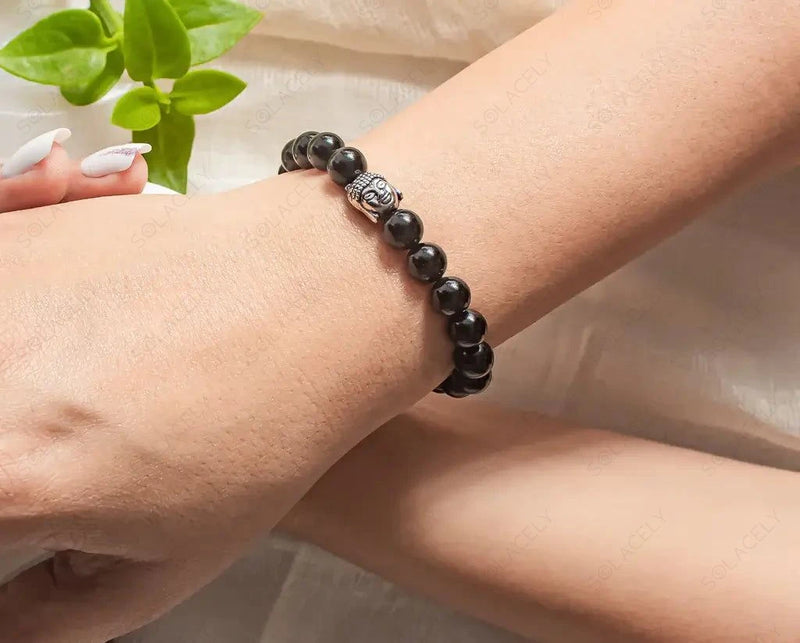
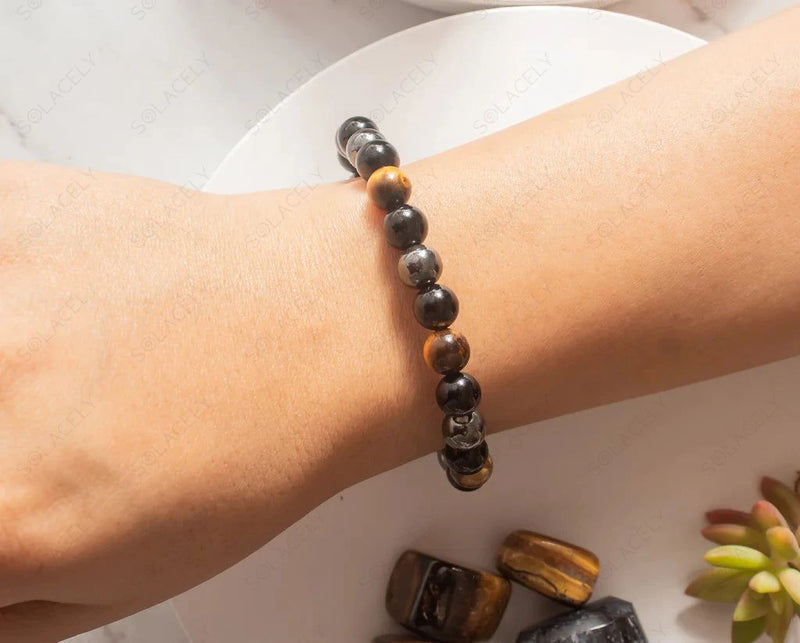
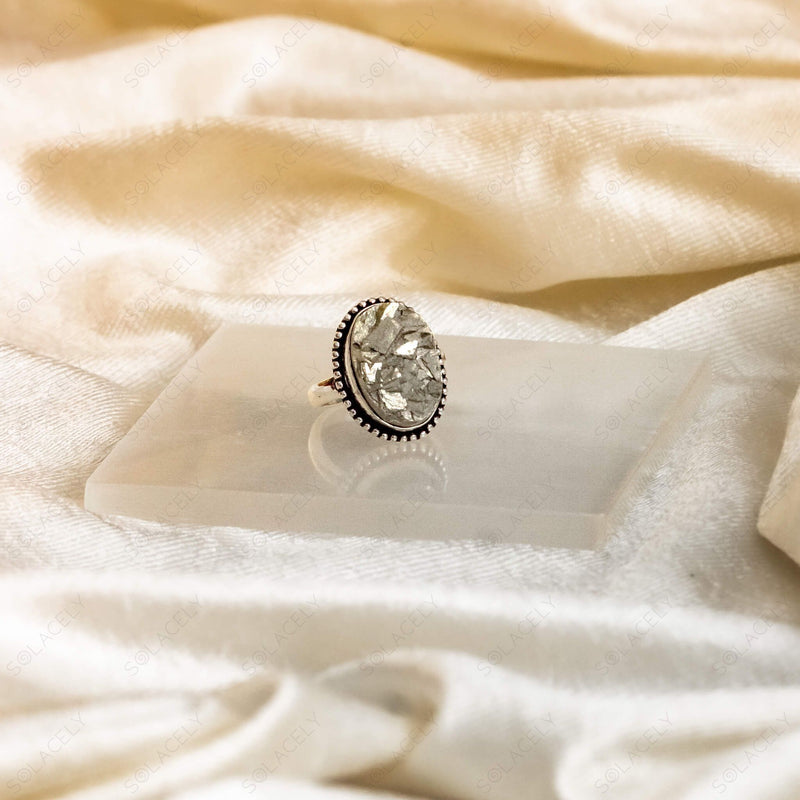
Black tourmaline and pyrite is a desk pairing rather than a jewellery one. The dark stone is kept for grounding and boundaries, the brassy gold one for confidence and prosperity. Pyrite stays off the wrist for a chemical reason rather than a durability one, and that single fact shapes how the pair is used.
Key takeaways
- Black tourmaline is schorl, a complex borosilicate at 7 to 7.5 on the Mohs scale, and the most abundant tourmaline in nature.
- Pyrite is iron disulfide at 6 to 6.5, the most common sulfide mineral, with the metallic gold lustre that earned it the fool's gold nickname.
- Pyrite is sensitive to moisture. Kept dry it lasts indefinitely, which is why it belongs on a desk or shelf rather than a wrist.
- Traditional practice places tourmaline at the root and pyrite at the solar plexus, so the pair reads as steadiness plus nerve.
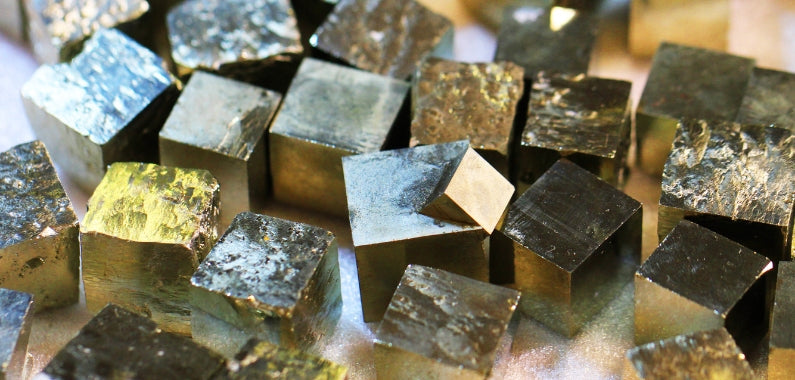
- The most prized pyrite comes from Navajun in Spain, where it grows as natural cubes that look sculpted but are quarried straight from the claystone.
- Everything described here is traditional belief and cultural practice.
Why are black tourmaline and pyrite paired?
Because they cover the two halves of a working life without overlapping. Black tourmaline is the boundary stone, kept for staying in your own space when a room is busy or a week is demanding. Pyrite is the confidence stone, kept for the part where you have to ask for something.
The framing is close to black tourmaline and citrine, but the two look nothing alike on a desk. Citrine is translucent and warm. Pyrite is opaque, metallic and heavy, and a Navajun cube reads more like a small ingot than a gemstone. That presence is a large part of why people choose this version.
It is chosen most often as a desk or altar set rather than something worn, partly because pyrite tends to come as larger raw or cubic pieces, and partly because of the moisture point below. If you want the pairing you can actually wear, our guide to black tourmaline combinations covers the alternatives.
What is black tourmaline?
Black tourmaline is properly called schorl, the sodium and iron member of the tourmaline group. Geology.com describes tourmaline as occurring in more colours than any other mineral group, and schorl accounts for the overwhelming majority of what is found in the ground. The boron makes the group distinctive and the iron makes this one black.
At 7 to 7.5 on the Mohs scale with poor cleavage, it tolerates knocks well, though it is brittle enough to chip on a tiled floor. The bulk of commercial supply comes from Minas Gerais in Brazil, with more from Tanzania, Nigeria, Madagascar, Mozambique and Namibia, plus specimen material from Maine, California and Pakistan.
It also carries an unusual physical property. Tourmaline is pyroelectric and piezoelectric, developing a small electrical charge when its temperature shifts or when it is compressed. Very few minerals do anything so visible on a tabletop, and that liveliness is part of why the stone gathered such an active reputation. Our black tourmaline guide covers the rest.
What is pyrite?
Pyrite is iron disulfide, and the sulfur atoms sit in bonded pairs, which is why some mineralogists prefer to call it an iron persulfide. Its colour is a pale brassy yellow with a genuinely metallic surface, and at 6 to 6.5 on the Mohs scale it is considerably harder than gold.
Geology.com describes it as the most common sulfide mineral, forming in igneous, metamorphic and sedimentary settings alike. What makes it collectable is the geometry. Pyrite grows as striated cubes, as twelve sided pyritohedra, and as complex twinned clusters. The cubes from Navajun in Spain are the famous ones, grown naturally in claystone and quarried whole rather than cut. Peru, Italy, Kazakhstan and the United States all produce good material too.
It is also noticeably heavy. A pyrite cube has roughly two thirds again the density of black tourmaline, and that weight in the palm is a large part of why people like holding it. Our pyrite guide covers cubes, clusters and jewellery.
Where does the fool's gold name come from?
It is a genuinely historical nickname rather than a modern invention. During the nineteenth century gold rushes in California, Australia and the Yukon, prospectors regularly took pyrite for gold, particularly stream bed material that had weathered into rounder shapes. The name stuck as a piece of miners' shorthand and it has been attached to the stone ever since.
The two are easy to tell apart once you know how, and the tests are the sort of thing a nineteenth century prospector could do at a creek. Gold is soft enough to mark with a copper coin and pyrite is not. Gold leaves a gold streak on unglazed porcelain while pyrite leaves a greenish black one. Gold flattens under a hammer and pyrite shatters. And gold is roughly four times as dense, so the same sized piece feels startlingly heavier.
Crystal practice has since turned the story around. The stone that looked like money became the stone kept for confidence about money, and that is the meaning a pyrite cube carries on a desk today.
Why pyrite belongs on a desk rather than a wrist
This is the one genuinely important care fact about the stone, and it is chemistry rather than toughness. Pyrite reacts slowly with moisture and oxygen to form iron sulfates, which show up as a pale crust on the surface. Mineral collectors call it pyrite decay, and in a damp room it can work through a finely crystalline specimen over years.
Daily wrist wear means daily contact with skin moisture, soap, hand cream and humid air, which is exactly the environment the stone likes least. A pyrite bead that stays bright for years on a shelf can dull noticeably in a single year on a wrist. So the sensible arrangement is tourmaline as the wearable stone and pyrite as the desk piece, and both then last indefinitely.
| Property | Black tourmaline | Pyrite |
|---|---|---|
| Mineral | Schorl, a borosilicate | Iron disulfide |
| Hardness | 7 to 7.5 Mohs | 6 to 6.5 Mohs |
| Colour | Opaque black | Metallic brassy gold |
| Weight | Ordinary for its size | Noticeably heavy |
| Moisture | A brief rinse is fine | Keep dry, wipe only |
| Best formats | Bracelet, pendant, pocket stone | Desk cube, shelf piece, pouch carry |
How do you use the pairing?
Four arrangements cover almost everyone, and the desk pair is the one people settle on.
- The desk pair. Tourmaline on one side, a pyrite cube on the other. The black against gold contrast is the whole appeal and it sits in your eyeline all day.
- Altar arrangement. Tourmaline tumbles marking the corners with a pyrite cube at the centre. One of the few setups where a crystal's natural geometry becomes part of the design.
- Pocket set. A small tourmaline in one pocket and a pyrite in a fabric pouch in the other. The pouch is the important part, since it keeps skin moisture off the gold stone.
- In the hand. Tourmaline in the dominant hand, pyrite in the other. Pyrite's density gives it an anchoring weight that people find unusually satisfying to hold.
A wallet carry is popular too, following the older merchant habit, though keep the stone in a small pouch so it never sits directly against cards. For the wider money set, our crystals for money guide compares the usual options.
How do you care for them?
Care for the pair at the more demanding standard, which is pyrite's.
Black tourmaline is easy. Warm water, mild soap and a soft brush for the striations, then a thorough dry. Skip ultrasonic and steam cleaners, since it dislikes sudden heat, and stand raw pieces on a dish because schorl sheds a few fragments when new.
Pyrite takes a dry cloth or a soft brush and nothing else. Keep it out of water entirely, including moon water bowls and any soak. Keep it out of bathrooms, and if you live somewhere humid, a closed box with a silica gel packet changed every few months keeps it bright for decades. Store it apart from other stones as well, since the fine dust from mild surface oxidation settles on anything sharing a pouch.
For energetic cleansing, moonlight, smoke, sound or a rest on selenite suit both stones, and all four are dry methods. That is convenient here, because the usual rinse under running water is the one thing pyrite cannot take.
The properties described here reflect traditional and cultural belief around crystals. They are not medical claims, they are not claims about physical shielding, and they are not a substitute for professional healthcare. If you are managing a health concern, speak to a qualified practitioner. Nothing here is financial advice. Keep pyrite out of reach of children and pets and away from food, wash your hands after handling raw specimens, and never place crystals in drinking water.
Sources
Written by Chetena Sharma. Reviewed by the Solacely editorial team.
Frequently asked questions
About the author


Written by Chetna Sharma, crystal healing practitioner and co-founder of Solacely. Chetna has worked with healing crystals for over a decade and curates Solacely's protective stone collection.