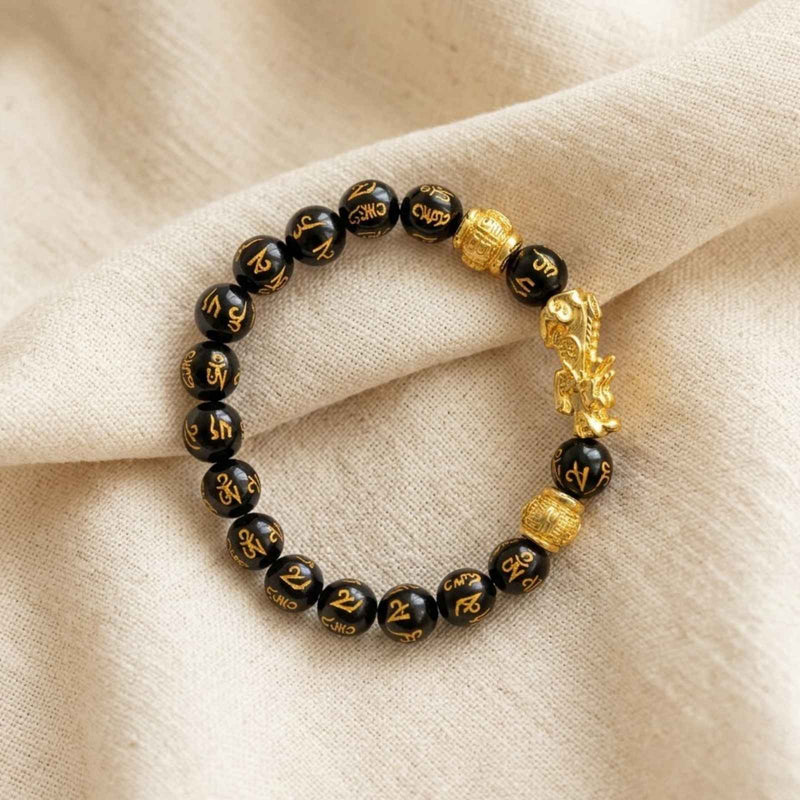
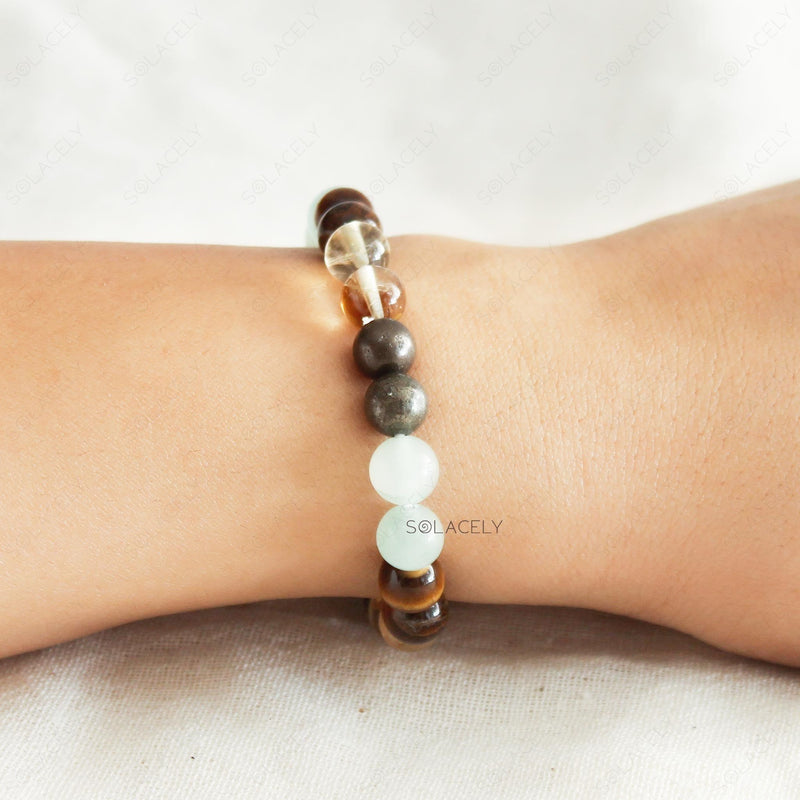
Wear a feng shui bracelet on your left wrist, with the Pixiu's head facing outward and away from your body. In feng shui the left side is the receiving side, so energy is traditionally drawn in there. Put it on with a clear intention, then leave it on daily. The steps below cover timing, orientation and care.
Key takeaways
- Left wrist, head facing out. The left is treated as the receiving side in feng shui, so wealth bracelets sit there.
- Pixiu is described in Chinese tradition as the ninth son of the dragon, a creature that takes in gold and silver and never lets it out again.
- The first wearing is traditionally given a marked moment: the hours between 11pm and 1am, or the first or fifteenth day of the lunar month.
- Black obsidian is a natural volcanic glass sitting around 5 to 5.5 on the Mohs scale, softer than quartz at 7, so it scratches easily.
- Keep it dry. Take the bracelet off for showers, pools and spas, since repeated soaking is hard on strung beads and elastic cord.
- Most wearers keep two customs: they do not pass the bracelet around to be tried on, and they stroke the Pixiu's back rather than its eyes or mouth.
How do you wear a feng shui bracelet, step by step?
Slide it onto your left wrist first, head outward, at a moment you have chosen rather than at random. The full sequence has seven parts: choosing, timing, wrist, orientation, activation, intention and the daily habit. Each one is short. Together they turn a bracelet into something you actually keep wearing.
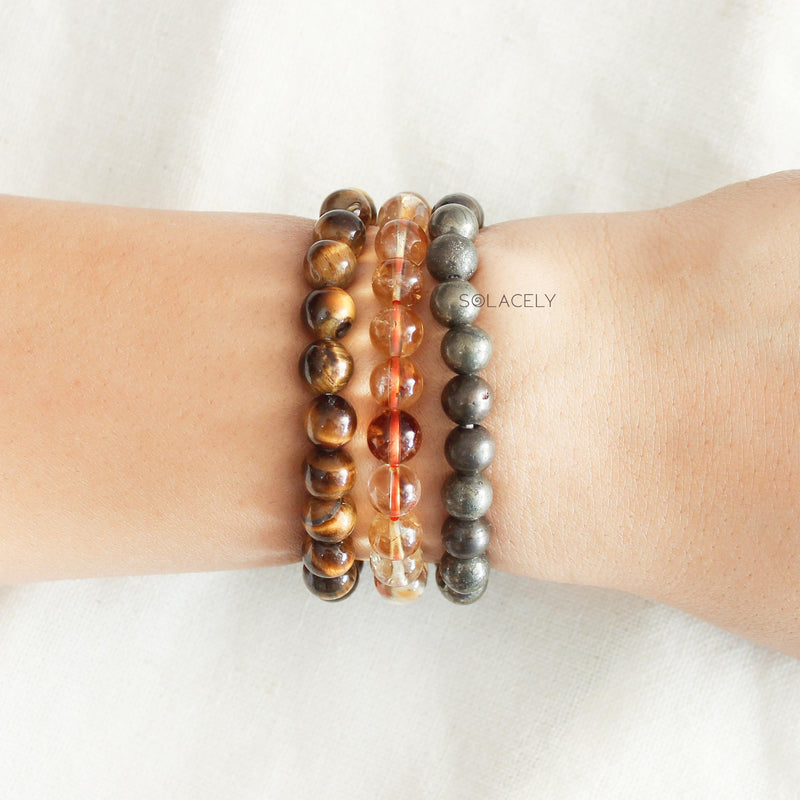
- Choose the bracelet you will actually wear. Pick the stone and the bead size you like looking at. Black obsidian with a Pixiu charm is the classic wealth pairing, though jade, citrine and tiger's eye each carry their own traditions. A bracelet you enjoy wearing is a bracelet that stays on.
- Pick your first wearing moment. Tradition treats the first wear as the one that counts. Many practitioners choose the hours between 11pm and 1am, when the day is turning over. Others prefer the morning of the first or the fifteenth day of the lunar month, or simply the start of a new month.
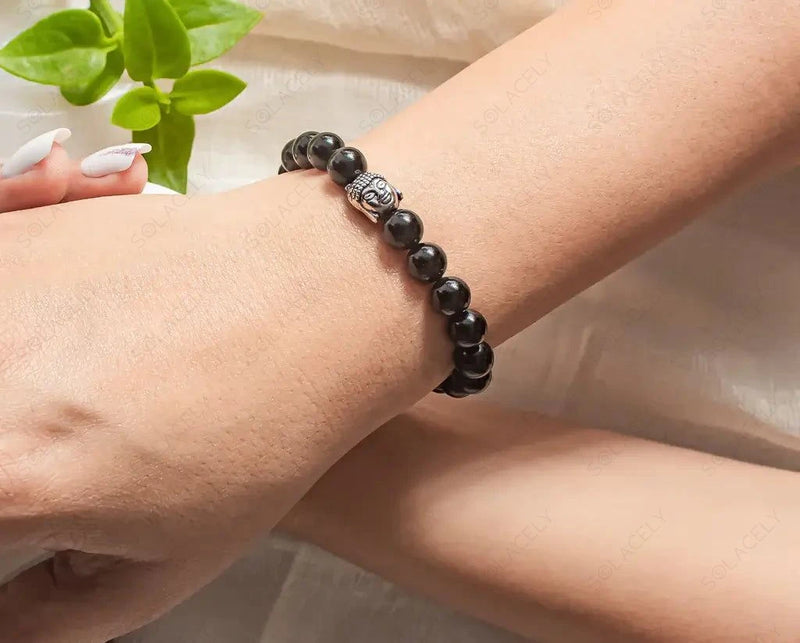
- Put it on your left wrist. The left is the receiving side, so anything worn to draw wealth or opportunity in sits there. Fasten it with your right hand and give it a few seconds rather than rushing out of the door.
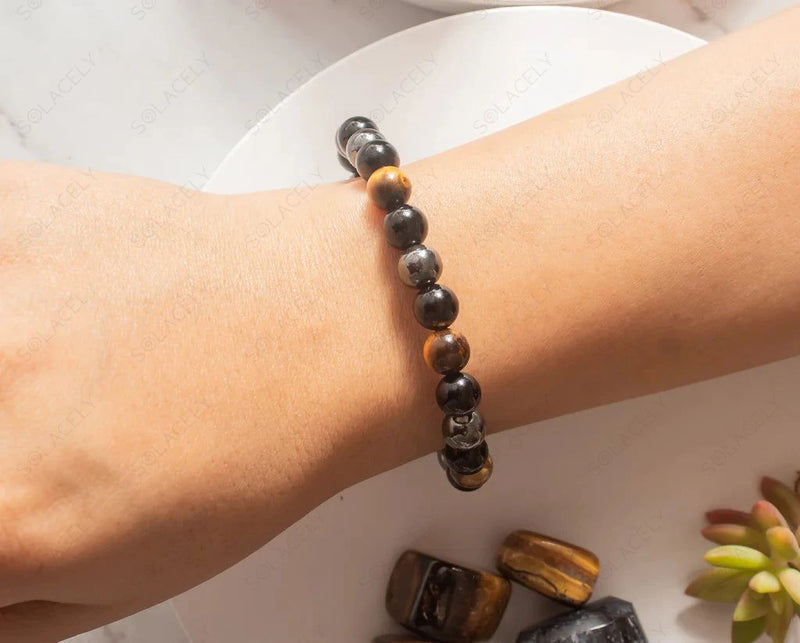
- Use the right wrist only for outward intentions. Some practitioners move a bracelet to the right when the intention points away from them: releasing, shielding, or sending energy out rather than gathering it. Obsidian and black tourmaline pieces worn for protection are sometimes kept there for exactly that reason.
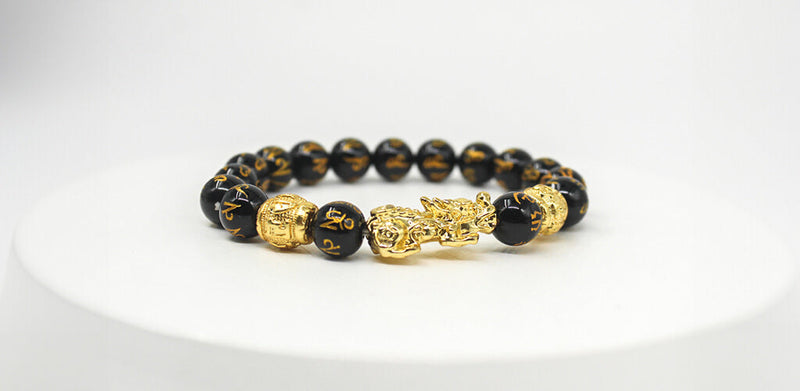
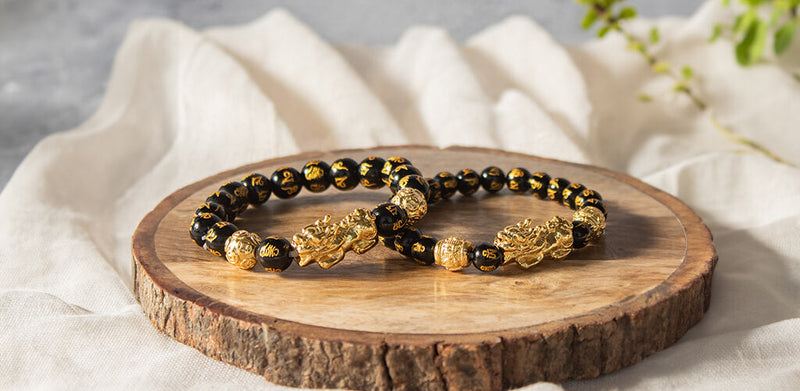
- Turn the Pixiu head outward. The head faces away from your body, out towards the wider world, so the creature is watching for wealth rather than looking back at you. Check the orientation every time you fasten the bracelet, because beads rotate as you move.
- Activate it. Hold the bracelet, name what you are asking for in plain words, and stroke the Pixiu's back and body while you speak. Our guide on how to activate your feng shui Pixiu bracelet walks through the full ritual, including the water and eye customs.
- Make it a daily habit. Wear it every day rather than saving it for occasions. Most wearers keep it on through work and sleep, remove it for washing and swimming, and touch the beads whenever they want the intention back in view.
Which wrist should a feng shui bracelet go on?
The left wrist, in almost every case. Feng shui reads the left side of the body as receiving and the right as giving, so a bracelet worn to gather wealth, luck or opportunity belongs on the left. The right wrist is kept for intentions that travel outward from you.
The rule is simple once you know what the piece is for. Pixiu, citrine, jade and green aventurine are worn to bring something in, so they go left. Black tourmaline, hematite and some obsidian pieces are worn to hold something off or move something out, and plenty of practitioners keep those on the right. If you wear two bracelets for different reasons, split them across both wrists.
There is no penalty for getting it wrong on a given day. Move the bracelet across, reset the head direction, carry on. Our wider guide to which hand you should wear a crystal bracelet on covers left handed wearers, watch clashes and stacking, and the piece on how feng shui works explains where the receiving and giving idea comes from.
What is Pixiu, and why does the head face outward?
Pixiu is a winged, lion like creature from Chinese tradition, described as the ninth son of the dragon. The stories say it feeds on gold and silver and has no way to let them out again, which is why it became the emblem of wealth that stays put. The head faces out to catch it.
In the best known telling, Pixiu offended the Jade Emperor and was punished in a way that sealed its rear, so everything it swallowed remained inside. Rather than a curse, the trait became the whole point. Carved Pixiu pairs still sit at the entrances of banks, shops and homes across Chinese communities, watching the street for what comes in.
That story is the reason head direction matters so much to wearers. A Pixiu turned inward is, in the logic of the tradition, looking at you instead of the world. Turned outward, it faces the road, the office, the market. Black obsidian is the stone it is most often carved from, and the pairing of a dark, glassy stone with a wealth guardian is a long standing one in feng shui practice.
How do you cleanse and recharge a feng shui bracelet?
Moonlight is the traditional choice. Leave the bracelet on a windowsill overnight, ideally around the full moon, and it is considered ready by morning. Sound, incense smoke and a dry bed of rice work too. Skip long water soaks, which are hard on cord, elastic and softer beads.
Once a month suits most wearers. Add an extra cleanse after a draining week, a house move, a job change or any stretch where the bracelet has been on your wrist through something heavy. Some people cleanse on the first day of the lunar month and treat it as a small reset.
If moonlight is not practical, you have options. A singing bowl, a stick of incense, a few hours on a selenite plate or simply a wipe with a dry cloth and a fresh statement of intention all serve the same purpose. Our guide to wearing a feng shui bracelet without cleansing in moonlight or sunlight covers what to do when neither is available.
What customs do regular wearers keep?
Two come up again and again: do not pass the bracelet around for other people to try on, and take it off before you shower or swim. A third is quieter but just as common. Wearers stroke the Pixiu's back and body, and leave its eyes and mouth alone.
The eyes are said to spot wealth and the mouth is said to take it in, so those two spots stay untouched, including by you. The back is fair game, and stroking it is the everyday way people renew the intention on a slow afternoon. If someone else does handle your bracelet, the usual response is a quick rinse of intention rather than panic, and the post on what to do if you touch your feng shui bracelet sets out the standard practice.
The rest is ordinary courtesy towards an object you care about. Keep it off the bathroom floor. Store it in a pouch or on a small dish rather than loose in a drawer. Put it on after moisturiser and perfume, not before. None of this is complicated, and all of it keeps the bracelet in better condition.
How do you care for a black obsidian feng shui bracelet?
Black obsidian is a natural volcanic glass, and geological references place it at roughly 5 to 5.5 on the Mohs scale. That is softer than quartz at 7, so it scuffs against harder beads and metal. Store it separately, keep it dry, and clean it with a soft dry cloth.
| Stone | Mohs hardness | Care note |
|---|---|---|
| Black obsidian | 5 to 5.5 | Natural volcanic glass. Marks easily; store away from harder beads and keys |
| Hematite | 5 to 6.5 | Keep dry and away from abrasives so the mirror polish stays bright |
| Jade (jadeite and nephrite) | 6 to 7 | Tough and durable, but dislikes harsh cleaners and very hot water |
| Quartz family (citrine, tiger's eye, clear quartz) | 7 | Hard enough for daily wear. Keep citrine out of prolonged strong sunlight |
Elastic is the part that usually gives way first. Cord stretches with heat, sweat, soap and time, so check for slack every few months and restring before it snaps rather than after. If a bead does chip, most jewellers can swap a single bead on a strung bracelet without rebuilding the whole thing.
Day to day, the habits are small. Take it off for the shower, the pool and the gym. Wipe it with a dry cloth at the end of a long day. Put it on last when you dress, after lotions and sprays have dried. Do that and the bracelet stays wearable for years, which is the point of a piece you are meant to keep on.
This article is for general information and reflects crystal and feng shui tradition rather than medical or financial guidance. Crystals and bracelets are not a treatment for any condition and are not a substitute for advice from a doctor, a mental health professional or a qualified financial adviser. Keep small beads away from young children, as they are a choking risk, and never place stones in drinking water.
Sources
Written by Chetena Sharma. Reviewed by the Solacely editorial team.
Frequently asked questions
About the author


Written by Chetna Sharma, crystal healing practitioner and co-founder of Solacely. Chetna has worked with healing crystals for over a decade and curates Solacely's protective stone collection.