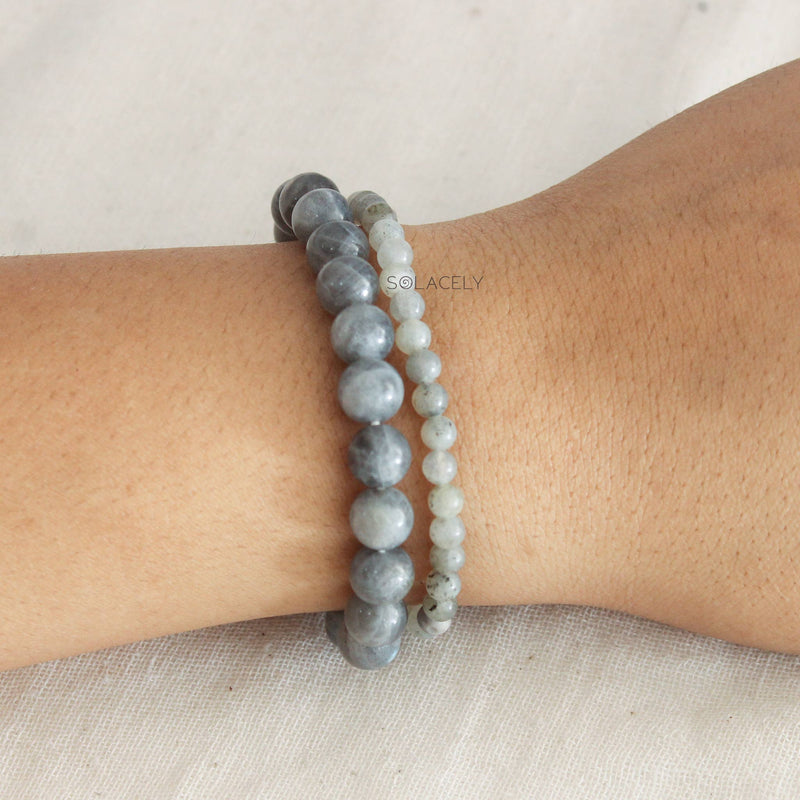
Wear a labradorite bracelet on your left wrist. Labradorite is a receiving stone, kept for intuition and for sensing your way through a change, and the left is the side that draws things in. The right is the exception, chosen when you are wearing it as a shield instead.
Key takeaways
- Left wrist for the usual intention: intuition, and finding your way through a transition.
- Right wrist if you bought it for its second tradition as a shielding stone.
- It chips. Two directions of cleavage mean it splits along flat planes if knocked.
- Wear it on the wrist you use less, whichever side that is. Durability beats convention here.
- Never put it in an ultrasonic cleaner. Smoke, sound and moonlight are the safe methods.
Why the left wrist
Crystal practice reads the left as the receiving side and the right as the projecting side. Anything you want to draw in goes left. Anything you want to send out or keep at a distance goes right.
Labradorite is a left hand stone in its main tradition. It is kept for the periods when you do not yet know the answer: a career you are not sure about, a relationship at a turning point, a move you cannot decide on. What it is worn for is sensing rather than deciding, and sensing is receptive work.
That is a narrower job than it sounds, and it is worth being clear about. Labradorite is not the stone for pushing a decision through. It is the stone for the stretch beforehand, while the shape of the thing is still forming.
When to wear it on the right
Labradorite carries a genuine second tradition, and it points the other way.
Alongside intuition, it is read as a shielding stone, worn to keep your own state separate from everyone else's. That is boundary work, and boundary stones belong on the right. Therapists, teachers, nurses and anyone else who spends a day absorbing other people's moods often wear labradorite specifically for this, and the right wrist matches that use.
So the question is which of the two you bought it for. Working something out, wear it left. Staying yourself in a draining room, wear it right.
Once you know which wrist feels right for wearing Labradorite, you can also choose a bracelet that reflects your personal intentions and style. Custom crystal bracelets allow you to select stones and design details that feel meaningful to you.
The practical exception that beats both
There is one situation where durability should overrule the convention entirely, and it comes up more with labradorite than almost any other stone.
Labradorite is a feldspar with two directions of cleavage. That means it does not simply scratch, it chips, splitting along flat internal planes when it meets a door frame or a desk edge. And the wrist that meets door frames is the one on your dominant side.
If you are left handed and the convention puts labradorite on your left, you are putting a chip prone stone on your busiest wrist. Switching sides for that reason is sensible rather than a compromise, and most practitioners would tell you the same.
Why the flash only appears sometimes
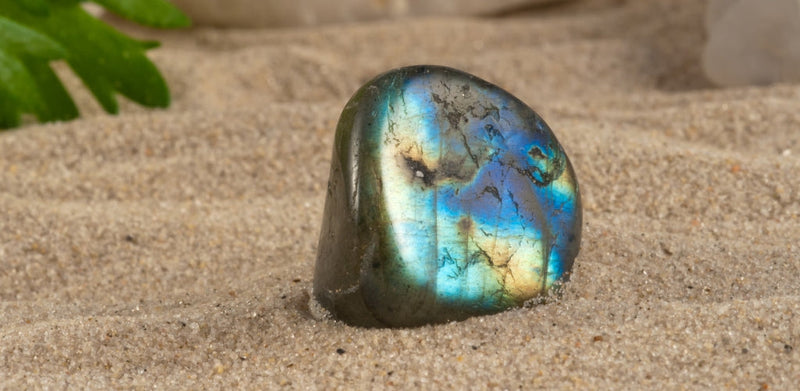
The blue, gold and green fire in labradorite has its own name, labradorescence, and it behaves differently from ordinary colour.
It comes from light bouncing off microscopic layers inside the stone rather than from a pigment, which is why it appears only when the piece is turned into a particular position and vanishes at other angles. On a bracelet that is a feature: the flash catches as your hand moves and is gone when it stops.
It is also a fair guide to quality. Beads cut so that the layers sit parallel to the surface flash across the whole strand. Beads cut carelessly show grey most of the time. Worth turning a bracelet in daylight before you buy it.
What to wear with it on the same wrist
| Partner stone | Mohs | What it adds |
|---|---|---|
| Amazonite | 6 to 6.5 | Exact hardness match, and calm before speaking |
| Moonstone | 6 to 6.5 | The same intuitive intention, closely matched |
| Green aventurine | 6.5 to 7 | Opportunity alongside the sensing |
| Clear quartz | 7 | Clarity, but harder and it will mark the labradorite |
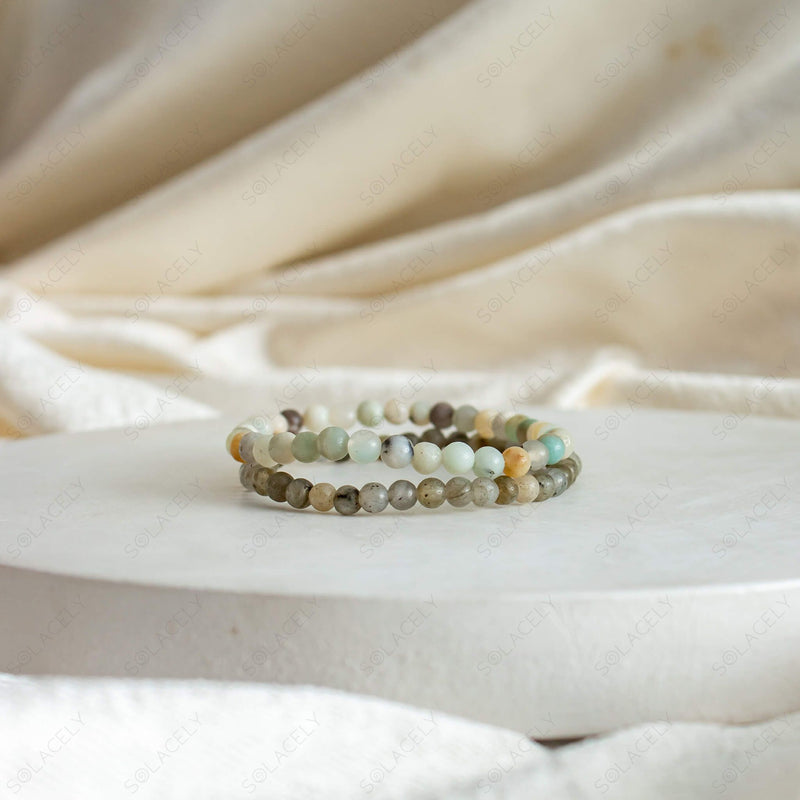
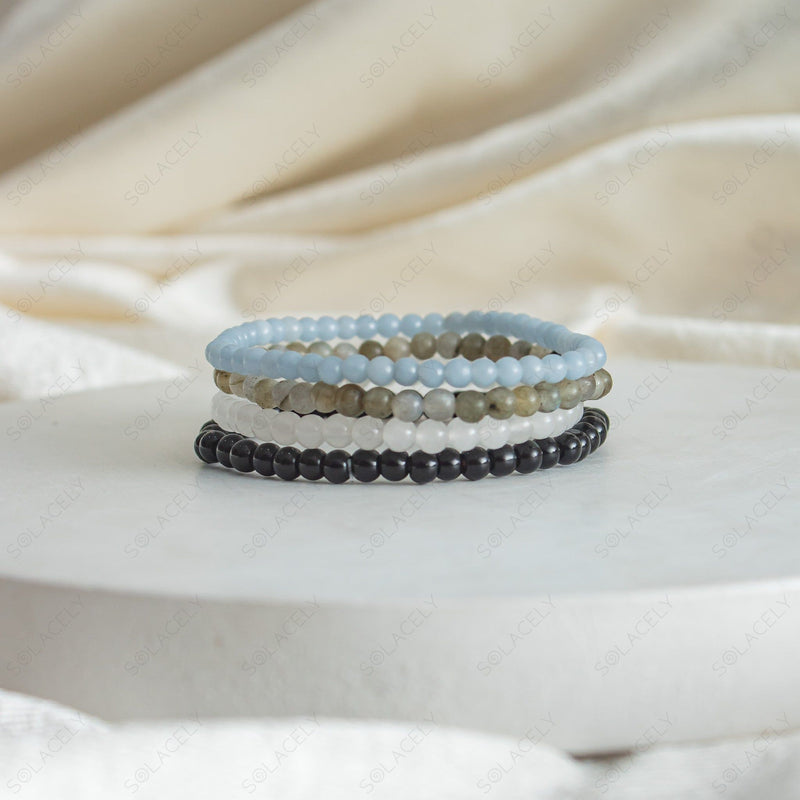
Amazonite and moonstone are the natural companions, both feldspars like labradorite itself and both matched on hardness, so a mixed strand wears evenly. We cover the aventurine pairing in green aventurine and labradorite.
Looking after it
Labradorite needs a little more care than the quartz family stones, and all of it follows from the cleavage.
A quick rinse and a soft cloth is fine, but do not leave it soaking, and never use an ultrasonic or steam cleaner, since the vibration can split it along an internal plane. Keep it out of a bag with keys. Take it off before the gym.
For cleansing, smoke, sound and a night of moonlight are all safe and none of them stress the stone. Treated reasonably, a labradorite bracelet keeps its flash for years.
Where to go next
For the rule applied across every stone, see our pillar guide to which hand to wear your crystal bracelet. For what the stone is and what it is kept for, see labradorite meaning, properties and benefits.
The uses described here reflect traditional and cultural crystal practice. They are not medical claims and are not a substitute for professional healthcare or advice.
Sources
Written by Chetena Sharma. Reviewed by the Solacely editorial team.
Frequently asked questions
About the author


Written by Chetna Sharma, crystal healing practitioner and co-founder of Solacely. Chetna has worked with healing crystals for over a decade and curates Solacely's protective stone collection.