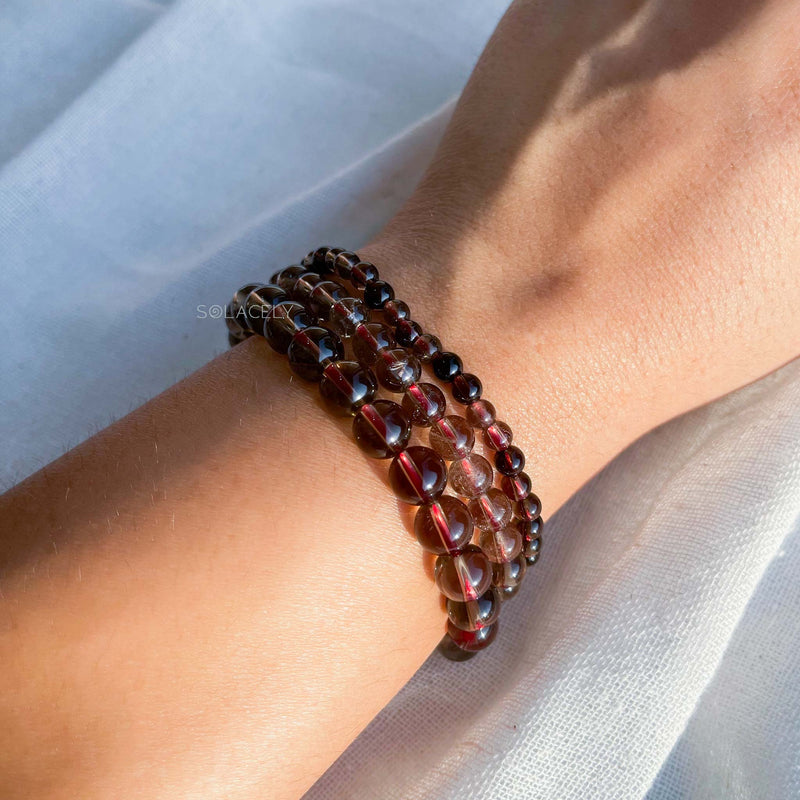
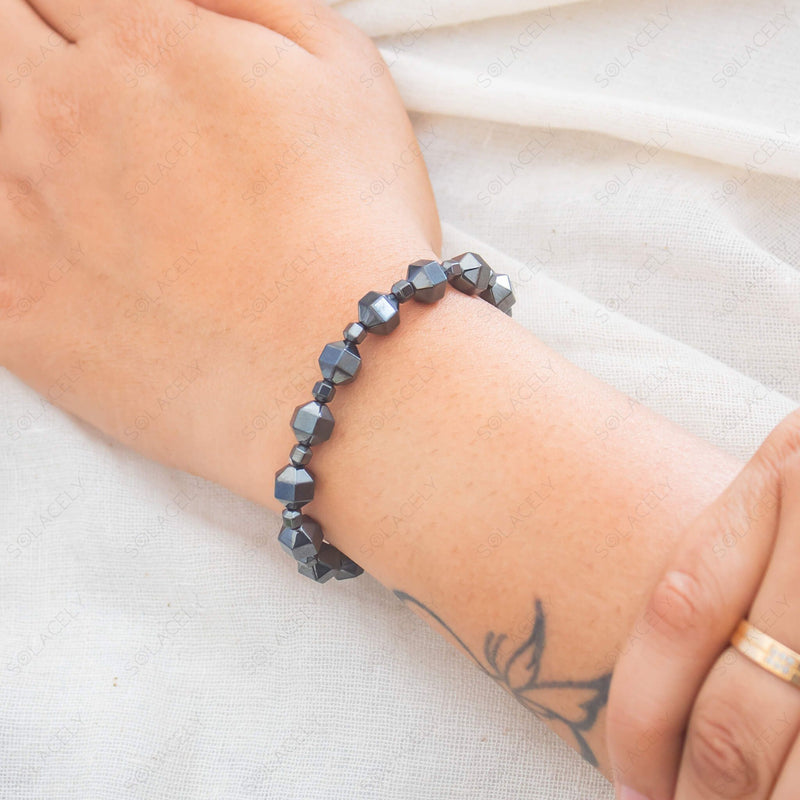
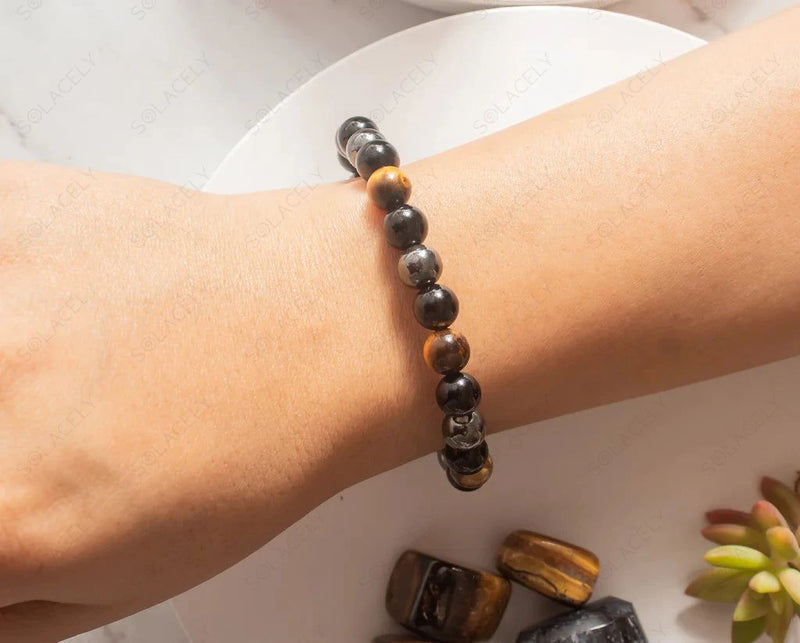
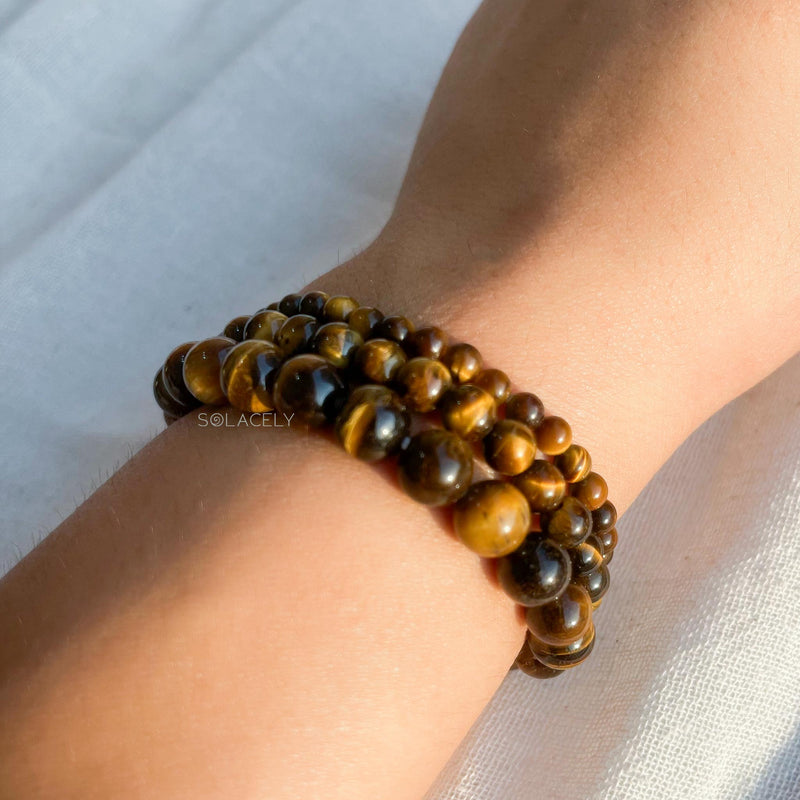
Hematite, black obsidian, tiger's eye, pyrite, smoky quartz and malachite are the stones most often chosen by men. All six are dark or metallic, most come in bead sizes that suit a broader wrist, and all of them sit under a shirt cuff without announcing themselves.
Key takeaways
- Six stones: hematite, black obsidian, tiger's eye, pyrite, smoky quartz, malachite.
- 8mm to 10mm beads suit most men. 6mm reads delicate on a broad wrist.
- Hematite and black obsidian for steadiness. Tiger's eye and pyrite for confidence.
- Pyrite must stay dry. It contains iron sulphide and rusts with repeated water or salt.
- Malachite: keep dry, never grind or sand it. Polished and worn, it is fine.
- A dark bracelet under a cuff is the most discreet way in. Start there.
The six stones
| Stone | Traditionally worn for | Mohs |
|---|---|---|
| Hematite | Grounding, steadiness through a long day | 5 to 6 |
| Black obsidian | Protection, clear sight about a situation | 5 to 5.5 |
| Tiger's eye | Confidence and nerve | 6.5 to 7 |
| Pyrite | Drive, ambition, work you want to win at | 6 to 6.5 |
| Smoky quartz | Settling after a hard week | 7 |
| Malachite | Change you have decided on | 3.5 to 4 |
Hematite has a distinct advantage as a first stone. It is heavy, cool, metallic and completely unremarkable to look at, which means it gets worn rather than kept in a drawer.
Wearing one without it looking like jewellery
This is the actual question behind most searches on the subject, and it has straightforward answers.
- Bead size. 8mm is the safe default. 10mm on a wider wrist. 6mm looks fine on a slim wrist and reads delicate on a broad one, which is usually not the effect wanted.
- Colour. Hematite, black obsidian and smoky quartz all read as plain dark beads at arm's length. Nobody asks about them.
- Under the cuff. A bracelet worn under a shirt sleeve is invisible sitting down and visible reaching for something, which is about the right amount.
- A pendant on a leather cord. Worn inside the shirt. The most discreet option of all, and the one to choose if a bracelet feels like too much.
The thing to avoid, if understatement is the aim, is a stack of three bright bracelets in different colours. One dark bracelet is a watch strap. Three is a decision people will ask you about.
Which hand
Tradition puts a stone you want to draw something in from on the left wrist, and a stone you want to send outward on the right. Hematite, black obsidian and smoky quartz are receiving stones and belong on the left for most people. Tiger's eye and pyrite are usually worn on the right, where the intention is projection rather than absorption.
Practical point that overrides all of it: wear it on the wrist that does not carry your watch, and on the hand you use less if you work with your hands. Our guide to which hand to wear a crystal bracelet on covers the reasoning stone by stone.
At work, at the gym, on site
Where you spend the day decides what survives. Smoky quartz and tiger's eye at 7 and 6.5 to 7 take knocks well and are the sensible picks if you work with your hands or lift.
Hematite is durable but the polished surface scuffs, so it looks better on a desk job than on a building site. Malachite at 3.5 to 4 is a shelf or pocket stone rather than a wrist stone for anyone doing physical work. Pyrite should come off before the shower and before the gym, since sweat is salt water.
For the grounding side of this specifically, crystals for grounding goes further, and crystals for confidence covers the tiger's eye end of the list.
Two stones that need care
Four of these six need nothing beyond a wipe with a soft cloth. Two do not.
Pyrite is iron sulphide. Water and salt will rust it, and repeated exposure makes it crumble at the edges over months rather than years. Take it off in the shower, keep it out of the sea, and cleanse it with smoke or moonlight rather than a salt bowl. Kept dry, it holds its metallic shine indefinitely.
Malachite is a copper carbonate and is soft. Polished pieces are perfectly fine to wear and handle. What it does not tolerate is soaking, and it should never be ground, sanded or filed, since the dust is not something to breathe. It also means malachite is not a stone to put in drinking water, whatever the elixir recipes say.
Black obsidian is volcanic glass and chips into sharp edges if dropped on tile. Worth knowing before it lives on a bathroom shelf. Crystals for protection covers where obsidian is traditionally placed around a home.
The uses described here reflect traditional and cultural crystal practice. They are not medical claims, and they are not a substitute for professional healthcare advice. Care warnings above are about the minerals themselves and are worth following.
Sources
Written by Chetena Sharma. Reviewed by the Solacely editorial team.
Frequently asked questions
About the author


Written by Chetna Sharma, crystal healing practitioner and co-founder of Solacely. Chetna has worked with healing crystals for over a decade and curates Solacely's protective stone collection.