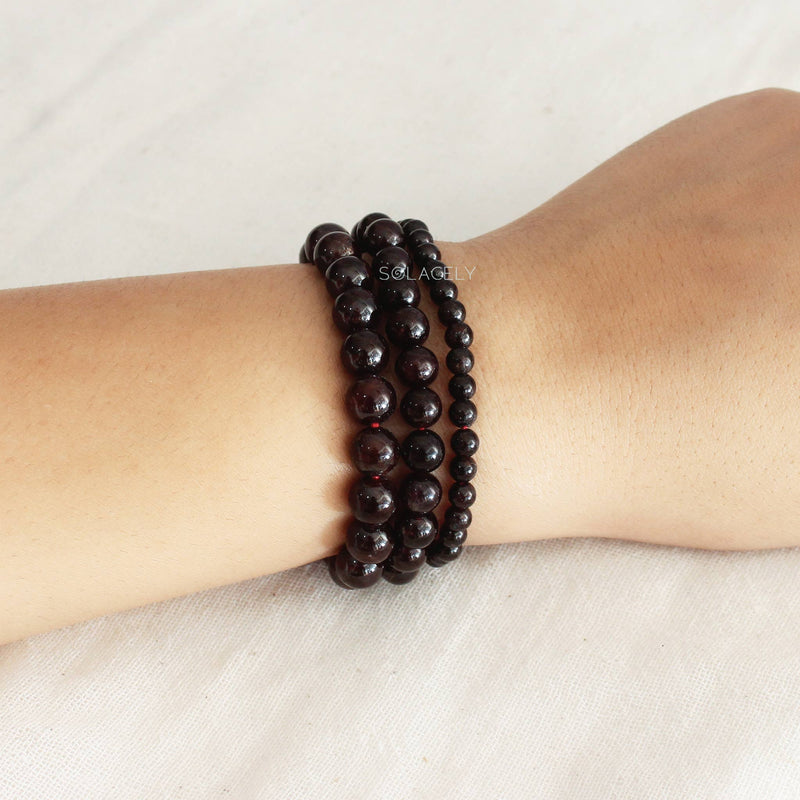
Red crystals are the stones that run from deep crimson through to orange red: garnet, red jasper, carnelian, ruby, bloodstone, red aventurine, red agate and fire agate. In crystal practice red is the colour of the root chakra, kept for drive, vitality, courage and grounding. Most of them owe that colour to iron.
Key takeaways
- Garnet is a group of related silicate minerals rather than a single mineral, and the group sits at roughly 6.5 to 7.5 on the Mohs scale.
- Ruby is red corundum, aluminium oxide, at 9 on the Mohs scale. It is the hardest of the common red stones.
- Red jasper, carnelian, red agate, red aventurine, bloodstone and fire agate all belong to the quartz family and sit at about 6.5 to 7.
- Iron gives most red stones their colour. Ruby is the exception: its red comes from traces of chromium.
- Rhodochrosite is manganese carbonate at 3.5 to 4. It is soft, reacts to acids and should never be soaked.
- Red is the traditional colour of the root chakra at the base of the spine, long associated with courage, energy and feeling steady.
What counts as a red crystal?
Any stone whose dominant body colour sits in the red band, from crimson and brick through to orange red. That includes garnet, red jasper, carnelian, ruby, red agate, red aventurine and fire agate. Bloodstone earns its place through its red flecks, and rhodochrosite sits at the pink red edge.
The boundaries are loose, and they are meant to be. Carnelian slides towards orange, rhodochrosite slides towards pink, and plenty of garnets read almost brown in low light. If you are sorting a collection by colour, our wider guide to crystal colours and what each one means explains how the bands are usually divided.
One useful distinction is opaque versus translucent. Red jasper is opaque and holds a flat, solid brick colour. Carnelian is translucent and glows when you hold it to a window. Both are chalcedony, both are quartz, and the difference comes down to how much iron oxide is packed into the stone and how finely it is spread.
What makes a crystal red?
Iron does nearly all of it. In the quartz family, fine particles of iron oxide such as hematite are dispersed through the stone and turn it brick red, rusty orange or deep brown red. In garnet, iron and manganese sit inside the crystal structure itself rather than as separate inclusions.
Ruby is the outlier. Its red comes from small amounts of chromium replacing aluminium in the corundum structure, which is also why fine ruby fluoresces so strongly under daylight. Change the trace element and you change the stone entirely: the same mineral with iron and titanium instead becomes blue sapphire.
Rhodochrosite is a third route again. It is a manganese carbonate, so the manganese is a main ingredient rather than a trace, which is why the colour is so saturated and why the material is so much softer than quartz. Carbonates are simply softer minerals than silicates.
Which red crystals should you know?
Nine stones cover almost everything sold as a red crystal. Six of them are quartz at roughly 6.5 to 7 on the Mohs scale, garnet is a group ranging from about 6.5 to 7.5, ruby is corundum at 9, and rhodochrosite is a soft carbonate at 3.5 to 4. The table below sets them side by side.
| Stone | Mineral family | Mohs hardness | Source of the red |
|---|---|---|---|
| Ruby | Corundum, aluminium oxide | 9 | Traces of chromium |
| Garnet (almandine, pyrope, spessartine) | Garnet group silicates | 6.5 to 7.5 | Iron and manganese in the structure |
| Red jasper | Quartz, opaque chalcedony | 6.5 to 7 | Iron oxide spread through the stone |
| Carnelian | Quartz, translucent chalcedony | 6.5 to 7 | Iron oxide, more finely dispersed |
| Red agate | Quartz, banded chalcedony | 6.5 to 7 | Iron oxide in bands |
| Red aventurine | Quartz with mineral platelets | About 7 | Hematite or goethite flakes |
| Fire agate | Quartz, layered chalcedony | 6.5 to 7 | Thin iron oxide layers, iridescent |
| Bloodstone | Quartz, green chalcedony | 6.5 to 7 | Iron oxide spots on a green ground |
| Rhodochrosite | Manganese carbonate | 3.5 to 4 | Manganese as a main ingredient |
Garnet is a family, not one mineral. Almandine leans deep red to brownish red, pyrope gives the clear blood red used in Victorian jewellery, and spessartine runs orange red. They share a crystal structure and differ in chemistry, which is why the hardness is quoted as a range. Our full guide to garnet meaning and properties goes further into the varieties. In crystal tradition garnet is the stone people reach for when they want commitment and follow through.
Red jasper is the workhorse. Opaque, evenly coloured and tough enough for daily beads, it takes a good polish and shrugs off knocks. It has been carved for seals and amulets for thousands of years, and it remains the stone most often kept as a steadying, grounding companion. There is more in our red jasper meaning and uses guide.
Carnelian is the warm, glowing one. Ancient Egyptian and Roman workshops cut it for signet rings because it does not stick to hot wax. Today it is long associated with confidence, creative momentum and getting started on things you have been circling. See our carnelian properties guide for the detail.
Ruby sits above the rest on hardness and on price. At 9 on the Mohs scale it is second only to diamond among natural gem materials, which is why it wears so well in rings. Traditionally it is the stone of vitality and courage, the red crystal people keep for passion rather than for calm.
Bloodstone is technically green, a dark green chalcedony scattered with red iron oxide spots, and is also called heliotrope. It has been worn for centuries as a stone of endurance and quiet strength. Red aventurine owes its glitter to tiny platelets of hematite or goethite, an optical effect called aventurescence. Fire agate carries thin layers of iron oxide that throw iridescent orange and red flashes, more like opal play of colour than a flat body tone.
Red agate is banded rather than solid, and the bands are what people look for. Rhodochrosite, with its raspberry and cream banding from Argentina and Colorado, is the softest on this list by a wide margin, and it is kept as a stone of self kindness rather than fire.
Why is red the root chakra colour?
In the chakra system, red belongs to Muladhara, the root chakra at the base of the spine. It governs the basics: safety, stability, physical energy and the sense of having your feet on the ground. Red stones are placed there because the colour matches, and that correspondence is the whole logic of the system.
Garnet, red jasper and bloodstone are the classic root chakra choices. Carnelian is often assigned one step up, to the sacral chakra, because its orange red tone straddles both. If you want the layout and the practice rather than just the colour theory, our root chakra crystal guide walks through it.
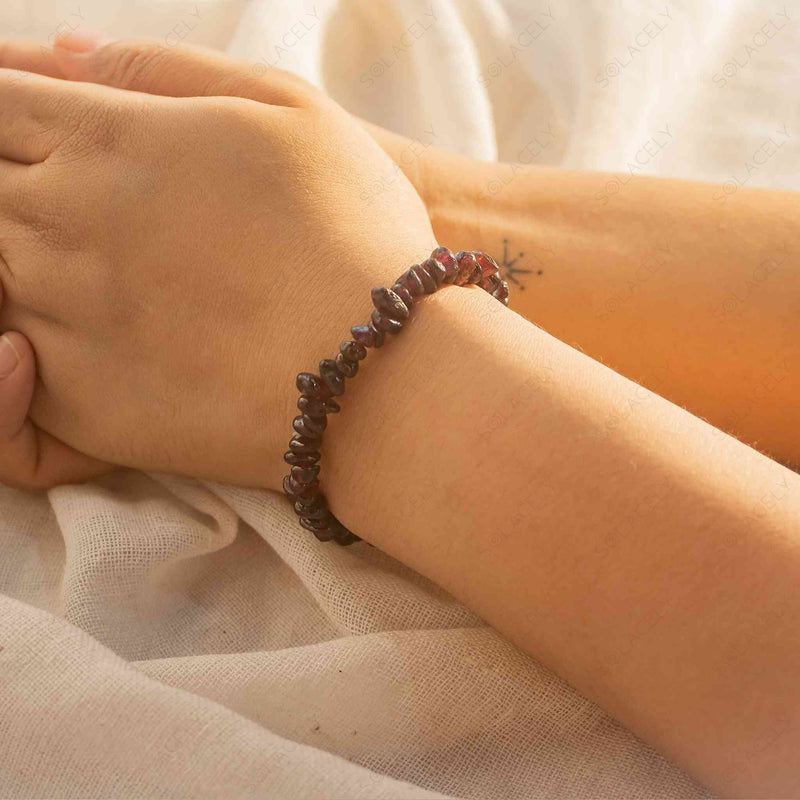
What does that look like in practice? Usually something small. A red jasper tumble in a pocket before a difficult conversation, a garnet bracelet worn on days that need momentum, a stone set on the desk where you will see it. The object keeps the intention in view, which is most of what a daily practice needs.
How do you use red crystals day to day?
Wear them where you will notice them. Bracelets and pendants are the most common forms because red stones in the quartz family sit at about 6.5 to 7 on the Mohs scale, hard enough for daily contact with keyboards, sleeves and door handles. A pocket tumble does the same job for less.
Bracelets are traditionally worn on the receiving hand, usually the left, though people vary and consistency matters more than the wrist you pick. Many people find a single stone worn steadily is more useful than a drawer of stones worn once each.
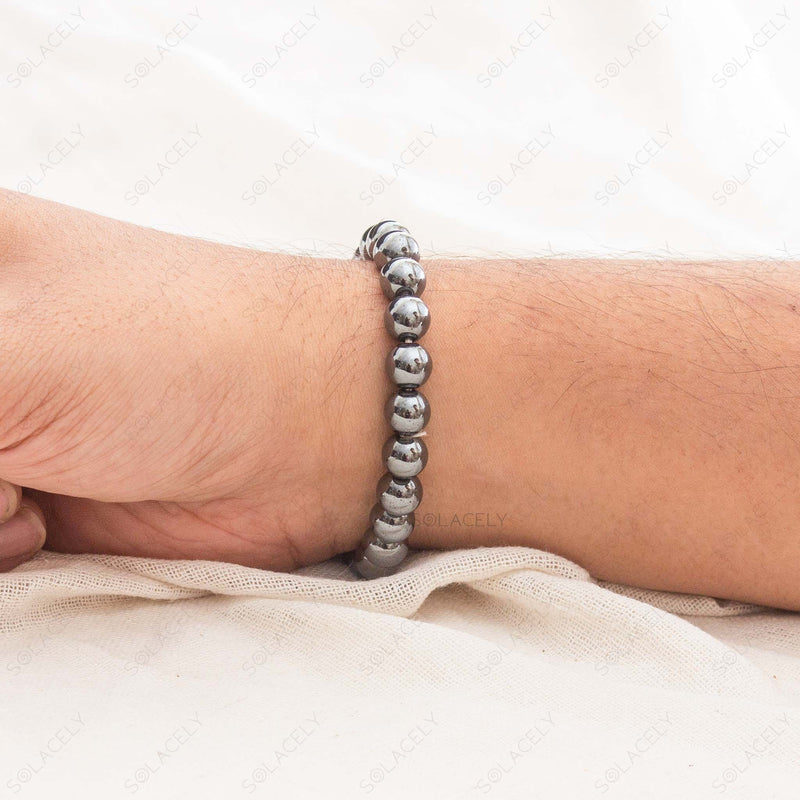
Red pairs well with black and grey grounding stones such as hematite and black tourmaline, and it balances nicely against green and pink for a softer effect. Keep pairings to two or three stones. A stack of eight competing intentions is harder to hold in mind than one clear one.
How do you care for red crystals?
Most of them are easy. Quartz family reds, jasper, carnelian, agate, aventurine and bloodstone, all sit near 7 on the Mohs scale and handle a brief rinse in lukewarm soapy water followed by a thorough dry. Ruby at 9 is tougher still. Rhodochrosite is the one that needs real care.
Rhodochrosite is a carbonate at 3.5 to 4. It scratches against almost anything harder, reacts to acids including lemon juice and vinegar, and should never be soaked or put through an ultrasonic cleaner. Wipe it with a soft dry cloth and store it separately from harder beads.
Two more notes. Fire agate carries its iridescence in a very thin surface layer, so avoid abrasive polishes that could cut through it. And as with all coloured stones, a long summer on a bright windowsill is not a kindness. Store your reds in a drawer or a pouch instead, and keep small beads and tumbles well away from young children and pets.
Crystals are kept for tradition, comfort and focus. They are not a treatment for any medical or mental health condition, and nothing here should replace or delay advice from a qualified professional. Keep small stones and beads away from young children and pets, do not place crystals in drinking water, and speak to your doctor or a mental health professional about any health concern.
Sources
- Geology.com, Garnet: mineral group, varieties and properties
- GIA, Ruby: description, quality and care
Written by Chetena Sharma. Reviewed by the Solacely editorial team.
Frequently asked questions
About the author


Written by Chetna Sharma, crystal healing practitioner and co-founder of Solacely. Chetna has worked with healing crystals for over a decade and curates Solacely's protective stone collection.