Rose Quartz Crystal: Meaning, Benefits & Properties (2026 Guide)
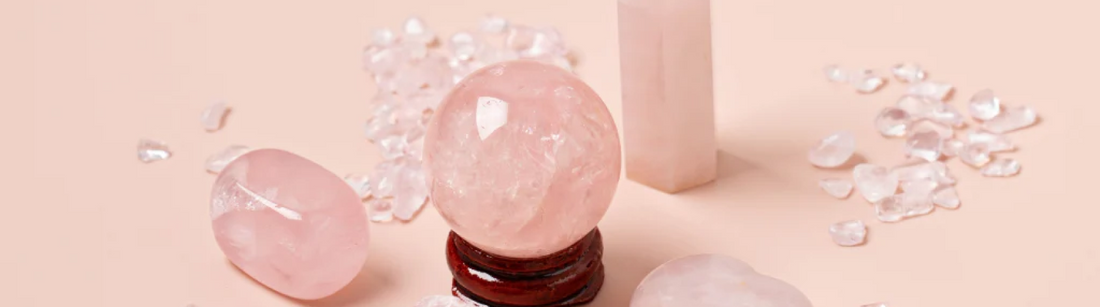

Rose quartz is the pink variety of quartz, silicon dioxide (SiO₂), with a Mohs hardness of 7 and a specific gravity of 2.6 to 2.7 (Geology.com). It almost always occurs as massive, anhedral material in pegmatites and hydrothermal veins rather than well-formed crystals. Most crystal-healing literature still says the pink colour comes from trace titanium, manganese, or iron, but late-1990s research at the California Institute of Technology found something more interesting: the colour comes from microscopic pink fibres of a borosilicate mineral similar to dumortierite, informally called "dididumortierite" (Geology.com). In crystal-healing tradition, rose quartz is the heart-chakra "stone of unconditional love." This guide covers the verified mineralogy, the surprising colour-cause story, the traditional benefits, and the right way to cleanse and care for the stone.
- Rose quartz is silicon dioxide (SiO₂, Mohs 7, SG 2.6 to 2.7), trigonal crystal system, almost always massive rather than crystalline (Geology.com).
- The pink colour comes from microscopic borosilicate fibres similar to dumortierite, identified by Caltech researchers in the late 1990s — not from trace iron or titanium, despite older textbook explanations.
- The rare transparent "pink quartz" is a different beast: coloured by irradiation-induced colour centres, and prone to fading in heat or light.
- Crystal-healing use: heart chakra (Anahata), associated with love, compassion, forgiveness, and emotional balance. The default "love stone."
- Care: durable enough for daily wear at Mohs 7, but cut and faceted pink quartz pieces should be kept out of prolonged direct sunlight to be safe.
- Major sources: Brazil, South Africa, India, Madagascar, Namibia, Mozambique, Sri Lanka (Geology.com).

What Is Rose Quartz Crystal?
Rose quartz is the pink variety of macrocrystalline quartz: silicon dioxide (SiO₂), Mohs 7, specific gravity 2.6 to 2.7, trigonal crystal system (Geology.com; Britannica). It almost always occurs as massive, anhedral material in pegmatites and hydrothermal veins, not as well-formed crystals. That's why most rose quartz on the market is tumbled, carved, or shaped into hearts and spheres rather than cut as faceted gems.
"Quartz" itself is an old German word first used by the mineralogist Georgius Agricola in 1530 (Britannica). The Greek krystallos root that gave us "crystal" originally referred only to clear quartz. Rose quartz earned its modern name purely from the colour: rose, like the flower, the soft pink end of the warm-tone spectrum.
In crystal-healing tradition, rose quartz is the "stone of unconditional love." Practitioners associate it with the heart chakra, romantic and platonic love, self-compassion, and emotional healing. It's also the most popular "starter crystal" we sell — the stone people buy when they're new to the practice and want something gentle.
What Causes the Pink Colour in Rose Quartz?
The honest answer is: not what most crystal books say. For more than a century, the standard textbook explanation was that rose quartz gets its pink colour from trace amounts of titanium, manganese, or iron substituting into the crystal structure. In the late 1990s, researchers at the California Institute of Technology examined the colour-bearing fibres in massive rose quartz and identified them as a borosilicate mineral with properties similar to dumortierite, informally called "dididumortierite" (Geology.com).
That's a meaningful update. The pink in your rose quartz tumble isn't dissolved iron. It's millions of microscopic pink fibres of a different mineral, suspended throughout the quartz, scattering light in a way that gives the stone its characteristic translucent rosy glow. The older "iron, manganese, titanium" explanation does still apply to the much rarer transparent variety known as pink quartz, where colour comes from irradiation-induced colour centres.
This matters for two practical reasons. First, the dididumortierite-coloured massive rose quartz most people own is light-stable. It generally doesn't fade in normal use. Second, if you've bought a transparent, faceted "pink quartz" gem, that can fade with prolonged heat or sun exposure (Geology.com) — an important care difference most jewelers don't mention.
Where Does Rose Quartz Come From?
Major commercial sources of rose quartz include Brazil, South Africa, India, Madagascar, Namibia, Mozambique, and Sri Lanka (Geology.com). Brazil has historically been the most important producer of high-quality massive rose quartz, particularly the soft, evenly-coloured material used for tumbled stones, beads, hearts, and spheres. The stone forms in granite pegmatites and hydrothermal veins, often alongside other quartz varieties like smoky quartz and clear quartz.
Rose quartz has shown up in human use for millennia. Beads and amulets carved from it have been recovered from archaeological sites across the ancient Mediterranean and Near East. Egyptian, Greek, and Roman cultures all used rose quartz for jewelry and burial goods, and Greek and Roman writers described it among the desirable coloured stones, although Britannica notes that the older Greek krystallos term was reserved specifically for clear quartz (Britannica).
One useful piece of trivia: quartz of all colours, including rose quartz, is piezoelectric, meaning it generates a small electrical charge when squeezed (Britannica). The same property is why quartz crystals run watches and radios. Crystal-healing tradition has long claimed rose quartz "vibrates" energetically. The mineralogy at least gives the language a hook.
What Are the Benefits and Healing Properties of Rose Quartz?
Crystal-healing tradition assigns rose quartz three layers of benefit: emotional (self-love, compassion, forgiveness), physical (heart and circulation support, energetic only), and metaphysical (heart-chakra balance, attracting love, spiritual softness). None of these claims is medically validated. They reflect long-standing tradition and personal practice rather than clinical research.
Emotional Healing Properties
Rose quartz is the stone people buy when they want to soften something. Self-criticism, grief, a broken heart, anger that's outlasted its cause — the traditional indications all cluster around the same emotional territory: opening, releasing, and being kinder to yourself. In ten years of running rose quartz through bracelet customs at Solacely, I'd estimate at least 70% of customers buying rose quartz mention "self-love" without prompting.
Common traditional uses I see in client sessions: rose quartz held during a journaling practice focused on self-forgiveness, a tumbled stone tucked into a pillowcase during a difficult sleep stretch, or a piece kept in a partner's pocket during a relationship rough patch. Whether the effect is energetic or simply ritual focus is a fair question. Practitioners would say "both."
Physical Healing Properties (Traditional)
In the crystal-healing tradition, rose quartz is associated with the heart and circulatory system, partly through its heart-chakra link and partly through the soft pink colour echoing the colour of healthy tissue. Practitioners place it over the chest during energy work and sometimes pair it with green aventurine or emerald for what's traditionally called "heart support."
None of this is medical treatment. Rose quartz hasn't been shown to lower blood pressure, improve circulation, or strengthen immunity in any peer-reviewed study. The "physical" tradition is best read as a metaphor for attention rather than a treatment claim.
Metaphysical & Heart-Chakra Properties
Metaphysically, rose quartz is the default heart-chakra stone. Tradition reads its pink colour as soft, feminine, water-element energy, and pairs it with the emotional and relational concerns the heart chakra governs: love given, love received, and the ability to remain open without becoming porous. It's the most common "starter crystal" people buy because the energy is gentle.
Practitioners often pair rose quartz with clear quartz to amplify intention, with amethyst for emotional calming, and with green aventurine for opportunity in love. Used alone, it's most often programmed as a daily companion rather than a single-use ritual stone — closer to a long, slow infusion than a focused sprint.
Which Chakra Is Rose Quartz For?
Rose quartz is the primary stone associated with the heart chakra (Anahata), the energy centre at the centre of the chest, traditionally linked to love, compassion, forgiveness, and emotional balance. The pairing is intuitive. The heart chakra's secondary colour in modern chakra theory is soft pink alongside its primary green, and rose quartz's translucent rosy hue matches that almost exactly.
Some practitioners also use rose quartz secondarily on the higher heart or thymus chakra (an "additional" centre between the heart and throat in extended chakra systems), which is associated with empathy and unconditional love. It's rarely used on the lower chakras. The energy is too soft and too cool for solar plexus or root work in most traditions.
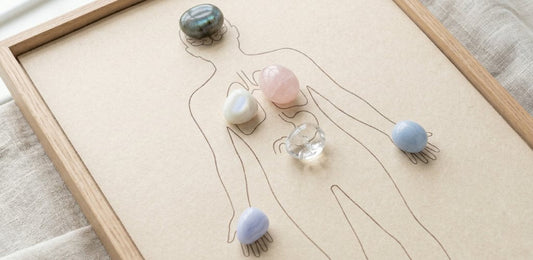
A simple way to use this: lie down, place a small rose quartz tumble at the centre of your chest, and breathe slowly for five to ten minutes with one specific intention (forgiveness, self-acceptance, opening to love). Keep it gentle. Rose quartz isn't a high-intensity stone, and the practice shouldn't be either.
How Can You Use Rose Quartz Day-to-Day?
The three most common uses are jewelry, meditation, and home placement. Each one has a slightly different goal, and the form of rose quartz you choose should match that goal. Tumbled stones are versatile for meditation and altar work. Polished hearts are made for gifting. Faceted cuts are jewelry-grade but rarer and require more careful sun exposure.
Rose Quartz Jewelry
Rose quartz jewelry is the easiest entry point, partly because the stone at Mohs 7 wears well in daily use without obvious scratching. Beaded bracelets are by far the most common form and pair naturally with clear quartz, amethyst, or green aventurine in stacked sets. Pendants worn at heart level are a traditional placement choice — the stone sits where its energy is said to act.
One care note: massive rose quartz coloured by dididumortierite fibres is light-stable in normal use, but cut and faceted "pink quartz" pieces can fade with sustained sun exposure (Geology.com). If a piece is unusually clear and faceted, store it out of direct sunlight when you're not wearing it.
Rose Quartz for Meditation
For meditation, place a tumbled rose quartz on the centre of your chest, lying down, and breathe slowly with the intention you want the practice to address: self-compassion, forgiveness, releasing a relationship, opening after grief. Ten minutes is enough. Rose quartz is a soft, slow stone. The practice should match.
If lying down isn't workable, hold a stone in each palm, close your eyes, and notice where the warmth meets the skin. The practice doesn't have to be complicated. Heart-chakra work is more about presence than technique.
Rose Quartz at Home
Rose quartz is one of the most popular home-placement crystals in the modern tradition. Common placements: bedroom (relationships and emotional softness), front entrance (welcoming energy), and any room used for difficult conversations (the kitchen table, the family room). Hearts, spheres, and clusters all work. The stone's strength is gentleness, so the placement should be where you want softness, not where you want sharpness or structure.
In feng shui terms, rose quartz is most often placed in the "love and relationships" gua (the back-right corner of a room, looking from the door). The placement matters less than the consistency. A rose quartz piece you actually notice every day will feel more "active" than one you've forgotten about.
How Do You Cleanse and Charge Rose Quartz?
Rose quartz at Mohs 7 is durable enough that physical cleaning is straightforward: warm soapy water with a soft cloth handles tumbled stones, hearts, and most jewelry. Skip ultrasonic cleaners, steam, and harsh chemicals. For energetic cleansing, dry methods are gentlest, especially for any cut or faceted "pink quartz" pieces, which can fade in sustained heat or light (Geology.com).
Why Cleanse and Charge Rose Quartz?
In crystal-healing practice, cleansing clears residual energy a stone has picked up from its environment or wearer. Even if you don't subscribe to the energetic side, regular cleansing is good physical hygiene for jewelry: it removes skin oils, dust, and lotion residue that dull the stone's natural lustre.
A reasonable cadence: cleanse rose quartz once a month with normal use, more often if you're using it during a difficult emotional period or wearing it daily through workouts. Charging is a separate step (re-energising the stone toward a specific intention), usually done immediately after cleansing.
How to Cleanse Rose Quartz (4 Safe Methods)
- Sound. Hold the stone near a singing bowl or tuning fork for 30 to 60 seconds. Safe for every form of rose quartz, including jewelry.
- Smoke. Pass the stone through sage, palo santo, or incense smoke for about a minute. Don't hold it in direct flame.
- Moonlight. Set the stone on a windowsill overnight, ideally on a full or new moon. Bring it back inside before morning.
- Selenite or clear quartz contact. Rest the rose quartz on a selenite plate or beside a clear quartz cluster for 6 to 12 hours.
Water cleansing (warm soapy water, brief rinse) is mineralogically safe for rose quartz at Mohs 7 with no cleavage. The reason most cleansing traditions still skip it is practical: water can damage the stringing on bracelets and corrode metal settings on jewelry, and for any rare faceted pink quartz, prolonged sun-drying is a fade risk.
How to Charge Rose Quartz (4 Methods)
- Moonlight. The default rose quartz charging method. Place the stone on a windowsill overnight, ideally on a full or new moon. Moonlight pairs naturally with rose quartz's soft, feminine, water-element associations.
- Brief indirect sunlight. Up to an hour, indirect, mid-morning. Skip for any cut or faceted piece, since the rare transparent pink quartz variety can fade with sustained light or heat (Geology.com).
- Intention setting. Hold the cleansed stone at chest level, state one specific intention out loud (forgiveness, self-acceptance, opening to a particular relationship), and breathe with it for two to three minutes.
- Crystal grid. Place rose quartz at the centre of a grid surrounded by clear quartz points to amplify a heart-chakra intention. Leave for 24 hours.
Frequently Asked Questions
What is rose quartz?
Rose quartz is the pink variety of quartz (SiO₂, Mohs 7, specific gravity 2.6 to 2.7), a trigonal silicate that almost always forms as massive, anhedral material in pegmatites and hydrothermal veins rather than well-formed crystals (Geology.com). Its pink colour comes from microscopic borosilicate fibres similar to dumortierite, identified by Caltech researchers in the late 1990s.
What causes the pink colour in rose quartz?
Late-1990s Caltech research found that the colour comes from microscopic pink fibres of a borosilicate similar to dumortierite, informally called "dididumortierite" (Geology.com). The older textbook explanation that pink colour comes from trace titanium, manganese, or iron applies more accurately to the rare transparent "pink quartz," not the standard massive rose quartz most people own.
Is rose quartz the same as pink quartz?
No. Rose quartz is the common massive, translucent variety coloured by dididumortierite fibre inclusions, and it's generally light-stable. Transparent "pink quartz" is a rare crystalline variety coloured by irradiation-induced colour centres, and its colour often fades with heat or light exposure (Geology.com).
Which chakra is rose quartz for?
Rose quartz is the primary stone associated with the heart chakra (Anahata), the energy centre traditionally linked to love, compassion, forgiveness, and emotional balance. Its soft pink colour matches the heart chakra's secondary colour symbolism (alongside green) almost exactly in modern crystal-healing practice.
Can rose quartz fade in sunlight?
Massive rose quartz coloured by dididumortierite fibres is generally light-stable. The rarer transparent "pink quartz" fades with heat or sustained light exposure (Geology.com). To be safe, keep any cut or faceted pink quartz piece out of prolonged direct sunlight, since faceted material is much more likely to be the unstable variety.
How do you cleanse rose quartz safely?
Rose quartz at Mohs 7 is durable in warm soapy water with a soft cloth. Skip ultrasonic cleaners, steam, and harsh chemicals. For energetic cleansing, the safest options are sound (singing bowl, tuning fork), smoke (sage, palo santo), moonlight overnight, or contact with a selenite plate. Brief moonlight charging is gentler than sun for any pink quartz.
Where is rose quartz mined?
Major commercial sources include Brazil, South Africa, India, Madagascar, Namibia, Mozambique, and Sri Lanka (Geology.com). Brazil is historically the most important producer of high-quality massive rose quartz used for tumbled stones, beads, hearts, and carvings.
About the author