Tiger's Eye Crystal: Meaning, Benefits & Properties (2026 Guide)


Tiger's eye is the courage stone with a glow inside it. Mineralogically, it's a chatoyant variety of quartz, silicon dioxide (SiO₂) with a Mohs hardness of 6.5 to 7 and a specific gravity of 2.64 to 2.71 (Wikipedia). What makes it special is the silky, drifting band of light that appears to shift across the surface when the stone is rotated, an optical effect called chatoyancy, named for the French chat (cat) and oeil (eye). Roman soldiers wore engraved tiger's eye amulets into battle, and the modern crystal-healing tradition still treats it as the default stone for confidence, courage, and grounded action. This guide covers the verified mineralogy (including the 2003 Penn State research that rewrote how tiger's eye actually forms), the chakra associations, and the right way to care for the stone.
- Tiger's eye is a chatoyant variety of quartz (SiO₂, Mohs 6.5 to 7, SG 2.64 to 2.71), with the silky drifting band caused by parallel fibrous structure inside the stone (Wikipedia).
- 2003 research at Penn State (Heaney and Fisher) found tiger's eye doesn't form through asbestos replacement as the textbook explanation said for over a century. It forms through a quartz crack-seal vein mechanism, with the fibres locked safely inside stable quartz.
- Crystal-healing use: solar plexus chakra (Manipura) for confidence and willpower; sacral chakra (Svadhisthana) for creativity; root chakra (Muladhara) for grounding.
- Roman soldiers wore engraved tiger's eye into battle for protection (Wikipedia) — one of the oldest documented uses in the Western tradition.
- Major sources: South Africa, Australia, Brazil, India, Namibia, USA, Burma, Canada, China, Korea, Spain (Wikipedia).
- Care: durable enough at Mohs 6.5 to 7 for daily-wear bracelets, pendants, and rings.

What Is Tiger's Eye Crystal?
Tiger's eye is a member of the quartz group: silicon dioxide (SiO₂), Mohs hardness 6.5 to 7, specific gravity 2.64 to 2.71 (Wikipedia). What sets it apart from clear quartz, amethyst, and rose quartz is internal structure rather than chemistry. Tiger's eye is fibrous on a microscopic scale, with parallel mineral fibres running through the stone in tight bands, and that fibrous structure is what gives the stone its shimmer.
The colour palette runs from honey-gold to deep root-beer brown, with darker bands that look almost black under low light and burn like polished bronze in direct sun. The classic blue-grey "hawk's eye" is the same stone family with slightly different mineral weathering. Polished cabochons, tumbled palmstones, and beaded bracelets are the most common forms.
In crystal-healing tradition, tiger's eye is the courage stone. Practitioners associate it with confidence, grounded action, focus during high-pressure work, and the protective "all-seeing" attention the chatoyant band suggests. The customers I see returning for second tiger's eye pieces are almost always people in roles that require nerve: founders, athletes, performers, anyone whose work involves visible stakes.
What Causes the Cat's Eye Effect?
The shimmer is called chatoyancy. It's caused by parallel intergrowth of quartz crystals and altered amphibole fibres, which have mostly turned into iron-bearing limonite over geological time (Wikipedia). Light hitting the stone reflects off these microscopic parallel fibres at slightly different angles, producing the silky band of light that drifts across the surface as the stone is rotated. It's the same optical principle behind the silk-thread shimmer on certain woven fabrics.
Here's where it gets genuinely interesting. For more than 100 years, the textbook explanation was that tiger's eye forms when fibrous crocidolite asbestos is gradually replaced atom-by-atom by quartz, leaving a "fossil" of the fibrous structure behind. In 2003, mineralogists Peter Heaney and Donald Fisher at Pennsylvania State University looked at tiger's eye specimens under high-resolution microscopy and found something different: the textures don't match pseudomorphic replacement at all. Instead, they argued, tiger's eye forms through a crack-seal vein mechanism, where quartz and amphibole fibres grow synchronously while a vein in the rock is repeatedly fractured and re-sealed (Heaney & Fisher, 2003, Geology, vol. 31).
The practical implication for buyers: tiger's eye doesn't actually contain loose asbestos fibres. The fibres are quartz, locked inside stable quartz, and finished polished tiger's eye is no more a respiratory concern than any other piece of polished quartz jewelry. The asbestos worry is a hand-me-down from the older textbook explanation that turned out to be wrong.
Where Does Tiger's Eye Come From?
Tiger's eye is mined commercially in Australia, India, Namibia, South Africa, Brazil, Canada, China, Korea, Spain, Burma, and the United States (Wikipedia). South Africa's Northern Cape province has historically been the most important commercial source, particularly the Asbestos Mountains region near Prieska, where most of the world's gem-quality tiger's eye for jewelry and tumbled stones is mined.
The historical record runs deep. Roman soldiers wore engraved tiger's eye amulets into battle, believed to provide protection from spears and arrows (Wikipedia). The combination of the stone's chatoyant "all-seeing eye" appearance and its association with the protective gaze of a watchful predator made it one of the most popular protective stones of the late Roman Republic and early Empire. Egyptian craftspeople carved similar chatoyant stones into the eyes of statues, partly for visual effect and partly for symbolic protection.
Tiger's eye has continued in nearly unbroken use across cultures since. Medieval European jewellers cut it as cabochons for signet rings. Victorian-era mourning jewelry used the deep brown shade as an alternative to jet. By the late 1900s tiger's eye had become one of the most popular stones in the global wellness market, valued for its accessibility, durability, and the visual drama of its banded shimmer.
What Are the Benefits and Healing Properties of Tiger's Eye?
Crystal-healing tradition assigns tiger's eye three layers of benefit: emotional (courage, focus, decisiveness), physical (energetic support tied to vitality and the solar plexus area, traditional only), and metaphysical (protection, grounding, "all-seeing" awareness). None of these claims is medically validated. They reflect long-standing tradition rather than clinical research.
Emotional Healing Properties
Tiger's eye is the stone people reach for when they need nerve. Job interviews, public speaking, hard conversations, the kind of decision that matters and won't make itself — practitioners point to all of these as classic tiger's eye indications. The tradition pairs courage with focus, treating the stone as something that helps you concentrate on what's actually in front of you rather than the imagined audience around it.
The most common phrase I've heard from customers about tiger's eye is some version of "I needed something that would steady me." Whether the effect is energetic or simply ritual focus is a fair question. Practitioners would say "both."
Physical Healing Properties (Traditional)
In the crystal-healing tradition, tiger's eye is associated with the solar plexus area — energy, stamina, and the kind of grounded vitality the tradition links to that region. Practitioners place it over the upper abdomen during energy work and sometimes pair it with carnelian or pyrite for a "fire-and-grounding" stack.
None of this is medical treatment. Tiger's eye hasn't been shown in any peer-reviewed study to influence energy levels, stamina, or any biological process. The "physical" tradition is best read as a metaphor for attention rather than a treatment claim.
Metaphysical & Protection Properties
Metaphysically, tiger's eye is the protection stone of the modern crystal tradition, on the strength of its Roman-soldier history alone. The "all-seeing eye" reading of the chatoyant band — a pupil-like shimmer that drifts as the stone moves — is the visual basis for the protective tradition: a stone that watches back. It's used in protective grids, kept in cars and bags during travel, and gifted to people heading into demanding new chapters.
Practitioners often pair tiger's eye with black tourmaline for layered psychic protection, with hematite for grounding, and with citrine when courage and abundance are linked goals (a launch, a pitch, a negotiation). Used alone, it tends to feel sturdy rather than soft — closer to a steady hand on the shoulder than a comforting hug.
Which Chakra Does Tiger's Eye Activate?
Tiger's eye is most strongly associated with the solar plexus chakra (Manipura), the energy centre between the navel and the lower ribs traditionally linked to confidence, willpower, and personal authority. The pairing is intuitive: solar plexus energy is golden and warm in chakra colour theory, and tiger's eye is a literal golden, sun-warm stone with a fire underneath.
It's also commonly used on the sacral chakra (Svadhisthana) for creativity and emotional flow, and on the root chakra (Muladhara) for grounding and a sense of physical safety. The three lower chakras together form what practitioners sometimes call the "action axis," and tiger's eye covers the whole stretch in a way few single stones do.
A simple way to use this: place a small tiger's eye on the solar plexus during a five-minute breath practice, set one specific intention around something that requires nerve (a meeting, a confrontation, a decision), and remove the stone afterwards. Direct, specific intentions work better with tiger's eye than vague ones.
How Can You Use Tiger's Eye Day-to-Day?
The three most common uses are jewelry, meditation, and protection placement. Each has a slightly different goal, and the form of tiger's eye you choose should match it. Tumbled stones are versatile for meditation. Beaded bracelets are the most popular jewelry form, paired naturally with hematite, lava stone, or black onyx. Larger raw chunks anchor a desk or a car well.
Wearing Tiger's Eye Jewelry
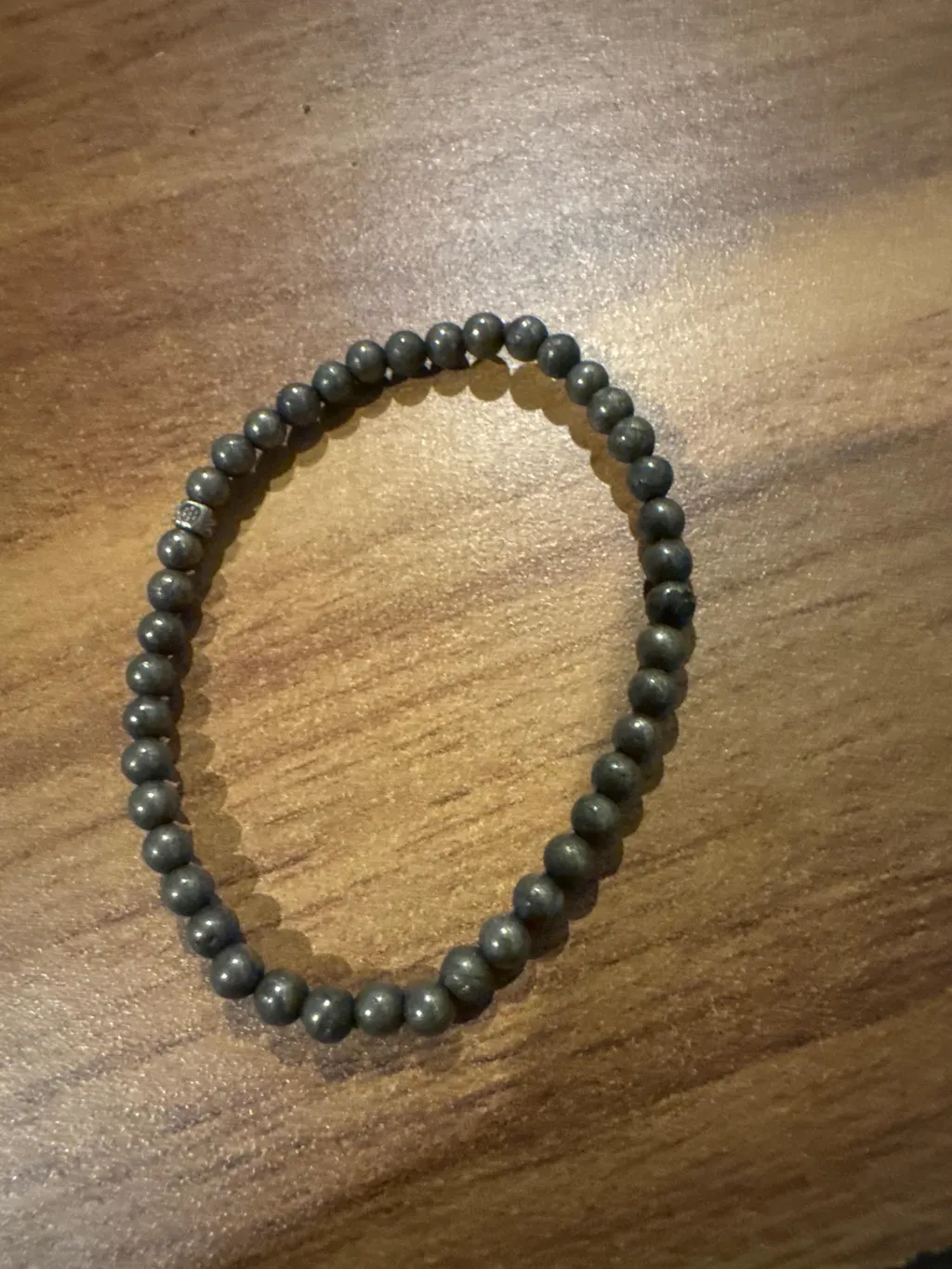
Tiger's eye jewelry is one of the easiest crystal-jewelry entry points because the stone at Mohs 6.5 to 7 wears well in daily use without obvious scratching. Beaded bracelets are by far the most common form, especially in men's stacks where the warm brown reads as understated rather than overtly "crystal." Polished cabochons set in silver or rose gold work beautifully as pendants, and chatoyant signet-style rings have a long jewelry-history pedigree.
If you're new to crystal jewelry, a single tiger's eye bead alongside grounding stones (hematite, black onyx, lava stone) is a more flexible starting point than an all-tiger's-eye strand. The chatoyant band is striking enough that even a single bead carries visual weight.
Tiger's Eye for Meditation
For meditation, hold a tumbled tiger's eye in your dominant hand and close the other around it. The stone has noticeable physical weight at SG 2.64 to 2.71 (Wikipedia), and that weight is part of the practice. It anchors attention.
A specific tiger's eye meditation for high-pressure days: three rounds of slow breathing, one stated intention focused on a specific upcoming task, three more rounds, then put the stone in your pocket and go do the thing. Three to five minutes. The point is propulsion plus steadiness, not deep contemplation.
Tiger's Eye for Protection and Workspace
Tiger's eye is one of the most-recommended protection and grounding stones in the modern crystal tradition. Common placements: a small piece in the car for travel protection, a tumble in the work bag for high-stakes meetings, a polished cabochon on a desk during difficult project stretches. The consistency matters more than the specific spot.
In feng shui terms, tiger's eye is most often placed near the front entrance of a home for protection or in the wealth corner (back-left from the front door) for the abundance tradition. Many practitioners pair it with black tourmaline at the entrance for layered protection.
How Do You Cleanse and Charge Tiger's Eye?
Tiger's eye at Mohs 6.5 to 7 is durable enough that physical cleaning is straightforward: warm soapy water with a soft cloth handles tumbled stones and most jewelry. Skip ultrasonic cleaners and steam (sudden temperature shifts can damage any quartz). For energetic cleansing, dry methods are gentlest, and brief direct sunlight is generally acceptable for charging.
Why Cleanse and Charge Tiger's Eye?
In crystal-healing practice, cleansing clears residual energy a stone has picked up from its environment or wearer. Even if you don't subscribe to the energetic side, regular cleansing is good physical hygiene for jewelry: skin oils, dust, and lotion residue dull the stone's natural shimmer over time, and removing them keeps the chatoyant band crisp.
A reasonable cadence: cleanse tiger's eye once a month with normal use, more often if you wear a piece daily through workouts or use it in active protection practice. Charging is a separate step (re-energising the stone toward a specific intention), traditionally done after cleansing.
How to Cleanse Tiger's Eye (4 Safe Methods)
- Sound. Hold the stone near a singing bowl or tuning fork for 30 to 60 seconds. Safe for every form of tiger's eye, including jewelry.
- Smoke. Pass the stone through sage, palo santo, or incense smoke for about a minute. Don't hold it in direct flame.
- Moonlight. Set the stone on a windowsill overnight, ideally on a full or new moon. Bring it back inside before morning.
- Selenite or clear quartz contact. Rest the tiger's eye on a selenite plate or beside a clear quartz cluster for 6 to 12 hours.
Skip ultrasonic cleaners and steam. Both can stress the stone's banded structure. Brief contact with clean water is fine but extended salt-water immersion isn't recommended for the metal in jewelry settings.
How to Charge Tiger's Eye (4 Methods)
- Brief sunlight. Place tiger's eye in indirect or short direct sunlight (15 to 30 minutes max). Solar charging matches its golden, fire-element associations beautifully.
- Intention setting. Hold the cleansed stone, state one specific courage-or-protection intention out loud (a meeting to handle, a journey to take), and breathe with it for two to three minutes.
- Pocket carry. The traditional Roman-soldier method. Carry the stone in a pocket through a deliberately challenging day, then place it back on its altar. The stone takes on the energy of the practice.
- Crystal grid. Place tiger's eye at the centre of a grid surrounded by clear quartz points and small black tourmaline tumbles to amplify a protection or courage intention. Leave for 24 hours.
Frequently Asked Questions
What is tiger's eye crystal?
Tiger's eye is a chatoyant variety of quartz, silicon dioxide (SiO₂) with a Mohs hardness of 6.5 to 7 and a specific gravity of 2.64 to 2.71 (Wikipedia). It's known for its silky, golden-to-brown bands that appear to shift like a cat's eye when the stone is rotated, an optical effect called chatoyancy.
What causes the cat's eye effect in tiger's eye?
The chatoyant shimmer comes from the parallel intergrowth of quartz crystals and altered amphibole fibres now mostly turned into iron-bearing limonite (Wikipedia). Light reflecting from these microscopic parallel fibres produces the silky band that drifts across the surface as the stone moves.
Which chakra is tiger's eye for?
Tiger's eye is most strongly associated with the solar plexus chakra (Manipura) for confidence and willpower, and secondarily with the sacral chakra (Svadhisthana) for creativity and courage. Some practitioners also use it on the root chakra (Muladhara) for grounding and protection work.
Where does tiger's eye come from?
Tiger's eye is mined commercially in Australia, India, Namibia, South Africa, Brazil, Canada, China, Korea, Spain, Burma, and the United States (Wikipedia). South Africa's Northern Cape province has historically been the most important commercial source of high-quality material for jewelry and tumbled stones.
Is tiger's eye safe to wear?
Yes. Modern research by Heaney and Fisher (2003) found tiger's eye forms through a quartz crack-seal vein mechanism rather than asbestos replacement, and the fibres in finished tiger's eye are encased in stable quartz. Polished cabochons, beads, and tumbled stones pose no respiratory hazard in normal jewelry use.
Can tiger's eye get wet?
Yes. At Mohs 6.5 to 7, tiger's eye is durable enough for warm soapy water cleaning with a soft cloth. Skip ultrasonic cleaners and steam (sudden temperature changes can damage any quartz). For energetic cleansing, sound, smoke, moonlight, and selenite contact are the gentlest options.
Did Roman soldiers really wear tiger's eye?
Yes. Roman soldiers wore engraved tiger's eye amulets believed to protect them in battle (Wikipedia). The combination of the stone's chatoyant "all-seeing eye" appearance and its association with courage made it one of the most popular protective stones of the late Republic and early Empire periods.
About the author