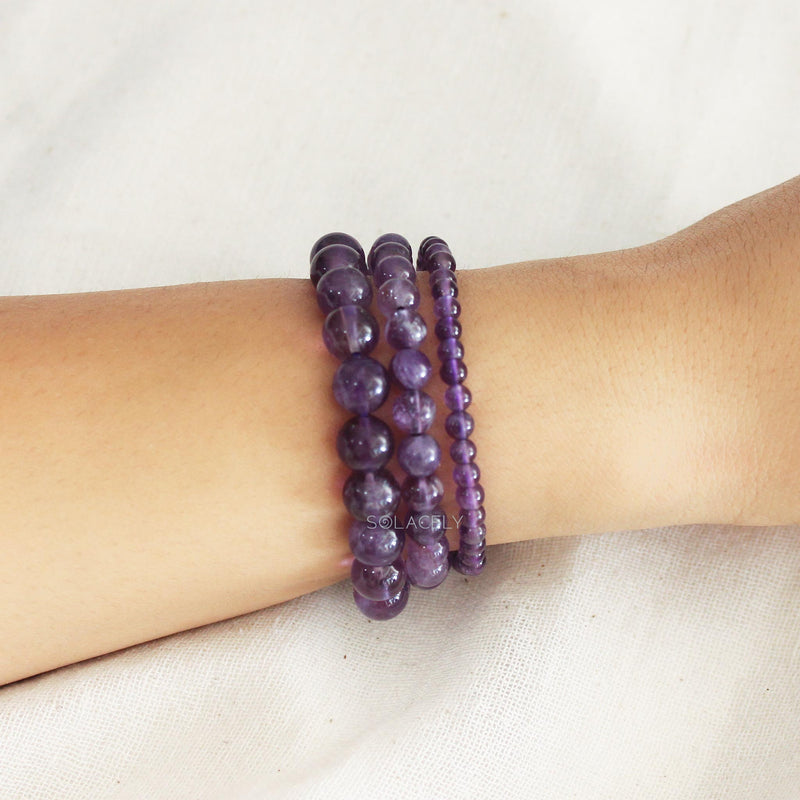
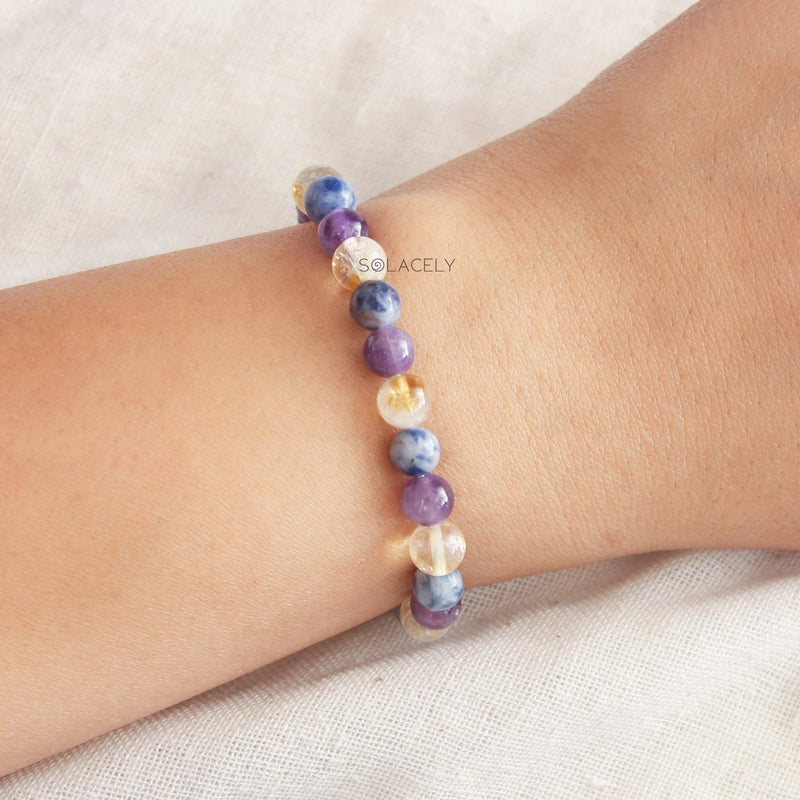
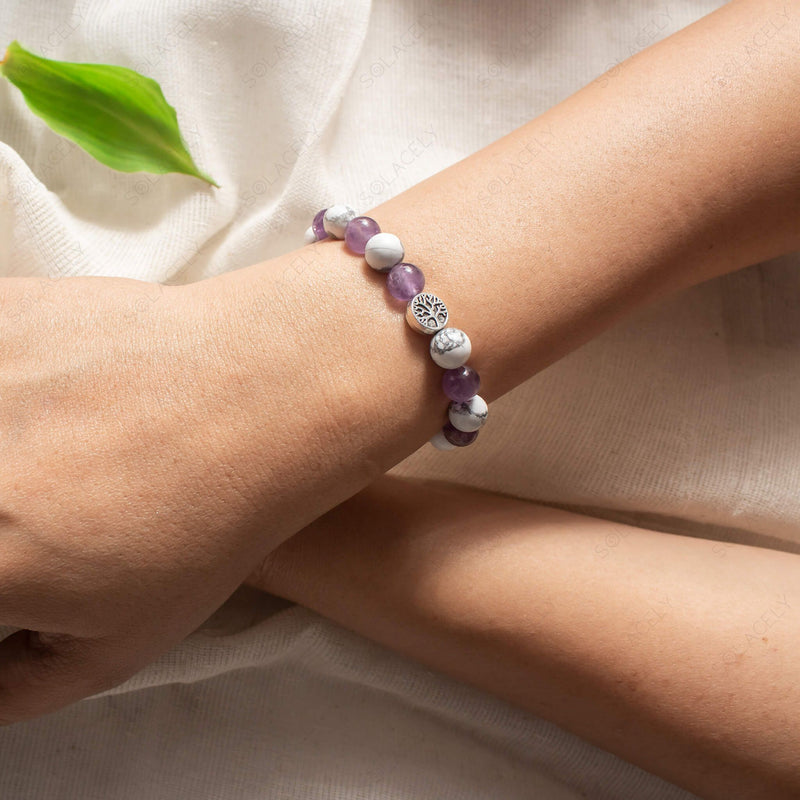
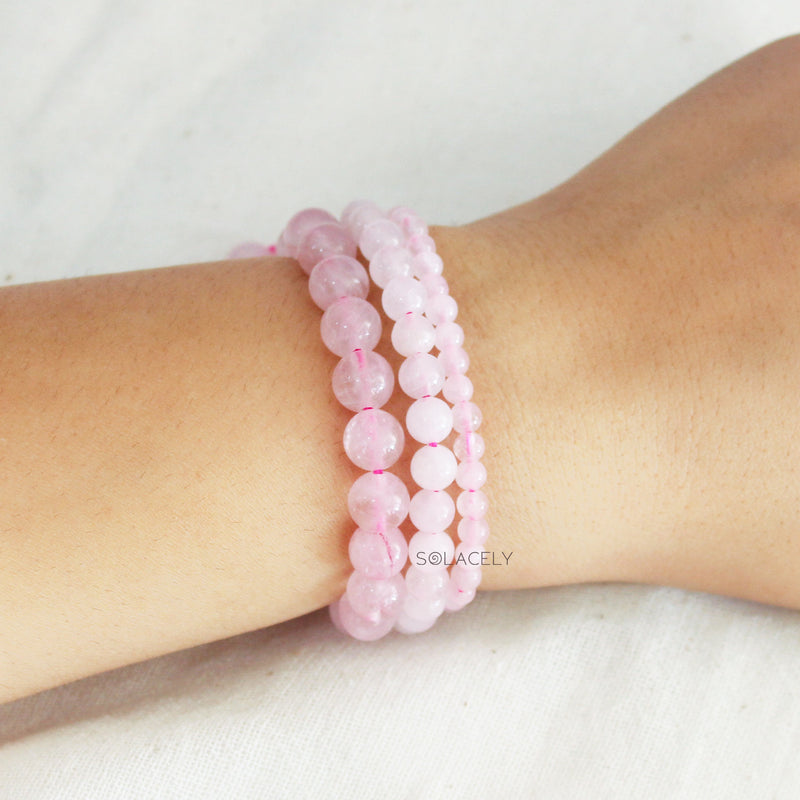
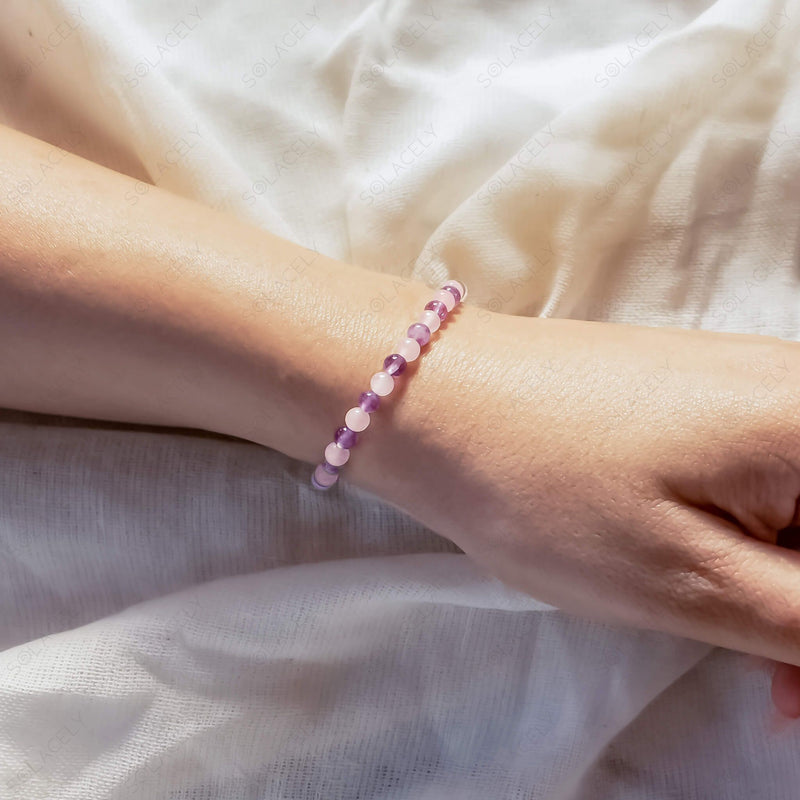
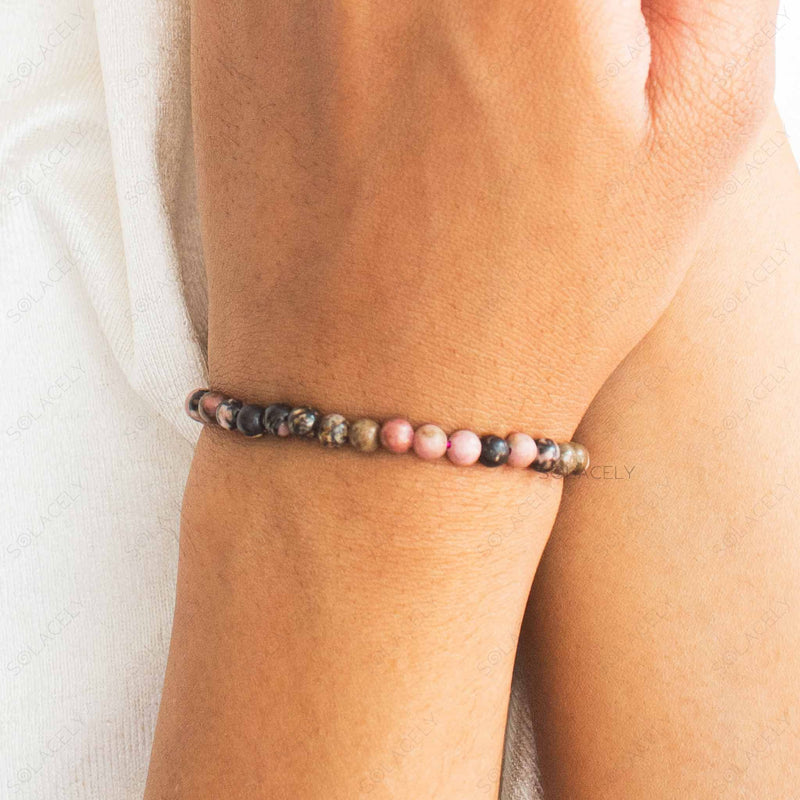
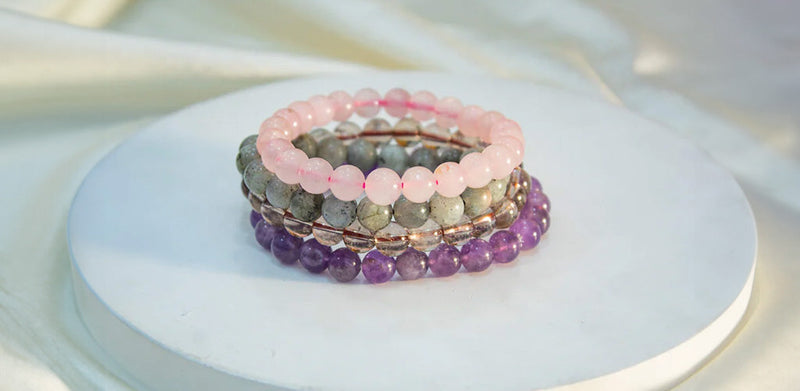
Amethyst, howlite and lepidolite are the traditional calming stones; rose quartz and rhodonite the self-regard ones. Pairing one from each group is the usual approach, because anxiety and harsh self-talk tend to arrive together, and a single stone addresses only half of it.
Key takeaways
- Traditional calm stones: amethyst, lepidolite, blue lace agate, howlite.
- Traditional self-regard stones: rose quartz, rhodonite.
- Pair one from each group. The two difficulties usually travel together.
- Keep the piece reachable in seconds. A stone in a display case is no help in the moment.
- Held as company alongside your doctor's care.
Why anxiety and self-love belong in the same article
They travel together. The spike comes first, then the second wave: the commentary about being weak, dramatic, or a burden for having had it. For a lot of people the second wave lasts longer than the first.
Working on only the calm side leaves the self-criticism running. Working on only self-regard leaves you kinder to yourself about something you have not learned to interrupt. That is why traditional practice pairs the two categories rather than picking from one.
The stones and what each is kept for
| Stone | Category | Traditionally kept for |
|---|---|---|
| Amethyst | Calm | Night-time anxiety, difficulty switching off |
| Lepidolite | Calm | Emotional swings and unsettled stretches |
| Blue lace agate | Calm | Anxiety about speaking or being perceived |
| Howlite | Calm | Racing thoughts, particularly at bedtime |
| Rose quartz | Self-regard | Softening how you speak to yourself |
| Rhodonite | Self-regard | Self-forgiveness after a hard day |
Amethyst is where most people start, and it tends to be the one that stays. It is the purple variety of quartz, hard enough for daily wear, and its association with clear-headedness and calm reaches back to Greek usage.
Holding a stone in the moment
This is the practice people describe most, and it takes about ninety seconds.
- Get the stone into your hand. This is why reachability matters more than beauty.
- Describe it silently. Cool or warm. Heavy or light. Smooth, ridged, faceted. What colour, exactly.
- Name three more things you can feel. Chair, floor, fabric against your arms.
- Breathe out longer than you breathe in. Four in, six or seven out. Five rounds.
- One plain sentence. Something true and undramatic: this passes, and I do not have to be good at this.
The stone gives your attention somewhere solid to go while the wave moves through, which is why a smooth tumbled piece works better than anything sharp or fussy. Our crystals for anxiety and panic attacks guide goes deeper on acute moments.
Building the self-love half
This part is slower and less dramatic. It is a daily thing rather than an emergency thing.
- Wear the self-regard stone. Rose quartz or rhodonite, on the wrist, where you will see it.
- Use it as an interrupt. When you catch yourself narrating something cruel, touch it and rephrase the sentence as you would say it to a friend.
- Aim for something you believe. "I love myself" bounces off. "That was harder than I gave myself credit for" lands.
- Give it a month. Self-talk is a habit, and habits move slowly.
Our rose quartz for emotional healing article covers the self-regard practice in detail, and crystals for emotional healing covers the wider set.
Where to keep them
This decides whether the practice works at all, and it is the part most guides skip. A crystal you have to go and find is a crystal you will not use.
Practical placements: one tumbled piece in the pocket of whatever you wear most, one in the front compartment of your bag, one in a desk drawer, one on the bedside table. Many people deliberately buy inexpensive tumbled stones for this and keep the nicer piece at home. That is the difference between a practice you have and a practice you use.
For night-time specifically, the placements in our crystals for sleep guide are the relevant ones, and crystals for anxiety and stress covers the day-to-day version.
Caring for these stones
Amethyst is quartz at 7 on the Mohs scale and takes warm water and a soft cloth easily, though it pales with long spells of direct sun, so charge it in moonlight or indirect light.
Howlite is softer, around 3.5, and marks easily, so store it on its own. Lepidolite is softer still and flakes along its layers, so handle it gently and keep it dry. Blue lace agate and rose quartz are the most forgiving of the group.
For energetic cleansing, sound, smoke, moonlight or a rest on selenite all suit them. Weekly suits a stone carried every day.
Crystal practices are traditional and complementary. They are not a treatment for anxiety, panic disorder, depression or any other condition and are not a substitute for professional care. Anxiety is common and very treatable: if it is affecting your sleep, work or relationships, please speak to a qualified healthcare professional. In a crisis, contact your local emergency service or a crisis line. Lepidolite contains lithium as part of its mineral structure and is in no way related to, or a replacement for, lithium medication.
Sources
- National Institute of Mental Health, Anxiety Disorders
- NCCIH, Relaxation Techniques: What You Need To Know
Written by Chetena Sharma. Reviewed by the Solacely editorial team.
Frequently asked questions
About the author


Written by Chetna Sharma, crystal healing practitioner and co-founder of Solacely. Chetna has worked with healing crystals for over a decade and curates Solacely's protective stone collection.