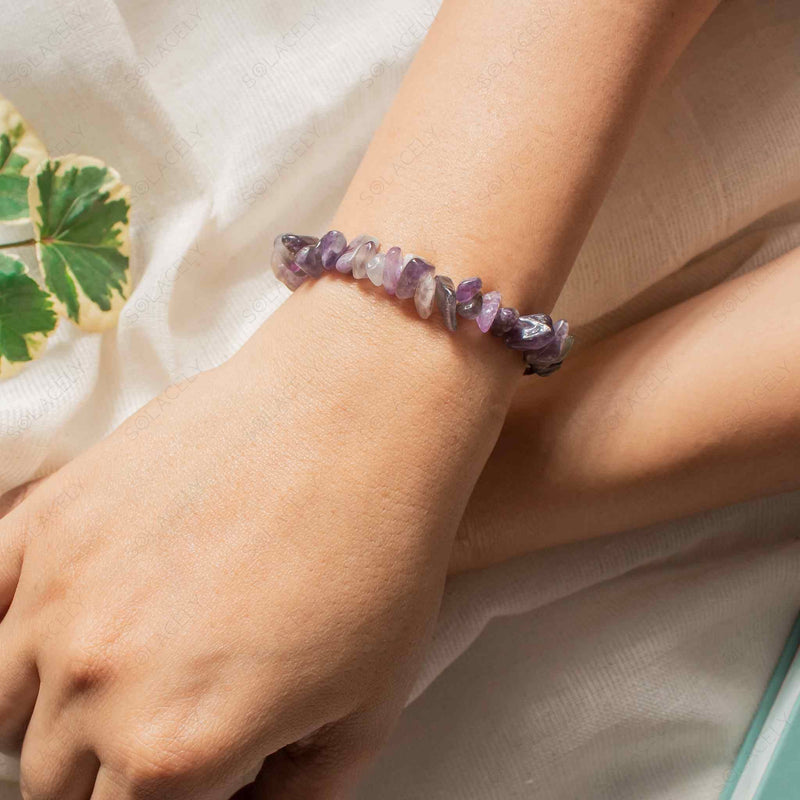
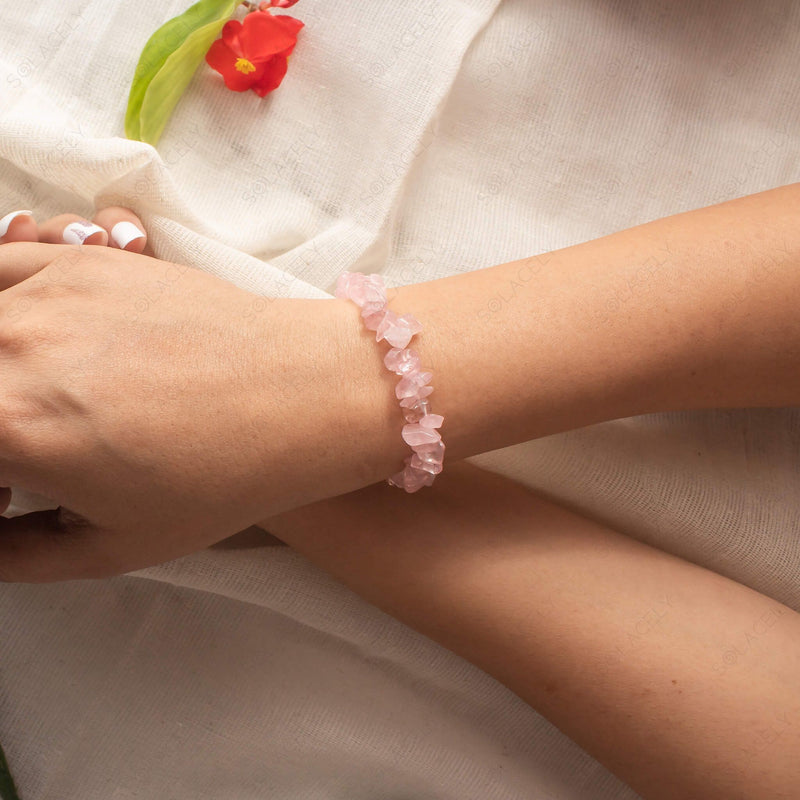
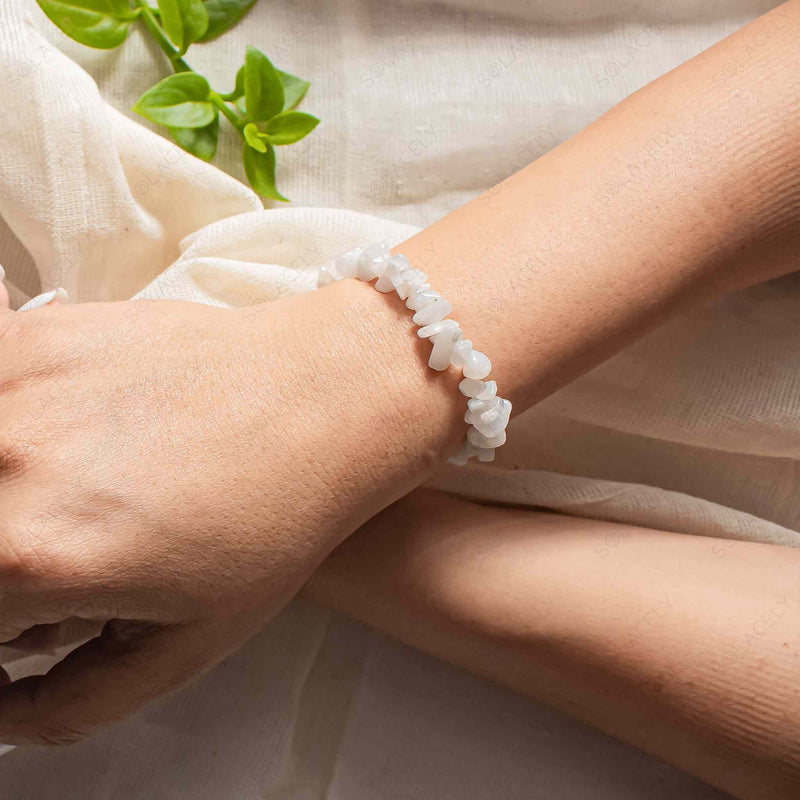
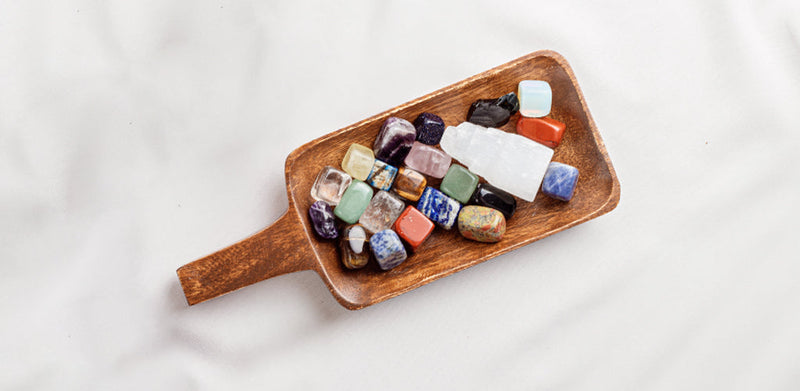
The crystals most often given to a daughter are rose quartz for self-kindness, amethyst for calm and sleep, moonstone for a coming-of-age gift, and green aventurine for confidence. Choose tumbled or beaded forms, match the format to her age, and treat it as a meaningful object rather than a remedy.
Key takeaways
- Rose quartz, amethyst, moonstone and green aventurine are the four stones most commonly chosen as gifts for daughters.
- Under age three, skip loose stones entirely. Small tumbles and chips are a choking hazard.
- Quartz-family stones sit at 7 on the Mohs scale and survive being dropped, lost, and found again, which matters with children.
- Never make crystal elixirs or gem water for a child, and never present a crystal as treatment for anything.
- Metaphysical properties described here are traditional belief, not medical fact.
How to choose a crystal for your daughter
Start with her age and what the gift is for, not with a list of meanings. A seven year old wants something she can hold and show people. A fifteen year old wants something she can wear that does not look like it came from a parent. A milestone gift wants a stone with a story attached. Those are three different purchases.
The second filter is durability. Children lose things, drop things, and put things in pockets with keys. Quartz-family stones, which includes rose quartz, amethyst, citrine, and clear quartz, all sit around 7 on the Mohs scale and take that treatment well. Softer stones like fluorite, selenite, or malachite do not.
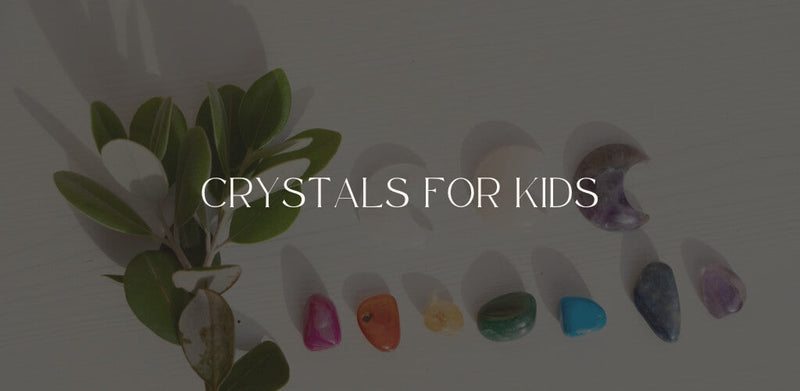
The third filter is honesty. Framing a stone as something that will fix anxiety or improve grades sets a child up badly. Framing it as a reminder, a keepsake, or a thing that is hers works far better. Our wider guide to crystals for kids takes the same line.
Rose quartz for self-kindness
Rose quartz is the default gift stone and there is a good reason for it. In crystal tradition it is associated with self-compassion far more than romance, which is exactly the association most parents actually want to pass on. It also happens to be pale pink and pleasant, which does no harm at that age.
According to the Gemological Institute of America, rose quartz owes its colour to microscopic inclusions distributed through the quartz, which is why the pink reads cloudy rather than transparent. That cloudiness is normal and not a sign of poor quality.
As a format, a tumbled palm stone works for younger children and a chip or beaded bracelet works from around eight upward. If the aim is specifically self-worth rather than general kindness, crystals for self-esteem narrows the field.
Amethyst for calm and bedtime
Amethyst is the bedroom stone. It is used traditionally for settling, and in practice it becomes part of a wind-down routine: the stone goes on the nightstand, the light goes down, the day ends. That ritual is the useful part, and it is worth saying so out loud rather than implying the mineral is doing something.
The GIA describes amethyst as the purple variety of quartz, coloured by iron and natural irradiation within the crystal structure. One practical consequence is that strong sunlight fades it over months, so keep it off a sunny windowsill if you want the colour to last.
For a bedroom set rather than a single stone, crystals for children's bedrooms covers placement and the sizes that make sense in a shared or small room.
Moonstone and green aventurine for older girls
Moonstone is the milestone stone. Its association with cycles and new beginnings makes it the usual choice for a first period, a sixteenth birthday, or a move to a new school. The GIA attributes its floating blue sheen, adularescence, to light scattering between microscopic layers within the feldspar. It is a genuinely lovely thing to explain to a teenager.
Green aventurine is the other common pick for this age, traditionally linked to confidence, luck, and taking a chance. It tends to be given before auditions, trials, and exams, which is a fair use as long as nobody claims it changes the outcome.
Moonstone is a feldspar at roughly 6 to 6.5 on the Mohs scale, softer than the quartz stones above, so a pendant survives better than a ring. Judge any new stone against the Mohs hardness scale before deciding on the format.
Age by age: what is actually appropriate
| Age | Suitable format | Avoid |
|---|---|---|
| Under 3 | None loose. A stone kept high on a shelf, out of reach | All tumbles, chips, and beaded jewellery |
| 3 to 6 | One large palm stone, supervised | Chips, small tumbles, anything with a clasp |
| 7 to 11 | Tumbled stones, chip bracelets, a small tree or sphere | Raw points with sharp edges, soft stones |
| 12 to 15 | Beaded bracelets, pendants, a keepsake stone | Anything framed as a fix for stress or grades |
| 16 and up | Jewellery she would choose herself, milestone stones | Choosing on meaning alone with no regard to taste |
Two hard rules apply at every age. Never make a crystal elixir or gem water for a child, because some minerals carry copper, lead, or fibrous inclusions and none of it belongs in a drink. And never let a crystal stand in for medical or psychological care.
Presenting it well
The gift lands better with a sentence than with a leaflet. Something as short as "this one is for being kind to yourself, including on the days you are not" does more than a printed list of properties, and it avoids the implication that the stone is doing the work.
Care is simple enough for a child to manage alone: warm water, mild soap, soft cloth, dried properly. No salt water, no long sun sessions, no soaking. Teaching her to look after it is part of what makes it hers. If you are building a birthday set rather than giving one stone, crystals for a birthday gift covers combinations that work together.
Let her have an opinion on it. A stone chosen entirely on meaning, with no regard to whether she likes the colour or would ever wear the format, tends to end up in a drawer within a fortnight. Taking her to choose, or offering two options rather than presenting one, changes the object from something given to something picked. That difference does more for whether it gets used than any property list.
It is also worth deciding in advance what you will say if she asks whether it works. The straightforward answer, that people have used these stones for a very long time as reminders and that nobody has shown they change anything physically, is not a disappointing one. Children generally handle honesty about this better than adults expect, and it protects her from the more extravagant claims she will meet online.
The properties described here reflect traditional and cultural belief around crystals. They are not medical claims and are not a substitute for professional healthcare. Crystals should never be used internally, made into drinking water, or given to a child as treatment for a physical or mental health concern. If your daughter is struggling with anxiety, sleep, or mood, speak to a GP or a qualified practitioner.
Sources
- Gemological Institute of America, Rose Quartz Description
- Gemological Institute of America, Amethyst Description
Written by Chetena Sharma. Reviewed by the Solacely editorial team.
Frequently asked questions
About the author


Written by Chetna Sharma, crystal healing practitioner and co-founder of Solacely. Chetna has worked with healing crystals for over a decade and curates Solacely's protective stone collection.