Feng shui works by arranging a space so that qi, the vital energy of the tradition, can move through it freely. Practitioners use four main tools to do that: the bagua map, the five elements, the commanding position, and the clearing of blocked or cluttered paths. Each one adjusts how energy enters, circulates and settles.
Key takeaways
- The name means wind and water, taken from a passage in the Book of Burial, a text traditionally attributed to Guo Pu, who lived in the third and fourth centuries CE.
- The bagua map divides a home into nine areas: eight life areas around a central health area, each tied to a trigram, a direction, an element and a colour.
- The five elements, wood, fire, earth, metal and water, relate through a generating cycle and a controlling cycle, which is how an overloaded room is rebalanced.
- The commanding position governs the bed, the desk and the stove. See the door from each, without sitting directly in line with it.
- Two schools shape most practice: Form School reads the shape of the land and the building, Compass School reads direction with a luopan.
What is qi, and how does it move through a home?
Qi is the vital energy that animates a landscape, a building and a body. In feng shui it is treated much like water. It enters through the front door, flows along corridors, pools in open rooms and drains away through windows. The work of the practitioner is guiding that flow.
Qi is described in three states. Sheng qi is the lively, nourishing kind that meanders gently and arrives in good order. Sha qi is sharp and fast, produced by long straight runs, protruding corners, or a road pointing at the house. Si qi is stagnant, the heavy air of a room nobody opens.
Practitioners look first at doors, windows and corridors. Qi enters at the front door, which the classical texts call the mouth of qi. A door opening onto a blank wall or a cluttered hallway meets an obstacle at once. A door lined up with a far window lets qi run straight out again.
The remedy is almost always to slow the flow or to soften an edge. A round table, a curved rug, a folding screen, a plant set in front of a sharp corner, a faceted crystal hung in a long corridor. Nothing dramatic. The tradition prefers small adjustments repeated in the right places.
What is the bagua map, and how is it used?
The bagua is a nine-part grid laid over a floor plan. Eight life areas sit around a centre, and each carries a trigram from the I Ching, a compass direction, one of the five elements and a colour. You read which room falls where, then adjust that area.
Bagua means eight trigrams. The trigrams themselves come from the I Ching, the Book of Changes, whose core text belongs to the Western Zhou period in the first millennium BCE. Feng shui inherited them, arranged them around a centre, and attached to each a domain of life: career, knowledge, family, wealth, reputation, partnership, children and benefactors.
There are two ways to align the grid, and both are practised. Classical schools orient it by compass with a luopan, so the wealth area genuinely sits in the south east. The Black Hat method used widely in the West aligns the grid's bottom edge with the wall holding the front door.
| Bagua area | Direction | Element | Colour |
|---|---|---|---|
| Career and path | North | Water | Black, deep blue |
| Knowledge and study | North east | Earth | Dark blue, beige |
| Family and ancestors | East | Wood | Green |
| Wealth and abundance | South east | Wood | Purple, gold |
| Reputation and recognition | South | Fire | Red |
| Partnership and marriage | South west | Earth | Pink, terracotta |
| Children and creativity | West | Metal | White |
| Benefactors and travel | North west | Metal | Grey, silver |
| Health and wholeness | Centre | Earth | Yellow, ochre |
Once the grid is placed, the usual advice is restraint. Choose one or two areas that matter this year and work on those. Decorating all nine at once produces exactly the busy room the tradition is trying to unclutter.
How do the five elements work together?
Wood, fire, earth, metal and water relate through two cycles. In the generating cycle each element feeds the next: wood feeds fire, fire makes earth, earth bears metal, metal carries water, water nourishes wood. In the controlling cycle each one checks another, which is how an overloaded room is brought back into balance.
The controlling cycle runs like this. Wood parts earth, earth dams water, water quenches fire, fire melts metal, metal cuts wood. Say a room feels agitated: too much red, too many candles, too many pointed shapes. That is fire in excess. The generating answer is to add earth, which draws the fire off. The controlling answer is to add water, which subdues it directly.
Elements are expressed through shape, colour and material, not literal objects. Wood appears as tall columns, green and teal, living plants and timber. Fire is triangles and points, red, candlelight. Earth is low flat squares, ochre and terracotta, ceramic and stone. Metal is circles and arcs, white and grey, brass and steel. Water is wavy shapes, black and deep blue, glass and mirror.
So a green cushion, a wooden frame and a tall plant all do the same job. That flexibility is what makes the system workable in a rented flat.
What is the commanding position?
The commanding position is the spot from which you can see the door without being directly in line with it, ideally with a solid wall behind you. It applies to three pieces of furniture above all others: the bed, the desk and the stove.
The logic is consistent across all three. In each case you are doing something that takes you out of alert readiness. You sleep, you concentrate, you cook. The tradition holds that a person settles when the entrance is in view, and that a solid wall at your back gives the support the classical texts call the mountain.
For the bed, that means a headboard against a solid wall, set diagonally across from the door, never with the foot pointing straight out of it. For the desk, face into the room rather than into a wall, with the door in view. For the stove, the cook usually stands with their back to the entrance, so a small mirror or reflective splashback is placed to return the view.
When a room will not allow it, the standard remedy is a mirror positioned to show the doorway. It is a recognised correction, used constantly in flats and small offices.
How do yin and yang balance a room?
Yin and yang describe the character of a space rather than its layout. Yin is quiet, cool, dark, soft and still. Yang is bright, warm, active and loud. A room works when it leans the right way for what happens in it, while still holding a little of the other.
Bedrooms lean yin: muted colours, layered fabric, low lamps, curved shapes, screens kept out of sight. Kitchens, dining tables, home offices and hallways lean yang, with brighter light, harder surfaces, stronger colour and movement. A bedroom with a treadmill in it and one bright overhead spotlight carries too much yang, and sleep is where that shows up first.
Neither pole is the goal on its own. A room that is entirely yin feels heavy and unused. A room that is entirely yang gives you nowhere to rest your eyes. Practitioners look for the tilt, then nudge it back.
How are crystals used in feng shui?
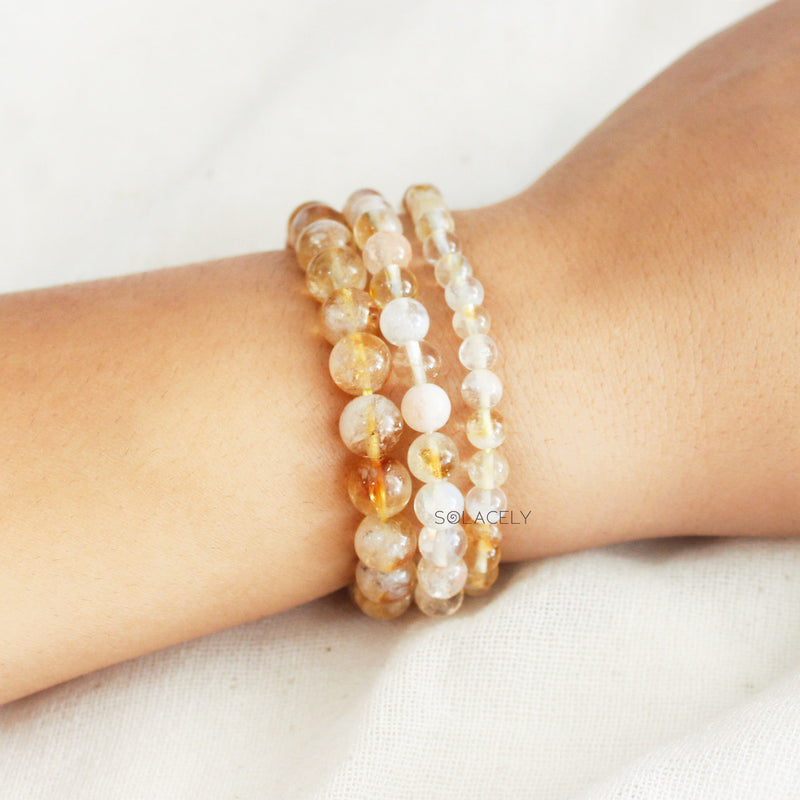
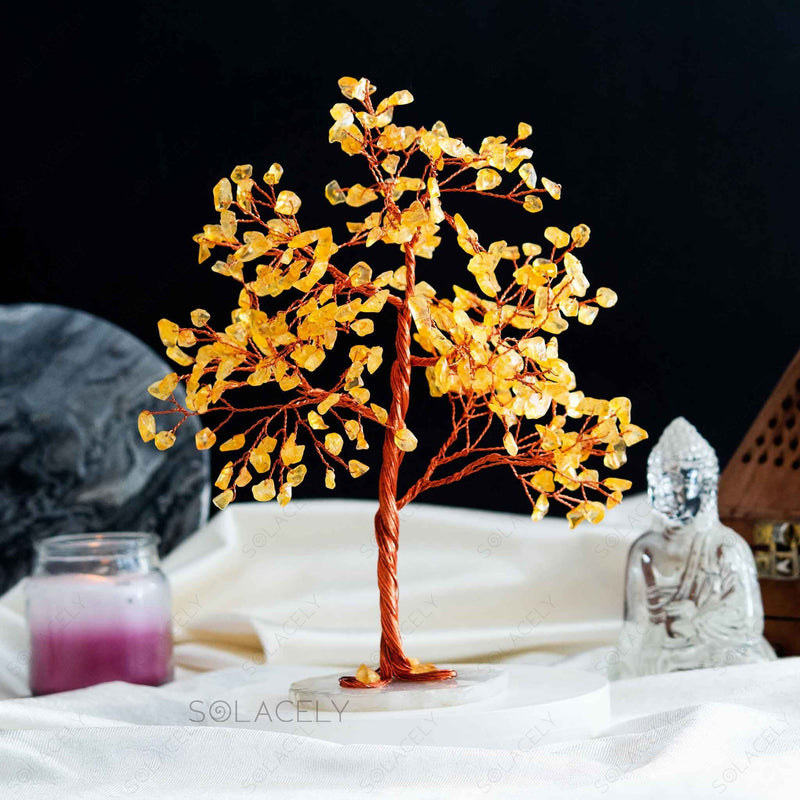
Crystals sit in feng shui as earth element objects: dense, formed underground and slow. They are placed in the bagua area they suit, chosen by colour to match that area's element, or hung in faceted form to break up qi that is travelling too fast along a straight run.
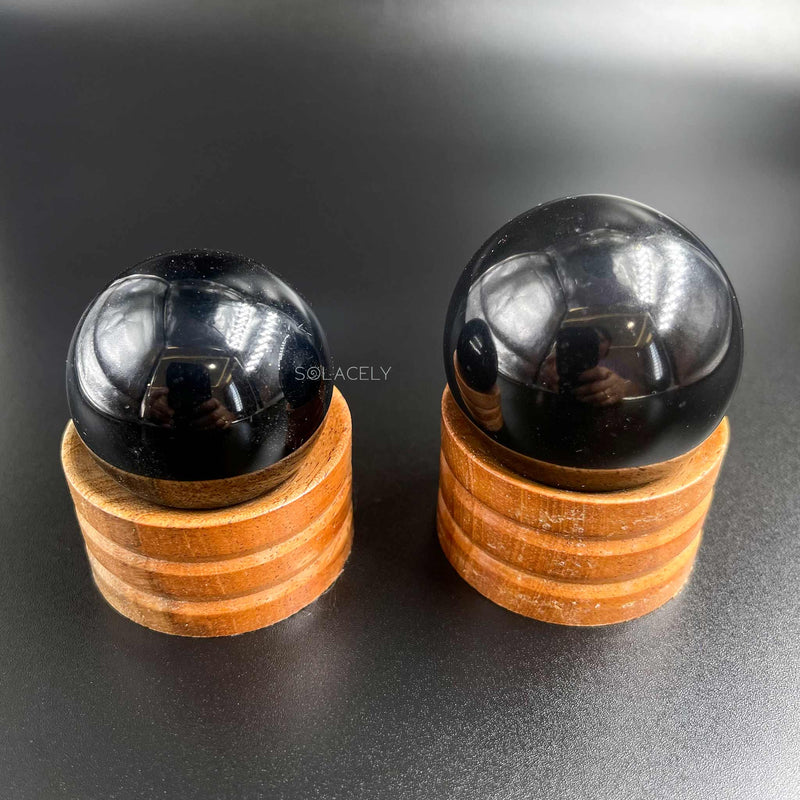
Placement follows the map. Citrine and other golden stones are traditionally kept in the south east, the wealth area. Rose quartz belongs in the south west, where partnership sits. Amethyst suits the north east and its association with study. Black stones are kept near the entrance to guard the mouth of qi, a pairing we look at closely in our piece on black obsidian and feng shui.
Jade holds a place of its own in Chinese practice, prized for centuries as the stone of virtue, longevity and good standing, and given as much for what it represents as for how it looks. Clear quartz is the other constant, cut into faceted spheres and hung on red cord in windows and long corridors, where it scatters incoming light and disperses fast-moving qi.
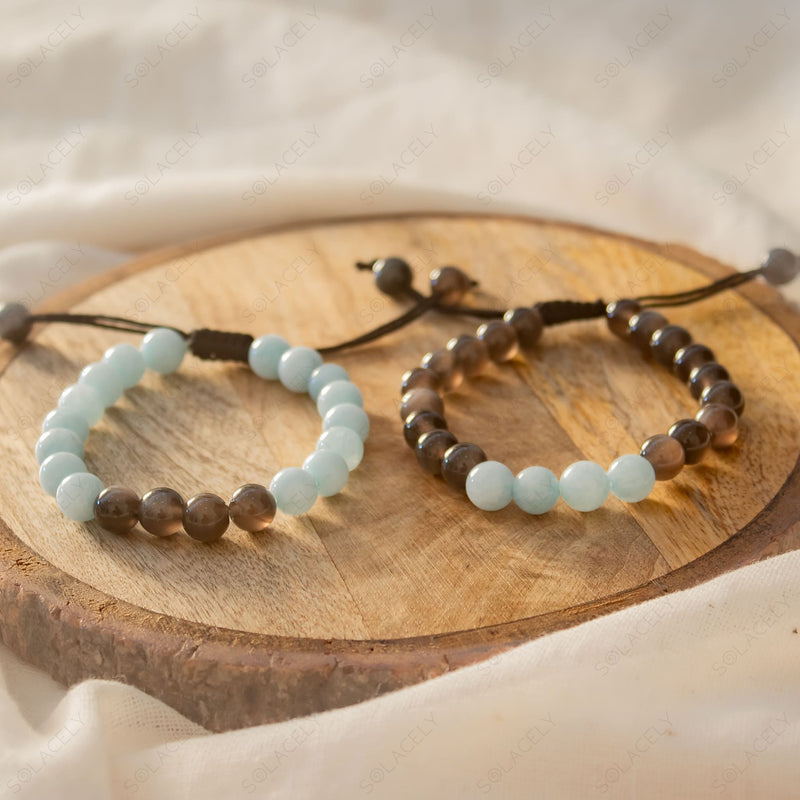
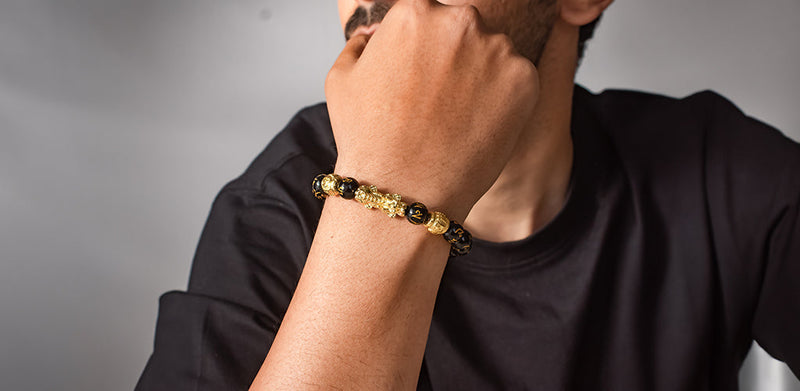
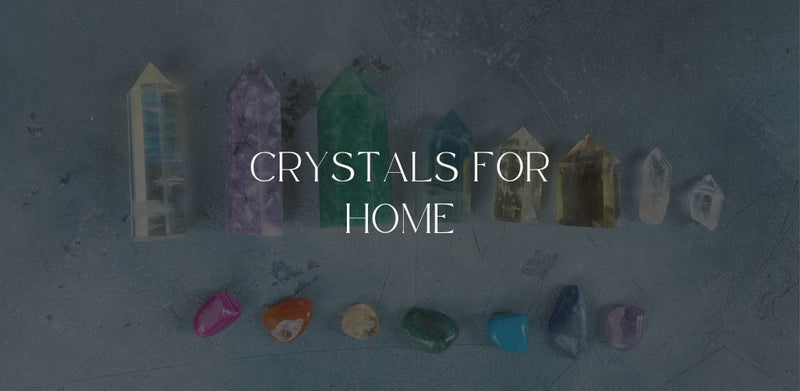
Weight matters as much as choice of stone. A large piece anchors a corner, while a scatter of small tumbles reads as decoration. Because crystals carry the earth element, a room already heavy with earth needs few of them. Our guide to crystals for the home works through this room by room, and the same principles carry onto the body when you wear a feng shui bracelet.
Where should you start in an ordinary home?
Start with the three places the tradition treats as decisive: the entry, the bed and the desk. Between them they cover how qi arrives, how you rest and how you work. Everything else, the nine areas, the element cycles, the colour schemes, comes more easily once those three are settled.
The entry
Clear the path. The front door should open fully, without catching on shoes, post or a coat rack. Fix the bulb, oil the hinge, sweep the step. Then give qi somewhere to arrive: a mat, a small plant, a light. A mirror set directly facing the front door is avoided, since it sends arriving qi back out.
The bedroom
Move the bed into the commanding position where the room allows, with a solid headboard against a solid wall. Take work out of the room. Cover or reposition any mirror that reflects the bed. Keep the space under the bed clear so qi can circulate while you sleep, which is also where crystals for the bedroom are usually placed.
The desk
Turn the desk so you face into the room with the door in view, and put something solid behind your chair. Clear the surface at the end of each day, since a working desk collects si qi faster than any other surface in the house. Our notes on crystals for the office desk cover what to keep there.
Feng shui guidance and crystals are offered here for personal, spiritual and decorative use. Nothing on this page is medical advice, and crystals are not a treatment for any physical or mental health condition. Please speak to a qualified healthcare professional about any health concern, and never delay or replace medical care. Keep small stones away from young children and pets, as they are a choking hazard, and never place stones in drinking water.
Sources
- GIA: Jade Description, History and Quality Factors
- Geology.com: Quartz Mineral Properties and Varieties
Written by Chetena Sharma. Reviewed by the Solacely editorial team.
Frequently asked questions
About the author


Written by Chetna Sharma, crystal healing practitioner and co-founder of Solacely. Chetna has worked with healing crystals for over a decade and curates Solacely's protective stone collection.