A geode is a hollow rock lined on the inside with crystals. The main types are named for whatever grew in that cavity: amethyst, clear quartz, agate, celestite, calcite and septarian. All of them begin as a bubble or void in volcanic or sedimentary rock that mineral-rich water slowly filled from the walls inward.
Key takeaways
- A geode is a rounded, hollow rock with a crystal lining. The type is named after the mineral that grew inside.
- Amethyst, clear quartz, agate, celestite, calcite and septarian are the six varieties you will meet most often.
- Quartz-family geodes, including amethyst and agate, sit at 7 on the Mohs hardness scale. Calcite is much softer at 3.
- They form over long stretches of time as mineral-rich water seeps into a cavity and deposits crystal on the walls.
- Keep amethyst geodes out of prolonged direct sun and keep calcite away from water and acids.
What is a geode?
A geode is a rock that is plain on the outside and crystal-lined within. The outer shell is usually a dull grey or brown, often rounded and heavier than it looks. Cut or cracked open, the inside reveals a cavity lined with crystal points or banded layers, which is the whole reason geodes are collected.
The word covers a family rather than a single mineral. What determines the type is which mineral happened to crystallise inside the void, and that depends on the chemistry of the water moving through the surrounding rock. Two geodes from the same hillside can hold quite different interiors.
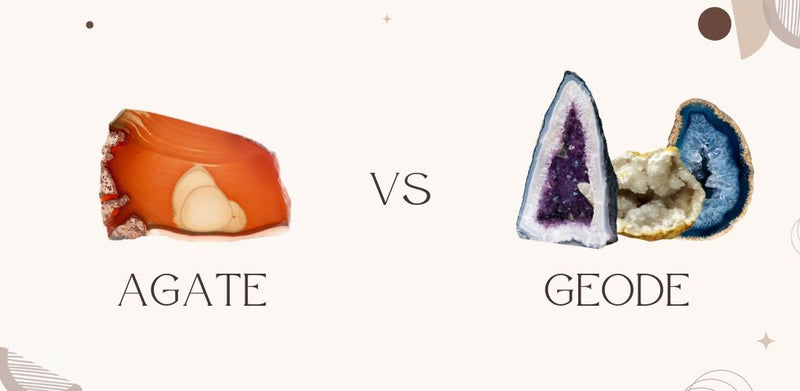
Geodes are close cousins to agate, and the two are often confused because agate frequently lines the outer band of a geode. Our note on agate compared with geodes sets out where one ends and the other begins.
How geodes form
Geodes start with a void. In volcanic rock that void is usually a gas bubble trapped in cooling lava. In sedimentary rock it can be the space left by a buried root, a shell or a nodule of softer material that later dissolved away. Either way, the result is a sealed pocket inside solid stone.
Groundwater carrying dissolved silica and other minerals then seeps through the surrounding rock and into that pocket. As conditions shift, the minerals come out of solution and settle on the cavity walls, building inward layer by layer over very long stretches of time. Slow, undisturbed growth is what produces well-formed points.
If the cavity fills entirely, the result is a solid nodule rather than a geode. The hollow centre is the defining feature, and it is simply what happens when the mineral supply runs out before the space does.
The main types of geodes
Geodes are named for the mineral lining the cavity. Six types account for almost everything on the market, and they differ in colour, crystal habit, hardness and what they are traditionally kept for. The table below is the quick comparison.
| Type | Interior | Mohs hardness | Traditionally kept for |
|---|---|---|---|
| Amethyst | Purple quartz points | 7 | Calm, rest, a quieter mind |
| Clear quartz | Colourless to milky points | 7 | Clarity and amplifying intention |
| Agate | Banded chalcedony, often with a quartz centre | 7 | Steadiness and balance |
| Celestite | Pale blue tabular crystals | 3 to 3.5 | Peace and gentle uplift |
| Calcite | White, honey or golden crystals | 3 | Warmth and fresh starts |
| Septarian | Yellow calcite veins in grey and brown | 3 to 4 | Grounding and patience |
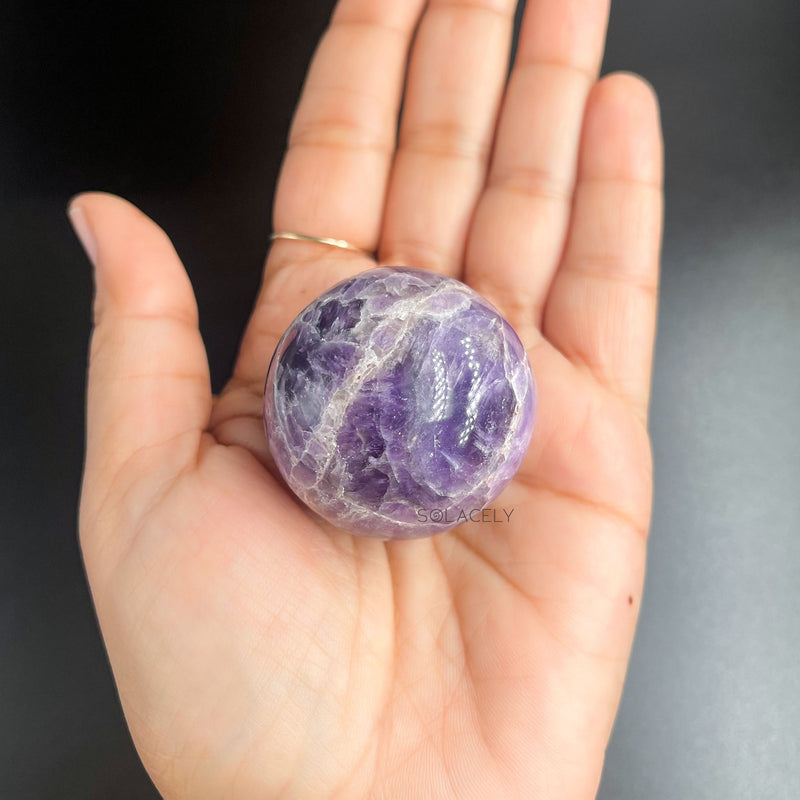
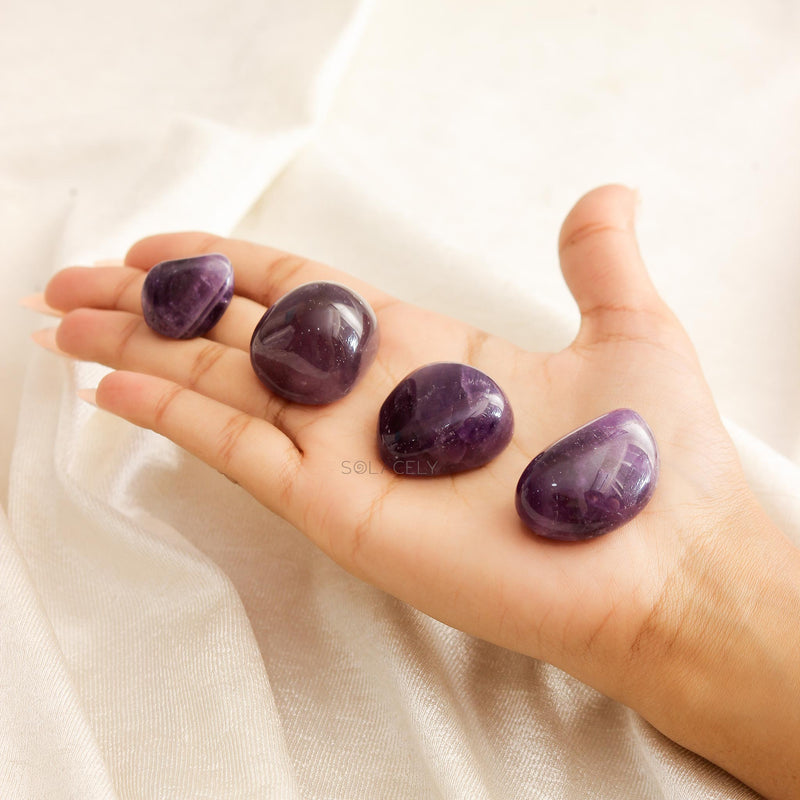
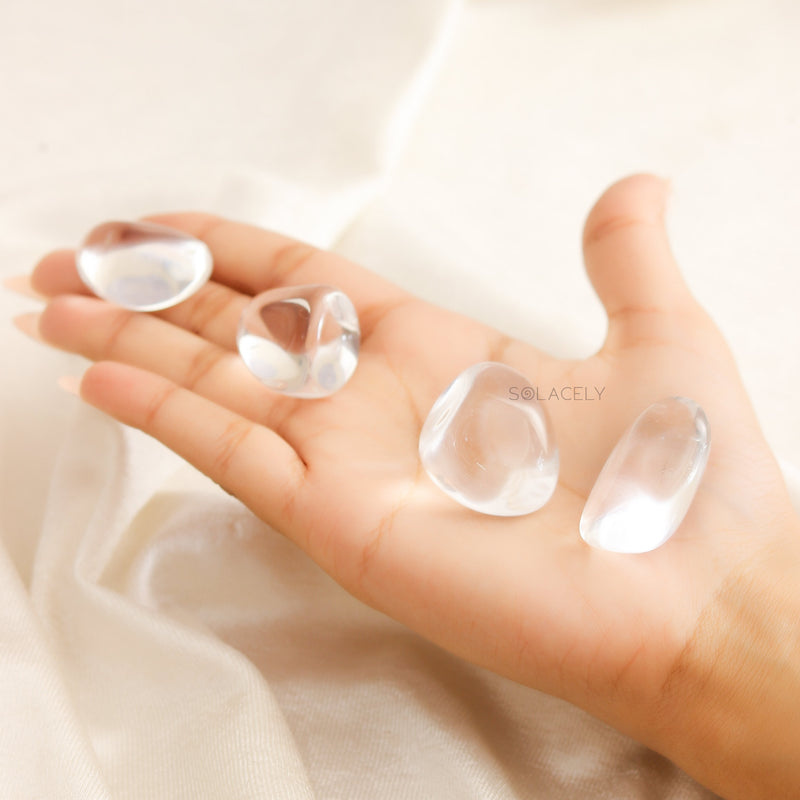
Amethyst geodes are the ones most people picture, and the deep purple cathedrals are the showpieces of the group. Clear quartz geodes are brighter and more architectural. Agate geodes show concentric banding around the rim, which is where the two families overlap most visibly, and our guide to agate crystals covers those bands in detail.
Celestite is the soft, powder-blue one, prized for colour rather than size. Calcite geodes range from milky white to warm honey. Septarian is the odd one out, a nodule shot through with yellow calcite veins rather than a clean crystal-lined cavity, and it is collected for that marbled pattern.
How to choose a geode
Choose by what you want to look at every day, because a geode is first and foremost a piece you live with. Colour saturation, the evenness of the crystal points and the shape of the opening matter more to the eye than sheer size. A small, well-formed piece often looks better on a shelf than a large one with a ragged face.
Weight is a fair guide to quality. A good geode feels solid, sits stably without wobbling and has an interior that catches light from across a room. If you want it as a centrepiece, look for a flat base or a cut half that stands on its own. If you want it in the hand, a small closed nodule or a palm-sized half is easier to live with.
Hardness is worth knowing before you buy. Quartz-family geodes handle handling. Celestite and calcite are much softer, closer to 3 on the Mohs scale, so they mark easily and belong somewhere they will not be knocked. For the wider quartz family, our guide to types of quartz crystals is a useful companion piece.
Where to keep a geode at home
A geode is traditionally placed where you want its quality to settle. Amethyst is kept in bedrooms and reading corners for rest. Clear quartz goes in a study or workspace where clarity is wanted. Citrine-toned calcite is kept in living rooms and near entrances for warmth and welcome.
Practically, give it a stable surface away from the edge of a shelf, and away from a window that gets long hours of hard afternoon sun. Amethyst fades with prolonged strong light, and that fading is permanent. A bookshelf, a mantelpiece or a side table suits it better than a sunny sill.
Larger cathedral pieces work as floor or console pieces and want a corner where they can be seen properly. Smaller halves are often kept in pairs, one at each end of a shelf. There is no wrong placement, only the one that keeps it in view and out of harm.
Cleansing and caring for a geode
Dust is the main thing a geode needs protecting from, because it settles between the points and dulls the sparkle. A soft dry brush, a makeup brush or a puff of canned air clears it without touching the crystal tips. Wipe the outer shell with a barely damp cloth if it needs it.
Water is not the friend of every geode. Quartz and amethyst tolerate a brief rinse, but celestite and calcite are soft and should stay dry, and calcite reacts to acids, so no vinegar or lemon-based cleaners anywhere near it. Never leave any geode soaking.
For cleansing in the spiritual sense, sound, incense smoke and moonlight all suit geodes well and none of them risk the stone. Moonlight is the traditional choice for amethyst and celestite. Our step-by-step on how to cleanse and charge crystals sets out each method in order.
Geodes are collected and kept as part of a long-standing spiritual and cultural tradition. They are not a medical device or treatment, and they do not diagnose, treat, cure or prevent any condition. Nothing here replaces advice from a doctor or other qualified professional. Cut geodes can have sharp crystal edges and heavy pieces can fall, so keep them out of reach of babies and young children.
Sources
Written by Chetena Sharma. Reviewed by the Solacely editorial team.
Frequently asked questions
About the author


Written by Chetna Sharma, crystal healing practitioner and co-founder of Solacely. Chetna has worked with healing crystals for over a decade and curates Solacely's protective stone collection.