The sixth house in astrology is the house of daily work, health, habits and service. It governs the unglamorous machinery of a life: the job rather than the career, the routines you keep, the state of your body, and the small duties that hold everything together. Traditionally linked to Virgo and ruled by Mercury.
Key Takeaways
- The sixth house covers daily work, health and habits, routine, service to others, and the ordinary obligations of getting through a week.
- Its natural sign is Virgo and its natural ruler is Mercury, which is why method, analysis and refinement run through its themes.
- In Vedic astrology it is Ari Bhava, the house of enemies, obstacles, debts and disease, and is counted among the difficult houses.
- It is not a bad house. Modern readings treat it as the house of competence: the work that keeps a life running.
- It describes your relationship with health, your habits and attentiveness, not a medical forecast. Astrology cannot diagnose anything.
- The sixth house closes the personal lower half of the chart, immediately before partnership opens at the seventh.
What the sixth house governs
The sixth house handles four connected territories: the daily grind of work, physical health and the habits that shape it, service to others, and the small obstacles that need managing. It is the least romantic house in the chart and arguably the most useful, because it describes what you actually do on a Tuesday.
The distinction between the sixth and tenth houses matters here. The tenth house is career: ambition, reputation, the shape of a professional life seen from outside. The sixth is the job: the tasks, the colleagues, the routine, the conditions you work in. You can have a glittering tenth house and a miserable sixth, or the reverse.
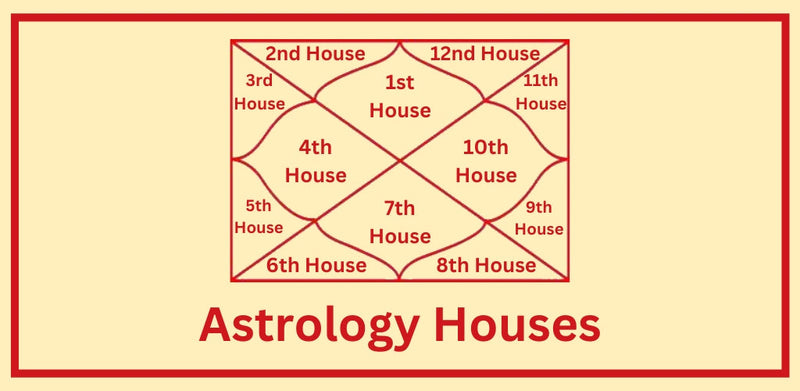
According to Encyclopaedia Britannica, the horoscope's twelve-house division descends from Hellenistic astrology, where each segment carried a field of life. The sixth was tied early to servitude, illness and hardship, which is where its difficult reputation begins. Modern readings have softened it considerably. For the full map, see our guide to the 12 astrological houses.
Ari Bhava: the sixth house in Vedic astrology
Indian astrology takes a starker view. The sixth house is Ari Bhava or Ripu Bhava, the house of enemies, and it governs conflict, competition, debt, litigation and disease. It is classed as a dusthana, one of the three difficult houses alongside the eighth and twelfth.
That framing sounds bleak until you notice what else sits there. Ari Bhava also covers the capacity to overcome: discipline, endurance, the ability to beat a rival or clear a debt. Traditional readings hold that well-placed planets in the sixth produce people who are formidable in adversity, precisely because the house is where difficulty lives.
The Western and Vedic readings converge on service and health, and diverge on tone. Where a Western astrologer sees routine and self-care, a Vedic one sees obstacles and the strength built by facing them. Both are describing the same territory: the friction of ordinary life and what you do about it.
Mercury and Virgo: why the sixth house is analytical
The sixth house takes its character from Virgo and Mercury. Mercury governs thinking, sorting and communication, and Virgo applies that to the practical world, which gives the house its distinctive quality of refinement. This is the part of the chart that notices what is slightly wrong and wants to fix it.
That analytical streak has an obvious upside and an obvious cost. The gift is competence: an eye for detail, the patience to do a thing properly, genuine care about craft. The shadow is the same instinct turned inward, which reads as perfectionism, anxiety about health, or an inability to leave well enough alone.
Remember that the natural ruler is a general rule rather than your personal one. Your sixth house is actually ruled by whichever planet governs the sign on its cusp, and that planet's placement elsewhere is said to link your daily work to another area of life.
Planets in the sixth house
A planet in the sixth house is read as colouring your working life, your habits and your approach to health. Most charts have no planets here, which is unremarkable.
| Planet in the 6th | Traditional reading |
|---|---|
| Sun | Identity bound up in work and usefulness; pride taken in doing the job well |
| Moon | Mood tied closely to routine and health; a need for orderly daily rhythm |
| Mercury | At home here; analytical, detail-oriented, drawn to systems and problem-solving |
| Venus | Pleasure taken in the work itself; harmony with colleagues, an eye for a well-run day |
| Mars | Hard-driving stamina; capable under pressure but prone to friction and overwork |
| Jupiter | Generosity in service; work that helps others, though a tendency to take on too much |
| Saturn | Serious discipline and endurance; heavy responsibility, slow but durable results |
| Uranus | Unconventional working life; a poor fit for rigid routine, drawn to irregular hours |
| Neptune | Compassionate service; boundaries at work can blur, and routine may feel formless |
| Pluto | Intensity applied to work and habit; capable of total overhaul of routine or health |
Read these as descriptions to reflect on, not verdicts. A Saturn placement does not doom you to drudgery, and a Mars placement does not guarantee burnout.
The sign on your sixth-house cusp
Everyone has a sign on the sixth cusp, whether or not a planet sits there, so this is the layer most people can use. It describes the style of your working day and the shape of routine that will actually suit you.
Fire signs on the cusp (Aries, Leo, Sagittarius) suggest work that needs momentum and variety; a monotonous routine tends to be abandoned. Earth signs (Taurus, Virgo, Capricorn) do well with structure and repetition, and often genuinely enjoy a system. Air signs (Gemini, Libra, Aquarius) want mental stimulation and people; isolation drains them. Water signs (Cancer, Scorpio, Pisces) work best when the task matters to them emotionally, and struggle to fake enthusiasm.
A useful question: what kind of workday leaves you tired but satisfied, rather than tired and hollow? The cusp sign usually points at the answer. Fighting it, by forcing a Sagittarius sixth into a rigid desk routine, is where a lot of avoidable misery comes from.
Crystals traditionally paired with the sixth house
Because the sixth house is Mercury-ruled and concerned with order and wellbeing, the stones associated with it are clear and methodical rather than dramatic: clear quartz, sodalite, green aventurine, amethyst and jade. In crystal tradition they are kept as a focus for attention on a desk or bedside, not used as any kind of treatment.
| Crystal | Traditional sixth-house association |
|---|---|
| Clear quartz | Focus and clarity through a working day |
| Sodalite | Orderly thinking, logic, keeping a level head |
| Green aventurine | Steady wellbeing and a calm relationship with the body |
| Amethyst | Rest, and switching off from work at the end of a day |
| Jade | Balance and steadiness across a long stretch of effort |
One stone on the desk does the job. The honest mechanism is attention: a visible object is a cue to pause, straighten up and reset, which is exactly what an overloaded sixth house tends to skip. For the sign that shares this house's character, see our guide to best crystals for Virgos.
Working with your sixth house
The sixth house is the most immediately actionable house in the chart, because everything it governs is something you can change this week. Where the fifth house gives permission to play, the sixth asks a plainer question: are your days actually built in a way you can sustain?
- Audit the routine, not the ambition. The sixth house does not care about your five-year plan. It cares whether Tuesday works.
- Treat health as habit, not crisis. Its traditional lesson is that small, boring, repeated actions matter more than dramatic interventions.
- Watch the perfectionism. Mercury-in-Virgo energy can turn self-improvement into self-criticism. Refinement should serve the work, not punish you.
- Notice who you serve. Service is a genuine sixth-house theme, but so is resentment when it flows only one way.
- Build in rest deliberately. This house has no natural off switch. It has to be scheduled.
The house directly opposite is the twelfth, which governs rest, solitude and letting go. Tradition reads them as a pair: relentless daily effort on one side, surrender on the other. The fifth house of play sits just below the sixth, and partnership opens above it at the seventh.
Sources
- Encyclopaedia Britannica, astrology: the horoscope and the house system. britannica.com
- Encyclopaedia Britannica, horoscope, the chart of the heavens and its twelve houses. britannica.com
- National Center for Complementary and Integrative Health (NIH), on health habits and wellbeing practices. nccih.nih.gov
Frequently asked questions
About the author


Written by Chetna Sharma, crystal healing practitioner and co-founder of Solacely. Chetna has worked with healing crystals for over a decade and curates Solacely's protective stone collection.