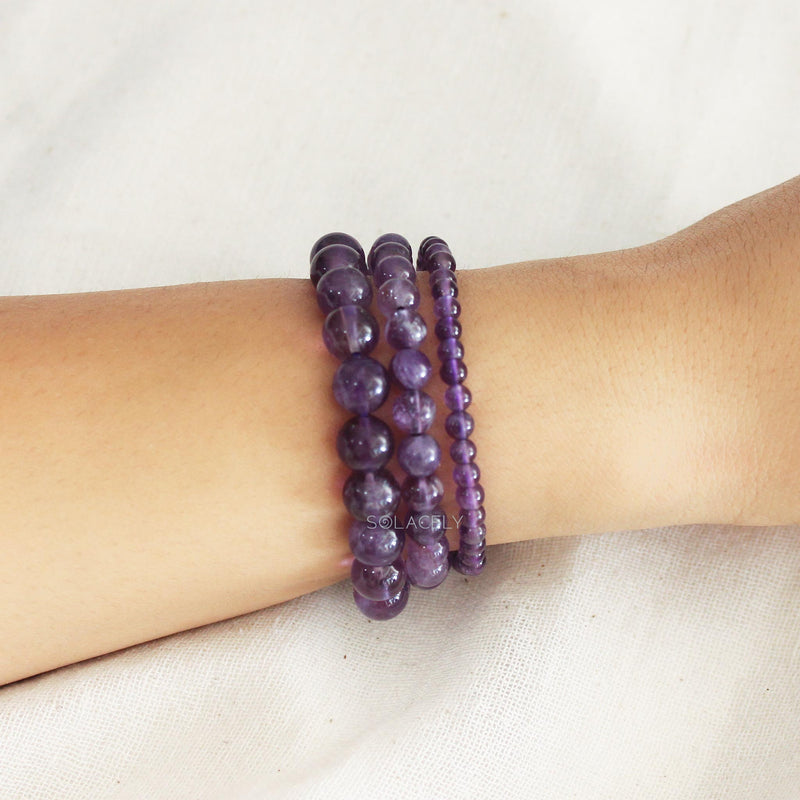
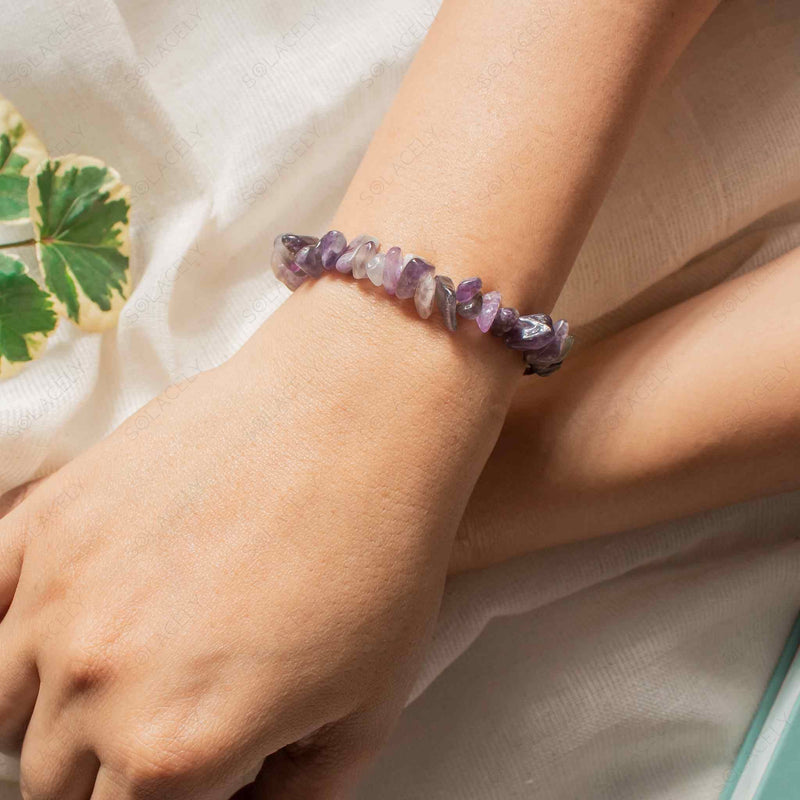
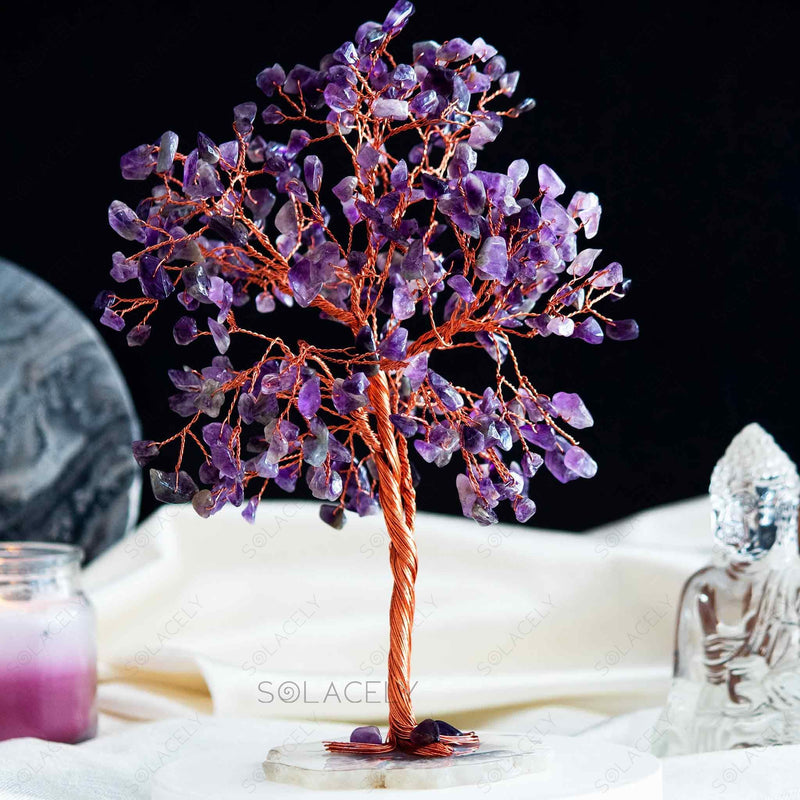
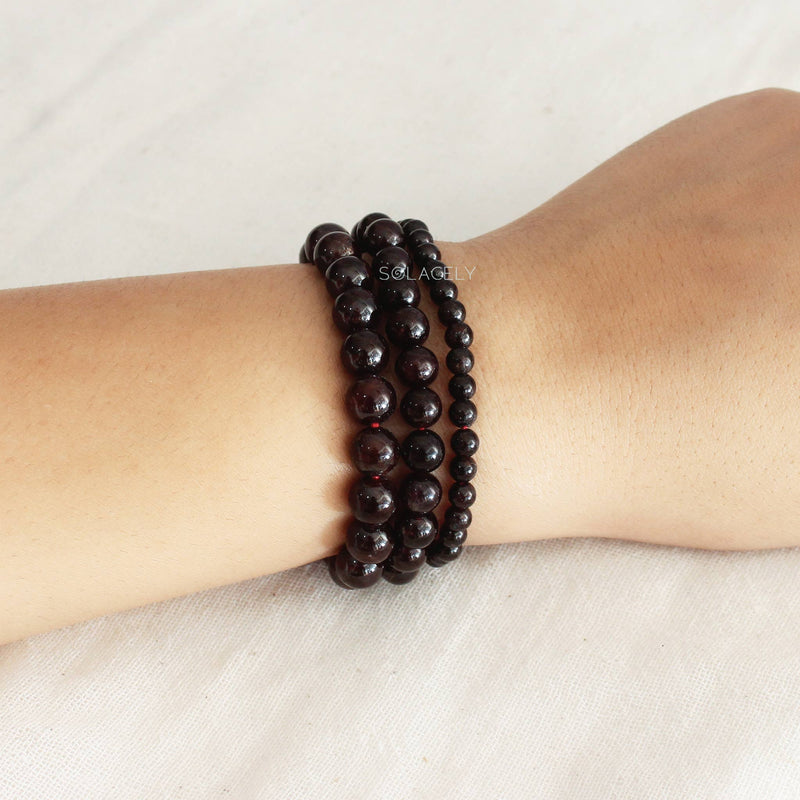
Amethyst and garnet are paired because they sit at opposite ends of the chakra system. Garnet is placed at the root for warmth and staying power, amethyst at the crown for quiet and perspective. The combination suits anyone who feels either too scattered or too heavy.
Key takeaways
- Garnet holds the root, amethyst the crown. That span is the whole logic of the pairing.
- Garnet is a group of silicate minerals rather than one species, generally 6.5 to 7.5 on the Mohs scale.
- Amethyst is the purple variety of quartz, coloured by iron, and sits at 7.
- Both are durable enough for daily wear in bracelets, pendants and rings.
- Keep amethyst out of long strong sun, which softens the purple over months.
Why this pairing is so common
Most recommended crystal pairings balance an active stone against a calming one. This one does something different: it spans a range. Garnet is traditionally placed at the root, the centre associated with safety and belonging, and amethyst at the crown, associated with perspective and quiet.
The practical translation is that the set suits two opposite complaints. If you feel scattered and slightly unreal, garnet is the half doing the work. If you feel heavy, stuck and unable to lift your head from the immediate, amethyst is. Wearing both means the set covers whichever way a week tips.
There is a visual argument too. Deep red against violet is a strong, old combination that appears throughout historical jewellery, and it reads as considered rather than as a wellness accessory.
What garnet actually is
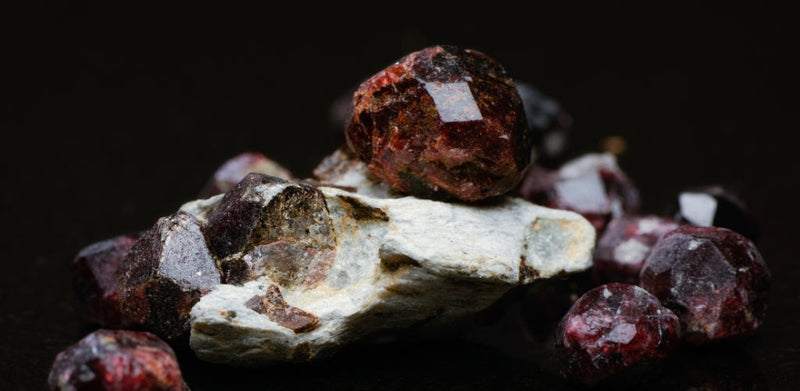
Garnet is not one mineral. According to the Gemological Institute of America, it is a group of silicates spanning many species and a wide colour range, with hardness generally between 6.5 and 7.5 on the Mohs scale. The deep red almandine and pyrope varieties are the ones most people picture.
Its traditional associations are unusually well documented. Garnet appears in Egyptian, Roman and medieval European jewellery, frequently carried by travellers, and that history is the root of its reputation for devotion, safe return and steady warmth rather than for sudden change.
Practically it is one of the easier coloured stones to live with. It takes a ring without complaint, tolerates ordinary handling, and is inexpensive in the common red varieties. The garnet meaning and properties guide covers the species differences.
What amethyst brings
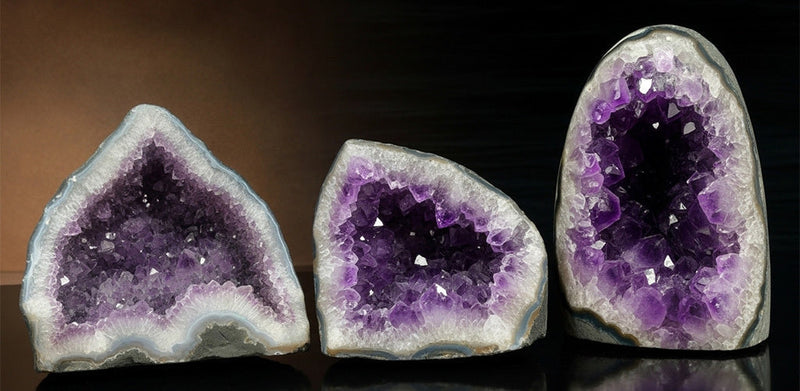
Amethyst is the purple variety of quartz, coloured by iron held within the crystal structure and by natural irradiation. At 7 on the Mohs scale with no cleavage, it is one of the most forgiving stones in any collection and suits every format.
In practice it is kept for settling rather than for energy. It is the stone people put on a nightstand, hold at the end of a working day, or wear when the difficulty is a mind that will not stop rather than a body that will not start. That is a narrower brief than most amethyst writing suggests, and it is the one that holds up.
The one real care note is light. Prolonged direct sunlight softens the purple over months, which is why a bright windowsill is the least kind place to keep it despite being the most obvious. The amethyst guide goes into the varieties.
Comparing the two
| Garnet | Amethyst | |
|---|---|---|
| Mineral | A group of silicates, many species | Quartz, coloured by iron |
| Hardness | 6.5 to 7.5 Mohs | 7 Mohs |
| Chakra placement | Root | Crown |
| Traditionally kept for | Devotion, warmth, staying power | Quiet, perspective, settling |
| Main care note | Avoid ultrasonics on fractured stones | Keep out of prolonged direct sun |
| Best format | Anything, including daily rings | Anything, including daily rings |
The hardness figures are close enough that neither will damage the other in storage, which is unusual among recommended pairings and makes this an easy set to keep in one pouch.
How the pair is worn
Convention puts garnet nearer the skin and amethyst on the outside, the reasoning being that the grounding stone stays close while the spiritual one faces outward. Plenty of people do the reverse and notice no difference, so treat it as convention rather than instruction.
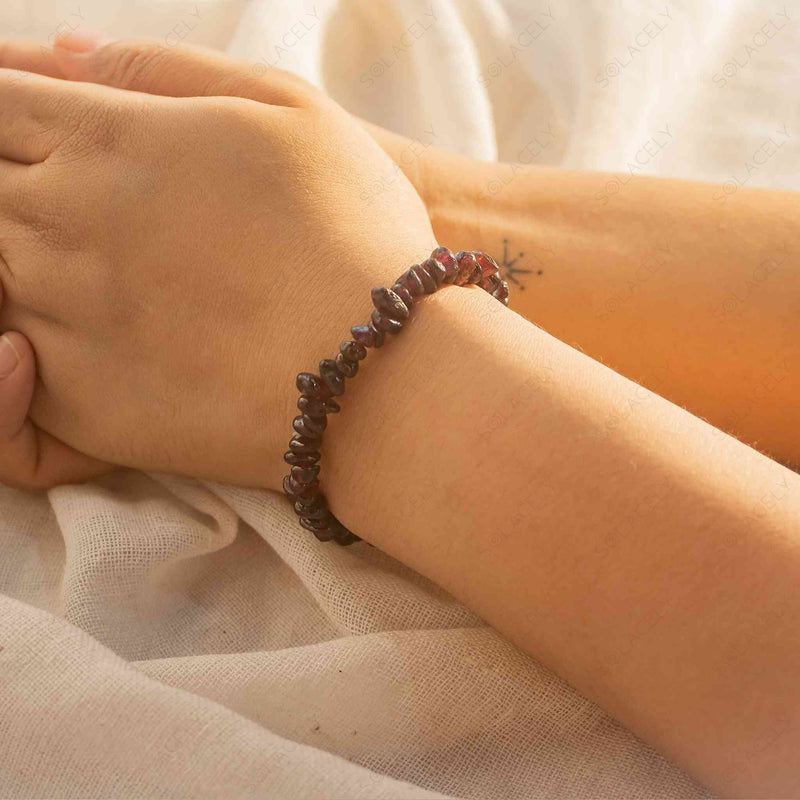
- Stacked bracelets. One strand of each on the same wrist, the most common arrangement.
- A single alternating strand. Reads as more deliberate than two separate stacks.
- Pendant and bracelet. Amethyst as the drop, garnet on the wrist, which separates the two intentions.
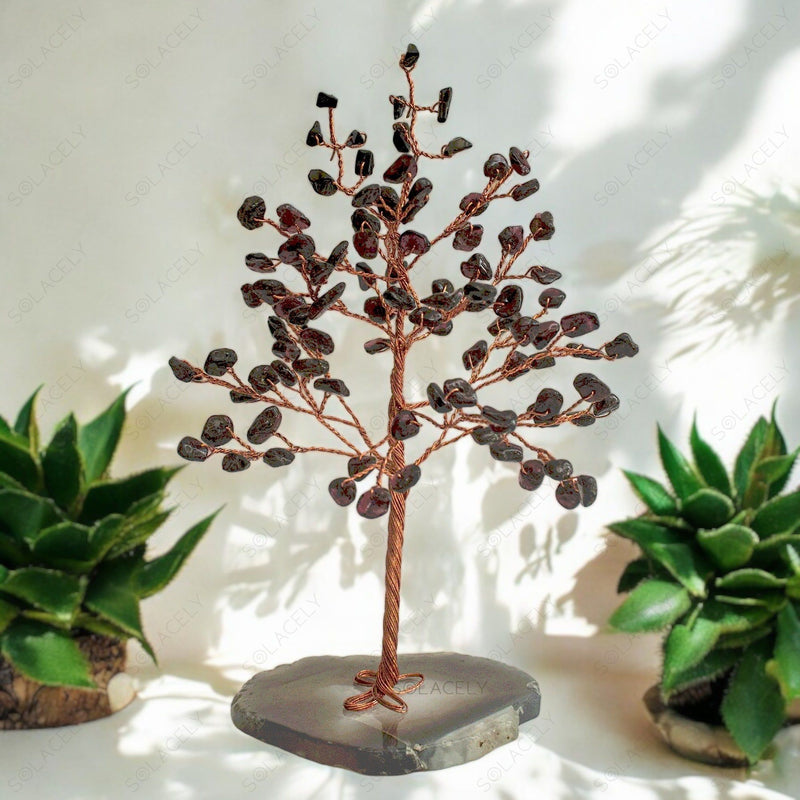
- At home. Garnet where you work, amethyst where you rest. Keeping them in different rooms suits people who want the stones to mark a transition.
If the pairing appeals but you want a gentler second stone, amethyst and selenite covers a softer version of the same crown-focused idea.
Care and cleansing
Both are easy. Warm water, mild soap, a soft brush and a full dry suits either stone, and both are hard enough to share storage with most of a collection without picking up scratches.
Two specific cautions are worth knowing. Avoid ultrasonic cleaners on any garnet with visible fractures, since vibration can propagate them. And keep amethyst away from prolonged strong sunlight, since that is the one thing that will visibly change it over time.
For energetic cleansing, moonlight or sound suit both, and neither needs salt. Many people find the act of cleansing after a demanding week is itself the useful part of the practice, which is a fair reason to keep doing it.
Who this combination suits
It suits people who want one set rather than a collection. Because the two stones sit at opposite ends of the same system, the pairing covers a wider range of days than a set built around a single intention, and that makes it a sensible first purchase for someone starting out.
It suits less well anyone whose need is narrow and specific. If the difficulty is squarely about boundaries, or squarely about sleep, a targeted stone will do more than a span. The breadth that makes this pairing forgiving also makes it less pointed.
One last practical point in its favour. Both stones are hard, affordable and widely available in every format, which means the set you buy is the set you will still be wearing in five years. Most pairings involving a softer partner stone cannot promise the same.
Choosing the two stones
With garnet, the red runs from a bright cherry through to a deep claret that reads almost black in low light, and both extremes are properly garnet. Hold a piece up to a light before deciding, since a stone that looks dramatic in a shop can turn flat and dark on a wrist under office lighting.
With amethyst, the range runs from pale lilac to deep royal purple, and price tracks depth and evenness of colour more than size. Banding is common and entirely natural. Pick the shade you would genuinely enjoy wearing rather than reaching automatically for the darkest piece on the tray.
The properties described here reflect traditional and cultural belief around crystals. They are offered for reflection and wellbeing and are not medical advice, a diagnosis, or a treatment for any condition. If you are managing a health concern, please speak with a qualified healthcare professional. Keep small stones away from young children, and never place crystals in drinking water.
Sources
- Gemological Institute of America, Garnet Description
- Gemological Institute of America, Amethyst Description
Written by Chetena Sharma. Reviewed by the Solacely editorial team.
Frequently asked questions
About the author


Written by Chetna Sharma, crystal healing practitioner and co-founder of Solacely. Chetna has worked with healing crystals for over a decade and curates Solacely's protective stone collection.