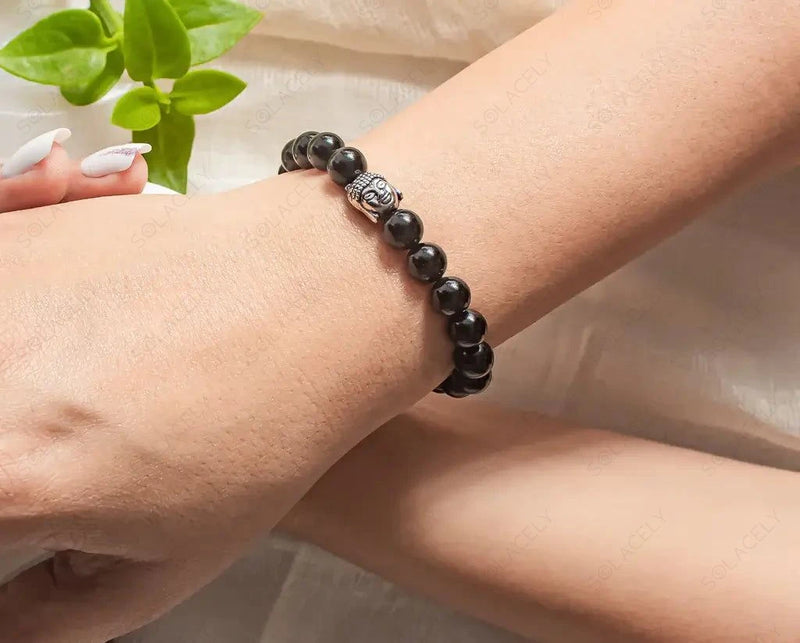
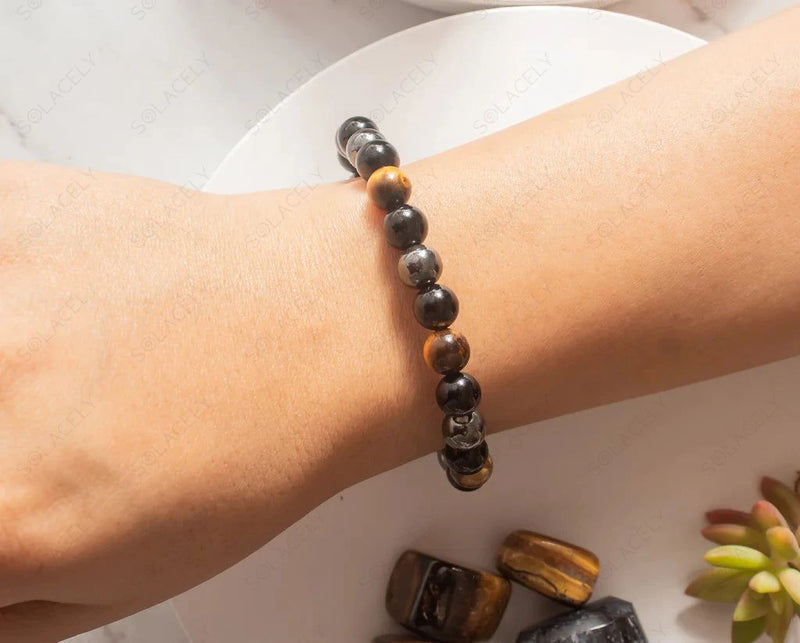
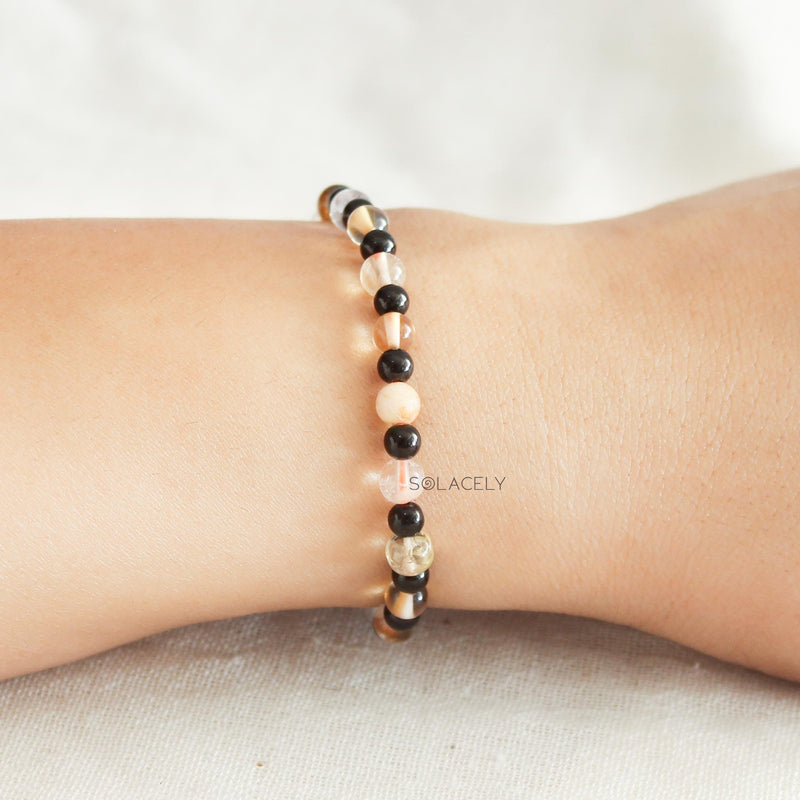
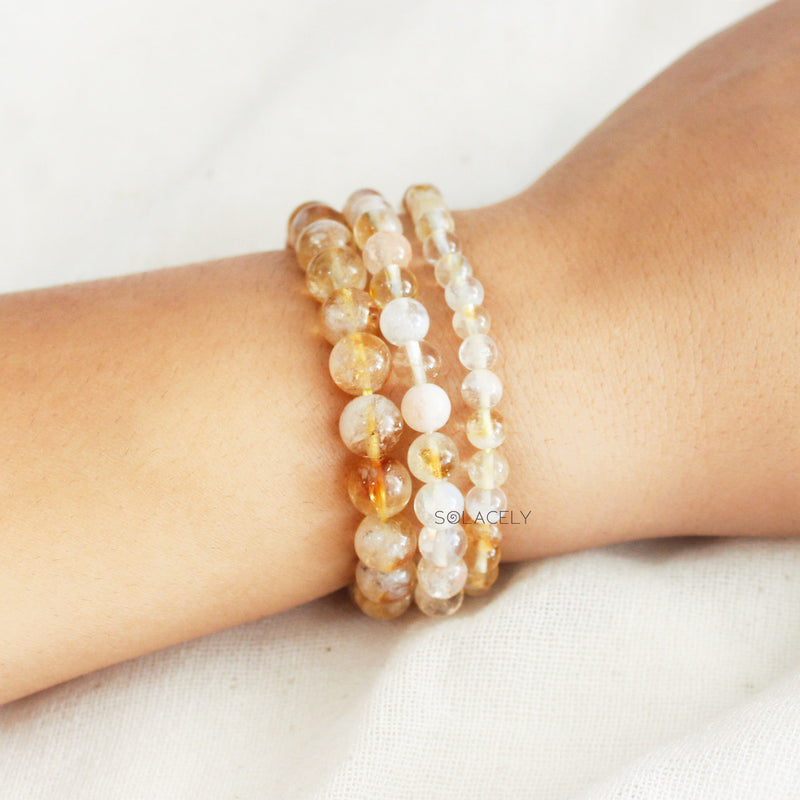
Black tourmaline is the stone most other crystals get paired with, because it grounds without competing. It is schorl, hard enough at 7 to 7.5 for daily wear, and it sits happily beside almost anything. This guide covers the combinations people actually buy and how to wear them. Every pairing here starts with the same stone. If you do not have it yet, a plain black tourmaline bracelet is the base.
Key takeaways
- Black tourmaline is schorl, a complex borosilicate at 7 to 7.5 on the Mohs scale, and the most abundant tourmaline in nature.
- It is genuinely piezoelectric and pyroelectric, developing a small charge under pressure or a shift in temperature. Few minerals do anything so visible.
- The best partners split the work rather than repeating it: citrine for momentum, selenite for clearing, rose quartz for warmth, amethyst for quiet.
- Watch the hardness gap. Tourmaline will mark selenite, moonstone and labradorite, so those pairings want a spacer bead or separate storage.
- Tourmaline is the one stone in most collections that needs no special care beyond a rinse and a dry.
- Everything described here is traditional belief and cultural practice.
Why is black tourmaline the stone everything pairs with?
Because it does one job cleanly and leaves room for a second stone to do another. Tourmaline is the boundary stone of modern practice, kept for grounding and for staying in your own space. That is a foundation rather than a flourish, which is why it turns up in more combinations than anything else in the range.
It is also unusually practical. Geology.com describes tourmaline as occurring in more colours than any other mineral group, with the black iron rich schorl making up the overwhelming majority of what is found. At 7 to 7.5 with poor cleavage it takes daily wear without fuss, and it is opaque, so it does not show the internal marks that a transparent stone would.
The physics is part of the reputation too. Tourmaline is pyroelectric and piezoelectric, generating a measurable charge when heated or squeezed, which is why it went into early pressure gauges and wartime sonar. Dutch traders in the eighteenth century used warmed pieces to pull ash from their pipes. Our black tourmaline guide covers the mineral itself.
The combinations at a glance
Twenty three pairings turn up regularly. The useful way to read this table is by what you want the second stone to add, since the tourmaline half is the same every time.
| Partner stone | What the pair is kept for | Wearable together? |
|---|---|---|
| Citrine | Boundaries plus momentum | Yes, matched hardness |
| Clear quartz | Grounding plus clarity | Yes |
| Selenite | Carry and clear | No, keep selenite on a shelf |
| Rose quartz | Protection plus warmth | Yes |
| Smoky quartz | Double grounding, gentler | Yes |
| Hematite | Weight and steadiness | Yes, with a spacer |
| Pyrite | Nerve about money | Desk pair, not a wrist pair |
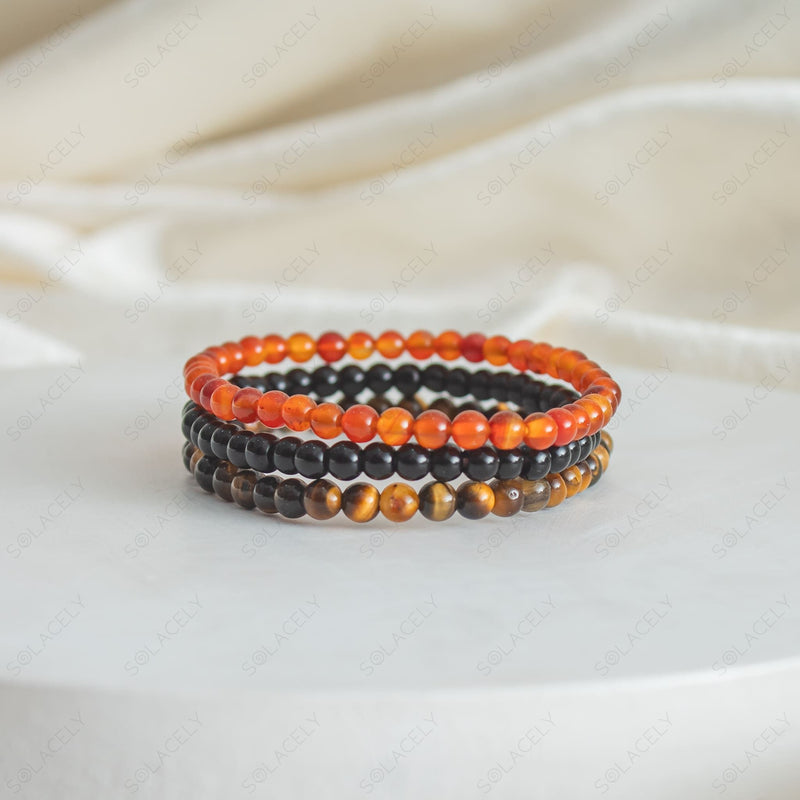
| Tiger's eye | Courage under pressure | Yes |
| Labradorite | Boundaries for empaths | Yes, with a spacer |
| Moonstone | Steadiness through change | Yes, with a spacer |
| Amethyst | Grounding plus calm | Yes |
| Green aventurine | Protected opportunity | Yes |
| Carnelian | Grounding plus drive | Yes |
| Lapis lazuli | Boundaries plus plain speech | Yes, with a spacer |
| Sodalite | Grounding plus clear thinking | Yes, with a spacer |
| Black onyx | Holding a firm line | Yes |
| Black obsidian | Seeing a situation plainly | Yes |
| Red jasper | Endurance | Yes |
| Amazonite | Calm honesty | Yes, with a spacer |
| Sunstone | Grounded confidence | Yes, with a spacer |
| Fluorite | Order under pressure | Desk piece, too soft to stack |
| Malachite | Boundaries and change | Keep out of reach, handle dry |
| Lepidolite | Grounding a racing head | No, lepidolite is too soft |
The pairings people actually buy
Six of the twenty three account for most of what leaves the shop. Each one is doing something the tourmaline cannot do alone.
With citrine
The working week pairing. Tourmaline holds the line and citrine supplies the nerve to ask for things, which is why freelancers and salespeople reach for it. Both sit at 7 or just above, so neither marks the other in a stack. Covered in full in black tourmaline and citrine.
With clear quartz
The simplest addition and the one most beginners make first. Clear quartz is treated in tradition as an amplifier, strengthening whatever it sits with, so the pair reads as grounding turned up rather than grounding plus something else. Matched hardness, no care complications, and it suits any format.
With selenite
The maintenance pairing, and the one that is not a bracelet. Selenite sits at 2 against tourmaline at 7 to 7.5, so bead on bead contact strips its polish within days. The right arrangement is a selenite plate on a shelf with the tourmaline resting on it overnight. Our black tourmaline and selenite guide covers the setup.
With rose quartz
Boundaries plus warmth, which is a more useful combination than it first sounds. People who describe themselves as taking on other people's moods often want the line held without hardening, and this is the pair that does it. Both are 7 on the Mohs scale and both take daily wear.
With hematite and pyrite
The desk arrangement. Hematite adds weight and pyrite adds the confidence to ask for what work is worth. Hematite sits at 5 to 6 so it wants a spacer if it shares a strand, and pyrite stays off the wrist entirely because moisture is unkind to it. Keep pyrite dry on a shelf and the trio lasts indefinitely.
With smoky quartz
Double grounding for people who find plain tourmaline too heavy to wear all day. Smoky quartz is the softer version of the same intention, still quartz at 7, and the two together read as steadiness rather than armour. A good first pairing for anyone easing into the practice.
Beyond those six, tiger's eye adds nerve for a decision, labradorite suits empaths who need reflecting rather than absorbing, moonstone carries steadiness through a transition, and amethyst turns the whole thing towards the quiet end for evening wear.
How do you wear a tourmaline combination?
Four formats cover nearly everyone, and the choice mostly follows the second stone rather than the tourmaline.
- Stacked strands. One stone per strand, worn together. The kindest arrangement for any softer partner, since nothing rubs.
- One alternating bracelet. The usual choice and the best looking. Add a spacer bead wherever the partner is softer than about 6.
- Pendant and pocket. Tourmaline in a pocket for the day, the partner worn where you can see it. Suits pairs with a wide hardness gap.
- Desk or shelf set. The right answer for pyrite, selenite and fluorite, none of which want a wrist.
The general rule is simple. If the partner sits below 6 on the Mohs scale, do not let it touch the tourmaline. Everything else is preference. For the wider protective set rather than combinations specifically, see our crystals for protection guide.
How do you cleanse and charge them?
Tourmaline is one of the least demanding stones in any collection, so the care routine is almost always set by whatever it is paired with.
For the tourmaline itself, warm water, mild soap and a soft brush for the striations, then a thorough dry. Skip ultrasonic and steam cleaners, since it is brittle and dislikes sudden heat. Raw pieces shed a few small fragments when new, which is normal for schorl and settles within weeks, so stand a rough piece on a dish rather than straight onto furniture.
For cleansing, moonlight overnight, smoke, sound or a rest on a selenite plate all suit it, and all four are safe for every partner on the list above. That matters, because the usual rinse under running water is wrong for selenite, pyrite and malachite. Where a pairing includes one of those, default to the dry methods for the whole set and nothing gets damaged.
The properties described here reflect traditional and cultural belief around crystals. They are not medical claims, they are not claims about physical shielding, and they are not a substitute for professional healthcare. If you are managing a health concern, speak to a qualified practitioner. Keep pyrite and malachite away from children and pets and handle them dry, and never place crystals in drinking water.
Sources
Written by Chetena Sharma. Reviewed by the Solacely editorial team.
Frequently asked questions
About the author


Written by Chetna Sharma, crystal healing practitioner and co-founder of Solacely. Chetna has worked with healing crystals for over a decade and curates Solacely's protective stone collection.