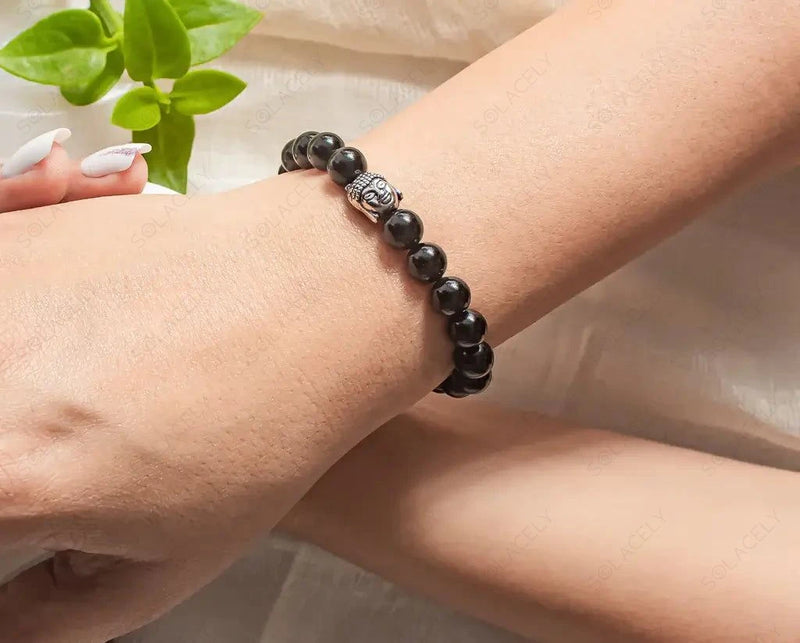
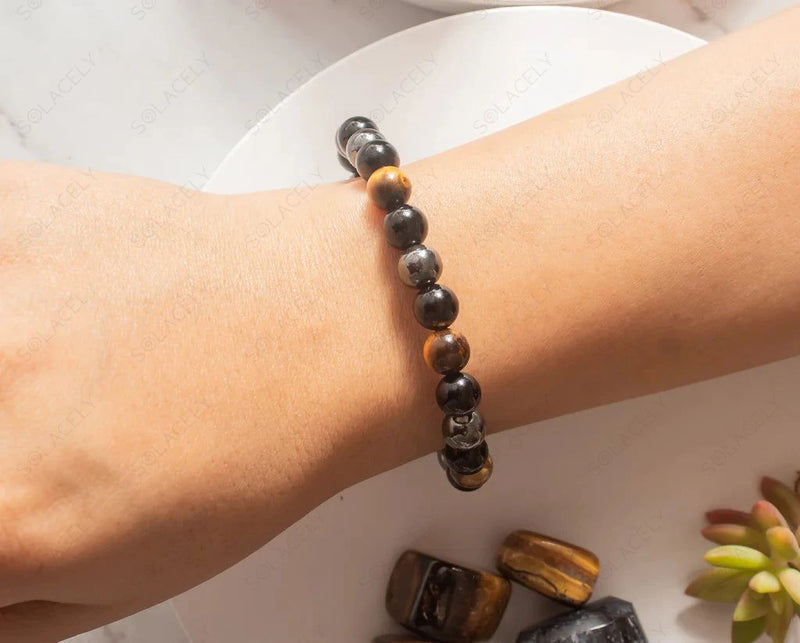
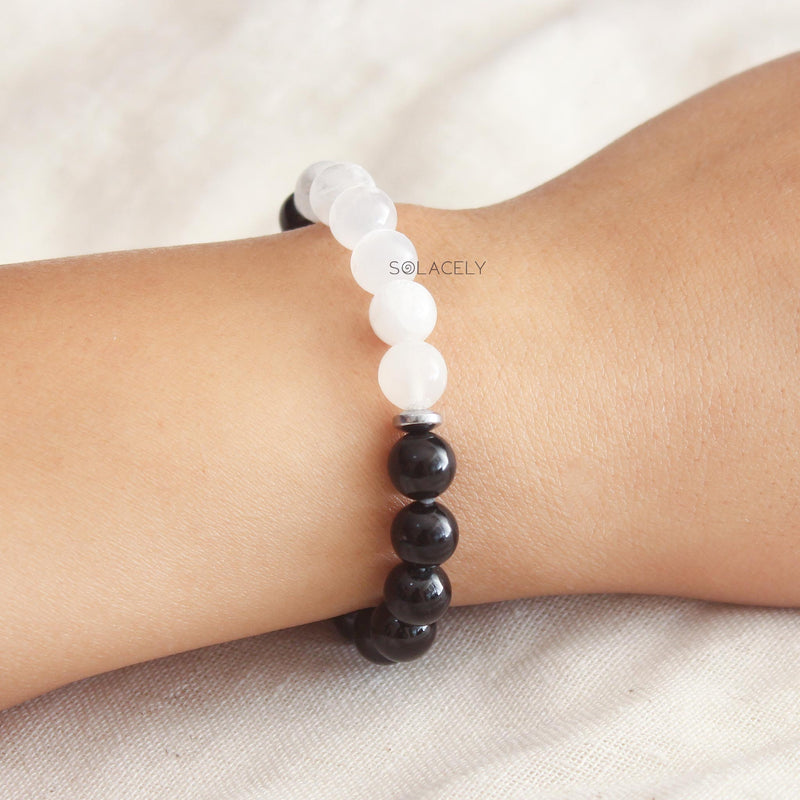
Black tourmaline and selenite is the protection and cleansing pair, and the most common way it is actually used is not as jewellery at all. The tourmaline is the piece you carry. The selenite is the plate it rests on overnight. A five point hardness gap between the two decides almost everything about how they are kept.
Key takeaways
- Black tourmaline is schorl, a complex borosilicate at 7 to 7.5 on the Mohs scale, and it is by a wide margin the most abundant tourmaline in nature.
- Selenite is the clear crystalline form of gypsum, at only 2. It marks with a fingernail and it dissolves slowly in water.
- Never store them touching. Tourmaline will take the polish off selenite within days of bead on bead contact.
- Tourmaline is genuinely pyroelectric and piezoelectric, developing a small charge under heat or pressure. It was used in pressure gauges and wartime sonar for exactly that reason.
- The practical split is simple. Tourmaline is the wearable stone, selenite is the shelf piece, the wand and the charging plate.
- Everything described here is traditional belief and cultural practice.
Why are black tourmaline and selenite paired?
Because one maintains the other. Black tourmaline is the boundary stone people carry into crowded places and difficult rooms. Selenite is the stone traditionally used to refresh other crystals, which gives it a job no other piece in a collection does. Rest the tourmaline on a selenite plate overnight and the pair has done its work without you doing anything at all.
In chakra terms the two sit at opposite ends, tourmaline at the root for grounding and selenite at the crown for openness and clarity. That is the symbolic reading, and it is why the combination turns up in so many beginner sets. The practical reading is more useful: this is the lowest maintenance protection and cleansing setup in modern practice, because the maintenance happens while you sleep.
It is chosen most by people who want one stone they carry daily and one arrangement at home that keeps it fresh. If you want the wider set of partners for the black stone, our black tourmaline combinations guide covers them, and amethyst and selenite is the gentler version of the same maintenance idea.
What is black tourmaline?
Black tourmaline is properly called schorl, the sodium and iron member of the tourmaline group. It is a borosilicate, and boron is what makes the whole group mineralogically distinctive. The iron is what makes this one black rather than pink or green.
At 7 to 7.5 on the Mohs scale it is harder than quartz and comfortable in daily wear. Its cleavage is poor, so it tolerates knocks better than a feldspar would, though it is brittle enough to chip if it meets a tiled floor. Raw crystals grow as long prisms with fine grooves running down the sides, and those striations are the easiest way to recognise a rough piece by touch.
The bulk of commercial supply comes from Minas Gerais in Brazil, with more from Tanzania, Nigeria, Madagascar, Mozambique, Malawi and Namibia, plus specimen material from Maine, California and Pakistan. Our black tourmaline guide covers formation and grading in more depth.
The electrical properties
Tourmaline belongs to a small group of minerals that are both pyroelectric and piezoelectric. It develops a measurable electrical charge when its temperature changes, and another when it is put under mechanical pressure. These are well documented physical properties, and they are the reason tourmaline crystals were used in early twentieth century pressure gauges and in sonar transducers during the Second World War.
Very few minerals do anything so visible on a tabletop, and people noticed it long before anyone could measure it. Dutch traders in the eighteenth century used warmed tourmaline to pull ash out of their pipes, which is where the old name aschentrekker came from. Three hundred years of treating this as an active, responsive stone sits behind the reputation it carries today.
What is selenite?
Selenite is the transparent, crystalline variety of gypsum, a hydrated calcium sulfate. The name has been used for clear gypsum since the fifteenth century, after the Greek word for the moon, in reference to the pale sheen that runs along a polished wand.
Geology.com describes gypsum as one of the more widespread sulfate minerals and a notably soft one. Selenite sits at 2 on the Mohs scale, soft enough to mark with a fingernail, and it has perfect cleavage in one direction, which is why wands split into thin sheets along their length if they are dropped or flexed.
Its real limitation is water. Gypsum is slightly soluble, so a wand left in a glass of water for an afternoon comes out cloudy and chalky at the surface. That is the whole reason every guide tells you to keep selenite dry. Most retail selenite comes from Morocco today. The most spectacular example is the Cave of the Crystals at the Naica Mine in Mexico, where selenite crystals over eleven metres long grew across hundreds of thousands of years. Our selenite guide covers plates, wands and towers.
The five point hardness gap
This is the number that decides how you keep the pair. Selenite at 2 sits against tourmaline at 7 to 7.5, and that is one of the widest gaps between two stones people are routinely told to combine.
In practice it means a tourmaline bead beside a selenite bead on the same strand will take the gloss off the selenite within days, cost it dimension within weeks, and start it chalking once skin moisture is added. So the pair is not a bracelet. It is a carry stone and a shelf piece, and once you accept that, both last indefinitely.
| Property | Black tourmaline | Selenite |
|---|---|---|
| Mineral | Schorl, a borosilicate | Gypsum, a hydrated calcium sulfate |
| Hardness | 7 to 7.5 Mohs | 2 Mohs |
| Cleavage | Poor, brittle on impact | Perfect in one direction, splits into sheets |
| Water | A brief rinse is fine | Keep dry, it is slightly soluble |
| Traditional role | Grounding and boundaries | Clearing and refreshing other stones |
| Best formats | Bracelet, pendant, pocket stone | Plate, wand, tower, shelf piece |
How do you use the pairing?
Four arrangements cover nearly everyone, and the first is the one most people settle on.
- The overnight plate. A selenite slab on a shelf or bedside table, with the tourmaline resting on it while you sleep. This is the classic setup and it asks nothing of you.
- Carry and come home. Tourmaline in a pocket or on the wrist through the day, back onto the plate at night. The rhythm is the practice.
- Meditation pair. Tourmaline held in the hand for weight, selenite wand laid in front of you or beside the mat. Keep the wand off hard floors, since a drop splits it along the cleavage.
- Threshold and shelf. Tourmaline by the front door in the traditional boundary placement, selenite higher up and well away from any damp.
One thing to avoid is a bathroom shelf. Between steam and splashes it is the worst room in the house for selenite, and the damage is gradual enough that people do not notice until the surface has gone dull. For the wider protective set, see our crystals for protection guide.
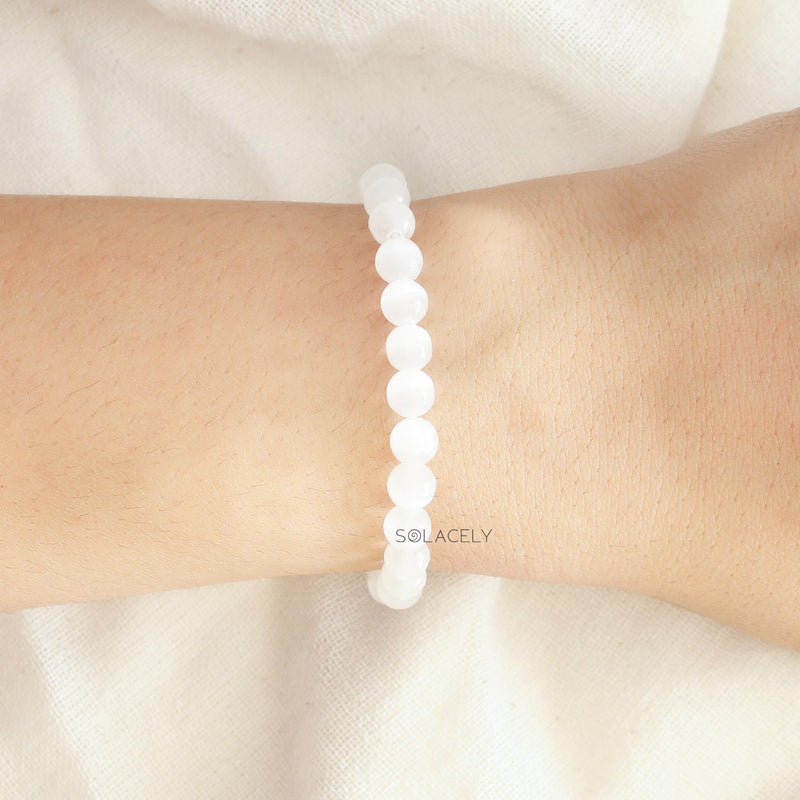
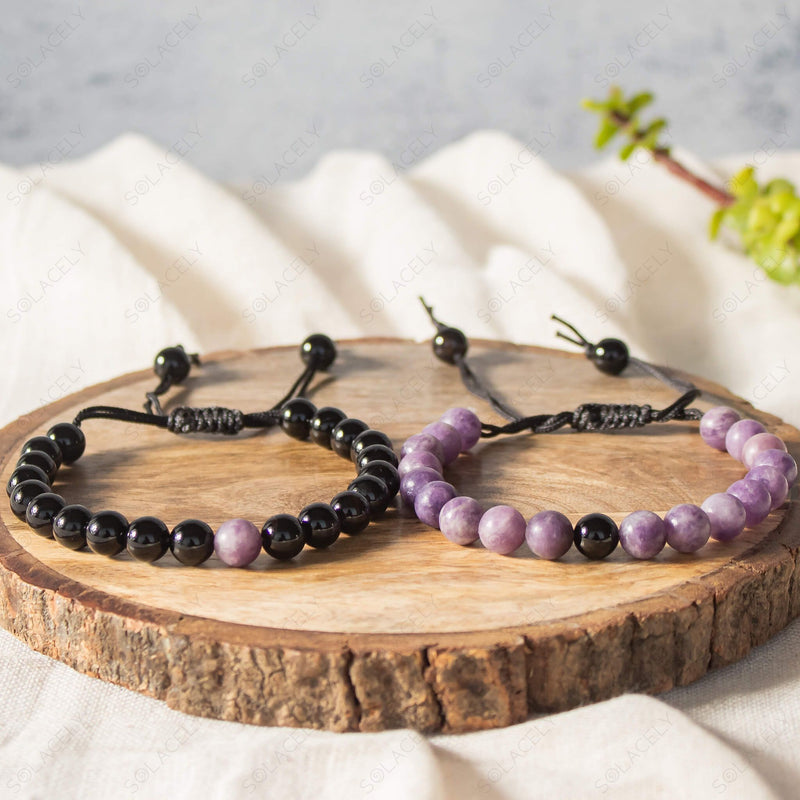
If you'd rather not build the pairing piece by piece, our selenite bracelet is a ready-made way to carry selenite's clarity on its own, worn for a ritual or a quiet afternoon rather than as an all-day habit.
Black tourmaline, selenite and clear quartz together
Many people add clear quartz to the black tourmaline and selenite pair to make a trio. In tradition black tourmaline grounds, selenite clears, and clear quartz amplifies and clarifies whatever sits beside it, so the third stone is read as brightening the whole arrangement rather than adding a new intention of its own.
Worn, the trio is one bracelet of each on the same wrist, or the two-in-one black tourmaline and selenite bracelet with a clear quartz piece beside it. Our selenite and clear quartz bracelet covers the lighter half of the trio on one strand, leaving a plain black tourmaline bracelet to anchor it. Whatever the combination, take the selenite off before water and rest it on a plate at night.
At home the three take their traditional places. Black tourmaline sits by the front door as the boundary stone. Selenite goes on a shelf or a sill that stays dry, well out of condensation and steam. Clear quartz sits in the centre of the room, a point or cluster on the table where you spend most of your time, where tradition holds it gathers and brightens what the other two set up.
Care is where the three part ways. Selenite is dry only: a dry cloth, no rinse, no soak, no bathroom. Black tourmaline and clear quartz both tolerate a brief rinse in lukewarm water and a thorough dry, though neither likes an ultrasonic or steam cleaner. Store the quartz and the tourmaline apart from the selenite, since both will scratch it, and let the plate do the energetic work for all three.
How do you care for them?
Care for these two separately, because almost nothing they need is the same.
Black tourmaline takes warm water, mild soap and a soft brush for the striations, then a thorough dry. Skip ultrasonic and steam cleaners, since it dislikes sudden heat. Raw pieces shed a few small fragments when new, which is normal for schorl and settles after a few weeks, so stand a rough piece on a dish rather than directly on furniture.
Selenite takes a dry cloth and nothing else. No rinse, no soak, no damp room. Store it apart from every harder stone in the collection, because tourmaline is far from the only thing that will scratch it. If a wand does split along its length, that is the cleavage doing what cleavage does rather than a fault in the piece.
For energetic cleansing, moonlight, smoke or sound suit both. Selenite is itself the passive option for everything else you own, which is the reason most collections end up with a plate sooner or later.
The properties described here reflect traditional and cultural belief around crystals. They are not medical claims, they are not claims about physical shielding, and they are not a substitute for professional healthcare. If you are managing a health concern, speak to a qualified practitioner. Keep small stones away from young children, and never place crystals in drinking water.
Sources
Written by Chetena Sharma. Reviewed by the Solacely editorial team.
Frequently asked questions
About the author


Written by Chetna Sharma, crystal healing practitioner and co-founder of Solacely. Chetna has worked with healing crystals for over a decade and curates Solacely's protective stone collection.