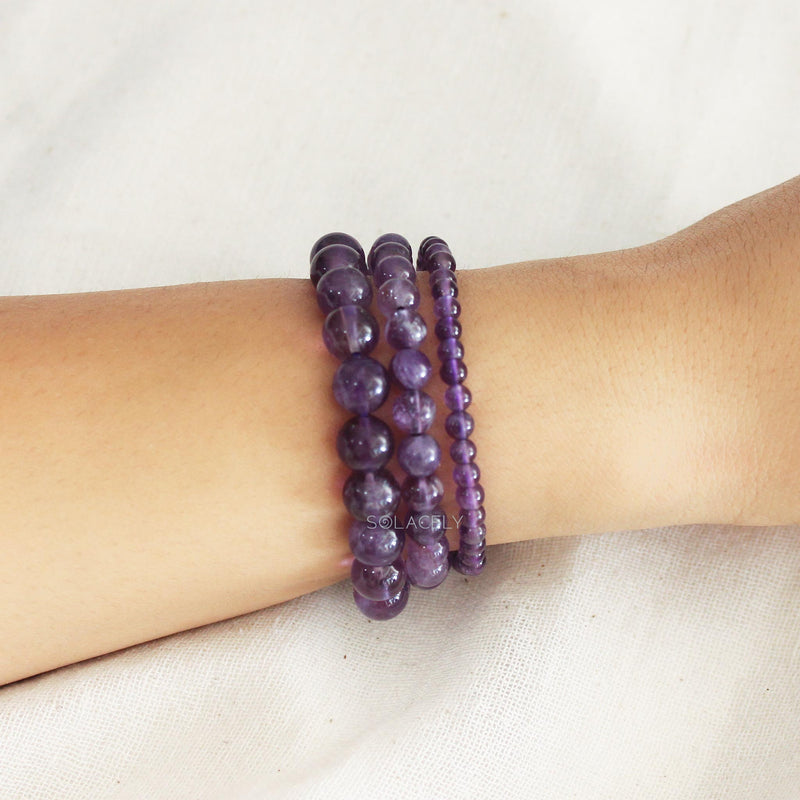
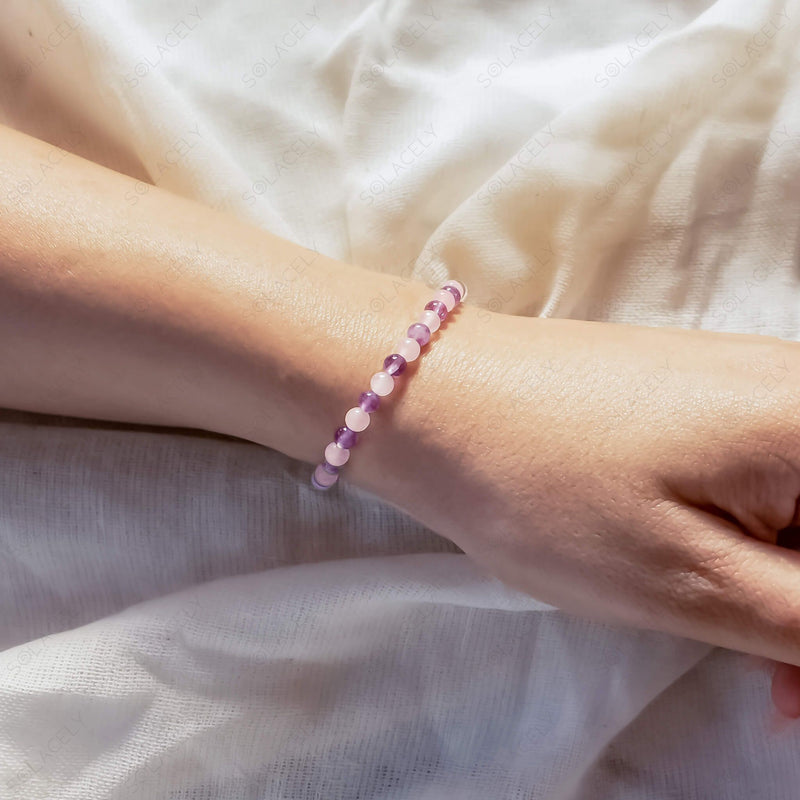
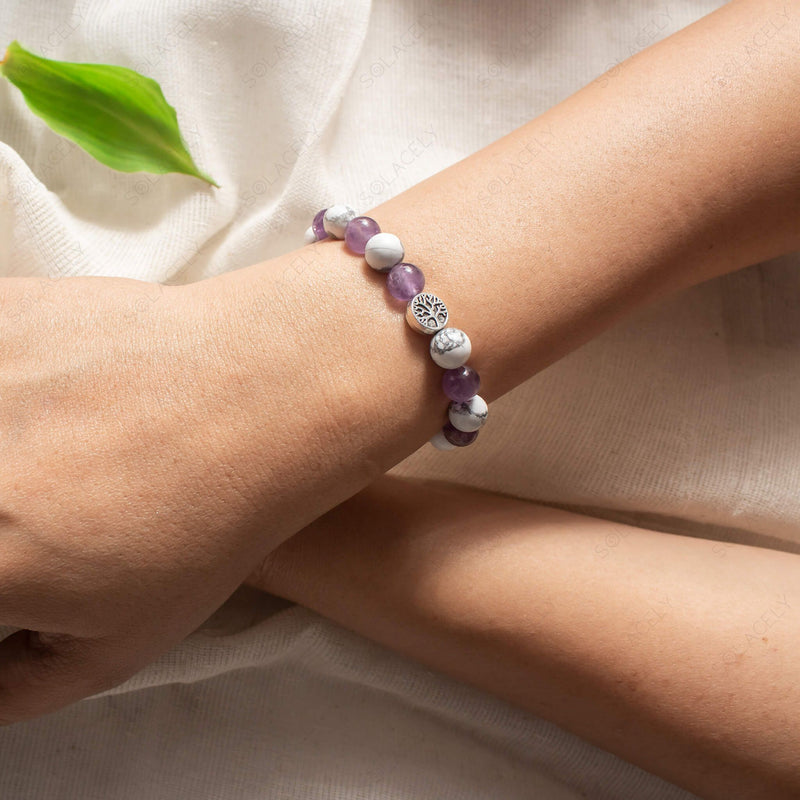
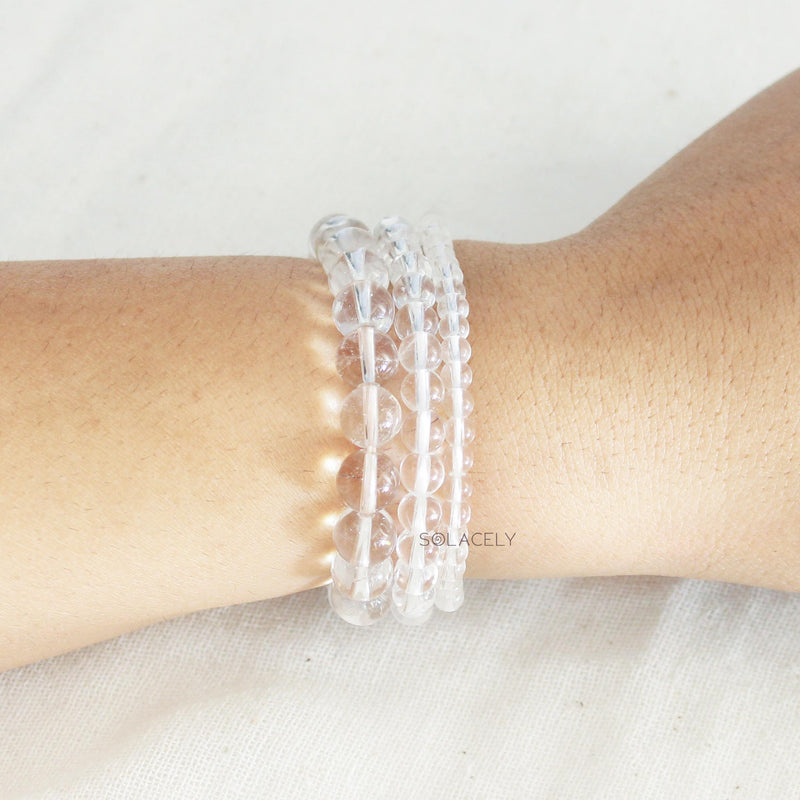
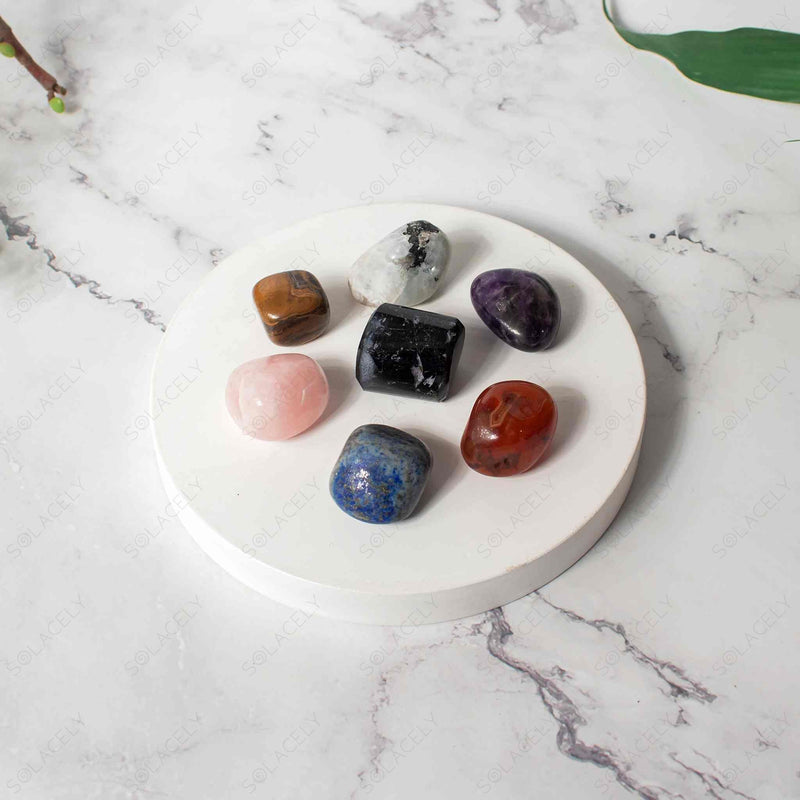
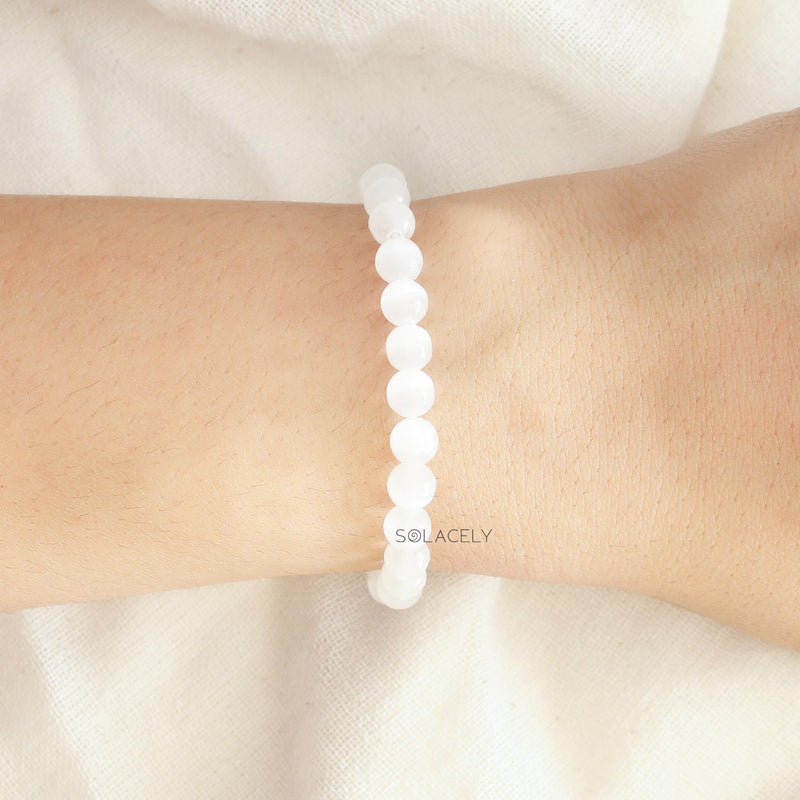
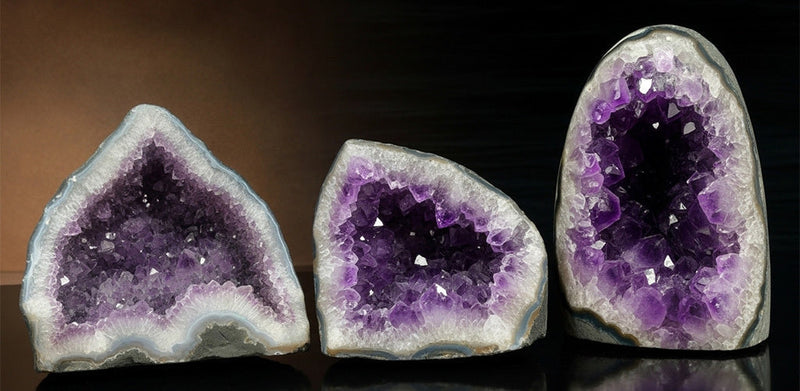
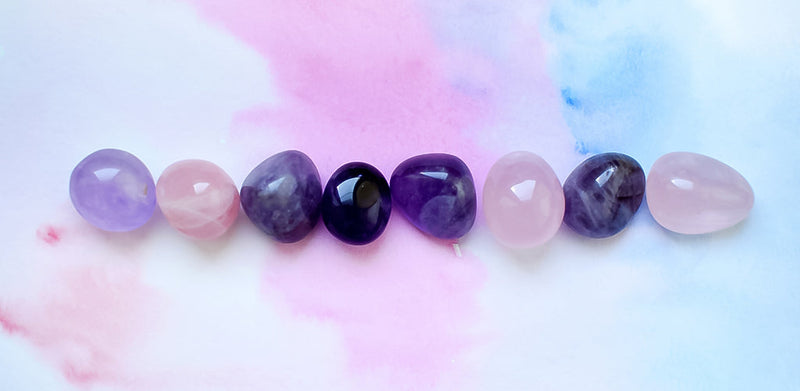
Amethyst pairs most naturally with clear quartz, rose quartz, selenite, citrine and black tourmaline. Each partner takes the calm amethyst is traditionally kept for and points it somewhere: clarity, tenderness, lightness, warmth or grounding. Choose one partner at a time rather than a bowlful, and let the pairing answer an actual question.
Key takeaways
- Clear quartz is the all-purpose partner, traditionally kept for amplifying whatever it sits beside.
- Rose quartz softens amethyst into the gentlest pairing in the set, for rest and self-kindness.
- Selenite is the lightening partner and the one used to cleanse the others.
- Citrine warms amethyst, and the two grow together naturally as ametrine.
- Black tourmaline anchors amethyst, which is the pairing people reach for on a heavy week.
Why pair amethyst at all?
Amethyst on its own is the calm stone, traditionally kept for rest, composure and a quieter mind. Pairing does not change that. What a second stone does, in crystal tradition, is give the calm a direction, so that settling becomes settled and focused, or settled and tender, or settled and grounded.
The practical version is simpler still. Two stones in a pocket, or two strands on a wrist, give you two reminders rather than one, and they tend to be reminders of different things. That is why pairing has stayed such a common practice, and why almost every amethyst owner ends up with a partner stone.
Before choosing a partner it helps to know what amethyst carries on its own. Our guide to amethyst meaning and properties covers the stone in full, from its Greek name to its chakra associations.
The five classic amethyst pairings
These five cover almost everything people come looking for. Each is a long-established combination with a clear traditional purpose, and each is easy to buy as beads, tumbles or a single strand. The table is the short version.
| Pairing | Traditionally kept for | Best as |
|---|---|---|
| Amethyst and clear quartz | Calm with clarity, intentions held steady | Bracelet or desk pair |
| Amethyst and rose quartz | Rest, self-kindness, softness | Bedside or bracelet |
| Amethyst and selenite | Lightness, spaciousness, cleansing | Shelf or altar pair |
| Amethyst and citrine | Calm with warmth and confidence | Bracelet or pocket pair |
| Amethyst and black tourmaline | Calm with grounding and protection | Daily wear or doorway |
Pairings for rest and softness
Amethyst with rose quartz is the gentlest combination in crystal practice. Amethyst is kept for stillness and rose quartz for self-love, so the pair is traditionally used when the difficulty is not a racing mind but a hard one, the sort of week where you have been unkind to yourself.
Keep them together on a bedside table, or wear the two as a stacked pair on the same wrist. Purple and soft pink is also simply a lovely combination to look at, which matters more than it sounds: a pairing you like the look of is one you will actually keep in view. Our note on amethyst and rose quartz covers the pairing in detail.
Selenite belongs in this group too. It is the lightening stone, traditionally used to clear and to open up space, and its milky white sits beautifully against purple. Many people keep a selenite bar under an amethyst cluster, which doubles as the simplest cleansing arrangement there is.
Pairings for clarity and focus
Amethyst with clear quartz is the workhorse pairing. Clear quartz is traditionally the amplifier, the stone kept to strengthen whatever intention sits beside it, so pairing it with amethyst is the standard way to give calm some definition. It is the combination most often used in meditation.
Lapis lazuli and sodalite are the other focus partners, both deep blue and both long associated with clear thinking and honest speech. Amethyst with lapis is the traditional study pairing, kept for the kind of work that needs a settled mind and a sharp one at the same time.
Fluorite is worth knowing about here as well, kept for order and for sorting a cluttered mind. It is softer than quartz at 4 on the Mohs scale, so it belongs in a bowl rather than on a wrist that gets knocked about. Pair it with amethyst on a desk rather than wearing the two.
Pairings for grounding and warmth
Amethyst with black tourmaline is the pairing for a heavy stretch. Tourmaline is the anchor, traditionally kept for grounding and protection, and it gives amethyst's calm something solid to sit on. This is the combination people wear through a demanding period at work or a difficult month at home.
Amethyst with citrine is the warm one. Citrine is the confidence and abundance stone, and the pairing is traditionally kept when calm alone feels a little flat and what is wanted is calm with some spark in it. The two even grow together in nature as ametrine, a single crystal that is purple at one end and gold at the other.
Carnelian and garnet do a similar job with more heat, both kept for courage and momentum. Hematite is the heavier grounding option if tourmaline feels too much. Our guide to amethyst and citrine covers that warm pairing on its own terms.
How to use and care for a paired set
Keep it simple. Wear the two stones together on one wrist, carry both as tumbles in the same pocket, or place them side by side where you will see them, on a desk, a bedside table or a windowsill that does not get hard afternoon sun.
In crystal tradition the left wrist is the receiving side, so a pair worn for taking something in goes on the left. If you are working with the pair in meditation, the usual arrangement is one stone in each hand, amethyst in the left and the partner in the right.
Give a pairing a few weeks before deciding whether it suits you. Crystal practice is not a matter of instant results, and most people find that a combination reveals itself slowly, through the small moments when you notice you have reached for it. If a pairing does not settle, swap the partner rather than the amethyst.
Care follows the softer stone. Amethyst, quartz and tourmaline are hard and easy, but selenite dissolves in water and must stay dry, and fluorite and calcite mark easily. Charge amethyst in moonlight rather than sun, since long hours of hard light fade it permanently. Our step-by-step on how to cleanse and charge crystals covers each method.
Crystal pairings are worked with as part of a long-standing spiritual and cultural tradition. They are not a medical device or treatment, and they do not diagnose, treat, cure or prevent any condition. Nothing here replaces advice from a doctor or other qualified professional, and you should never delay or stop medical care because of a crystal. Small tumbles and beads are a choking risk for babies and young children.
Sources
Written by Chetena Sharma. Reviewed by the Solacely editorial team.
Frequently asked questions
About the author


Written by Chetna Sharma, crystal healing practitioner and co-founder of Solacely. Chetna has worked with healing crystals for over a decade and curates Solacely's protective stone collection.