Black onyx is a banded variety of chalcedony, a microcrystalline quartz, traditionally worn for boundaries, steadiness and composure under pressure. It sits at 7 on the Mohs scale, which makes it durable enough for daily rings. Its deep even black comes from a dyeing practice used on chalcedony for centuries, which is what gives the stone its signature look.
Key takeaways
- Onyx is banded chalcedony, a form of quartz made of crystals too small to see individually.
- It is 7 on the Mohs scale, hard enough for rings, bracelets and everyday wear.
- The deep even black comes from a long established dyeing practice, used on chalcedony for centuries and completely stable.
- Traditionally used for boundaries, self-control and composure rather than for comfort or softness.
- Metaphysical uses described here are traditional belief, not medical fact.
What black onyx actually is
Onyx is a variety of chalcedony, which is quartz composed of crystals far too small to distinguish by eye. What defines onyx specifically is banding: parallel, straight layers, as opposed to the curved concentric bands that define agate. Geology.com sets out that distinction, and notes that agate and onyx are close relatives within the same family.
Because it is quartz, onyx inherits quartz durability. It sits at 7 on the Mohs scale, takes a high polish, and does not chip readily. That combination is why it has been carved into cameos, intaglios, signet rings and seals for well over two thousand years.
The word onyx on its own does not mean black. Sardonyx is the reddish brown and white banded form, and there are white, grey and brown varieties. Black onyx is the specific material most people mean, and it is the one that dominates the jewellery market.
Is your black onyx dyed?
Almost certainly, and that is worth knowing without being alarmed by it. Naturally solid black chalcedony of even colour is uncommon. The standard practice, documented since Roman times, is to soak grey or banded chalcedony in a sugar solution and then treat it with acid, which carbonises the sugar within the pores and produces a permanent, even black.
The treatment is stable. It does not wash out, fade in sunlight, or wear off with handling, which is why the trade treats it as accepted rather than as a defect. What matters is disclosure and price: dyed onyx should be sold as onyx at onyx prices, not presented as rare natural material at a premium.
There is a separate issue worth flagging. A good deal of cheap black jewellery sold as onyx is dyed howlite, black glass, or resin. Glass feels warmer to the touch and often contains bubbles. Howlite is much softer at 3.5 and will scratch with a knife point where genuine onyx will not.
Traditional meaning and use
Black onyx has carried a consistent character across traditions: self-discipline, endurance, and holding a line. In Roman use it was set into signet rings, partly because wax does not stick to polished chalcedony and partly because the stone was associated with steadiness and authority.
In modern crystal practice it is used for boundaries rather than comfort. It is the stone recommended most often to people dealing with a draining colleague, a demanding family situation, or a period requiring composure rather than expression. It sits alongside black tourmaline and obsidian in that role, and each has a slightly different character.
The distinction people find most useful is this. Obsidian is associated with cutting off. Black tourmaline is associated with shielding. Onyx is associated with holding steady while it happens. The black tourmaline guide covers the alternative.
Onyx compared with the other black stones
| Black onyx | Black tourmaline | Black obsidian | |
|---|---|---|---|
| Material | Chalcedony, a quartz | Borosilicate mineral | Volcanic glass, not a mineral |
| Hardness | 7 Mohs | 7 to 7.5 Mohs | 5 to 5.5 Mohs |
| Traditional role | Composure, self-discipline | Shielding, absorbing | Cutting ties, seeing clearly |
| Appearance | Even, glossy, uniform black | Matte, vertically striated | Glassy, sometimes with sheen |
| Suits rings | Yes | Yes, though it chips at edges | No, it chips readily |
| Usually treated | Yes, dyed | No | No |
If you are choosing between them on durability alone, onyx wins for anything worn on the hands. For a comparison of the other two, see black obsidian versus black tourmaline.
How to wear black onyx
Its durability makes it one of the few crystal-shop stones that genuinely suits a ring worn every day. It also takes an exceptional polish, which is why it reads as jewellery rather than as a wellness object, and that matters to a lot of people wearing it in professional settings.
- Rings. The classic format. A flat-topped signet is the historically traditional cut.
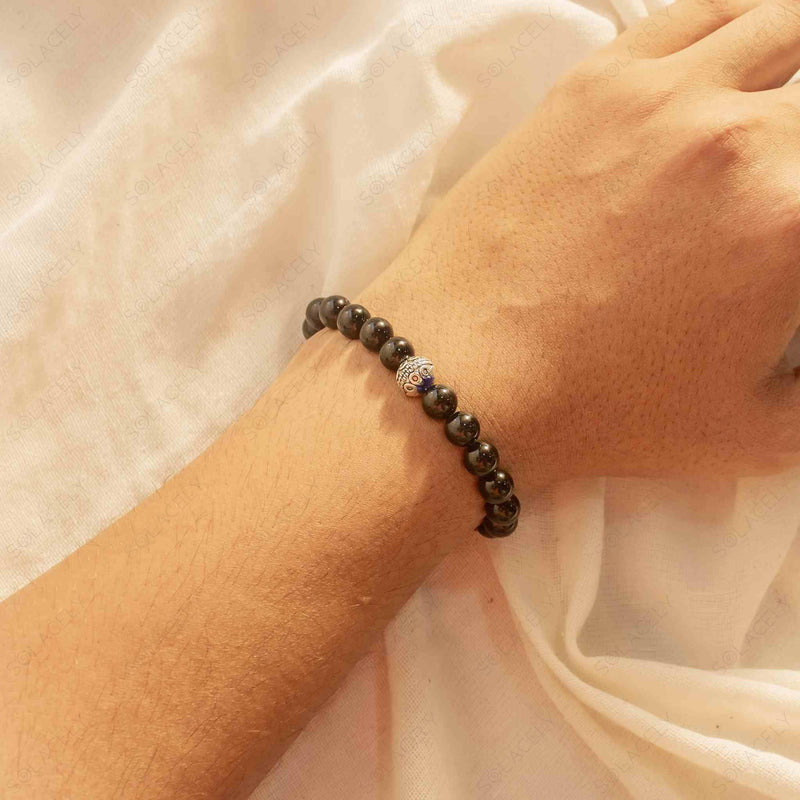
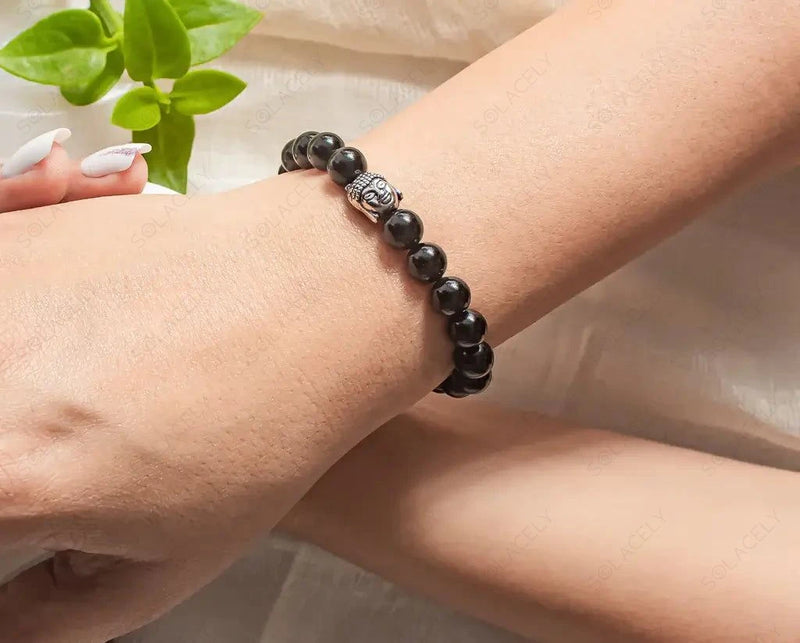
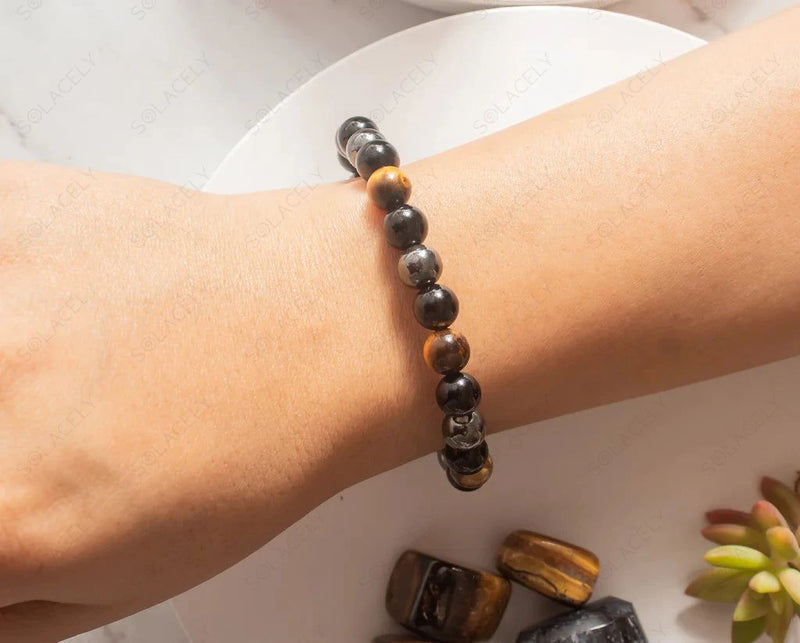
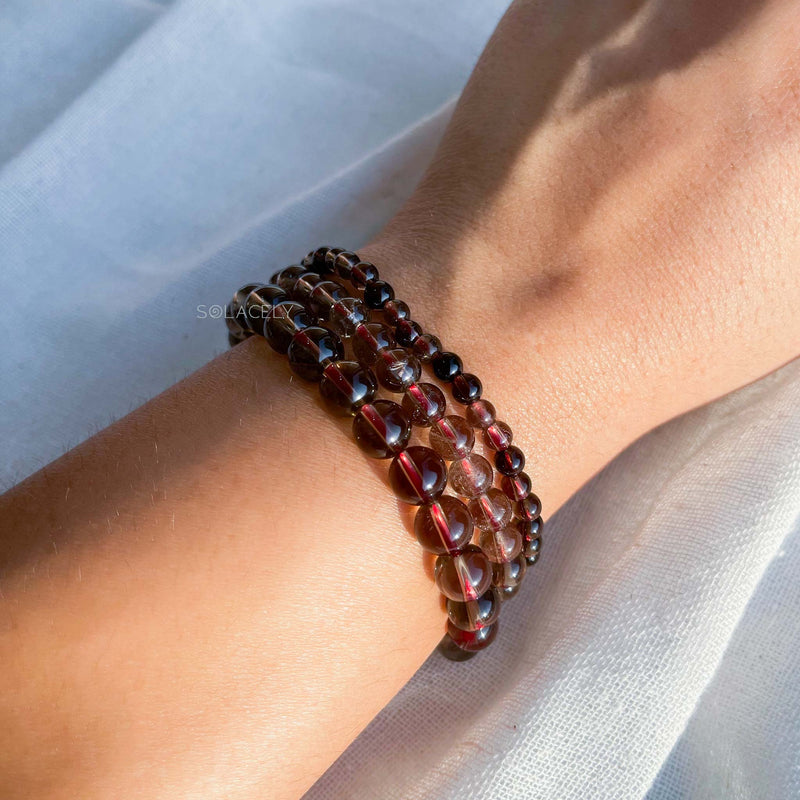
- Bracelets. Beaded strands, often paired with a lighter stone to break up the black.
- Pendants. Works well, and a larger flat piece shows the polish best.
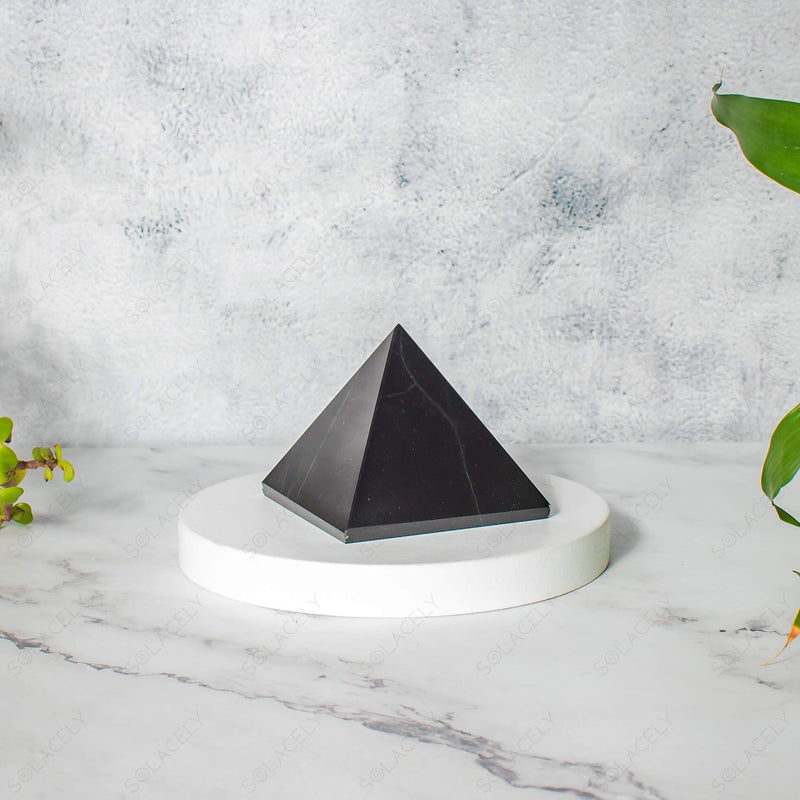
- At home. A pyramid or tumble near an entrance or a workspace, following the usual protective placement.
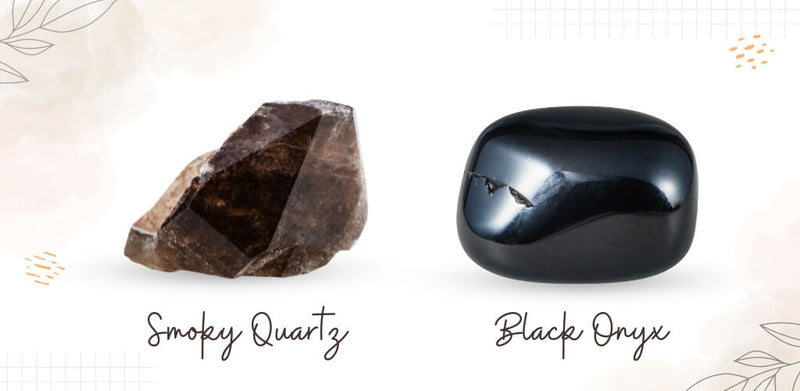
A common pairing is onyx with smoky quartz, which softens the effect while keeping the grounding character. That combination is covered in smoky quartz and black onyx.
Care and cleaning
Onyx is easy but not indestructible. Warm water, mild soap, a soft brush, dried fully. Because the black colour is a stable dye rather than a coating, ordinary washing will not affect it.
Avoid harsh chemicals, which is standard advice for chalcedony. Bleach, strong household cleaners and prolonged contact with perfume or hairspray can dull the polish over time. Put jewellery on after cosmetics have dried, and take rings off before cleaning the house.
Skip ultrasonic and steam cleaners. Chalcedony is porous at a microscopic level and dyed material in particular should not be subjected to either. For storage, check the Mohs hardness scale: at 7, onyx will scratch softer stones like malachite, selenite and lapis, so keep those separate.
Who black onyx suits
It suits people who need to hold a position rather than escape one. The recurring profile is somebody in a demanding role, or in a family situation where reacting is not an option, who wants a physical reminder to stay level. That is a genuinely useful thing for an object to do.
It suits less well anyone looking for softness. Onyx is not a comforting stone in the way rose quartz or amethyst are, and people who want reassurance often report it feeling austere. If protection is the general aim rather than composure specifically, crystals for protection covers the wider set, and crystals for confidence covers the assertiveness side.
One last practical point in its favour. Because it looks like ordinary black jewellery, onyx is the stone people actually keep wearing into offices, courtrooms and interviews. A stone worn daily beats a more fitting stone left in a drawer.
The properties described here reflect traditional and cultural belief around crystals. They are not medical claims and are not a substitute for professional healthcare or counselling. If you are managing stress, anxiety, or a difficult situation affecting your wellbeing, speak to a qualified practitioner rather than relying on a crystal practice.
Sources
Written by Chetena Sharma. Reviewed by the Solacely editorial team.
Frequently asked questions
About the author


Written by Chetna Sharma, crystal healing practitioner and co-founder of Solacely. Chetna has worked with healing crystals for over a decade and curates Solacely's protective stone collection.