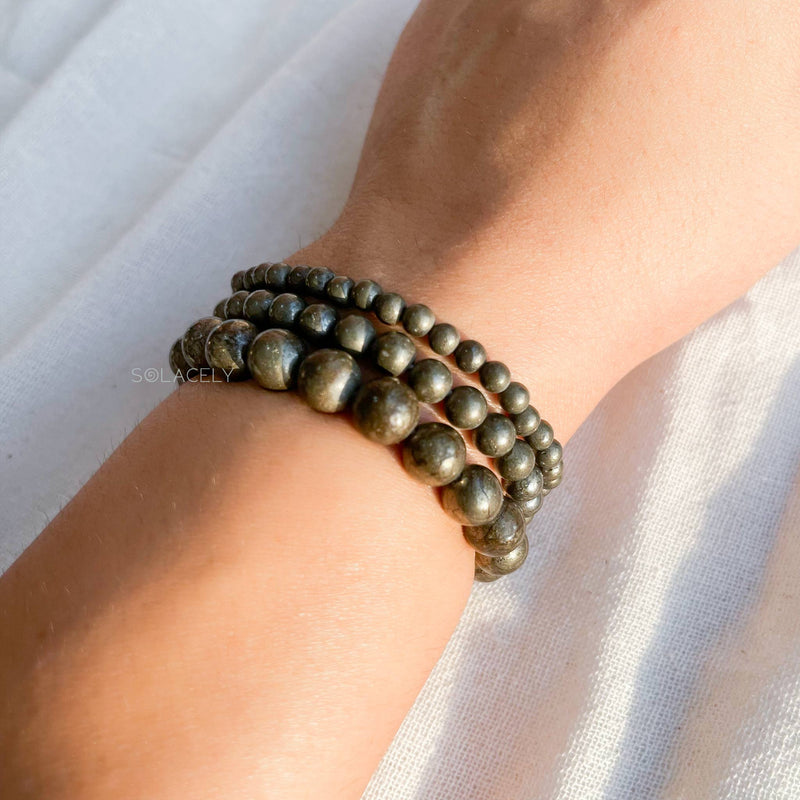
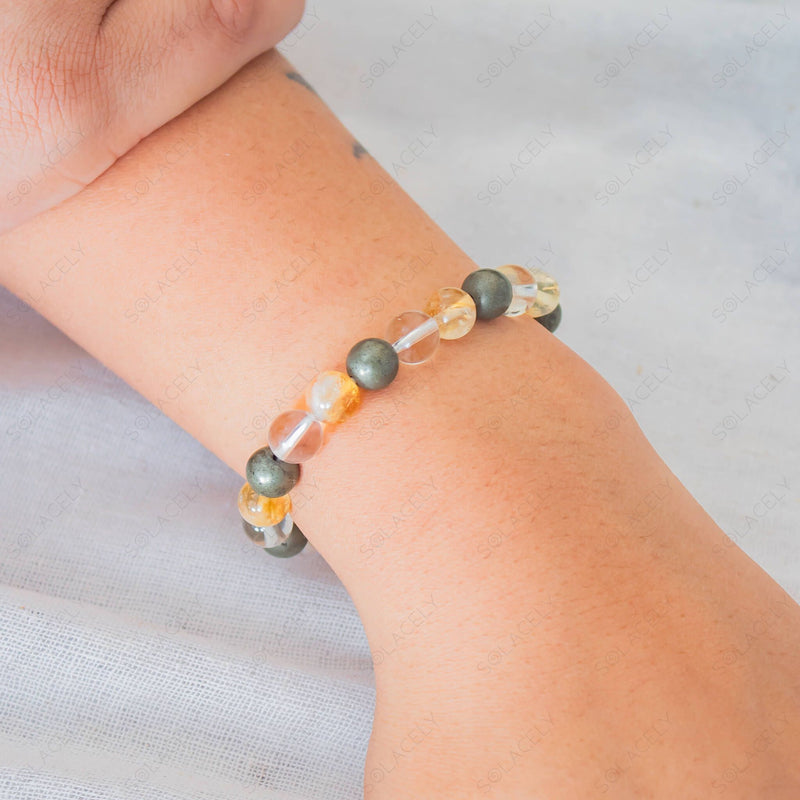
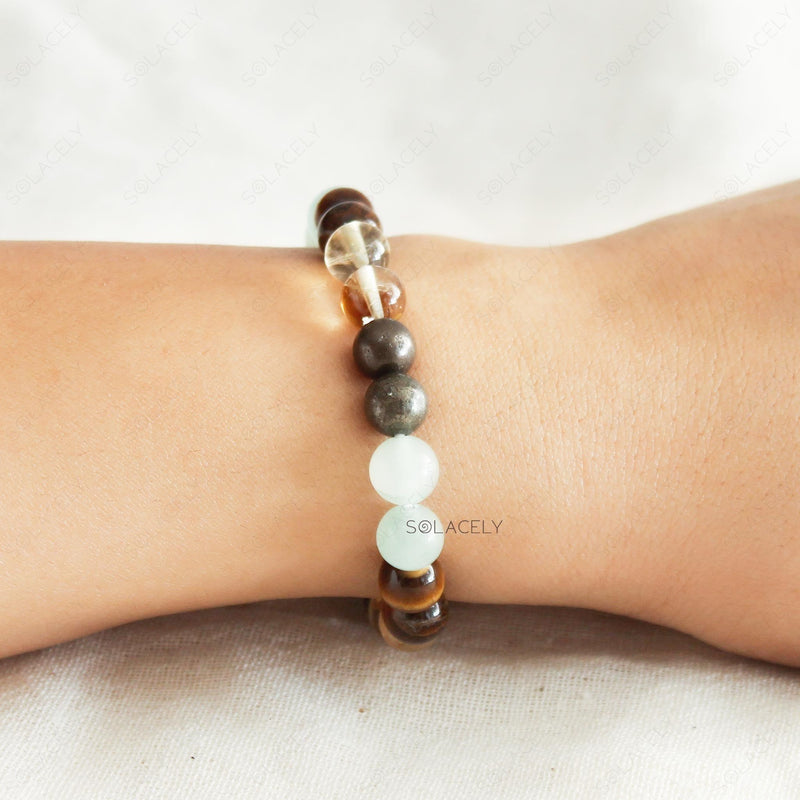
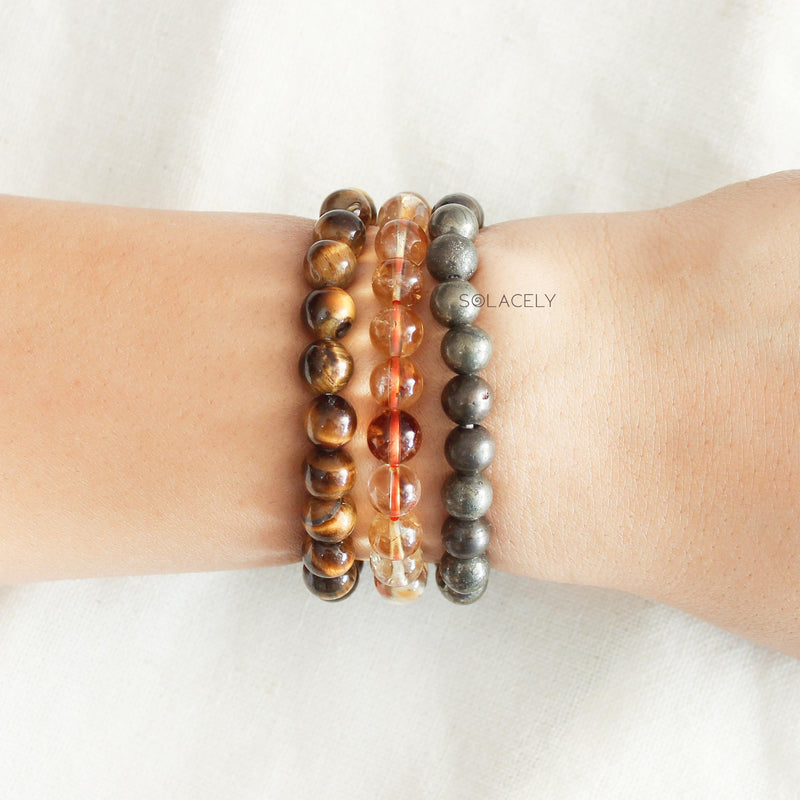
Put it on. That is genuinely the whole of it, and there is no wrong way to begin. What follows is a gentle seven day sequence for anyone who would like a little more ceremony than that: a quiet rest before the first wear, one breath and one intention on day one, and then the slow work of letting it become ordinary.
Key takeaways
- Let it rest somewhere quiet for a few hours before the first wear if you would like a moment of ceremony. Optional.
- Day one: hold it in both hands, one slow breath, name what you are wearing it for. Be specific.
- Days two to seven: wear it plainly. The point is for it to become unremarkable.
- Take it off before water, before the gym, and before heavy work.
- Some people find pyrite too activating at night and prefer to rest it. That is a normal preference, not a failure.
- Forgetting a step ruins nothing. You can set an intention on day nine.
Before the first wear
If you have a few hours, let the bracelet sit somewhere quiet before you put it on. A windowsill, a shelf, the box it arrived in with the lid open. There is nothing you need to do to it, and this step is entirely optional.
What it does is mark the difference between a parcel and a thing you have chosen to wear. Unwrapping something and immediately putting it on can feel like unwrapping anything else. A few hours in between gives the moment a shape.
Every Solacely pyrite bracelet is cleansed by singing bowl before it is packed, so there is nothing you need to clear before you begin. If you would like to cleanse it yourself anyway, do, but keep it away from water. Our guide to cleansing pyrite without water explains why.
Day one, setting your intention
Hold the bracelet in both hands, cupped, so you can feel the weight of it. Pyrite is denser than it looks and that is a good part of what makes it satisfying to hold.
Take one slow breath. Then name what you are wearing it for, out loud or silently.
Be specific. Not abundance, which is too large to act on, but I want to ask for what I am worth in Thursday's review. Not success, but I want to send the proposal I have been rewriting for three weeks. Pyrite is worked with for the mindset side of money rather than the luck side, so a concrete intention suits it better than a wish.
If you would like words for it: I am steady, I am prepared, and I can say what I am worth.
Then put it on and go about your day. That is day one finished.
Days two to seven, letting it become ordinary
Here is the honest part. Almost nothing happens on day two, and that is exactly as it should be.
What you are doing across this week is not maintaining a practice. It is letting a new object stop being new. By about day four you will stop feeling it on your wrist. By day six you will forget you put it on.
And then somewhere around day fourteen you will be halfway through a difficult meeting and catch the gold of it at the edge of your vision, and remember, in half a second, what you named on day one. That is the moment the whole thing is built for. It does not arrive on day one, and it cannot be hurried.
So wear it plainly this week. Do not perform anything, do not check in with it, do not repeat the intention daily unless you want to. Ordinary is the goal.
The moments worth choosing it for
Once it is part of your week, there are days it is worth reaching for deliberately.
Before a salary conversation or a review. The morning a business opens, or a shop, or a new listing goes up. Exam weeks, where our guide to crystals for interviews and exams covers the wider set. The first of the month, if you are someone who plans in months.
The common thread is a day that asks you to speak for yourself rather than a day that asks you to wait.
When to take it off
Four rules, and the first one genuinely matters for the life of the bracelet.
- Before showering, swimming or washing up. Pyrite is iron sulphide and reacts with water and humid air. This is the one non negotiable.
- Before the gym. Sweat accelerates dulling, and elastic ages faster under heat and salt.
- Before sleep, if you find it too activating. Some people do. Pyrite is kept for drive rather than rest, and a few people notice they settle better without it. Others sleep in it happily. Try both.
- Before heavy or manual work, where beads can knock against hard surfaces and the cord can catch.
A soft dry cloth every week or two is the whole of the maintenance.
A three minute morning practice
For anyone who would like something to actually do. This is three minutes, and it fits before coffee.
- Minute one. Hold the bracelet in your palm, not on your wrist. Feel the weight. Notice that it is cool, and that it takes a moment to warm.
- Minute two. One slow breath in, one slow breath out, three times. Then ask yourself a single question: what is the one thing today that I would rather avoid?
- Minute three. Put the bracelet on. Say, silently or aloud, that you will do that thing before lunch. Then go.
The practice is not the magic. Naming the avoided thing out loud, at the start of the day, while holding something heavy enough to notice, is a good way to stop it following you around until four in the afternoon.
What actually changes, and when
Worth being straight about this, because it is the question underneath most of the others.
What shifts first is attention, not circumstance. You notice the bracelet, you remember the intention, and you make a slightly different choice than you would have. That is a small thing on any given day and a large thing across a quarter.
There is no timeline to hold yourself to, and nothing is behind schedule. Some people feel the difference in a fortnight and some notice it looking back after three months.
A bracelet does not do the asking
By the end of the first week the ceremony will be over and you will simply be a person who wears a pyrite bracelet, which is the point.
It will not make the call for you or write the email or say the number out loud. It sits at the wrist, catches the light at an inconvenient moment, and reminds you that you meant to.
The uses described here reflect traditional and cultural crystal practice. They are not medical claims and are not a substitute for professional healthcare, financial or legal advice.
Sources
Frequently asked questions
About the author


Written by Chetna Sharma, crystal healing practitioner and co-founder of Solacely. Chetna has worked with healing crystals for over a decade and curates Solacely's protective stone collection.