Smoky quartz and black tourmaline is the most common grounding combination in crystal practice, and the two reinforce each other rather than balancing out. Black tourmaline holds the boundary, smoky quartz settles what is already inside it. Both are hard enough for daily wear and neither needs much looking after.
Key takeaways
- Black tourmaline's mineral name is schorl, the iron rich member of the tourmaline family.
- Tourmaline is pyroelectric, developing a small charge as its temperature shifts, which is part of its long protective reputation.
- Hardness is well matched: smoky quartz 7, black tourmaline 7 to 7.5.
- Traditional use: tourmaline at the threshold, smoky quartz in the room where you decompress.
- Both are dark and largely opaque, so a mixed bracelet reads as one piece.
- Keep smoky quartz out of sustained direct sun, which fades it.
Why these two are paired so often
Most grounding recommendations end up at one of these two stones, so pairing them is close to inevitable. What separates them is the direction of the work. Black tourmaline is the boundary stone: the tradition around it is about what does not get in. Smoky quartz is the settling stone: the tradition is about discharging what has already accumulated.
That distinction is why the pair is reached for on two counts at once, feeling permeable and feeling wired. Someone who only has the first may prefer tourmaline alone. Someone who only has the second is often better served by smoky quartz alone, or by pairing it with a lighter stone. Our guides to black tourmaline meaning and properties and smoky quartz meaning and benefits take each on its own.
What black tourmaline actually is
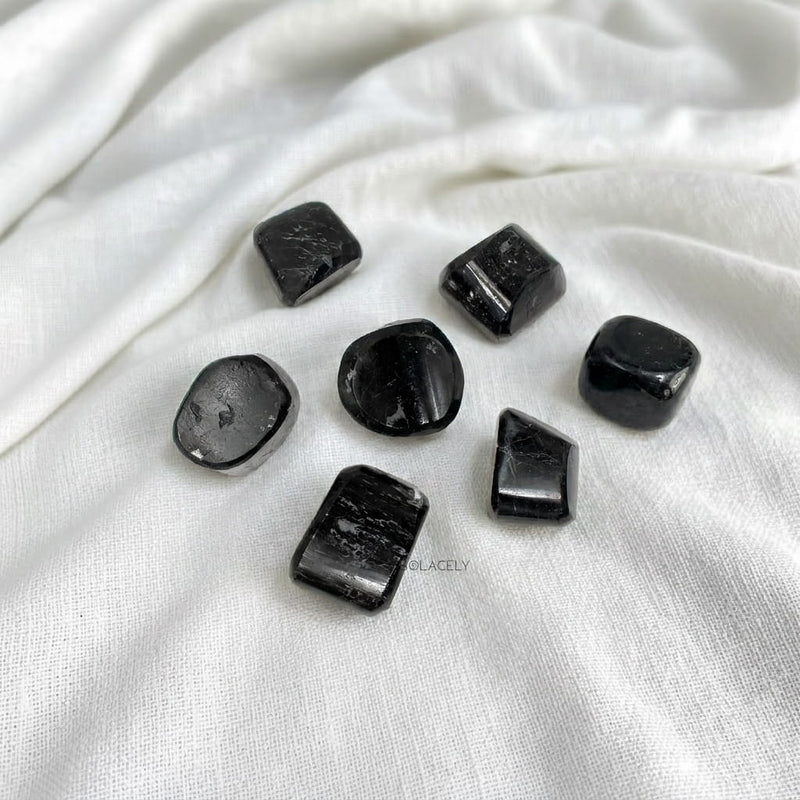
Tourmaline is not one mineral. It is a family of complex boron silicates that share a crystal structure but vary widely in chemistry, which is why tourmaline appears in more colours than almost any other gem. Black tourmaline is schorl, the iron rich member, and it is by far the most abundant of the family. That abundance is the whole reason black tourmaline costs a fraction of what pink or green tourmaline does.
Tourmaline also has a genuinely unusual physical quality. It is pyroelectric and piezoelectric, developing a small electrical charge as its temperature shifts or when it is compressed. Dutch traders in the eighteenth century noticed heated tourmaline drawing ash toward it and nicknamed it the ash puller. That quality is part of why the stone gathered its long reputation as a protective piece, and it is why black tourmaline is the stone people keep beside a desk or a router when screens are the drain.
How the two compare
| Black tourmaline | Smoky quartz | |
|---|---|---|
| Mineral | Schorl, a boron silicate | Quartz, silicon dioxide |
| Mohs hardness | 7 to 7.5 | 7 |
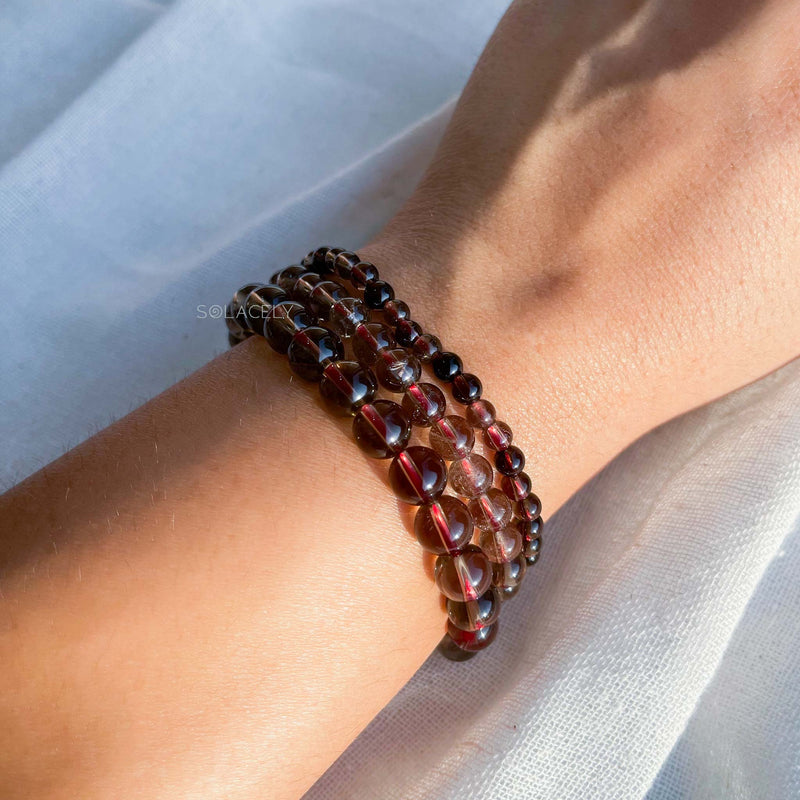
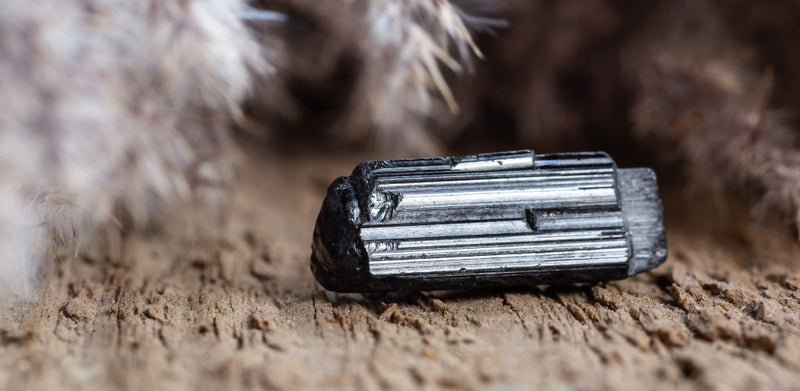
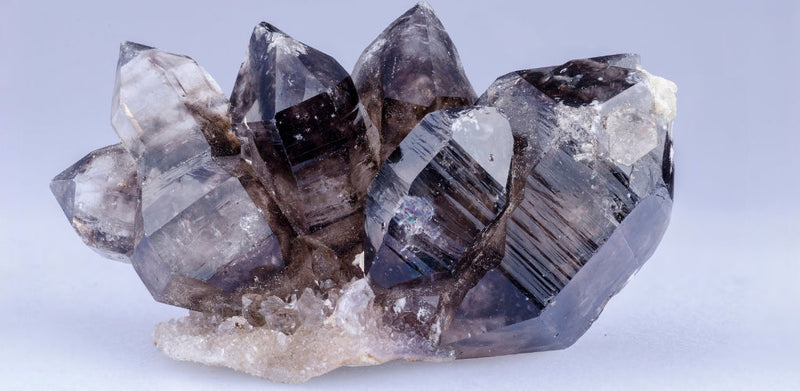
| Appearance | Opaque black, striated prisms | Translucent brown to grey |
| Traditional role | Boundary, deflection, protection | Grounding, discharging, settling |
| Care note | Brittle along striations, avoid knocks | Fades in prolonged direct sun |
Wearing the pair
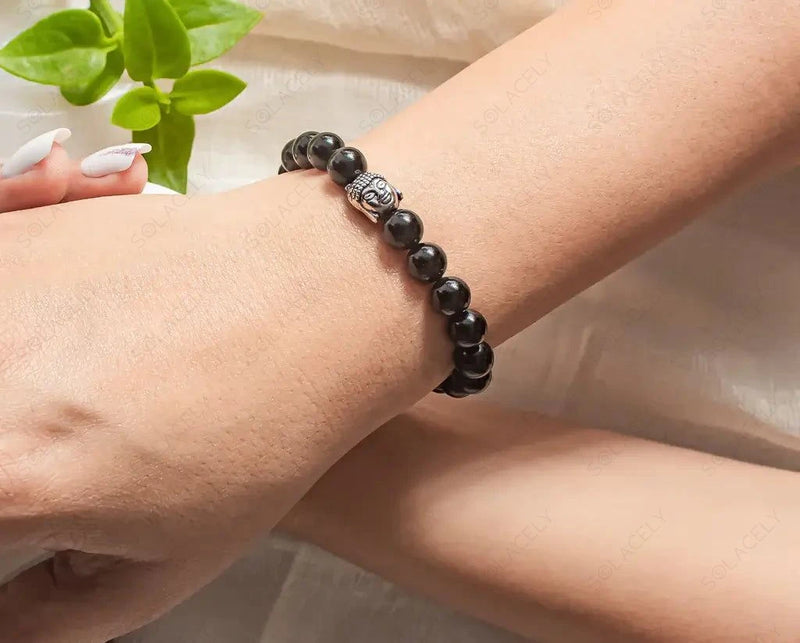
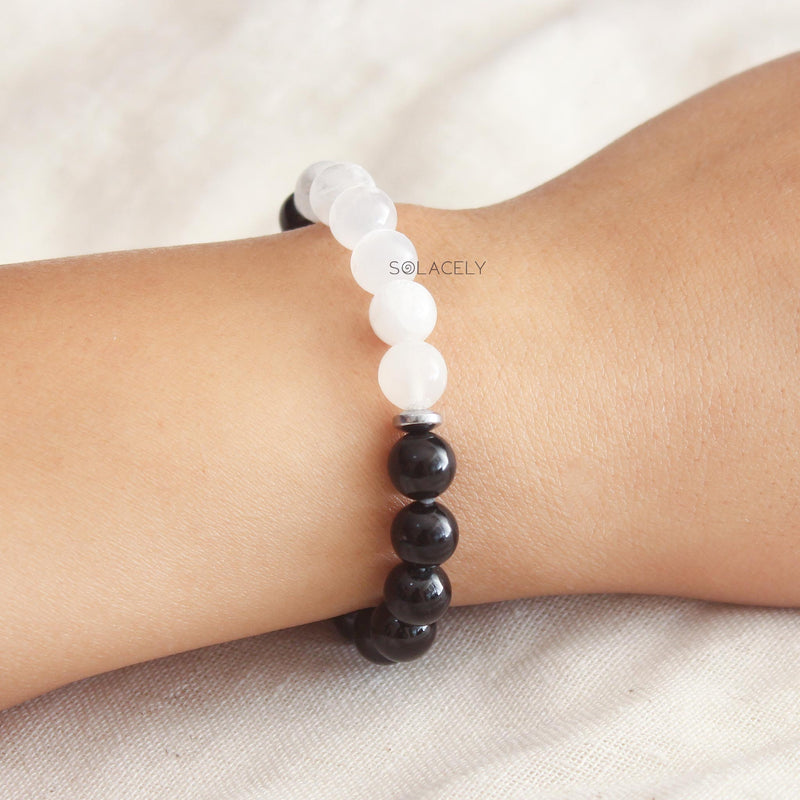
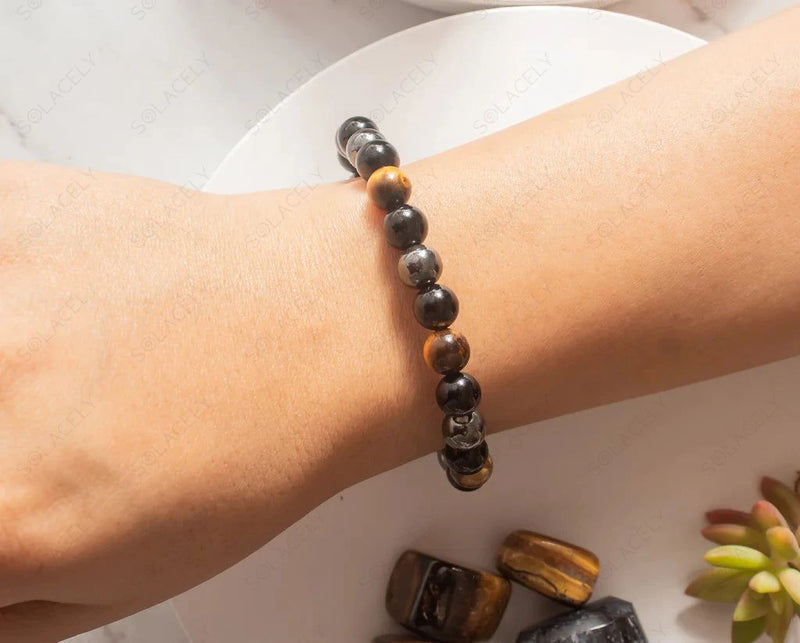
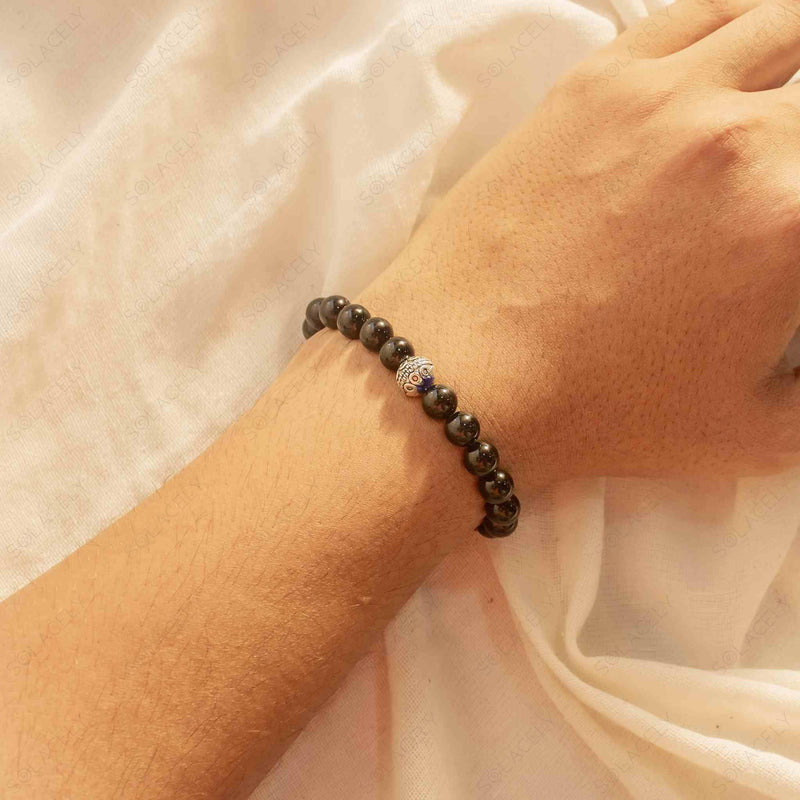
A mixed bead bracelet is the standard format and it works better than most crystal pairings, because the two stones are within half a point on the Mohs scale. Neither will grind the other down, and because both are dark and largely opaque the bracelet reads as one object rather than two competing colours.
If you prefer the stones separate, the usual arrangement is tourmaline worn and smoky quartz carried. Tourmaline is the constant, the thing you do not think about. Smoky quartz is what you reach for when you notice yourself running hot. More combinations are covered in black tourmaline crystal combinations.
Placing them at home
Traditional practice is specific here, and the logic is consistent. Black tourmaline goes at the threshold: near the front door, on a windowsill facing the street, or in the entryway. It is the doorman stone. Smoky quartz goes where you actually decompress, which for most people is the living room or beside the bed rather than the hallway.
One practical note that overrides the tradition. Do not put smoky quartz on a bright south facing sill, however good the placement sounds. Sustained direct sunlight lifts the colour centre that makes it brown, and a summer on a hot windowsill will leave you with a paler stone. For a broader home layout, see our guide to crystals for home protection.
Care for both
Warm water, mild soap, soft brush, dry properly. Both stones tolerate that well. Avoid ultrasonic cleaners: tourmaline crystals have deep striations running along their length and can be brittle across them, and a bead with an internal fracture will not enjoy the vibration.
Neither stone needs elaborate cleansing. If you follow a practice, both are safe with water, sound, smoke or moonlight. Only the sunlight caveat on smoky quartz is worth taking seriously.
Who this pairing suits
It suits people in high contact environments who come home depleted: open plan offices, retail, teaching, caring work, city commutes. It also suits anyone who finds most crystal aesthetics too soft, because there is nothing decorative about two black and brown stones.
It suits less well anyone looking for lift, warmth or openness. This is a steadying combination by design. If you want the grounding with a lighter top note, pairing smoky quartz with a brighter stone works well, and we cover one version in smoky quartz and amazonite. The full range is in our guide to crystals for protection.
The properties described here reflect traditional and cultural belief around crystals. They are not medical claims, they are not claims about physical shielding, and they are not a substitute for professional healthcare. If you are managing a health concern, speak to a qualified practitioner.
Sources
Written by Chetena Sharma. Reviewed by the Solacely editorial team.
Frequently asked questions
About the author


Written by Chetna Sharma, crystal healing practitioner and co-founder of Solacely. Chetna has worked with healing crystals for over a decade and curates Solacely's protective stone collection.