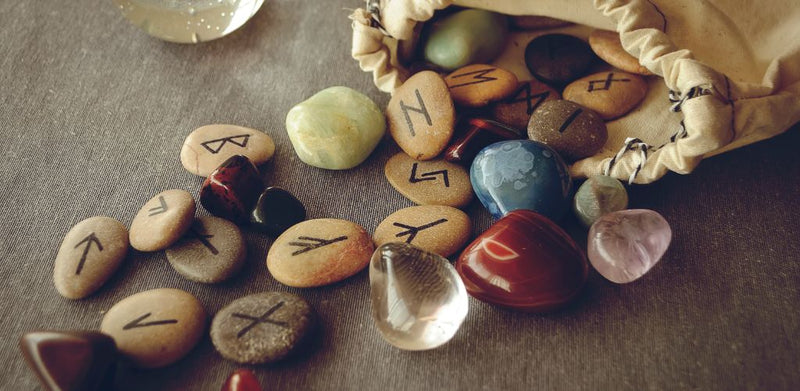
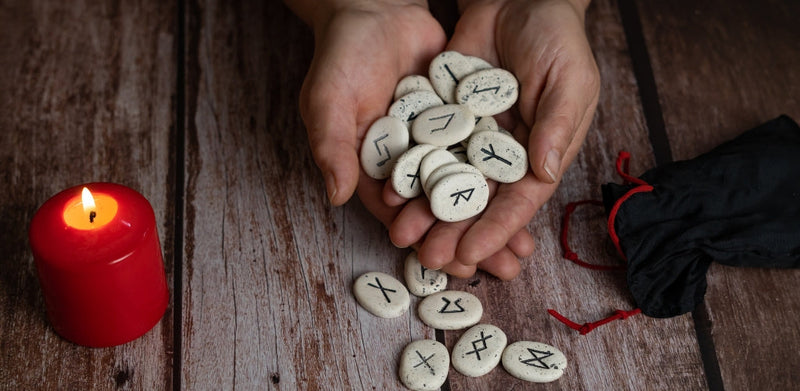
Viking rune symbols are the letters of the Younger Futhark, a 16-character runic alphabet used across Scandinavia during the Viking Age (roughly 793 to 1066 CE). Each rune was a working letter with a name and everyday meaning, carved into stone, wood, and bone. Later folk tradition reads those meanings as themes for reflection.
Key Takeaways
- Viking runes = the Younger Futhark, a 16-letter alphabet that replaced the older 24-letter Elder Futhark by around the 8th century CE.
- It came in two styles: Long-branch (formal, on runestones) and Short-twig (quick, everyday carving).
- Runes were letters first, used for names, memorials, and messages, not primarily for magic or divination.
- Famous marks like Aegishjalmur (Helm of Awe) and Vegvisir are Icelandic stave symbols recorded centuries later, not Viking-age runes, and we treat them as tradition.
- The Viking Age is dated to about 793 to 1066 CE, from the Lindisfarne raid to the Battle of Stamford Bridge.
What are Viking rune symbols?
Viking rune symbols are the characters of the Younger Futhark, the runic alphabet used by Norse speakers during the Viking Age. There are 16 of them, each an angular letter designed to be cut into hard materials. People today also read each rune as a theme, but their first job was writing.
The word 'futhark' comes from the first six runes, the way 'alphabet' comes from alpha and beta. According to Britannica, the runic script was used by Germanic peoples from about the 3rd century CE, and the Viking-age Norse inherited it in a slimmed-down form. Where the older alphabet had 24 letters, the Younger Futhark kept only 16.
That is the detail that sets Viking runes apart. If you have read our guide to the deeper meanings of rune symbols, which covers the full 24-letter Elder Futhark, you already know most of the rune names. This guide is narrower on purpose: it is about what the Vikings themselves actually carved.
Younger Futhark vs Elder Futhark: the key difference
The Elder Futhark had 24 runes and was used across Germanic Europe from roughly the 2nd to 8th century CE. The Younger Futhark, the true 'Viking' alphabet, cut that down to 16 runes around the 8th century, just as the Norse language was growing more complex. Fewer letters, more sounds per letter.
It seems backward that a richer language would use fewer letters. It happened anyway. Each Younger Futhark rune had to do double or triple duty, one sign standing for several related sounds, so readers leaned on context. This is why Viking runestones can be hard to transliterate even for specialists.
For crystal and manifestation work, most people actually use Elder Futhark rune names, because that fuller set maps more cleanly onto themes like abundance and protection. So there is a useful split. When you want history and Viking-age authenticity, look to the Younger Futhark below. When you want a symbol for a specific intention, the Elder Futhark guides are the better tool. Our post on rune symbols for protection is a good example of the intention-first approach.
| Feature | Elder Futhark | Younger Futhark (Viking) |
|---|---|---|
| Number of runes | 24 | 16 |
| Main period | c. 2nd to 8th century CE | c. 8th to 11th century CE |
| Used by | Germanic peoples broadly | Viking-age Norse |
| Typical use today | Divination, intention work | History, runestones, authenticity |
| Variants | One main form | Long-branch and Short-twig |
Long-branch and short-twig: two Viking styles
The Younger Futhark came in two written styles. Long-branch runes are fuller and more formal, favoured for carved runestones meant to last. Short-twig runes are simpler and quicker, used for everyday messages on wood and bone. Both spell the same 16-rune alphabet, just in different handwriting.
Think of it as the difference between a printed monument inscription and a scribbled note. Long-branch (sometimes called Danish) runes have complete vertical staves with clear branches, which is why they dominate the great memorial stones of Denmark and southern Sweden. Short-twig (Swedish-Norwegian) runes trim those branches down for speed.
A third, even more compact style called Staveless or Hälsinge runes appeared later in parts of Sweden, stripping the letters down almost to shorthand. For anyone picking up a rune set today, none of this changes the meaning of a rune. It simply explains why the same Viking letter can look different from one artefact to the next.
The 16 Younger Futhark runes and their meanings
The 16 Younger Futhark runes each carry a name and an everyday meaning drawn from Norse life, cattle, ice, sun, man, and so on. The table below lists them with the traditional themes people reflect on. Remember these are letters with folk associations, framed here as tradition, not fortune-telling.
| Rune name | Sound | Everyday meaning | Reflective theme |
|---|---|---|---|
| Fe | f | Cattle, wealth | Resources, prosperity |
| Ur | u | Iron, drizzle, aurochs | Strength, raw energy |
| Thurs | th | Giant, thorn | Force, caution, defence |
| As / Oss | a/o | A god (Odin), estuary | Wisdom, communication |
| Reid | r | Riding, journey | Movement, right action |
| Kaun | k | Ulcer, torch | Fire, transformation |
| Hagall | h | Hail | Disruption, testing |
| Naud | n | Need, hardship | Necessity, endurance |
| Is | i | Ice | Stillness, pause |
| Ar | a | Harvest, plenty | Reward over time |
| Sol | s | Sun | Vitality, guidance |
| Tyr | t | The god Tyr | Justice, courage |
| Bjarkan | b | Birch | Growth, new beginnings |
| Madr | m | Man, human | Self, community |
| Logr | l | Water, sea | Flow, intuition |
| Yr | R/y | Yew | Endings, protection |
Several of these names will look familiar if you already work with Elder Futhark runes, Fe is Fehu, Sol is Sowilo, Ar is Jera. The forms and sounds shifted, but the roots are shared. For the wealth-linked reading of Fe and its crystal pairings, our guide to rune symbols for abundance goes deeper.
How the Vikings actually used runes
Vikings used runes mainly as ordinary writing. The surviving evidence, thousands of runestones plus carvings on combs, sticks, weapons, and jewellery, shows names, memorials, ownership marks, and short messages. Divination and 'magic' existed in the wider culture, but the everyday reality was practical literacy carved into hard surfaces.
Norse carvers worked in wood, bone, antler, metal, and stone, not paper. That is why runes are angular: straight lines cut cleanly across a wood grain, while curves splinter. The Kylver stone from Gotland in Sweden, dated to around 400 CE, carries one of the earliest complete rune-rows, showing how old the tradition already was before the Viking Age began.
Many of the most famous Viking runestones are memorials. A typical inscription reads something like 'X raised this stone in memory of Y,' sometimes adding that the person died abroad, in England, in the east, or on a trading voyage. These stones are history books in stone, recording Norse travel from Greenland to Constantinople.
Aegishjalmur and Vegvisir: famous symbols, later sources
Aegishjalmur, the Helm of Awe, and Vegvisir, the 'wayfinder,' are the two symbols most people picture as 'Viking.' Both are stave symbols, geometric designs rather than alphabet letters, and both are recorded in Icelandic manuscripts written centuries after the Viking Age. We share them as Norse-derived tradition, not verified Viking-age artefacts.
Aegishjalmur is a radial design of protective staves. Its name appears in Old Norse poetry as a symbol of overpowering, awe-inducing protection, though the eight-armed drawing familiar today comes from post-medieval Icelandic grimoires. In tradition it stands for courage and defence, which is why it is popular in modern jewellery and tattoos.
Vegvisir is described in a 19th-century Icelandic manuscript as a stave that keeps a traveller from losing their way in bad weather. It is often called a Viking compass, but there is no evidence Vikings themselves used it. Both symbols are best understood as part of a living Norse-inspired folk tradition, meaningful today, historically much younger than the runestones. For a wider look at protective marks across cultures, see our top manifest symbols guide.
Viking runes vs Celtic symbols: not the same thing
Viking runes and Celtic symbols come from two different peoples and traditions. Runes are a Germanic and Norse writing system. Celtic knotwork, spirals, and the ogham script belong to the Celtic peoples of Ireland, Scotland, and Wales. They are often mixed up in modern design, but historically they are separate.
The confusion is understandable. Both are old European traditions, both were adopted into modern jewellery and tattoo art, and both traded influence around the Irish Sea during the Viking Age, when Norse settlers lived in Ireland and northern Britain. Some artefacts genuinely blend the two styles. That is cross-cultural contact, not a shared origin.
If your interest is knotwork, spirals, and the ogham alphabet rather than Norse runestones, our dedicated guide to Celtic rune symbols is the right companion to this one. Keeping the two apart is not pedantry. It helps you choose a symbol that actually means what you think it means.
Choosing and using a Viking rune set
A Viking rune set is a small collection of stones, wood chips, or bone tiles marked with rune symbols, used for reflection or as decor. When buying one, check whether it uses the 16-rune Younger Futhark or the 24-rune Elder Futhark, since most commercial sets are actually Elder. Choose by intention and material, not just looks.
Here is a simple approach:
- Decide your purpose. History and authenticity point to the Younger Futhark. Intention and reflection work usually use the Elder Futhark.
- Pick a material. Wood feels traditional and warm. Crystal sets add a stone's own associations, amethyst for calm, rose quartz for love, black tourmaline for protection.
- Check the carving. Clear, correctly-formed runes matter more than a fancy box. Compare against a reliable chart.
- Handle them. A set you enjoy holding is one you will actually use. Weight and finish are personal.
- Store them respectfully. A cloth pouch keeps stones from chipping and marks the set as something you value.
Frame any rune practice as tradition and focus, not prediction. For the reflective and meditative side of runework, our guide to rune symbols for spirituality is a gentle place to start.
Common misconceptions about Viking runes
The biggest misconception is that Vikings used runes chiefly for magic. In reality, the surviving record is overwhelmingly practical: names, memorials, and messages. Magic and divination existed in Norse culture, but treating every rune as a spell overstates the evidence. Runes were, first and last, an alphabet.
A few other myths worth clearing up:
- 'Vikings used the Elder Futhark.' They used the Younger Futhark. The Elder Futhark predates the Viking Age.
- 'Vegvisir and the Helm of Awe are ancient Viking symbols.' They are recorded in much later Icelandic manuscripts, so we treat them as Norse-derived tradition.
- 'Blank rune is traditional.' The blank or 'Odin' rune is a 20th-century addition, not part of any historical futhark.
- 'Runes and Celtic symbols are interchangeable.' They come from different peoples. See our Celtic rune symbols guide.
Keeping the history honest actually makes the symbols richer. You are engaging with a real writing system carved by real people who sailed from Norway to North America, not a Hollywood prop.
Sources
- Encyclopaedia Britannica, the runic alphabet. britannica.com
- Encyclopaedia Britannica, Futhark. britannica.com
- Encyclopaedia Britannica, Viking (people). britannica.com
Frequently asked questions
About the author


Written by Chetna Sharma, crystal healing practitioner and co-founder of Solacely. Chetna has worked with healing crystals for over a decade and curates Solacely's protective stone collection.